Although the AI Agent development frameworks are powerful, their steep learning curve, complex debugging processes, and frequent updates pose significant challenges for deployment in production environments. To simplify the development, debugging, deployment, and operation processes of AI Agents, AI Agent development platforms encapsulate core components such as LLM, memory, tools, and orchestration engines, providing pre-built templates, workflows, and a plugin ecosystem. With their low-code (or no-code) features, they offer SaaS-based products for enterprises, developers, business personnel, and individual users.
Currently, AI Agent development platforms are evolving along two paths: commercial closed-source platforms from large tech companies targeting users who require fully managed services from technology to operations, deeply integrating their vast cloud services and large model systems, providing pre-made templates, and building ecological barriers. The competitive logic is to create a platform that is deeply integrated with their core business (such as cloud services, CRM, office suites), making customers increasingly dependent on the platform as their data and processes accumulate within the ecosystem, thus building competitive advantages. On the other hand, open-source platforms target enterprises or individuals needing customized services, with their core value lying in a large developer community, technical transparency, and flexible vendor choices. Open-source development platforms allow users to freely combine the best tools, granting higher flexibility and control, but also require users to take on more integration and maintenance work.
The market for AI Agent development platforms is a rapidly differentiating and expanding new field with numerous participants. In the future, commercial closed-source and open-source platforms will deepen their respective moats in two ways: enterprises will lock in high-value customers by building deeper ecological moats; open-source platforms will empower individuals and enterprises needing customized services by providing more flexible and powerful tools.
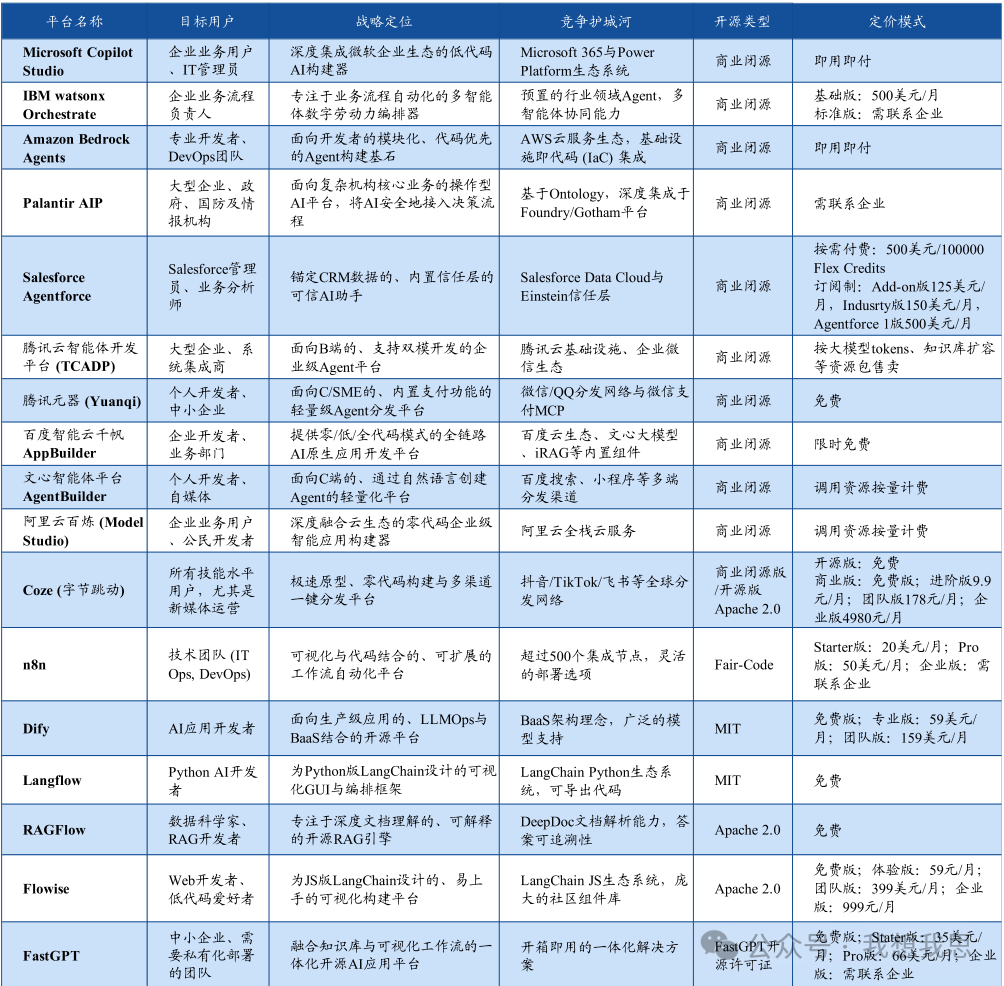
Figure 1: Comparison of some AI Agent platform features
Microsoft Copilot Studio: A low-code AI builder for enterprise ecosystems
Microsoft Copilot Studio is a low-code conversational AI platform launched by Microsoft in 2023, designed to enable organizations to create and customize their own Copilot and deploy it across multiple channels such as websites, mobile applications, and Microsoft Teams. The platform deeply integrates various Microsoft services, allowing developers and business users to connect to enterprise backend systems and data sources like SAP, Workday, etc., through a graphical interface and generative AI capabilities.
1) Deep ecological integration and fusion with enterprise-level genes: The core moat of Copilot Studio lies in its seamless integration with Microsoft Teams, Power Platform, SharePoint, and Office 365, among other Microsoft products. It features robust enterprise-level management and security capabilities, including fine-grained permission management, data loss prevention (DLP), and intelligent monitoring mechanisms, enabling easy access to internal enterprise data and services. This enterprise-level gene makes it more suitable for enterprise applications requiring strict data security and compliance controls, such as internal process automation.
2) A theme-centric conversational design model: In Copilot Studio, the process of building agents revolves around creating “Topics,” where each topic represents an independent conversation flow. Developers first define the topic’s “Trigger,” which can be activated by specific phrases from users or programmatic events. Then, by dragging and connecting different “Nodes,” such as “Question,” “Condition,” and “Message,” they construct complex conversational logic. The platform also introduces generative AI capabilities, allowing users to automatically create topics through simple natural language descriptions, further lowering the development threshold. The agent’s “Actions” capabilities, such as invoking a Power Automate process, serve as the primary means for connecting to external systems and executing real tasks.
IBM watsonx Orchestrate: A digital workforce orchestrator for enterprise process automation
IBM watsonx Orchestrate is an enterprise-level “digital workforce” platform launched by IBM, aimed at creating, managing, and orchestrating AI Agents capable of automating complex and multi-step business processes, thereby elevating AI from a simple task executor to a partner capable of handling complete business functions (such as human resources, procurement, and sales).
1) Multi-agent orchestration for complex business process automation: The core of watsonx Orchestrate is a team of AI Agents that work collaboratively, autonomously planning and executing tasks without the need for manual micro-management. Its “Orchestrator Agent” serves as the intelligent automation layer, dynamically selecting actions or invoking the most suitable Agent while managing dependencies and control flows. This reveals IBM’s strategic intent: it is a system designed for business process reengineering (BPR), aimed at large-scale automation transformation of entire business units rather than building small, standalone AI applications.
2) A dual-track development model for business and technical users: IBM provides two distinct paths for creating Agents, catering to both business and technical users. Business users can quickly build, test, and deploy AI Agents through a no-code “Agent Builder,” defining their profiles, connecting tools, and configuring behaviors. Professional developers can use the Python-based “Agent Development Kit” (ADK) to programmatically build highly customized Agents and support integration with third-party frameworks. This dual-track model is IBM’s strategic initiative to penetrate large enterprises, providing both self-service capabilities and deeply customized “escape hatches” to resolve common friction between business departments seeking speed and IT departments requiring control.
3) Focus on hybrid deployment and enterprise readiness with pre-built assets: watsonx Orchestrate seamlessly integrates into complex enterprise IT environments, emphasizing integration, reuse, and deployment flexibility. The platform supports both cloud-based SaaS and on-premises deployment (via Cloud Pak for Data), meeting the needs of highly regulated industries such as finance and healthcare. To accelerate value realization, IBM provides a comprehensive “Agent and Skills Catalog” containing numerous pre-built AI Agents, which are embedded with domain knowledge and pre-integrated with common enterprise applications like SAP, Oracle, etc. The platform also emphasizes its “open design,” allowing connections to most enterprise tools via OpenAPI specifications and integrating with IBM’s existing automation products like RPA, protecting customers’ existing investments.
Amazon Bedrock Agents: A developer-first modular foundation for building Agents Amazon Bedrock Agents is a fully managed service provided by Amazon Web Services (AWS), designed to help developers easily create generative AI applications that can perform complex business tasks on behalf of users. This service is built on top of Amazon Bedrock, leveraging its Foundation Models (FMs) capabilities to understand user requests, break down tasks, and invoke necessary APIs to complete operations through automated prompt engineering and model orchestration.
1) A foundational, framework-agnostic toolkit for Agentic systems: The core idea of Bedrock Agents is to provide the foundational components needed to build Agentic systems, continuing AWS’s classic IaaS/PaaS philosophy, offering developers a flexible, unbound set of building blocks. Developers can choose from large model providers (such as Anthropic, Meta) and Amazon’s own models, combining action groups (tools) and knowledge bases (RAG) to build Agents. The entire complex orchestration loop is handled by Bedrock services in the background, providing flexibility and ease of control.
2) A developer-centric build model centered around action groups and infrastructure as code: The primary development experience of the platform is code-driven, with the core being the definition of tools through APIs and programmatically managing the Agent lifecycle. The core mechanism for providing tools to Agents is the “action group,” each defined by an OpenAPI specification, while business logic is implemented in AWS Lambda functions. AWS uses infrastructure as code (IaC) frameworks (such as CloudFormation or CDK) to manage Agents, treating them as software components in a CI/CD pipeline. This approach roots Agent development in modern software engineering practices, significantly lowering the adoption threshold for organizations that have adopted API-driven architectures. Meanwhile, the console also provides an “Agent Builder” interface for rapid prototyping.
3) Focus on hybrid deployment and enterprise readiness with pre-built assets: watsonx Orchestrate seamlessly integrates into complex enterprise IT environments, emphasizing integration, reuse, and deployment flexibility. The platform supports both cloud-based SaaS and on-premises deployment (via Cloud Pak for Data), meeting the needs of highly regulated industries such as finance and healthcare. To accelerate value realization, IBM provides a comprehensive “Agent and Skills Catalog” containing numerous pre-built AI Agents, which are embedded with domain knowledge and pre-integrated with common enterprise applications like SAP, Oracle, etc. The platform also emphasizes its “open design,” allowing connections to most enterprise tools via OpenAPI specifications and integrating with IBM’s existing automation products like RPA, protecting customers’ existing investments.
Palantir AIP: An ontology-based AI command and control system
Palantir Technologies launched its Artificial Intelligence Platform (AIP) in April 2023, aiming to securely apply LLMs and other cutting-edge AI technologies to its core platforms, Gotham and Foundry. AIP is not a standalone product but is deeply integrated into existing platforms, empowering clients to leverage AI to accelerate decision-making, automate tasks, and discover new insights. Its vision is to empower organizations to effectively integrate data, decisions, and operations, transforming complex, fragmented data within enterprises into a coherent and actionable foundation.
1) Ontology: A digital twin designed for decision-centric AI: AIP’s most distinctive feature is its Ontology, a semantic layer capable of creating a dynamic, decision-centric model of the entire enterprise. By integrating the three core elements of any decision: data (the “nouns” or objects of the business, such as suppliers, components, and facilities), logic (the business rules and models governing interactions), and actions (the “verbs” or executable operations that impact the real world), it constructs a comprehensive enterprise “digital twin.” This design enables AIP to not only understand data points but also the complex network of relationships and operational realities they represent. By mapping and connecting everything from ERP data, IoT streams to unstructured documents and geospatial information, Ontology provides shared operations for employees and AI Agents to perform queries and reasoning tasks. This deep integration and modeling process itself builds a strong barrier. Once an enterprise encodes all its operational logic, data relationships, and action paths into this “central nervous system,” the time, capital, and operational disruption costs required to migrate this “digital twin” to other platforms will be very high.
2) AI Agent tools: From no-code AI to autonomous operations: AIP’s core feature is its comprehensive, multi-layered toolkit that safely and controllably integrates AI capabilities with the enterprise’s existing, highly complex operational environment, enabling seamless connections from data insights to business actions, building a complete ecosystem: first, by deeply binding with the Foundry Ontology, ensuring that all AI interactions strictly adhere to the enterprise’s predefined data permissions and governance rules, fundamentally addressing the security and compliance issues of using AI in sensitive environments; secondly, AIP provides a full spectrum of development tools for users in different roles, from low-code (such as AIP Logic, Workshop widgets) to professional code (such as Pipeline Builder, functions, and code workspaces), allowing both business analysts and software engineers to leverage AI to build and enhance workflows; finally, it emphasizes “action-oriented” features, transforming AI’s analytical results into executable business operations through functionalities like AIP Automate and AIP Agent. This design, which fully integrates AI capabilities into a unified, secure, and action-oriented operational platform, builds its core barrier – customers rely not on a single AI function but on a deeply embedded “AI operating system” that is difficult to separate from their business processes.
Salesforce Agentforce: A data-driven trusted platform for CRM Salesforce has positioned its Agentforce as its primary AI Agent platform, aiming to become the “world’s leading digital workforce platform” by enhancing every employee and transforming customer experiences through large-scale deployment of AI Agents. Its most significant advantages and differentiating features lie in its native, deep integration with the vast, trusted customer data within the Salesforce Customer 360 platform and Data Cloud. All AI Agent activities are governed by the robust security and privacy framework of the Einstein Trust Layer, ensuring that AI operates securely and responsibly.
1) Deep integration with trusted CRM data: The differentiating capability of Agentforce lies in its ability to reason and act based on Salesforce’s rich, contextual internal data – for many large companies globally, Salesforce is the only true source of customer relationships. Born within the CRM, Agentforce’s Agents can natively understand the complete context of customer history, service cases, purchase records, and marketing interactions, generating highly personalized and relevant responses and actions. This characteristic, rooted in trusted, proprietary data, is key to providing accurate, consistent experiences and avoiding generic or “hallucinated” responses generated by ungrounded models.
2) Low-code customization and comprehensive development tools: Salesforce provides a powerful suite of low-code tools for Agentforce, including Agent Builder, Prompt Builder, Model Builder, and Flow Builder, enabling enterprises to easily build, test, manage, and customize their own AI Agents. This means that businesses can quickly create and deploy AI Agents tailored to their unique business needs without requiring deep programming knowledge. This flexibility and ease of use, combined with pre-built agent templates, significantly lowers the barrier to AI application adoption for enterprises, accelerating the process from concept to practice.
3) Autonomy and automation capabilities: The AI agents of Agentforce possess a high degree of autonomy, capable of operating independently within predefined guardrails. They can understand human intent, retrieve relevant data, create action plans, and execute tasks without continuous human intervention. This autonomy enables Agentforce to handle a variety of complex business processes, from customer service and sales lead follow-up to internal employee support, 24/7, significantly enhancing efficiency, reducing operational costs, and freeing employees from repetitive tasks to focus on more strategic initiatives.
Tencent Cloud Intelligent Agent Development Platform and Tencent Yuanqi: Two customized platforms for B-end and C-end
The Tencent Cloud Intelligent Agent Development Platform (TCADP) was officially launched on May 21, 2025, as Tencent’s Agent development platform for B-end, characterized by flexible development modes and solid engineering technology, capable of meeting the diverse needs of enterprises with varying complexities.
1) Dual-mode development and canvas-based orchestration: TCADP supports both low-code drag-and-drop building (suitable for intelligent Q&A) and code-oriented modes for professional developers (achieving complex logic through atomic capability interfaces), balancing ease of use with functional depth. Developers can flexibly orchestrate nodes of various frameworks such as LLM+RAG, Workflow, or Multi-agent on a visual canvas, integrating enterprise APIs into the agents to ensure stable and controllable outputs.
2) High-performance RAG and multi-end scenario validation: TCADP combines excellent models like DeepSeek and Tencent’s own vector database, achieving efficient knowledge retrieval with an average response time of less than 1 second, supporting GPU acceleration and cache optimization. It has been fully validated in scenarios such as retail, government, and education, and supports deployment to Tencent’s collaborative tools like WeChat Work, making it very suitable for enterprise applications that need to connect with the Tencent ecosystem.
Tencent Yuanqi was launched on May 17, 2024, as a lightweight AI Agent development platform for individual developers and small and medium enterprises, emphasizing low-code development, rapid distribution, and ecological integration, suitable for quickly building conversational intelligent agents, public account customer service, and other scenarios.
1) Lightweight low-code rapid development: Quickly build agents through modules such as prompts, workflows, and knowledge bases; deeply integrated with the Tencent ecosystem, providing basic plugins (such as web parsing, image generation) and simple workflow orchestration, suitable for non-technical users; focusing on personal assistants and WeChat public account platforms, applicable to lightweight scenarios such as public account customer service, educational Q&A, personal assistants, etc., emphasizing rapid launch and low-cost operation.
2) Convenient Agent commercialization payment solutions: WeChat Pay MCP (Merchant Cooperation Platform) is a core commercialization capability provided by Tencent Yuanqi, allowing agent creators to receive user tips or payments through WeChat Pay. WeChat Pay MCP supports various payment scenarios, including generating payment QR codes on PC Web and invoking WeChat Pay in mobile H5 environments, enabling creators to trigger payment processes based on predefined prompts or specific logic in workflows, providing a flexible and convenient path for the commercialization of Agents.
Baidu Intelligent Cloud Qianfan AppBuilder and Wenxin Intelligent Agent Platform AgentBuilder: A dual-track development platform for enterprise-level and developer ecosystems
Qianfan AppBuilder was launched by Baidu on April 16, 2024, positioned as an AI-native application development tool, now transformed into a full-link large model application development management platform for B-end. Qianfan AppBuilder provides a complete toolchain from RAG, Agent to workflow, UI Builder, with pre-built Baidu AI search, iRAG, and other featured components, supporting zero-code, low-code, and full-code development methods, aiming to help enterprises complete the development, deployment, and iteration of large model applications in the shortest time.
1) Integrated zero-code, low-code, and full-code: AppBuilder supports “zero-code” drag-and-drop visual building, “low-code” component assembly, and full-code development for professional developers through OpenAPI and SDK. Users can quickly configure dialogue interfaces, card styles, and multi-turn interaction logic in the UI Builder, and also achieve deep integration and customization of complex business and enterprise APIs through workflow nodes or atomic capability interfaces.
2) Full-link AI capabilities and ecological access: The platform is built-in with three major development paradigms: RAG, Agent, and Workflow, and pre-built with rich components such as Baidu AI search, iRAG, document understanding, image understanding, and speech recognition; it also provides extended modules such as knowledge base management, vector databases, team collaboration, batch tasks, and MCP services, bridging the “last mile” of model invocation, data governance, application distribution, and commercialization.
The Wenxin Intelligent Agent Platform AgentBuilder was launched by Baidu on April 16, 2024, positioned as a lightweight Agent development platform for individual developers, self-media, and small and medium enterprises, capable of generating dialogue robots, public account customer service, learning assistants, and other applications through natural language descriptions, and directly publishing to WeChat Mini Programs, WeChat Work, public accounts, Xiaomi App Store, and other multi-ends.
1) Multi-modal models and data customization: The platform is built-in with large language models such as “Wenxin Yiyan” and supports users to upload their own documents, spreadsheets, images, and other multi-source data, autonomously completing indexing and slicing management, capable of building knowledge bases highly tailored to professional scenarios, providing precise and controllable response bases for intelligent agents.
2) Flexible development and multi-end distribution: The Wenxin Intelligent Agent Platform provides various development modes such as agents, workflows, and workflow agents, balancing low-threshold rapid experimentation and deep customization needs; after development, it can be published to WeChat Mini Programs, WeChat Work, public accounts, web embedding, and other multi-ends with one click, and supports MCP services to achieve a commercialization revenue loop.
Alibaba Cloud Bailian (Model Studio): An enterprise-level intelligent agent platform deeply integrated with the cloud ecosystem
Alibaba Cloud Bailian (Model Studio) is a one-stop large model development and application building platform, aimed at enabling developers and enterprises to easily develop, train, and deploy large model applications, allowing more focus on application innovation.
1) A zero-code AI application builder for enterprises: The core positioning of the Bailian platform is to become an enterprise-level, zero-code solution, helping enterprises quickly build intelligent applications. Its building process is designed to be extremely simplified, where users first select a foundational large model (such as Tongyi Qianwen series) in the console, then define system prompts to set the agent’s role and behavior guidelines through a simple interface. After that, users can inject private domain knowledge by adding “Knowledge Bases” to achieve RAG, or select “Plugins” to enable the agent to invoke external tools (such as text-to-image, weather queries).
2) Strategic positioning of deep integration with cloud infrastructure: The most notable feature of the Bailian platform is its native integration with Alibaba Cloud infrastructure. It is not just a model invocation tool but serves as the central hub for enterprises to build AI applications using Alibaba’s full-stack cloud capabilities (from underlying computing power, object storage to upper-level large model services). The platform’s design supports building single-agent applications while also providing the capability to build “agent orchestration applications,” capable of creating multi-agent groups with automatic planning and collaboration capabilities to handle more complex tasks. This indicates its strategic intent to become the unified entry point for enterprises to deploy AI strategies on Alibaba Cloud.
ByteDance Coze: A no-code AI agent building and multi-channel distribution platform
Coze is a next-generation AI application development platform launched by ByteDance in February 2024. Its core positioning is to become a no-code platform for users of all skill levels, aiming to simplify the creation process of AI chatbots and agents, allowing non-programmers to quickly turn ideas into reality. On July 26, 2025, Coze will open-source its core project Coze Studio and Coze Loop, lacking important features such as user group management, rapid drag-and-drop interface development, and numerous plugins compared to the commercial version.
1) A “fast food” experience of no-code and rapid deployment: Coze is currently one of the easiest platforms to get started with, allowing users to create a chatbot in just 5 minutes through dialogue and point-and-click. Its core advantage lies in one-click publishing to multiple platforms such as Douyin, Feishu, Doubao, and Telegram, greatly simplifying the distribution process.
2) Plugin-based construction and ecological integration based on “skills”: The building process revolves around adding “skills” to agents, including “Plugins” (tools), “Knowledge Bases” (RAG), and “Databases” (long-term memory). The platform is deeply integrated with ByteDance’s ecosystem, providing over 60 built-in plugins (such as news search, text-to-image) and workflow functions, allowing users to combine capabilities like building a RAG system that can read PDF documents and answer questions or an agent that can call external search engines for real-time information. Although its support for complex business logic is limited, it is very suitable for individual developers and new media operations to quickly validate ideas.
n8n: An open-source automation platform with node-based workflows and code flexibility
n8n is a workflow automation platform founded by Jan Oberhauser in Berlin in 2019, aimed at providing technical teams with out-of-the-box visual automation solutions, supporting self-hosting and cloud deployment, helping users efficiently connect various services and automate complex business processes through drag-and-drop workflows and a rich node ecosystem.
1) Open-source fair code license and scalable ecosystem: n8n adopts a source code open and mixed MIT/commercial fair code license, with core code hosted on GitHub, allowing the community to contribute nodes, features, and improvements without restrictions, while enterprise users can also choose to pay for additional support and advanced features. This model provides flexible scalability for organizations of different sizes while maintaining transparency and security.
2) Low-code visual process building and native AI integration: The platform provides an intuitive node-based editor, allowing users to quickly design end-to-end workflows through drag-and-drop triggers and action nodes. Currently, it has over 400 pre-built integration nodes and supports embedding JavaScript/Python code in workflows and accessing AI models like Anthropic and OpenAI, enabling complex tasks such as text generation, data processing, and multi-agent loops.
3) Flexible deployment and enterprise-level security: n8n supports various self-hosting methods, including Docker, Kubernetes, and also provides n8n Cloud for fully managed services. Self-hosting can run in private networks or offline environments, ensuring complete data control; cloud services eliminate maintenance and provide multi-environment management, log monitoring, and fine-grained permission control based on SAML/LDAP, meeting diverse needs from small teams to large enterprises.
Dify: An open-source production-grade LLM application development platform
Dify (released on May 9, 2023) is an application-centric open-source LLMOps platform aimed at simplifying the building, operation, and management of production-grade generative AI applications. Its architecture integrates the concepts of Backend-as-a-Service (BaaS) and LLM operations (LLMOps).
1) A BaaS architecture for AI applications: Dify’s architecture innovatively merges the concepts of Backend-as-a-Service (BaaS) and LLMOps, providing a complete backend tech stack that encapsulates model integration, data management, and API services, allowing developers to focus on application logic itself. It supports a wide range of model providers, including OpenAI, Anthropic, Google, and many open-source and domestic models like Zhiyu AI and Wenxin, providing developers with great flexibility.
2) Orchestration through prompt IDE and workflow nodes: Building applications on Dify revolves around two core components: one for carefully designing and testing prompts, the “Prompt IDE,” and a visual workflow orchestrator. Developers can choose to create basic “conversational” applications or more complex “workflow” applications. In workflow mode, developers can drag and connect nodes representing large language models (LLMs), knowledge bases (for RAG), and tools to build complex data processing and content generation pipelines. This mode is particularly suitable for application scenarios requiring multi-step logical processing.
3) Open community and strong scalability: Dify’s open-source nature and embrace of open standards (such as OpenAPI) make its tool ecosystem highly scalable. When a new popular API emerges, community members can quickly create Dify tools for it, allowing all Dify users to enjoy the latest technological benefits.
Langflow: A visual multi-agent building framework for LangChain
Langflow is an open-source visual framework officially released in June 2024, essentially serving as a professional visual GUI for LangChain developers, transforming complex code logic into intuitive, drag-and-drop flowcharts.
1) A visual programming interface designed for LangChain: The core innovation of Langflow is to provide an intuitive, drag-and-drop visual interface for the LangChain framework, which originally required extensive coding. Users can connect components representing LLMs, prompts, tools, chains, and agents on a canvas to visually construct complex logical flows. These flows can be exported in JSON format for reuse in Python applications or directly deployed as an API endpoint.
2) Focus on highly customized process orchestration: Langflow is particularly suitable for intermediate to advanced developers to build highly customized AI applications. It supports custom component development and fine process control, capable of simulating complex multi-agent collaboration. However, it focuses more on process “orchestration” rather than “autonomous decision-making” of Agents, and has a higher entry threshold for non-technical personnel, requiring certain operational capabilities for self-deployment. The platform supports MCP protocols, demonstrating its ambition in the multi-agent direction.
RAGFlow: An open-source Agent development platform based on deep document understanding
RAGFlow is an RAG (Retrieval-Augmented Generation) engine officially open-sourced by the InfiniFlow team on April 1, 2024, based on deep document understanding, integrating various large models to provide question-answering capabilities with traceable citations, while also supporting intelligent parsing and retrieval of various complex document formats, forming an integrated architecture of “RAG + Agent.”
1) Deep document understanding and explainable chunking: RAGFlow’s “DeepDoc” module focuses on layout analysis and OCR recognition of PDF, DOCX, Markdown, tables, and even scanned documents, combined with a templated chunking strategy, achieving precise extraction of massive unstructured data. Its “Quality in, quality out” philosophy ensures the credibility of output answers based on the quality of input documents.
2) Trustworthy retrieval generation and citation management: The platform builds a multi-stage retrieval – reordering (recall & rerank) process, automatically attaching original paragraphs and source links when generating replies in conjunction with Agents, significantly reducing the risk of AI hallucinations. Users can view all citations with one click in the dialogue interface, achieving auditability and verifiability of answers.
3) Plugin-based components and Agent ecosystem: In addition to the core RAG engine, RAGFlow provides modules for document management, knowledge bases (Datasets), and AI Chat, and also supports Python/JavaScript code execution components under the Agent framework (Sandbox Code Executor), allowing users to write scripts to extend retrieval, analysis, or external system interaction capabilities. The plugin-based design allows integration with multiple model providers such as OpenAI and Anthropic, and facilitates customization of new data sources and tools.
Flowise: An open-source visual platform for building AI Agents and workflows
FlowiseAI is an open-source platform for building AI Agents through visual means, similar to Langflow, serving as a visual frontend for the LangChain framework. Its core idea is to enable users to build customized Agent applications in minutes through a drag-and-drop user interface, supporting everything from Chatbots to MAS.
1) A visual workflow of “drag-and-drop orchestration”: The core of Flowise is its “Chatflow” canvas, where users design AI logic through intuitive drag-and-drop and connecting nodes. Each node represents a specific functional module, such as a language model, an API tool, a local document, or a vector database. Its advantages lie in its great usability and flexibility, allowing non-technical personnel to easily get started, while developers can also extend the platform’s boundaries through custom nodes, quickly validating and iterating AI application prototypes.
2) Highly modular and scalable component ecosystem: The strength of Flowise lies in its underlying component library and open architecture. The platform is built-in with ready-to-use integration nodes for hundreds of mainstream large language models, vector databases, data loaders, and API tools. Users can freely combine these modules to meet specific needs, such as building a RAG (Retrieval-Augmented Generation) system that can read PDF documents and answer questions, or an agent that can call external search engines for real-time information. This modular design ensures that the platform can continuously integrate new tools and models as AI technology evolves.
3) Flexible deployment options and enterprise-level features: To meet the needs of different users, Flowise offers various solutions from local deployment to cloud hosting. Users can fully privatize Flowise on their servers through Node.js or Docker, ensuring data security and control, which is particularly important for enterprises handling sensitive information. At the same time, the platform also provides official cloud hosting services, saving maintenance and infrastructure expansion costs. Its backend architecture is based on Node.js, with a separation of front and back ends, and provides complete APIs, SDKs, and embedded components, facilitating seamless integration of built AI applications into existing websites or business processes, with scalability to meet production environment demands.
FastGPT: An open-source AI application building platform integrating knowledge bases and visual workflows
FastGPT is an open-source knowledge base question-answering and visual workflow orchestration platform aimed at helping developers and business personnel quickly build, deploy, and manage intelligent question-answering systems based on large models. The platform integrates data preprocessing, vector retrieval (RAG), and visual workflows into three core capabilities, allowing users to get started without complex configurations.
1) Integrated knowledge base and visual workflow orchestration: FastGPT deeply integrates knowledge base management with workflow orchestration, providing a “Flow” visual editor, where users can achieve end-to-end processes from document import, vector retrieval to model invocation through drag-and-drop nodes. During the dialogue process, the system can automatically provide prompts for the next steps and track intermediate outputs from various modules, supporting multi-level module encapsulation and sub-process reuse, significantly simplifying the construction process of complex question-answering scenarios.
2) Multi-source data and plugin model integration: The platform supports various data sources and file formats (PDF, DOCX, TXT, HTML, MD, CSV, PPT, Excel, etc.), and can specify dedicated vector models for different knowledge base nodes; it also provides flexible plugin model access solutions, allowing invocation of cloud models like OpenAI and Anthropic, as well as local or third-party large models through OneAPI, SiliconCloud, PPIO, etc., enabling model on-demand replacement and hybrid deployment.
3) Rapid deployment and multi-mode operation: FastGPT supports one-click deployment through Docker Compose, Kubernetes, and Sealos, allowing users to complete privatization deployment and service launch in minutes; the open-source version follows the FastGPT Open Source License based on Apache 2.0, allowing direct use as backend services, while the commercial version offers more enterprise-level customization features. Whether for local self-hosting or FastGPT Cloud (fastgpt.io) fully managed mode, it can meet diverse needs from small team PoC to large-scale production.
Source: Guotai Junan Securities