For the GESP Level 3 exam: C++ 202403 Level 3 Letter SummationThis problem is relatively simple, but the main difficulties are:1. Confusing character type conversions can lead to chaotic results, with conversions going back and forth.2. Candidates often struggle to remember ASCII codes; what should they do? How much to subtract or add?Look at the problem: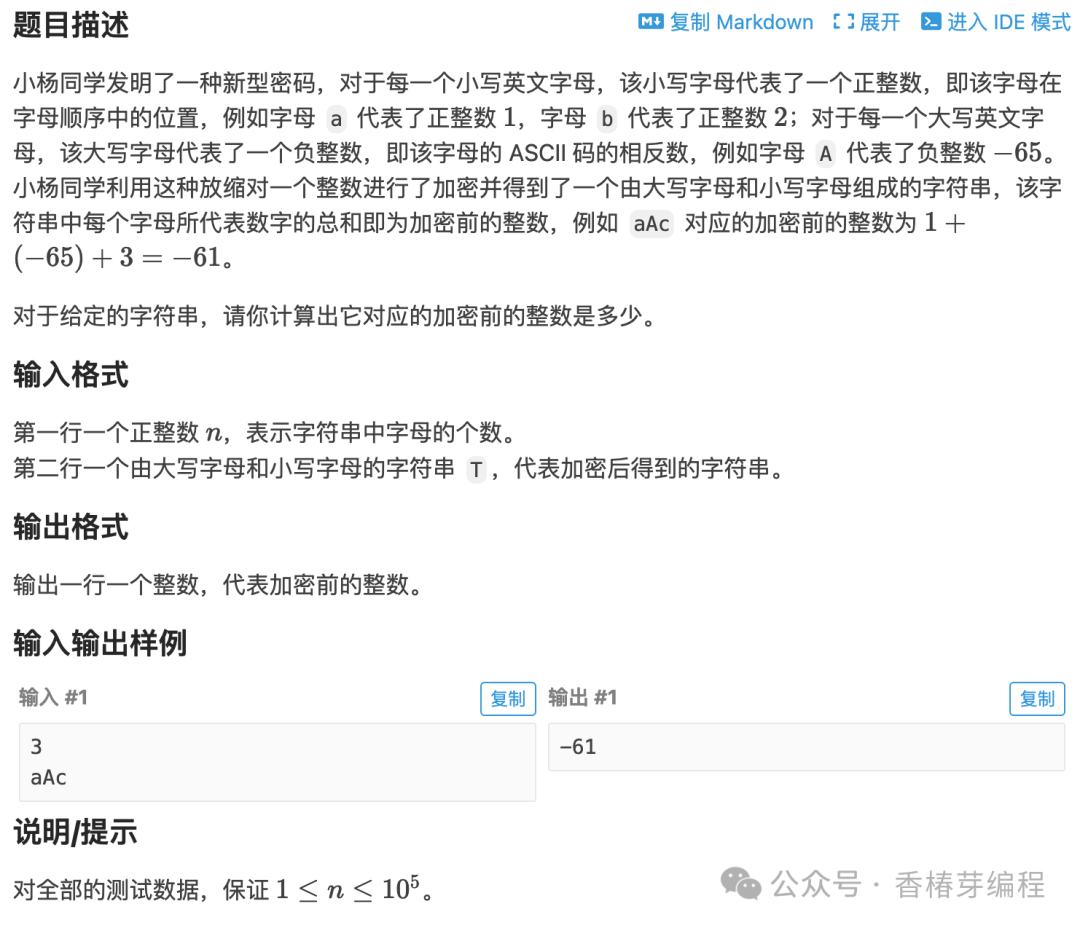
Solution Approach:
1. If you don’t know what ASCII is, you can write code to output it and find out. For example:
cout<<(int)'a'<<" "<<(int)'A'; 97 65Now you know how to add or subtract!
Look at the code:
#include <bits/stdc++.h>using namespace std;int main(){ int n; string s; cin >> n >> s; int result = 0; for (char c : s) { (c > 96) ? result += c - 96 : result -= c; } cout << result;} for (char c : s) can also be replaced with for( int i=0;i<s.size();i++)What does for (char c : s) mean?
| 1. The loop will automatically iterate through all characters in the string s, 2. Each time, the current character is assigned to the variable c (of type char). 3. The loop body (the code within the braces) can operate on each character c. |
Here it is read-only, so you can directly use char c.But what if you want to modify it in reverse? For example, changing c to c+4 and then assigning it back to s. You would need to use the address operator.
#include <bits/stdc++.h>using namespace std;int main(){ string s = "abc"; for (char &c : s) { c = (int)c + 4; } cout << s;// Output efgIsn’t this simpler than using s[i]?Have you learned it?