Compared to other types of sensors, ultrasonic sensors have unique advantages, but they also have some limitations.
These characteristics make them widely used in various fields, from industrial automation to medical diagnostics, as well as smart homes and environmental monitoring.
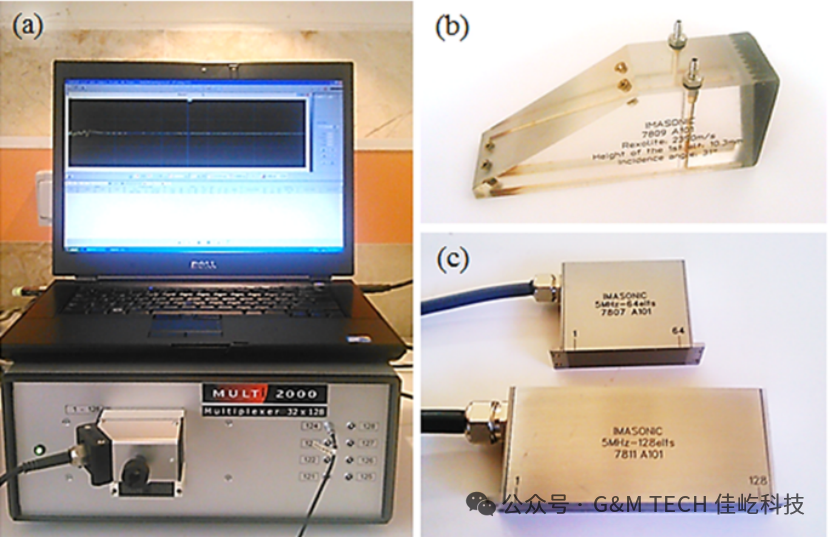
Different Types of Ultrasonic Sensors
Source: (Naserabadi & Sodagar, 2022)[13]
This figure shows different types of ultrasonic sensors, demonstrating the diversity in design and application of ultrasonic sensors. From left to right, there is an ultrasonic analysis system connected to a laptop, a prototype of an ultrasonic height sensor, and an ultrasonic transducer with a metal casing.
1
Non-contact Measurement:
One of the most significant features of ultrasonic sensors is their ability to perform non-contact measurements (Lan et al., 2014)[1]. This means that the sensor does not need to directly contact the object being measured, thus avoiding damage or contamination to the object’s surface. This feature is crucial in various applications, especially in scenarios where interference or destruction of samples must be avoided.
For example, when measuring the distance to corrosive liquids or high-temperature objects, non-contact measurement can effectively protect the sensor and extend its lifespan (Klambauer & Bergmann, 2017)[2] (Lan et al., 2014)[1].
In food processing and biomedical fields, non-contact measurement ensures a sterile and safe measurement process (Siswati et al., 2023)[3] (Patel et al., 2025)[4] (Troyee et al., 2023)[5].
2
Wide Applicability:
Ultrasonic sensors are suitable for measuring various objects and environmental conditions (Cao et al., 2024)[6]. They can be used to measure gases, liquids, and solids, and there are no strict requirements regarding the material, color, or transparency of the measured object (Shen et al., 2023)[7] (Zhao et al., 2024)[8].
Therefore, ultrasonic sensors are widely used in industrial processes such as level monitoring, flow measurement, object detection, and positioning (Klambauer & Bergmann, 2017)[2] (Rocchi et al., 2019)[9].
Additionally, some ultrasonic sensors can operate in harsh environments, such as high temperatures (Wang et al., 2025)[10], high humidity (Li et al., 2023)[11], and dusty conditions (Wang et al., 2024)[12].
3
High Sensitivity and Resolution:
Ultrasonic sensors have high sensitivity and resolution, capable of detecting small changes and details (Nakatsuji et al., 2023)[13] (Zhang et al., 2024)[14].
By optimizing sensor design and signal processing algorithms, measurement accuracy can be further improved.
For example, in medical diagnostics, high-resolution ultrasonic imaging can help doctors detect small tumors and lesions (Cao et al., 2024)[6].
In industrial inspections, high-sensitivity ultrasonic sensors can be used to detect small defects and cracks in materials (Wang, 2023)[15].
4
Interference Resistance:
While optical sensors are easily affected by smoke and dust, ultrasonic sensors can resist these interferences to some extent (Wang et al., 2024)[12].
Environmental factors such as dust, temperature, air pressure, and humidity can affect the attenuation and reception of ultrasonic signals, but through reasonable sensor design and signal processing techniques, the interference from these factors can be reduced, ensuring measurement accuracy and reliability (Wang et al., 2024)[12].
5
Signal Processing and Data Analysis:
Ultrasonic sensors are often used in conjunction with complex signal processing and data analysis systems to extract useful information (Feng et al., 2022)[16] (Kuang et al., 2023)[17].
For example, digital signal processing (DSP) technology can be used to filter, amplify, and correct ultrasonic signals, thereby improving measurement accuracy and reliability (Feng et al., 2022)[16].
Additionally, artificial intelligence (AI) and machine learning (ML) algorithms can be used to analyze and model ultrasonic data for more advanced measurement and diagnostic functions (Patel et al., 2025)[4].
6
Low Cost:
Compared to some other high-end sensors, ultrasonic sensors are relatively low in cost, making them economically advantageous in various applications (Khudaverdieva, 2023)[18] (Hunter, 2023)[19].
With ongoing technological advancements and increased production scale, the cost of ultrasonic sensors is expected to decrease further.
Wide Range of Applications
1
Biomedical Applications:
They can be used to monitor physiological parameters such as heart rate (Cao et al., 2024)[6], blood flow velocity, and respiratory rate (Troyee et al., 2023)[5], and can also be used for medical imaging and diagnostics (Cao et al., 2024)[6].
A wearable ultrasonic echocardiogram system based on a single sensor can be integrated into a wearable patch for monitoring breathing patterns and gestures (Gao et al., 2024)[20].
2
Automation and Intelligence:
With the continuous development of automation and intelligent technologies, the application of ultrasonic sensors in robotics (Tonmoy et al., 2023)[21], smart homes, and industrial automation is becoming increasingly widespread (Khudaverdieva, 2023)[18] (Cao et al., 2024)[6].
For example, in robotic navigation, ultrasonic sensors can be used to perceive the surrounding environment, enabling autonomous obstacle avoidance and path planning (Tonmoy et al., 2023)[21].
In smart homes, ultrasonic sensors can be used for gesture recognition, personnel detection, and security monitoring.
Limitations
Despite the many advantages of ultrasonic sensors, there are also some limitations. For example, their measurement range is relatively small (Chen et al., 2025)[23], they are easily affected by environmental factors (Wang et al., 2024)[12], and they have limited penetration capabilities with certain materials (Zhang et al., 2024)[24].
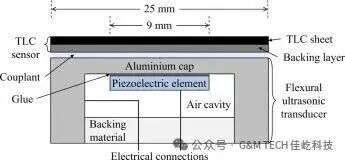
Structure and Components of the Flexural Ultrasonic Transducer
Source: (Turvey et al., 2024)[25]
For example, the illustration shows a cross-sectional view of a flexural ultrasonic transducer, with a total width of 25 mm and an internal dimension of 9 mm (Turvey et al., 2024)[25]. This transducer consists of multiple components such as TLC film, aluminum cup, piezoelectric elements, and backing materials, each playing a specific role in the generation, transmission, and reception of ultrasonic waves (Turvey et al., 2024)[25].

Jia Yi Technology

Official Website|gmtechcn.com
Sales Department Email|sale@gmtechcn