
|Author: Guo Hong1,† Wu Teng1 Luo Bin2
(1 Peking University, School of Electronics, Quantum Information Technology Center)
(2 Beijing University of Posts and Telecommunications, School of Electronic Engineering, State Key Laboratory of Information Photonics and Optical Communications)
Abstract
As one of the three core quantum technologies today, quantum sensing technology serves as an important physical realization basis for quantum information perception and acquisition. It is also the oldest, most mature, and widely applicable quantum technology with the greatest potential applications. This article is the first part of quantum sensing, mainly introducing the fundamental theory and methods of quantum sensing. First, it theoretically summarizes the definition and basic concepts of quantum sensing, points out the origin of the “quantum nature” of quantum sensing, and proposes its technical extension and classification basis from the perspective of practical applications. Next, it details the basic implementation architecture of quantum sensing and describes the core technical indicators that characterize quantum sensing performance, summarizing the physical principles and technical methods used to improve quantum sensing performance.
Keywords Quantum Sensing, Atomic Energy Levels, Quantum Coherence, Quantum Sensors, Quantum Information Perception and Acquisition
1Introduction
Quantum sensing is one of the core development directions in the three major quantum technology fields. It serves as the physical realization basis for quantum information perception, alongside quantum communication and quantum computing, forming the three pillars of current quantum technology. Various quantum sensors based on quantum sensing principles also play important roles in many fields. Compared to quantum computing and quantum communication, the development history of quantum sensing technology is longer, its technology is more mature, its applications are more widespread, and its effects are more significant. With the development of quantum theory and information technology, the concept and technical extension of quantum sensing are continuously expanding, and its technical manifestations are becoming increasingly diverse. This article mainly introduces the basic concepts, technical extensions, and basic methods of quantum sensing.
2Basic Concepts of Quantum Sensing
In the traditional sense, sensing generally refers to the response characteristics of macro objects to certain physical quantities to achieve detection and perception. For example, temperature sensors and pressure sensors can be constructed based on the dependence of the electrical characteristics of macro materials on the physical quantities to be measured. Early quantum sensing technology (mainly referring to the quantum electronics technology formed around the 1930s) was also based on this idea, with the difference being that the physical effects responding to the measured physical quantities shifted from macro physical effects to the quantum states of microscopic particles. For example, various sensors based on atomic energy levels utilize the discreteness of the quantum states of microscopic particles. The measured physical quantity causes changes in the probability distribution of the different states of microscopic particles. By measuring these changes in probability distribution, the measured physical quantity can be detected. The coupling between quantum states and the measured physical quantity constitutes the core of quantum sensing.
Quantum sensing technology has developed alongside the advancement of quantum theory and the discovery of quantum characteristics of microscopic particles, as well as the progress in physics and information technology. From an application perspective, the quantum characteristics can be summarized as: discreteness, coherence, and randomness. Among these, the coherence of microscopic particles (such as atoms) is reflected not only in the coherent superposition of single-particle states (in fact, early quantum sensing technologies mainly utilized this characteristic), but also in the coherent superposition of multiple particle states, namely quantum entanglement. The preparation of entangled states, how they are manipulated and evolve under the influence of the measured physical quantity, and how they are detected after evolution are fundamentally different from early quantum sensing technologies. Furthermore, the development of microwave oscillators, quantum frequency standards, atomic clocks, lasers, semiconductors, integrated circuits, nonlinear optics, and quantum optics has greatly promoted the development of techniques for preparing, manipulating, evolving, and reading quantum states, bringing more possibilities and broader space for the development of quantum sensing technology.
2.1 The Source of Quantum Nature in Quantum SensingAlthough quantum sensing has been studied for a long time, there has never been a standardized definition. In 2003, J. P. Dowling and G. J. Milburn published a significant paper titled “Quantum Technology: The Second Quantum Revolution”, which first explicitly proposed the concept and definition of “the second quantum revolution”[1]. In this paper, the concept of “quantum technology” is established based on quantum principles such as quantization (discreteness), uncertainty principle, quantum superposition, quantum tunneling, quantum entanglement, and quantum decoherence. Quantum technology is divided into quantum information technology (including quantum algorithms, quantum cryptography, and quantum information theory), quantum electromechanical technology, and coherent quantum electronics (mainly superconducting quantum circuits). At the same time, quantum photonics is proposed independently from quantum technology, including spintronics, molecular coherent quantum electronics, solid-state quantum computing, quantum optics, quantum optical interference technology, quantum lithography and microscopy, quantum squeezing, non-interacting imaging, quantum teleportation, coherent matter technology (i.e., atomic interferometers), atomic optics, atomic gravity gradient meters, and atomic lasers. It can be seen that the initial classification of quantum technology was relatively chaotic at different levels. With the introduction of the concept of the “second quantum revolution” and its development over the past two decades, quantum technology has gradually crystallized into three core development directions: quantum computing (including but not limited to quantum computing, quantum simulation, quantum acceleration, and quantum algorithms), quantum communication (including but not limited to quantum key distribution, quantum teleportation, and quantum direct communication), and quantum sensing (including but not limited to quantum precision measurement, quantum metrology, quantum sensors, and quantum information perception). For quantum sensing, its origins can be traced back to as early as 1879[2], which means that even before the establishment of quantum theory, people had already realized that certain properties of microscopic particles could be used to measure physical quantities (Figure 1), emphasizing that the advantage of this method lies in the intrinsic properties of microscopic particles, which do not change with time or space[2]. For example, the fixed energy intervals determined by the discrete energy levels of electrons outside the atomic nucleus form the basis of atomic clock technology; the determined proportional relationship between the amplitude of the external magnetic field and energy level shifts, determined by the discrete values of angular momentum in spatial orientation, forms the basis of atomic magnetometer technology; and so on.
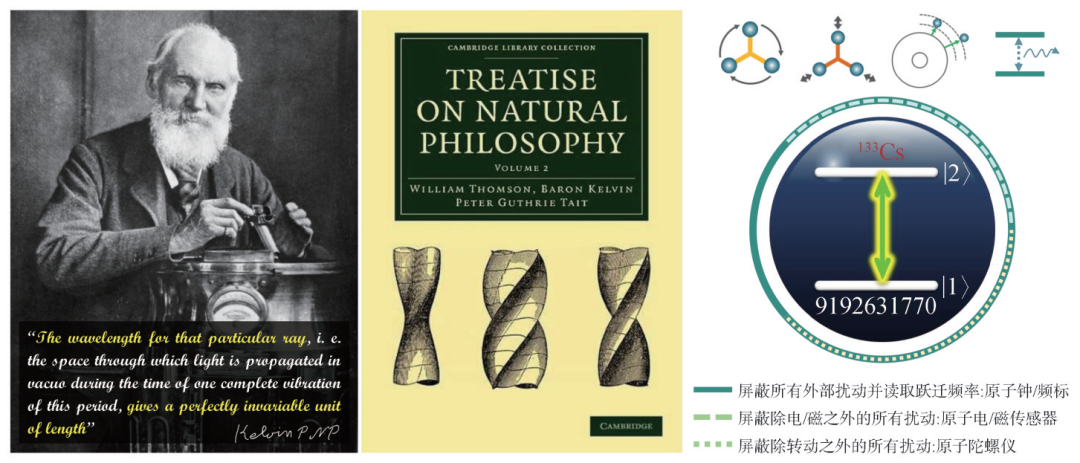
Figure 1 Left: William Thomson (the first Baron Kelvin) and his discussion on utilizing atomic energy levels for precision measurement of physical quantities; Middle: Cover of the book Treatise on Natural Philosophy published by Thomson (1879, second edition), which mentions the text quoted in the left image, meaning “the wavelength of the specific rays emitted by atoms, i.e., the distance traveled by light of a specific frequency in a fixed time period (period time), can provide a length standard that does not change with time”; Right: The basic idea of using the energy level structure of microscopic particles for physical quantity sensing and precision measurement.From the above, it can be seen that early quantum sensing utilized the discreteness of microscopic particles to provide certainty and consistency in measurements, and in improving sensing performance, it did not depart from the framework of classical sensing technologies, still employing classical noise suppression methods and signal extraction methods. With the introduction of special quantum states, such as entangled states and squeezed states, and the continuous development of laser technology, especially the rapid advancement of semiconductor laser technology and nonlinear optical technology in the late 1980s, the technical barriers and difficulties in preparing, manipulating, and reading special quantum states have been greatly reduced, allowing quantum sensing to truly differ fundamentally from classical sensing—evolving from classical independent sensing (detection) to quantum effect-based correlated sensing (detection). Overall, a scientific and normative academic definition of the concept and technical connotation of quantum sensing has taken a long time, and many have made related attempts. In 2017, C. Degen, F. Reinhard, and P. Cappellaro published a lengthy review paper titled “Quantum Sensing” in Reviews of Modern Physics[3], which can be considered the most significant effort to date academically to define the concept and technical extension of quantum sensing technology—this paper provides the broadest coverage of quantum sensing currently available and further attempts to propose a universal quantum sensing protocol (or technical classification method) modeled after the criteria method proposed by D. DiVincenzo for quantum computers in 2000[4]. In this paper, the definition, source of quantum nature, and technical extension of quantum sensing can be classified into three categories based on the following criteria: (1) using quantum objects to measure physical quantities, characterized by quantized energy levels (quantum states). Specific examples include energy levels of electrons, magnetic ions, atomic nuclei, or vibrational levels from superconductors, neutral atoms, trapped ions, or other spin systems; (2) using quantum coherence (i.e., spatial and temporal superposition states with wave-like properties) to measure physical quantities; (3) using quantum entanglement to enhance measurement sensitivity or precision, thereby surpassing the statistical limits of classical measurement. 2.2 Technical Classification of Quantum SensingBased on the above three categories, early quantum sensing technologies can basically be summarized into the first two categories. With the realization of quantum entanglement and the development of laser technology, researchers began to fully explore the enormous potential of special quantum states and quantum state manipulation methods in reducing measurement uncertainty, leading to the development of quantum precision measurement, quantum parameter estimation, and other technologies. In this article, we collectively refer to these technologies as quantum sensing. On the one hand, this aligns with the definitions mentioned above, and on the other hand, the core of different technologies is to utilize the coupling between quantum states and the measured physical quantities, ultimately leading to the same outcome. However, the emphasis of development at this stage differs: the first two categories focus more on enhancing the ability to perceive small changes in physical quantities; the third category focuses more on how to further reduce the measurement uncertainty of the measured physical quantities under limited resources. From the practical application of quantum sensing, in 2022, the United States released a report titled “Bringing Quantum Sensors to Fruition”[5], which defines quantum sensors as: “Quantum sensors are devices that use quantum mechanical properties (such as atomic energy levels, photon states, or the spins of fundamental particles) for metrology,” placing the emphasis of the concept on its extension, merely illustrating which technologies belong to quantum sensors in an “exemplary” manner—whether a sensor itself is sufficiently “quantum” does not affect its effectiveness at this stage. Therefore, based on the “inductive method,” a framework for quantum sensors can be provided. Based on this idea, as quantum technology has risen to the status of national strategic technology in developed countries worldwide, we can first list the representative documents related to quantum strategy from developed countries that focus on quantum technology (Table 1) and attempt to describe the concept of quantum sensors and classify them. Overall, as of now, the quantum sensing technology widely recognized in developed countries is gradually focusing. The current common quantum sensing technologies can also be divided into three major categories. It can be seen that the classification results basically align with the academic classification standards mentioned above.Table 1 Examples of Quantum Sensor Technologies in Major Scientific Powers
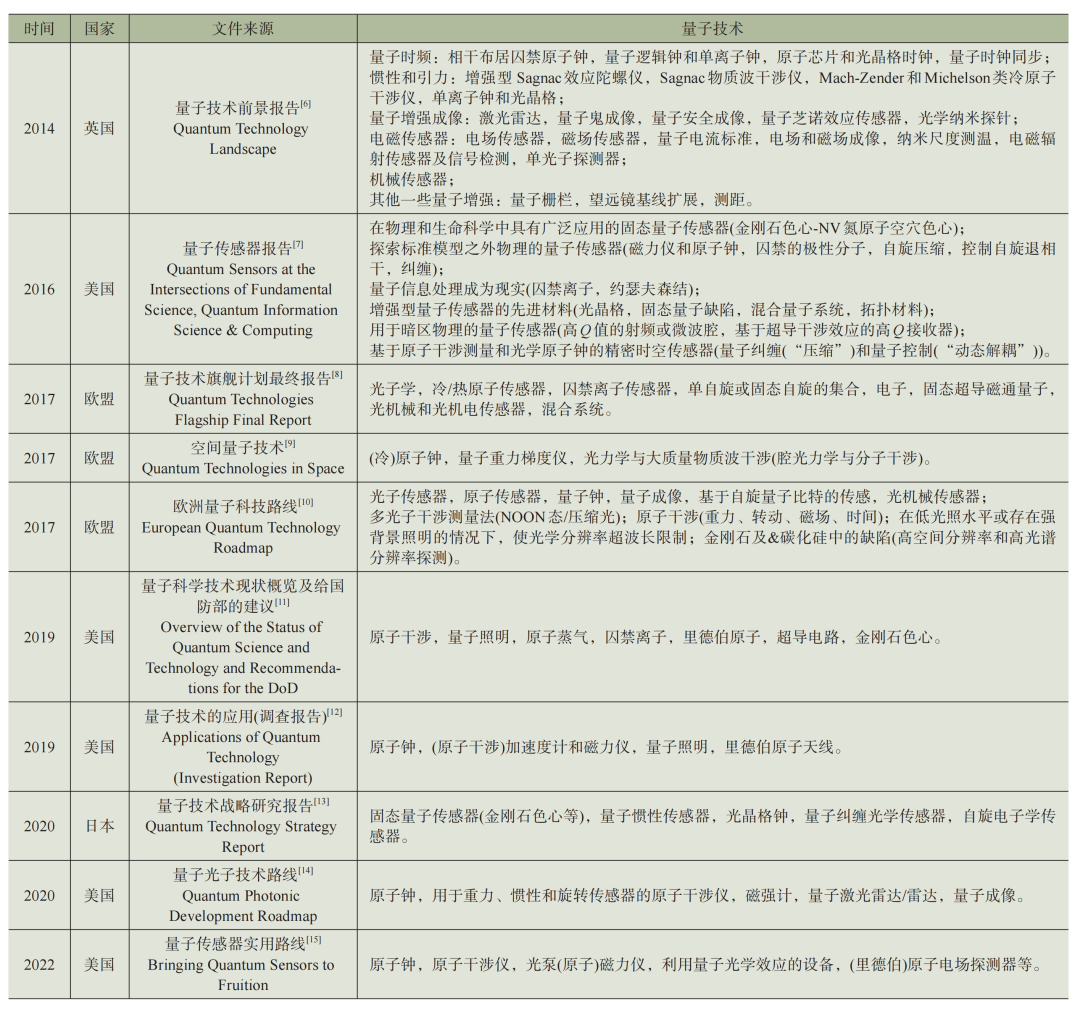
The first category includes mature technological directions that have formed representative practical products and are gradually constructing new industrial structures, mainly including atomic clocks, atomic magnetometers, superconducting interference magnetometers, atomic interferometers, nuclear magnetic resonance technology, etc. The second category includes technologies in the practical development process, mainly including optical frequency atomic clocks (including optical lattice clocks), diamond color center (NV color center) technology, quantum correlation imaging, etc. The third category is still in the laboratory and academic research stage, mainly including (Rydberg) atomic electric field detectors, quantum illumination, and quantum precision measurement technologies and methods based on special quantum states (such as squeezed states and entangled states), etc.3Description of Quantum Sensing Performance and Improvement Methods
The core of sensing or measurement reflects the ability to measure physical quantities or respond to changes in physical quantities. In addition, the repeatability and consistency of sensing performance and results are also one of the key development directions today. This section will first provide the basic framework of quantum sensing and introduce the description methods for quantum sensing performance indicators. Based on this, it will discuss how to improve the performance indicators of quantum sensing technology from both physical and technical methods.
3.1 Basic Framework of Quantum SensingQuantum sensing primarily relies on the precise control and reading of the states (quantum states) of microscopic particles. In fact, the basic framework and implementation methods of quantum sensing can be described using the universal framework of quantum technology, namely, the preparation of quantum states, the evolution of quantum states, and the reading of quantum states. Therefore, from this perspective, quantum sensing and quantum computing are equivalent. The difference between the two lies in the complexity of the preparation and evolution of quantum states; quantum computing is more complex than quantum sensing, mainly reflected in the fact that quantum computing requires transforming (or compiling) the problem to be solved or the algorithm to be implemented into a series of interactions Hamiltonians that realize quantum state evolution, while for quantum sensing, in the evolution of states, it generally only needs to consider the form of evolution of quantum states under the influence of the measured physical quantities. In other words, quantum sensing focuses more on how to precisely control and read the evolution of quantum states. In addition, quantum computing has higher requirements for quantum entangled states, while entanglement is not a necessary condition for quantum sensing. Specifically, the universal framework of quantum sensing includes seven basic steps. This part mainly references the review paper “Quantum Sensing”[3]. This article builds upon this and supplements and explains the basic structure of the quantum sensing framework based on representative quantum sensing technologies such as atomic magnetometers, atomic clocks, and nuclear magnetic resonance. Step 1: Initialization of Quantum States. The state of the microscopic particles needs to be prepared in an initial state. Generally, this initial state can be selected as a certain eigenstate of the microscopic particles (such as the energy eigenstate of a two-level atom). For quantum sensors based on atomic ensembles, this step is also referred to as polarization. For example, strong magnetic fields in nuclear magnetic resonance, magnetic selection state techniques in atomic clocks, and light pumping techniques in atomic magnetometers. Step 2: Preparation of Quantum States. This step mainly transforms the quantum state into a state that can be used for sensing. This state needs to evolve under the influence of the measured physical quantities. Generally, this is achieved by applying certain control pulses to prepare the state. For example, a 90° magnetic field pulse in nuclear magnetic resonance; in addition, a series of more complex manipulation methods can be designed to prepare special quantum states, such as entangled states and squeezed states. Step 3: Evolution of Quantum States. The prepared quantum state evolves under the influence of the measured physical quantities, which is key to achieving quantum sensing. For example, under the influence of a magnetic field, the intrinsic magnetic moment of microscopic particles interacts with the external magnetic field. If the state of the microscopic particles is not the eigenstate of this interaction, evolution will occur. The evolution process can phenomenologically reflect the evolution laws of states through the Larmor precession of the magnetic moment in the magnetic field, and by measuring the angle (or frequency) of precession, information about the magnetic field can be obtained. Atomic clocks utilize the intrinsic interactions of atoms to accurately extract the evolution frequency of microscopic particles’ states under intrinsic actions by shielding all external influences. Step 4: Transformation of Quantum States. The main purpose of this step is to transform the evolved quantum state into an observable state. For example, in atomic clocks, after preparing the atomic state into a superposition state using a 90° pulse and evolving under intrinsic interactions, another 90° pulse needs to be applied. This step mainly depends on the subsequent observation methods. If the chosen observation method can directly observe the evolved superposition state, this operation is not required. Step 5: Reading of Quantum States. Compared to the initial state, the evolved state is generally a superposition state of the original eigenstates; thus, the result obtained from a single measurement is random and can only yield one of the eigenstates. The reading (or measurement) is a Bernoulli process, with a probability of 1-p of obtaining state A and a probability of p of obtaining state B. This probability cannot be obtained through a single measurement and requires multiple measurements. Step 6: Repeated Measurements. Repeat the above steps 1-5. Ideally, the measurement results obtained will be the probabilities of different eigenstates. Repetition has two meanings: on one hand, it reflects the repeated execution of steps 1-5 for a single particle; on the other hand, it reflects the average detection results of a particle ensemble. These two meanings of repetition can be carried out in parallel. Step 7: Estimation of the Measured Physical Quantity. According to the analysis of the previous steps, the probabilities and their changes of obtaining different eigenstates contain information about the measured physical quantity. By measuring the probabilities, information about the value of the physical quantity can be obtained. The above framework can essentially summarize all technologies related to quantum sensing at present, and the differences among different technological directions mainly reflect the varying emphases of the seven steps mentioned above.3.2 Performance Indicators of Quantum SensingThe core technical indicators of quantum sensing include noise, sensitivity, precision, etc. These indicators are both related and distinct. Generally speaking, noise mainly reflects a class of physical factors that affect measurement results and has random characteristics. Sensitivity, although closely related to noise, also depends on signal strength, reflecting the minimum value of the physical quantity change that the system can discern. Precision (or accuracy) focuses on the difference between the measurement result and the true result, which is related to noise (statistical error) and also depends on the error introduced by the measurement method (systematic error). Noise.Noise in quantum sensing can be mainly divided into classical noise and quantum noise. Classical noise is generally referred to as technical noise (mainly referring to noise introduced by macro systems, such as intensity noise of lasers, frequency noise, detector shot noise, and dark current noise, which actually all stem from spontaneous radiation, a quantum effect, but are usually classified as technical/classical noise), dark current noise, etc., as well as random interference from external non-measured physical quantities, such as blackbody radiation, vibration noise, temperature noise, etc. Quantum noise primarily arises from measuring quantum states, and its essence is the uncertainty principle, which is an inevitable result of projecting measurement on an unknown quantum state. For example, if the probability of obtaining a measurement result of A is p, and the probability of obtaining a measurement result of B is 1-p, as mentioned earlier, the probability p contains information about the measured physical quantity. Assuming the total number of measurements is n, then the number of times A is measured is np, and the number of times B is measured is n(1-p), the uncertainty (or variance) of p can be calculated as p(1-p)/n, and this uncertainty is the quantum projection noise. Quantum projection noise can be manipulated by setting different quantum states (such as squeezed states), but it is not the case that the smaller the quantum projection noise, the better. For example, in the aforementioned case, when p is 0 or 1, the uncertainty of p is 0, at which point the microscopic particle is in an eigenstate (basis), but this state is not optimal for sensing—sensing is more concerned with the signal-to-noise ratio. Sensitivity.Sensitivity refers to the minimum value of the change in a physical quantity that the sensing system can reflect, mainly determined by the signal-to-noise ratio within a certain bandwidth range, and can be divided into sensitivity indicators determined by classical or quantum noise. For example, for atomic magnetometers, the sensitivity formula under classical noise can be written as [(T2)(SNR)γ]-1, where T2 is the transverse relaxation time (which reflects the coherence time of the quantum superposition state to some extent), SNR is the signal-to-noise ratio within a certain bandwidth range (the longer the average time and the smaller the bandwidth, the lower the noise and the greater the signal-to-noise ratio), and γ is a constant (describing the conversion coefficient between the magnetic field and frequency under specific atomic states). The sensitivity under quantum noise, such as quantum projection noise, is generally written as [(T2)(NT)γ2]-1/2, where N is the number of interacting particles, and T is the total measurement time. T/T2 can also be regarded as the average number of measurements (the upper limit of single measurement time is determined by the relaxation time of the quantum state). The sensitivity limit determined by quantum projection noise is inversely proportional to the number of interacting particles and the measurement time, often referred to as the standard quantum limit. This can be further improved by preparing special quantum states, such as entangled states and squeezed states, but is currently still limited to systems composed of a small number of particles. Precision.Also known as accuracy, it mainly reflects the measurement errors introduced during the sensing process, including statistical errors and systematic errors. Among these, statistical errors depend on the noise level; the smaller the noise, the smaller the measurement dispersion, thus the smaller the statistical error. Systematic errors mainly arise from errors introduced by measurement methods and system non-idealities, mainly reflected as the offset from the true physical quantity. Precision more reflects the long-term stability and repeatability of the sensing system. The reason quantum sensing can achieve high performance in precision is primarily due to the high-precision control and protection of quantum states of microscopic particles. In addition, indicators describing the performance of quantum sensing also need to include range, bandwidth, etc. These indicators are not detailed here, mainly because they still follow the definitions in classical sensing and have not technically departed from classical frameworks. On the other hand, from the current state of technological development, the quantum characteristics of microscopic particles have not brought about disruptive effects similar to those in concepts like sensitivity and precision. In fact, due to the high sensitivity of quantum states to external environments, quantum sensing is limited in dynamic range and bandwidth; for example, the bandwidth and sensitivity of atomic magnetometers are mutually constrained. In recent years, with the development of diamond color centers and miniature atomic gas chambers combined with optical resonators, quantum sensing has achieved high levels of spatial resolution while ensuring high sensing sensitivity indicators. Especially with the development of diamond color center sensing technology, it is gradually moving towards sensing technologies that combine high sensitivity, high spatial resolution, large dynamic range, and high bandwidth (detailed content will be introduced in another article). 3.3 Methods for Improving Quantum Sensing PerformanceCombining the description and analysis of the core performance indicators of quantum sensing mentioned above, the following will attempt to summarize the main physical principles and technical methods for improving the detection sensitivity, reducing detection noise, and enhancing detection precision of quantum sensing technologies. Since this attempt is based on induction, it cannot cover all methods for improving the sensitivity of quantum sensing technology. Through the following introduction, it can be seen that most of the technologies in Table 1 (except those related to safety) can be included.
3.3.1 Physical Principles
The improvement of sensitivity and precision in quantum sensing technology, also known as the “quantum enhancement” effect, can be simply divided into two main parts: quantization and quantum coherence. This is also what we currently understand about the basic properties of microscopic particles (Figure 2).
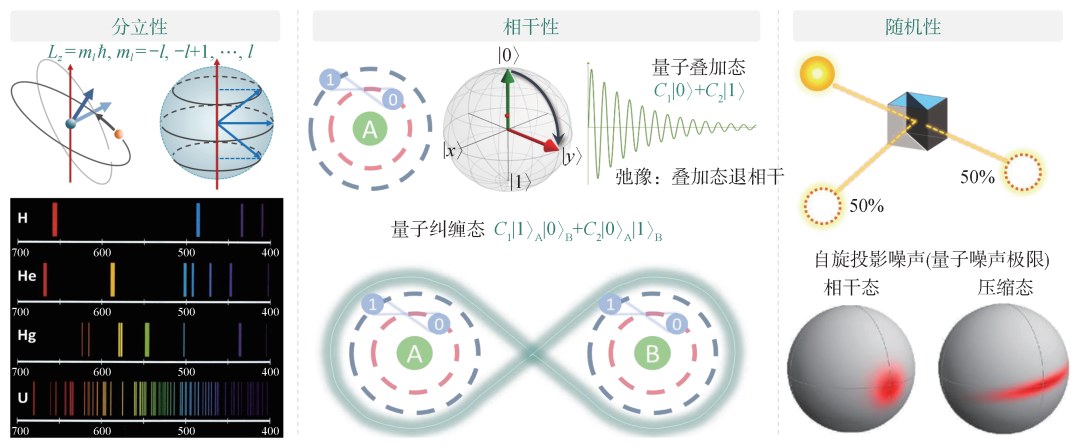
Figure 2 Basic properties of microscopic particles: discreteness (discrete energy levels), coherence (quantum superposition states, entangled states), randomness (quantum noise)Quantization.The quantization (or discreteness) of the basic sensing unit’s microscopic structure is the physical basis for almost all quantum sensors and is fundamental to the application of various quantum effects and their control methods. Its accuracy is reflected in the “quantization” itself. The quantum characteristics of some physical systems provide theoretical support for sensitivity limits (for example, superconductivity). It should be noted that, contrary to traditional definitions, this article argues that “quantization” does not merely refer to “discreteness,” which mainly involves the natural conclusion of quantum bound states, but also emphasizes the homogeneity in the basic assumptions of quantum mechanics (here, strict academic proof of bound states and quantum mechanical postulates is not pursued). Importantly, the quantization of atomic energy levels and the basic assumption of homogeneity in quantum mechanics fundamentally ensure the high consistency of transition frequencies between different atomic energy levels, and the high precision of frequency measurement further constitutes the core capability of modern precision measurement, and is one of the fundamental guarantees for quantized metrology (i.e., tracing back to fundamental physical constants)—to date, frequency is the physical quantity that humans can measure with the highest precision—not only referring to measurement accuracy but also reflecting long-term consistency and repeatability in measurements. Quantum Coherence.Quantum coherence mainly involves the coherent superposition characteristics of quantum states (including the control and maintenance of quantum entanglement characteristics), which are key to enhancing and improving the precision and sensitivity of quantum sensing technology. For early quantum sensing technologies, such as atomic clocks, atomic magnetometers, and atomic gyroscopes, one of the key factors determining their sensing performance is how to maintain the coherence characteristics of quantum states. Coherence characteristics can largely be represented by the Q value of the characteristic signal, such as the resonance signal linewidth in quantum sensing technologies of atomic clocks and atomic magnetic sensors, which is also T2 in the formula [(T2)(SNR)γ]-1, and is generally inversely proportional to the linewidth; thus, the longer the coherence time, the narrower the signal linewidth, the larger the Q value, and the higher the detection sensitivity performance indicator of the sensor. Accompanied by the development of cold atom technology, the matter wave interference technology has emerged, and we can boldly attribute the improvements in measurement precision and detection sensitivity of quantum sensing technologies to the further manifestation of the “wave nature” in quantum systems. The improvements in measurement precision and detection sensitivity of quantum sensing technology can largely be attributed to the quantum version of classical optical interference measurement technology (optical interference represents the highest level of classical measurement, such as gravitational wave detection). Together with other classical theories, it follows the transition from the amplitude interference of classical waves to the probability amplitude interference of “quantum waves,” thereby unifying within the theoretical framework of quantum coherence and quantum statistical theory. Furthermore, the introduction of special quantum states (such as squeezed states, NOON states, etc.) and quantum control methods (such as dynamical decoupling, quantum non-demolition measurements, etc.) that enhance the sensitivity and precision of sensing technologies ultimately reflect the control and maintenance of coherence characteristics and entanglement properties of quantum states. 3.3.2 Technical MethodsBased on the analysis of the physical principles related to quantum sensing mentioned above, the main technical implementations for improving quantum sensing performance indicators can be divided into three main approaches. (1) Preparation and Maintenance of High Q Value Systems. The quantization of the basic sensing unit’s microscopic structure is the physical basis for almost all quantum sensors, but quantization itself does not guarantee improved measurement accuracy. If we do not consider quantum systems that introduce quantum entanglement, the improvement of measurement accuracy fundamentally resembles that of classical systems, relying on the high Q value of the sensing unit. This applies not only to circuits or optical cavities but also to atomic systems, which are the most important quantum sensing systems. The discreteness of “atoms” does not guarantee measurement accuracy (but can ensure measurement consistency); a high Q value atomic system is fundamental to ensuring measurement accuracy—its essence reflects the atomic system’s response capability to the measured physical quantities. The larger the Q value, the stronger the atomic system’s response to the measured physical quantities. The Q value of atomic systems can be defined as the ratio of transition frequency to transition linewidth, which is also the fundamental reason for the inevitable transition from atomic clocks to optical clocks[16] (increasing transition frequencies) and from thermal atoms to cold atoms[17] (reducing transition linewidth). (2) Quantum Enhancement Techniques of Interferometers. Optical interferometers have played an important role in the history of precision measurement, with the Michelson-Morley experiment being the most famous. The improvement of measurement accuracy in classical optical interferometers requires shorter wavelengths and stronger coherence (diffraction limit), often achieved through light source selection (from visible light to ultraviolet, X-rays, etc.), light source stability (increasing coherence time), and lengthening the interferometer arms. The statistical principles of their measurement values still adhere to the classical statistical law of 1/N1/2. The quantum coherence brought about by quantum mechanics provides more options for the “light source” of interferometers, and atomic interferometers have made significant progress towards short-wavelength matter wave interferometers. Furthermore, electron, neutron, and antimatter particle interferometers can also be realized. The introduction of entangled light and special light field states based on it provides the basic conditions for the measurement accuracy of interferometers to improve to the Heisenberg limit of 1/N, and the technology of injecting entangled light has technically achieved this leap[18]. Additionally, ghost imaging technology using intensity interference and superconducting quantum interference devices can be included in this category. (3) Converting Physical Quantity Measurements to Frequency Measurements. Modern quantum optical technologies represented by lasers and high-finesse (high Q value) optical cavities are one of the fundamental guarantees for enhancing quantum sensing capabilities. With the continuous maturation of quantum frequency standard technologies centered around atomic clocks, human precision measurement capabilities in frequency, as a fundamental unit, have reached an astonishing level—the uncertainty of frequency measurement has reached the level of 10-19[19], and daily operational atomic clocks (fountain) can also reach levels of 10-15[20], which is far superior to the measurement accuracy of other physical quantities. Therefore, converting other physical quantities into frequency measurements through interaction with quantum systems (especially atomic energy levels) has become an important method. Representative technologies include light-pumped atomic magnetometers (which relate magnetic fields to frequencies through gyromagnetic ratios based on specific atomic energy levels), Rydberg atomic electric field measurements[21,22], and dual comb ranging, etc. In addition, some technical schemes, including but not limited to multi-path techniques in atomic gas chambers, zero difference and heterodyne detection, dual comb technologies, etc., are not listed because these technical means for improving quantum sensing performance fundamentally align with classical optical interferometers, microwave radar detection, and electrical signal time detection technologies, and do not belong to the typical quantum effects (i.e., discreteness, coherence) that lead to improvements.4Definition of Quantum Sensors
Similar to the three elements of quantum sensing, the review[3] attempts to provide a definition of quantum sensors:
(1) The state of the quantum system must possess the basic conditions of distinguishability and discreteness, equivalent to a two-level system;
(2) The state of the quantum system must have the possibility to initialize to any state and be read;
(3) The state of the quantum system can be manipulated, typically by alternating electromagnetic fields;
(4) There is a fixed conversion relationship between the state of the quantum system and the measured physical quantity, generally expressible as γ=∂qE/∂Vq, where ∂V represents the change of the measured physical quantity, and correspondingly, ∂E represents the change of the quantum system’s energy, with q=1 indicating a linear relationship and q=2 indicating a quadratic relationship (and so on).
It can be seen that, unlike the previous definitions related to sensing, there is no deliberate emphasis on quantum entanglement effects here. Instead, a definition of quantum sensors is provided entirely from a practical perspective. Therefore, combining the current development status, typical representatives of quantum sensors that have entered the practical stage include atomic clocks, atomic magnetometers, and atomic interferometers. At the same time, diamond color centers and Rydberg atomic electric field detection are gradually becoming important technological development directions due to their unique advantages and have attracted considerable attention. This section involves the practical applications of quantum sensing technology. Due to space constraints, we will discuss the overall development status and further development trends of quantum sensing technology and quantum sensors in another article.
5Conclusion
This article mainly introduces the basic theory and methods of quantum sensing, summarizing the definition and basic concepts of quantum sensing from a theoretical perspective, pointing out the origin of the “quantum nature” of quantum sensing, and providing the technical extension and classification basis of quantum sensing from the perspective of practical applications. The article also details the basic implementation architecture of quantum sensing and describes the core technical indicators that characterize quantum sensing performance, summarizing the core physical principles and technical methods used to improve quantum sensing performance. It is important to note that quantum sensing technology has continuously evolved alongside the development of quantum theory, and its conceptual connotation and technical extension have also continuously expanded over nearly a century of development.
To date, quantum sensing has become one of the three core development directions of current quantum technology. At the same time, it is also the oldest, most mature, and widely applicable quantum technology with the greatest potential applications. However, even so, like quantum computing and quantum communication, quantum sensing faces the challenge of resisting the decoherence mechanisms introduced by external environments on quantum states—quantum states are highly sensitive to external environments, which is both an advantage of quantum sensing and a technical challenge for its stable and reliable use in complex environments. In comparison, quantum computing is more direct in its approach to dealing with decoherence mechanisms caused by the environment—attempting to shield all external interference as much as possible. The core purpose of quantum sensing is to sense external information; how to fully leverage the disruptive performance advantages brought by quantum sensing in more complex and practical environments is one of the core issues that quantum sensing must address at present.
In summary, although quantum sensing has undergone a century of development, it is still in its infancy, with a wide range of technologies involved and diverse conceptual connotations and descriptive methods. Against this background, this article is an attempt to summarize and consolidate the core concepts, key theories, and technical methods of quantum sensing. Given that the author’s research direction cannot cover all technical areas of quantum sensing, there may inevitably be shortcomings and incompleteness in the descriptions of some technologies and theories, for which criticism and corrections are welcome.
References
[1] Dowling J P,Milburn G J. Philosophical Transactions A,2003,361:1655
[2] Thomson W, Tait P G. Treatise on natural philosophy. Claredon Press,1867,1
[3] Degen C,Reinhard F,Cappellaro P. Reviews of Modern Physics,2017,89:035002
[4] DiVincenzo D P. Fortschritte der Physik:Progress of Physics,2000,48:771
[5] Bringing Quantum Sensors to Fruition. https://www.quantum.gov/wpcontent/uploads/2022/03/BringingQuantumSensorstoFruition.pdf
[6] UK Quantum Technology Landscape 2014. https://www.quantum‐commshub. net/wpcontent/uploads/2020/09/QuantumTechnology‐Landscape.pdf
[7] Quantum Sensors at the Intersections of Fundamental Science,Quantum Information Science & Computing. https://www. osti.gov/biblio/1358078
[8] Quantum Technologies Flagship Final Report. https://era. gv. at/public/documents/3365/Finalreport.pdf
[9] Quantum Technologies in Space. https://qtspace.eu/wp-content/uploads/2023/08/QTspace_Stretegic_Report_Intermediate.pdf
[10] Acín A et al. New Journal of Physics,2018,20:1
[11] Wolf S A,Joneckis L G,Waruhiu S et al. Overview of the Status of Quantum Science and Technology and Recommendations for
the DoD. Institute for Defense Analyses,2019 Applications of Quantum Technology
[12] Applications of Quantum Technology(Investigation Report).https://dsb. cto. mil/reports/2010s/DSB_QuantumTechnologies_Executive%20Summary_10.23.2019_SR.pdf
[13] Quantum Technology Strategy Report. https://www8. cao. go.jp/cstp/tougosenryaku/ryoushisenryaku.pdf
[14] Quantum Photonic Development Roadmap. https://www.optica.org/industry/online_industry_library/quantum_photonics_roadmap/
[15] Bringing Quantum Sensors to Fruition. https://www. quantum.gov/wp-content/uploads/2022/03/BringingQuantumSensorsto-Fruition.pdf
[16] Ludlow A D,Boyd M M,Ye J et al. Reviews of Modern Physics,2015,87:637
[17] Pezzè L,Smerzi A,Oberthaler M K et al. Reviews of Modern Physics,2018,90:035005
[18] Pan J W,Chen Z B,Lu C Y et al. Reviews of Modern Physics,2012,84:777
[19] Brewer S M,Chen J S,Hankin A M et al. Physical Review Letters,2019,123:033201
[20] NIST’s Cesium Fountain Atomic Clocks . https://www.nist.gov/pml/time-and-frequency-division/time-realization/cesium-fountainatomic-clocks
[21] Budker D,Romalis M. Nature Physics,2007,3:227
[22] Marcis A,Budker D,Rochester S. Optically Polarized Atoms:Understanding Light-atom Interactions. Oxford University Press,2010
[23] Gallagher T F. Reports on Progress in Physics,1988,51:143
(References can be viewed by scrolling up and down)
This article is selected from “Physics” 2024, Issue 4