In-Depth Analysis of Linux Mutex Mechanism and Implementation
1. Basic Concepts and Design Philosophy of Mutex
1.1 What is a Mutex
A mutex (Mutual Exclusion Lock) is one of the most fundamental synchronization primitives in operating systems, used to protect critical section resources, ensuring that only one executing thread can access the protected shared resource at any given time. The implementation of mutex in the Linux kernel has evolved from simple to complex, and has now become a highly optimized synchronization mechanism.
1.2 Design Goals and Principles
The design of Linux mutex follows several core principles:
- • Efficiency: Achieve a fast path in the absence of contention.
- • Fairness: Avoid thread starvation, ensuring that waiting threads have a chance to acquire the lock.
- • Scalability: Adapt to multi-core environments, reducing cache coherence traffic.
- • Debugging Support: Provide rich debugging information and deadlock detection mechanisms.
2. Core Data Structure Analysis
2.1 Mutex Structure
struct mutex {
    atomic_long_t       owner;
    spinlock_t      wait_lock;
    struct list_head    wait_list;
#ifdef CONFIG_MUTEX_SPIN_ON_OWNER
    struct optimistic_spin_queue osq;
#endif
#ifdef CONFIG_DEBUG_MUTEXES
    void            *magic;
#endif
#ifdef CONFIG_DEBUG_LOCK_ALLOC
    struct lockdep_map  dep_map;
#endif
};
Detailed Explanation of Each Field:
| Field | Type | Description |
|---|---|---|
<span>owner</span> |
<span>atomic_long_t</span> |
Atomic variable, stores lock owner information and status flags. |
<span>wait_lock</span> |
<span>spinlock_t</span> |
Spinlock protecting the wait queue. |
<span>wait_list</span> |
<span>struct list_head</span> |
Queue of threads waiting to acquire the lock. |
<span>osq</span> |
<span>struct optimistic_spin_queue</span> |
Optimistic spin queue (MCS lock). |
<span>magic</span> |
<span>void *</span> |
For debugging purposes, verifies the validity of the mutex. |
<span>dep_map</span> |
<span>struct lockdep_map</span> |
Tracks lock dependencies. |
2.2 Bit Layout of the Owner Field
The owner field uses bit manipulation to encode various information:
/*
 * Bit definitions for the owner field:
 * Bit 0: Is the lock held? (1=held, 0=free)
 * Bit 1: Are there waiters? (1=there are waiters, 0=no waiters)
 * Bit 2: Is handoff enabled?
 * Remaining bits: Pointer to the task_struct of the lock owner.
 */
#define MUTEX_FLAG_WAITERS  0x01
#define MUTEX_FLAG_HANDOFF  0x02
#define MUTEX_FLAG_PICKUP   0x04

static inline struct task_struct *__mutex_owner(struct mutex *lock)
{
    return (struct task_struct *)(atomic_long_read(&lock->owner) & ~0x07);
}
2.3 Wait Queue Node
struct mutex_waiter {
    struct list_head    list;
    struct task_struct  *task;
    struct ww_acquire_ctx *ww_ctx;
#ifdef CONFIG_DEBUG_MUTEXES
    void            *magic;
#endif
};
3. Working Principle and State Transitions
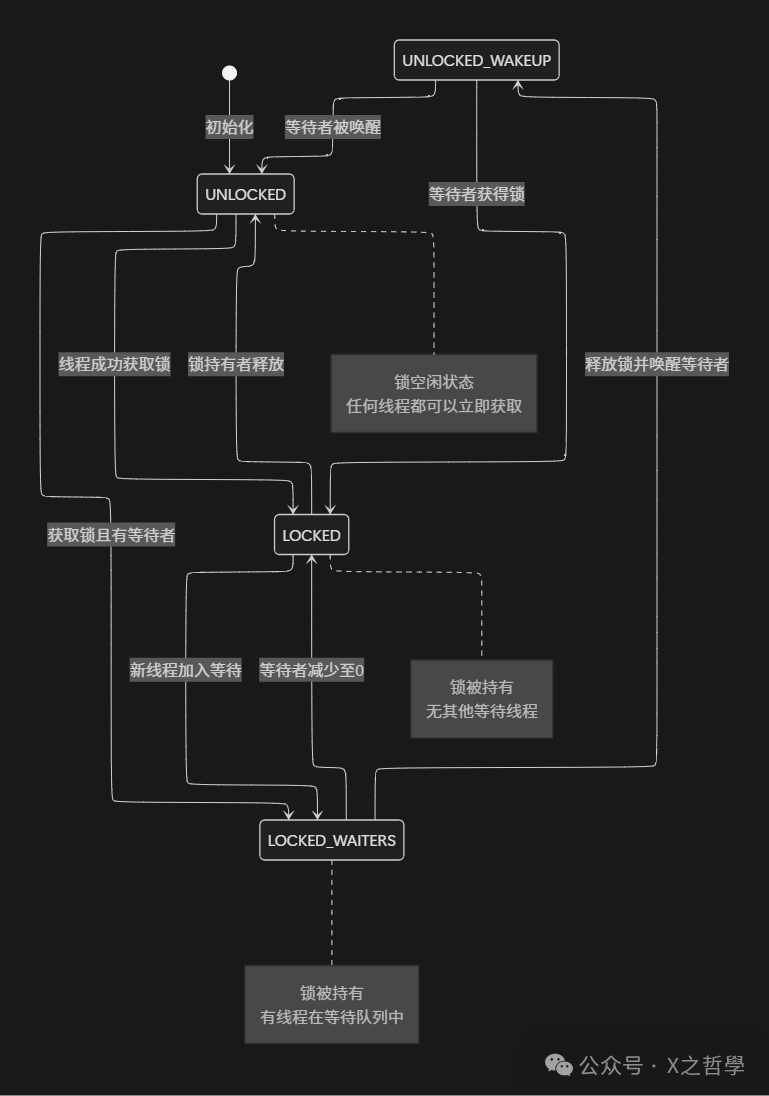
3.1 Mutex State Machine
3.2 Core Algorithm Flow
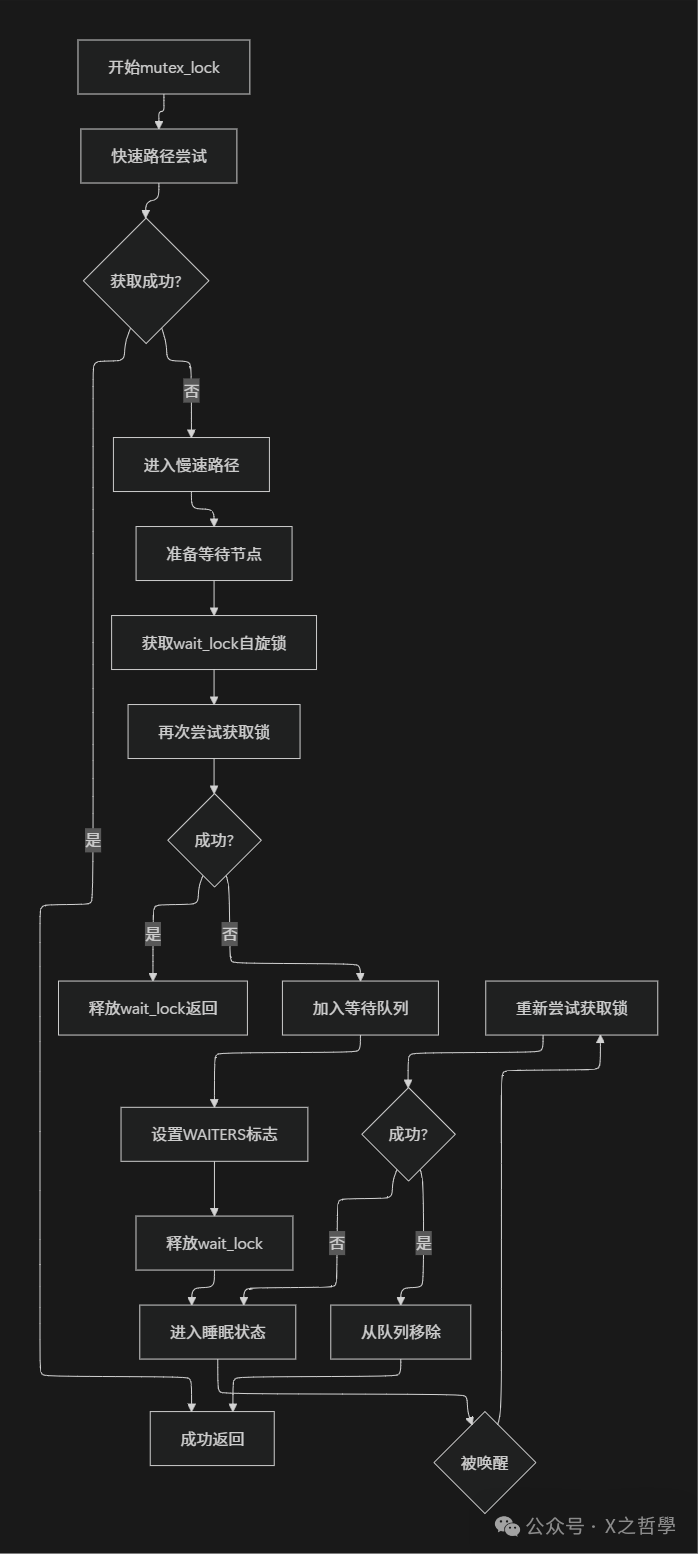
3.2.1 Lock Operation (mutex_lock)
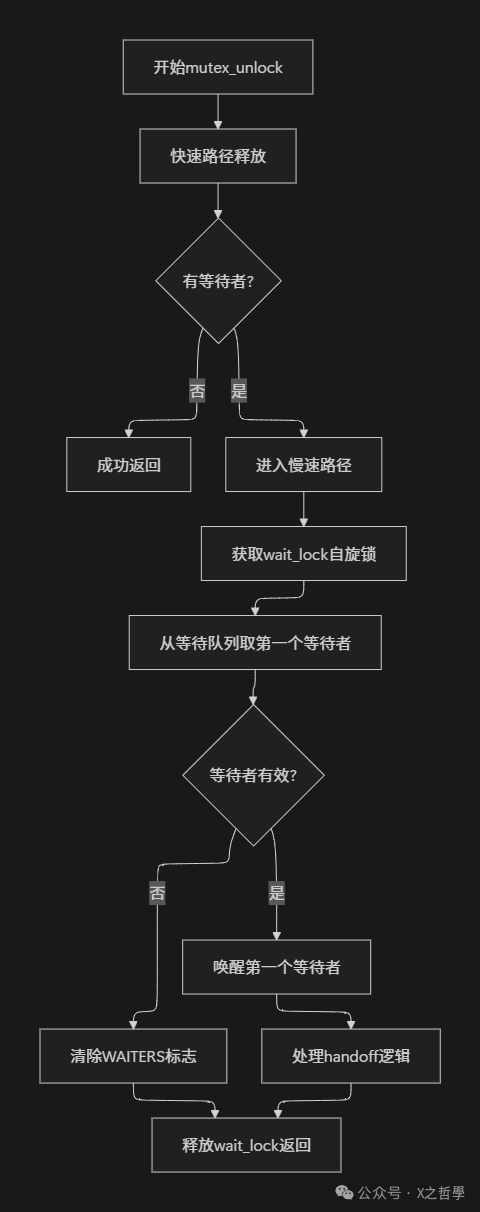
3.2.2 Unlock Operation (mutex_unlock)
3.3 Optimistic Spinning
The Linux mutex implements an optimistic spinning mechanism. In multi-core systems, when the lock is held by another CPU, the current thread does not immediately sleep but instead spins for a limited number of times.
static inline int mutex_optimistic_spin(struct mutex *lock,
                    struct mutex_waiter *waiter)
{
    /* Check if spinning is appropriate */
    if (!mutex_can_spin_on_owner(lock))
        return 0;

    /* Set MCS lock node */
    if (!osq_lock(&lock->osq))
        return 0;

    /* Spin loop */
    while (true) {
        struct task_struct *owner;

        /* Check if the lock has been released */
        owner = __mutex_owner(lock);
        if (!owner)
            break;

        /* Check if the owner is still running */
        if (!mutex_spin_on_owner(lock, owner))
            break;

        cpu_relax();
    }

    /* Try to acquire the lock */
    return mutex_try_to_acquire(lock);
}
4. In-Depth Analysis of Core Implementation Code
4.1 Fast Path
The fast path is key to optimizing mutex performance, allowing lock acquisition through atomic operations in the absence of contention.
static __always_inline bool __mutex_trylock_fast(struct mutex *lock)
{
    unsigned long curr = (unsigned long)current;
    unsigned long zero = 0UL;

    /* Atomic compare and exchange: if lock->owner == 0, set to current */
    if (atomic_long_try_cmpxchg_acquire(&lock->owner, &zero, curr))
        return true;

    return false;
}

void __sched mutex_lock(struct mutex *lock)
{
    /* First try the fast path */
    if (__mutex_trylock_fast(lock))
        return;

    /* Fast path failed, enter slow path */
    __mutex_lock_slowpath(lock);
}
4.2 Slow Path
When the fast path fails, the thread enters the slow path to handle contention situations.
static noinline void __sched
__mutex_lock_slowpath(struct mutex *lock)
{
    struct mutex_waiter waiter;
    bool first = false;
    struct ww_acquire_ctx ww_ctx;

    /* Prepare wait node */
    debug_mutex_lock_common(lock, &waiter);
    debug_mutex_add_waiter(lock, &waiter, current);

    /* Disable kernel preemption */
    preempt_disable();

    /* Optimistic spin attempt */
    if (__mutex_trylock_or_spin(lock, &waiter)) {
        preempt_enable();
        return;
    }

    /* Acquire wait queue lock */
    raw_spin_lock(&lock->wait_lock);

    /* Try to acquire the lock again */
    if (__mutex_trylock(lock))
        goto skip_wait;

    /* Set waiter flag */
    if (!__mutex_waiter_is_first(lock, &waiter))
        __mutex_add_waiter(lock, &waiter, &lock->wait_list);

    /* Set the WAITERS flag of the lock */
    atomic_long_or(MUTEX_FLAG_WAITERS, &lock->owner);

    /* Enter sleep loop */
    for (;;) {
        /* Set task state to uninterruptible */
        set_current_state(TASK_UNINTERRUPTIBLE);

        /* Check if the lock is available again */
        if (__mutex_trylock(lock))
            break;

        /* Release wait queue lock and sleep */
        raw_spin_unlock(&lock->wait_lock);
        schedule_preempt_disabled();
        raw_spin_lock(&lock->wait_lock);

        /* Check if selected by handoff */
        if (__mutex_waiter_is_first(lock, &waiter) &&
            __mutex_handoff(lock, &waiter))
            break;
    }

    /* Successfully acquired the lock, remove from wait queue */
    __mutex_remove_waiter(lock, &waiter);

skip_wait:
    raw_spin_unlock(&lock->wait_lock);
    preempt_enable();
}
4.3 Unlock Implementation
void __sched mutex_unlock(struct mutex *lock)
{
#ifndef CONFIG_DEBUG_LOCK_ALLOC
    /* Fast path: directly clear owner */
    if (__mutex_unlock_fast(lock))
        return;
#endif

    /* Slow path: handle waiters */
    __mutex_unlock_slowpath(lock);
}

static noinline void __sched __mutex_unlock_slowpath(struct mutex *lock)
{
    struct task_struct *next = NULL;
    DEFINE_WAKE_Q(wake_q);
    unsigned long owner;

    /* Acquire wait queue lock */
    raw_spin_lock(&lock->wait_lock);

    /* Clear the lock owner */
    owner = atomic_long_xchg_release(&lock->owner, 0);

    /* If there are waiters, wake the next one */
    if (!list_empty(&lock->wait_list)) {
        /* Get the first waiter */
        struct mutex_waiter *waiter = list_first_entry(&lock->wait_list,
                            struct mutex_waiter, list);
        next = waiter->task;

        /* Wake the waiter */
        wake_q_add(&wake_q, next);

        /* Handle handoff mechanism */
        if (owner & MUTEX_FLAG_HANDOFF)
            __mutex_handoff(lock, waiter);
    }

    /* Release wait queue lock */
    raw_spin_unlock(&lock->wait_lock);

    /* Perform wake-up operation */
    wake_up_q(&wake_q);
}
5. Advanced Features and Optimizations
5.1 Adaptive Spinning
The Linux mutex implements an adaptive spinning strategy, deciding whether to spin based on the state of the lock owner:
static bool mutex_spin_on_owner(struct mutex *lock, struct task_struct *owner)
{
    bool ret = true;

    rcu_read_lock();
    while (lock->owner == owner) {
        /* If the owner is not running, it is not worth spinning */
        if (!owner->on_cpu) {
            ret = false;
            break;
        }

        /* If the owner is being preempted, it is not worth spinning */
        if (need_resched()) {
            ret = false;
            break;
        }

        cpu_relax();
    }
    rcu_read_unlock();

    return ret;
}
5.2 Handoff Mechanism
The handoff mechanism ensures fair transfer of lock ownership, preventing thread starvation:
static inline bool __mutex_handoff(struct mutex *lock,
                   struct mutex_waiter *waiter)
{
    if (!(atomic_long_read(&lock->owner) & MUTEX_FLAG_HANDOFF))
        return false;

    /* Directly hand the lock to the waiter */
    atomic_long_set(&lock->owner, (unsigned long)waiter->task);
    list_del_init(&waiter->list);
    return true;
}
6. Practical Application Examples
6.1 Using Mutex in Kernel Modules
#include <linux/module.h>
#include <linux/kernel.h>
#include <linux/fs.h>
#include <linux/mutex.h>

static DEFINE_MUTEX(my_mutex);
static int shared_data = 0;

static ssize_t my_read(struct file *filp, char __user *buf,
                      size_t count, loff_t *ppos)
{
    int retval = 0;

    /* Acquire mutex */
    mutex_lock(&my_mutex);

    /* Critical section: read shared data */
    if (copy_to_user(buf, &shared_data, sizeof(shared_data))) {
        retval = -EFAULT;
        goto out;
    }
    retval = sizeof(shared_data);

out:
    /* Release mutex */
    mutex_unlock(&my_mutex);
    return retval;
}

static ssize_t my_write(struct file *filp, const char __user *buf,
                       size_t count, loff_t *ppos)
{
    int retval = 0;

    if (count != sizeof(shared_data))
        return -EINVAL;

    /* Acquire mutex */
    mutex_lock(&my_mutex);

    /* Critical section: write shared data */
    if (copy_from_user(&shared_data, buf, sizeof(shared_data))) {
        retval = -EFAULT;
        goto out;
    }
    retval = sizeof(shared_data);

out:
    /* Release mutex */
    mutex_unlock(&my_mutex);
    return retval;
}

static struct file_operations my_fops = {
    .owner = THIS_MODULE,
    .read = my_read,
    .write = my_write,
};
6.2 User Space pthread Mutex Example
#include <stdio.h>
#include <pthread.h>
#include <unistd.h>

pthread_mutex_t mutex = PTHREAD_MUTEX_INITIALIZER;
int shared_counter = 0;

void* thread_function(void* arg) {
    int thread_id = *(int*)arg;

    for (int i = 0; i < 5; i++) {
        /* Acquire mutex */
        pthread_mutex_lock(&mutex);

        /* Critical section begins */
        int current = shared_counter;
        printf("Thread %d: read counter = %d\n", thread_id, current);
        usleep(1000); // Simulate some processing time
        shared_counter = current + 1;
        printf("Thread %d: updated counter to %d\n", thread_id, shared_counter);
        /* Critical section ends */

        /* Release mutex */
        pthread_mutex_unlock(&mutex);

        usleep(10000); // Give other threads a chance to run
    }

    return NULL;
}

int main() {
    pthread_t threads[3];
    int thread_ids[3] = {1, 2, 3};

    /* Create three threads */
    for (int i = 0; i < 3; i++) {
        pthread_create(&threads[i], NULL, thread_function, &thread_ids[i]);
    }

    /* Wait for all threads to finish */
    for (int i = 0; i < 3; i++) {
        pthread_join(threads[i], NULL);
    }

    printf("Final counter value: %d\n", shared_counter);
    return 0;
}
7. Debugging and Performance Analysis Tools
7.1 Common Debugging Commands
| Command | Usage | Example |
|---|---|---|
<span>perf</span> |
Performance analysis | <span>perf record -g ./program</span> |
<span>strace</span> |
System call tracing | <span>strace -f ./program</span> |
<span>ltrace</span> |
Library function call tracing | <span>ltrace -f ./program</span> |
<span>gdb</span> |
Source-level debugging | <span>gdb ./program</span> |
<span>lockdep</span> |
Lock dependency detection | <span>echo 1 > /proc/sys/kernel/lockdep</span> |
7.2 Mutex Related Debugging Techniques
7.2.1 Lockdep Deadlock Detection
# Enable lockdep
echo 1 > /proc/sys/kernel/lockdep

# Check lockdep output
dmesg | grep -i "possible deadlock"
7.2.2 ftrace Tracing Mutex Operations
# Enable mutex event tracing
echo 1 > /sys/kernel/debug/tracing/events/lock/mutex/enable

# Start tracing
echo 1 > /sys/kernel/debug/tracing/tracing_on

# Run test program
./test_program

# Stop tracing
echo 0 > /sys/kernel/debug/tracing/tracing_on

# View tracing results
cat /sys/kernel/debug/tracing/trace
7.3 Performance Analysis Example
Using perf to analyze mutex contention:
# Record mutex related events
perf record -e 'sched:sched_switch' -e 'lock:lock_acquire' -e 'lock:lock_release' ./program

# Generate report
perf report

# Count mutex wait times
perf script | awk '/mutex/ {print $5}' | sort | uniq -c
8. Comparison with Other Synchronization Mechanisms
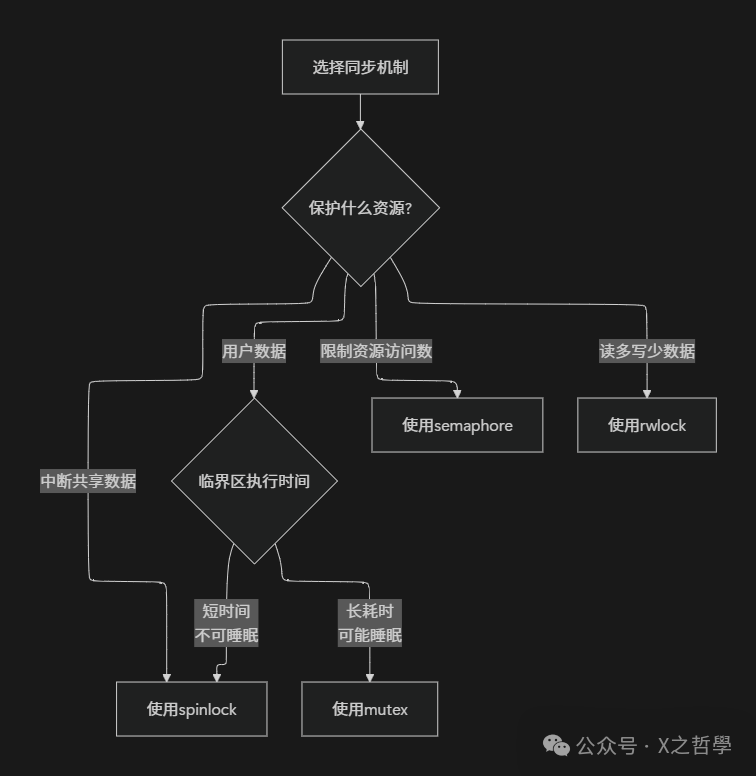
8.1 Comparison of Different Lock Mechanisms
| Feature | Mutex | Spinlock | Semaphore | Rwlock |
|---|---|---|---|---|
| Sleep Behavior | Can sleep | Spin wait | Can sleep | Can sleep |
| Hold Time | Long | Very short | Variable | Variable |
| Reader/Writer | Mutual exclusion | Mutual exclusion | Counting | Distinguishing |
| Performance Overhead | Medium | Low (no contention) | Higher | Medium |
| Applicable Scenarios | User data protection | Interrupt handling | Resource pool | Read mostly, write less |
8.2 Selection Guide
9. Best Practices for Performance Optimization
9.1 Reducing Lock Contention
/* Bad practice: coarse-grained lock */
static DEFINE_MUTEX(global_lock);
void process_data(void) {
    mutex_lock(&global_lock);
    /* Long processing... */
    mutex_unlock(&global_lock);
}

/* Good practice: fine-grained locks or data locality */
struct per_cpu_data {
    struct mutex lock;
    int data;
};

static DEFINE_PER_CPU(struct per_cpu_data, cpu_data);

void process_data(void) {
    int cpu = get_cpu();
    struct per_cpu_data *p = &per_cpu(cpu_data, cpu);

    mutex_lock(&p->lock);
    /* Process local data... */
    mutex_unlock(&p->lock);

    put_cpu();
}
9.2 Lock Ordering to Avoid Deadlocks
/* Correct lock ordering */
void process_ab(struct data_a *a, struct data_b *b) {
    /* Always acquire a's lock first, then b's lock */
    mutex_lock(&a->lock);
    mutex_lock(&b->lock);

    /* Process data... */

    mutex_unlock(&b->lock);
    mutex_unlock(&a->lock);
}

void process_ba(struct data_b *b, struct data_a *a) {
    /* Also follow a->b order */
    mutex_lock(&a->lock);
    mutex_lock(&b->lock);

    /* Process data... */

    mutex_unlock(&b->lock);
    mutex_unlock(&a->lock);
}
10. Conclusion
The Linux mutex is a highly optimized synchronization primitive that strikes a good balance between performance and fairness through carefully designed data structures and algorithms. Let us review the key points:
10.1 Summary of Core Mechanisms
| Mechanism | Function | Advantage |
|---|---|---|
| Fast Path | Quick acquisition in the absence of contention | Extremely low overhead, single atomic operation |
| Optimistic Spinning | Spin waiting in multi-core environments | Reduces context switch overhead |
| Wait Queue | Manages waiting threads | Ensures fairness, avoids starvation |
| Handoff Mechanism | Directly transfers lock ownership | Reduces wake-up overhead, improves fairness |