
In the face of complex diseases, traditional research methods often struggle to capture the critical instantaneous pathological processes. This issue features two groundbreaking studies that successfully freeze the key moments of disease occurrence, leveraging the ultra-fast, ultra-high-resolution imaging capabilities and multi-dimensional analysis advantages of Multi-SIM X.
GP Targets FarR Protein to Eliminate MRSA Persisters
New Mechanism of Radiation-Induced Brain Injury and Nanotherapy Emerges
Below, we present a detailed interpretation of these two studies.
GP Targets FarR Protein to Eliminate MRSA Persisters
Supporting New Research Discoveries
In the global public health arena, Methicillin-resistant Staphylococcus aureus (MRSA) has long been a stubborn adversary. It can evade conventional antibiotics by entering a metabolically dormant “persister” state, leading to recurrent infections that are difficult to eradicate, posing significant challenges for clinical treatment. Statistics show that over 100,000 people die each year from MRSA infections globally, with nearly 30% of hospital-acquired pneumonia cases caused by MRSA. More troubling is that traditional antibiotics like vancomycin and meropenem have limited effectiveness against MRSA persisters, while some alternative therapies are difficult to apply widely due to toxicity issues. Developing safe and effective anti-persister drugs has become an urgent priority.
Plant-derived isoprenylated flavonoids have garnered attention in recent years due to their good membrane permeability and bioactivity, but their mechanisms against persisters remain unclear.
In August 2025, a collaborative study by the South China Botanical Garden of the Chinese Academy of Sciences, the First Affiliated Hospital of Guangzhou Medical University, and Guangzhou Laboratory was published in The Innovation Life titled “Prenylated flavonoids combat metabolically dormant methicillin-resistant Staphylococcus aureus by targeting FarR”.
The study utilized Multi-SIM X technology to fully leverage its advantages in imaging and multi-dimensional analysis of fungal samples, providing robust support for bacterial cell biology.
Contribution of Multi-SIM X in this article

Multi-SIM X ultra-resolution microscope imaging of Staphylococcus aureus expressing only GFP and simultaneously expressing GFP and FarR protein (FarR is the primary target of GP, playing a key role in GP-mediated bacterial killing, and its core regulatory role in MRSA persister formation needs to be validated).
👉 Experimental results show
In the control group (expressing only GFP), 39% of bacteria exhibited significant protein aggregates (bright spots), while the proportion of bacteria with protein aggregates in the FarR overexpression group significantly increased to 57%.
This indicates that FarR overexpression significantly promotes the formation of protein aggregates in Staphylococcus aureus, further supporting that FarR can enhance bacterial stress tolerance by regulating protein homeostasis, playing a critical role in persister formation.
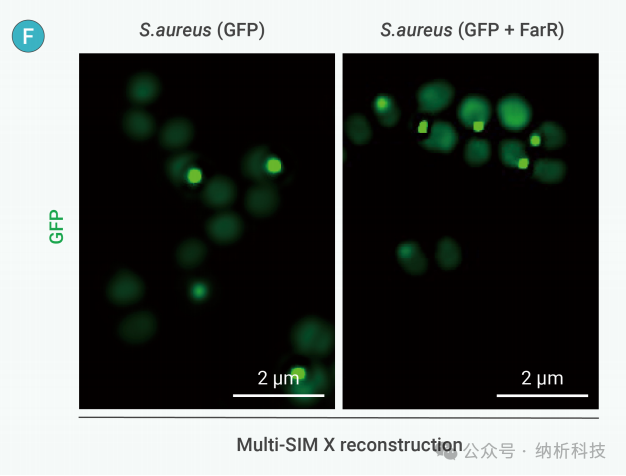
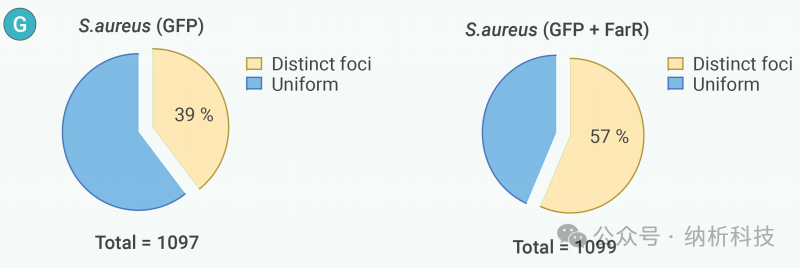
Figure caption: F. Staphylococcus aureus carrying different growth stage GFP expression plasmids was co-cultured with or without FarR protein. G. Representative data and semi-quantitative analysis of the percentage of bacterial cells (including aggregates, bright spots). Data are presented as mean ± standard deviation (n≥3). Multiple comparisons were performed using ordinary one-way ANOVA.
Summary of research findings
The research team screened 3′-C-geranylphloretin (GP) from 44 isoprenylated flavonoids and found that its bactericidal effect on MRSA persisters was superior to that of vancomycin, significantly reducing MRSA load in the lungs of mice, improving lung tissue pathological damage, and showing no significant toxicity to normal mice. Mechanistically, GP targets the transcriptional regulator FarR, activating the TCA cycle and fatty acid metabolism in MRSA, disrupting bacterial membrane integrity, inducing reactive oxygen species (ROS) accumulation and apoptotic-like cell death, while also clearing antibiotic-induced persisters and disrupting biofilms, providing a novel strategy for combating MRSA infections. In summary, this study not only discovered a class of lead compounds with clinical application potential against persisters but also proposed FarR as a key target regulating the formation of Staphylococcus aureus persister states for the first time.
Super-resolution imaging technology will play an increasingly important role in drug mechanism research in the field of anti-infection, driving the birth of more innovative therapies targeting persistent bacteria.
Original link:
https://www.the-innovation.org/article/doi/10.59717/j.xinn-life.2025.100154
From Microscopic Pathogens to Macroscopic Neural Injury, Super-Resolution Imaging Technology is Breaking the Limits of Life Observation
New Mechanism of Radiation-Induced Brain Injury and Nanotherapy Emerges
Supporting New Research Discoveries
Cranial radiotherapy is an important method for treating head and neck tumors (such as nasopharyngeal carcinoma and glioma), but it often leads to radiation-induced brain injury (RIBI), resulting in cognitive decline, motor dysfunction, and severely reduced quality of life for patients.
Although it is known that neuroinflammation plays a central role in RIBI, the specific molecular mechanisms remain unclear, and there is a lack of effective treatment strategies that can precisely target neuroinflammation. In recent years, the role of the cGAS-STING pathway in neurodegenerative diseases has received much attention, but its mechanisms in RIBI have yet to be systematically revealed.
In 2025, a significant study titled “Understanding the toxicity induced by radiation-triggered neuroinflammation and the on-demand design of targeted peptide nanodrugs” was published by the team of Fan Saijun from the Institute of Radiation Medicine, Chinese Academy of Medical Sciences, in collaboration with the team of Liu Luntao and the team of Zou Bingwen from West China Hospital of Sichuan University in Signal Transduction and Targeted Therapy (IF > 30).
✦ The research team systematically elucidated the core pathogenic mechanism of RIBI for the first time using zebrafish (larvae/adult) and mouse models:
Radiation → Mitochondrial ROS explosion → mtDNA leakage into the cytoplasm → Activation of cGAS-STING pathway → Driving neuroinflammation.
Based on this, the team designed a dual-functional peptide nanodrug Pep-Cu5.4O@H151, which can simultaneously eliminate ROS and inhibit STING signaling, significantly improving neuroinflammation and cognitive function in mouse models.
Contribution of Multi-SIM X in this article
The application of Multi-SIM X ultra-high-resolution imaging technology provided indispensable visual evidence for hypothesis validation and pathway analysis.
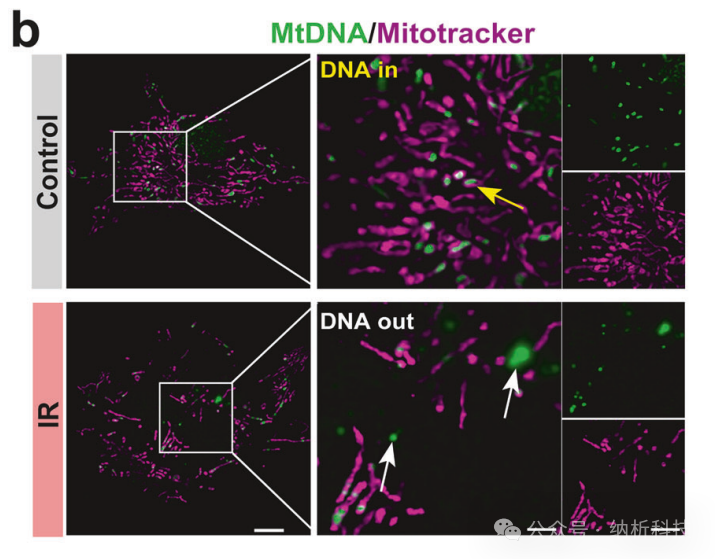
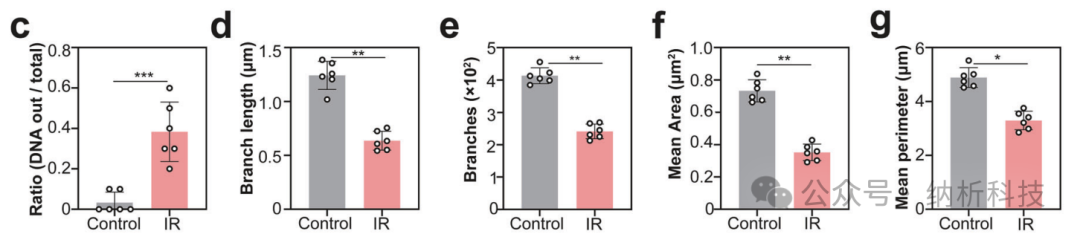
Figure caption: b. Visualization technology for live cell mitochondrial DNA (MitoTracker: PK Mito Deep Red, MtDNA: SYBR; yellow arrow: mitochondrial DNA localized in the cristae; white arrow: mitochondrial DNA in the cytoplasm). c. Quantitative analysis of mitochondrial DNA leakage frequency (n=6). d-g Mitochondrial morphology analysis: branch length (d), branch number (e), average area (f), and average perimeter (g) (n=6).
Through Multi-SIM X imaging, researchers visually observed:
01
After radiation (IR) treatment, the mitochondrial cristae of microglia collapsed and fractured, with mtDNA (marked by yellow arrows) that was originally confined to the mitochondrial matrix or cristae leaking extensively into the cytoplasm (marked by white arrows);
02
The mitochondrial branch length in radiation-treated cells decreased by 43%, network connection points were lost by 32%, and the average mitochondrial area decreased by 36%, with perimeter shortening by 25%. This further confirmed the causal relationship between mitochondrial structural damage and mtDNA leakage.
Thanks to the ultra-fast, ultra-high-resolution imaging capabilities of Multi-SIM X, researchers were able to “capture” the critical moments of the pathogenic pathway of RIBI at the subcellular level, providing direct visual evidence for mechanism validation.
Summary of research findings
This study not only fills the cognitive gap in the pathogenic mechanism of RIBI but also promotes breakthroughs in the application of nanodrugs in neuroprotection.
✦ From a mechanistic perspective:
It first clarifies the core role of the ROS-mitochondria-cGAS-STING pathway in RIBI, presenting the chain of “mitochondrial damage → mtDNA leakage → neuroinflammation” in its entirety, providing precise directions for subsequent target development;
✦ From an application perspective::
The design of the Pep-Cu5.4O@H151 nanodrug is highly ingenious—combining blood-brain barrier penetrating peptides with microglia-targeting peptides to solve the problem of drug delivery to the brain.
Multi-SIM series products break the resolution limitations of traditional microscopes, allowing researchers to clearly observe the dynamics of organelles and the distribution of related proteins.
Original link:
https://www.nature.com/articles/s41392-025-02375-9



Nanalyze Technology|Global leader in super-resolution microscopy technology
Recommended Reading
August Collection (Part 1) | Multi-SIM Supports Research
When STED Meets SIM, Sino-German Scientists Discuss the New Future of Microscopy Technology—Nobel Laureate Stefan Hell Visits Tsinghua
For the First Time! Domestic AI Microscopy Image Processing and Analysis Software DeepInsight Delivered