
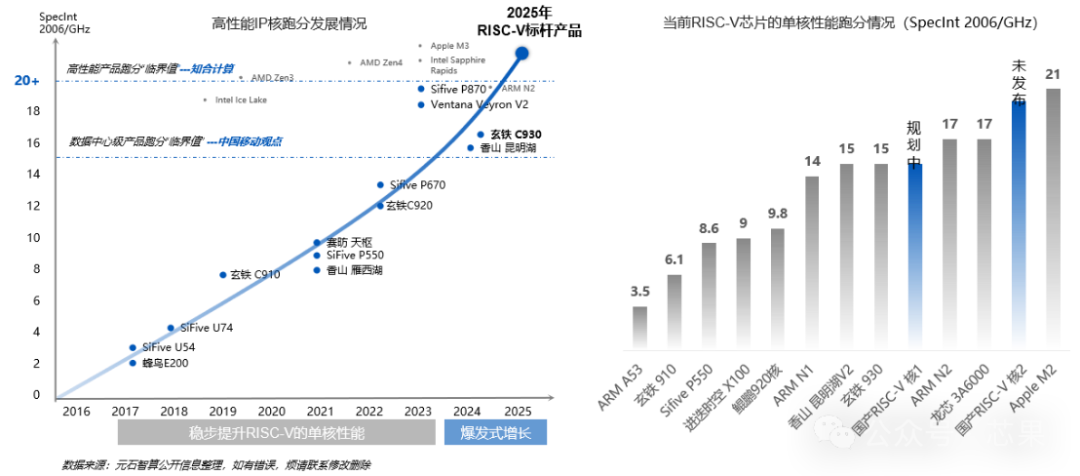
A wave of chip innovation based on open instruction sets is spreading globally, from Silicon Valley to Shenzhen, as tech companies compete for control over the future of the RISC-V architecture. In February 2025, Alibaba’s Damo Academy’s XuanTie team showcased its server-grade processor C930 at the Ecological Conference, achieving a high performance level of 15 points per GHz. Meanwhile, Shenzhen’s Sifang Technology’s “Fang·Tianshu” processor has performance comparable to ARM-A76.
These technological advancements signify that the RISC-V architecture is rapidly expanding from the Internet of Things (IoT) domain to high-performance computing scenarios. The global semiconductor market is thus undergoing a quiet revolution, driven by innovative companies from China and the United States.
01 Technical Breakthrough: XuanTie C930’s Server Ambitions
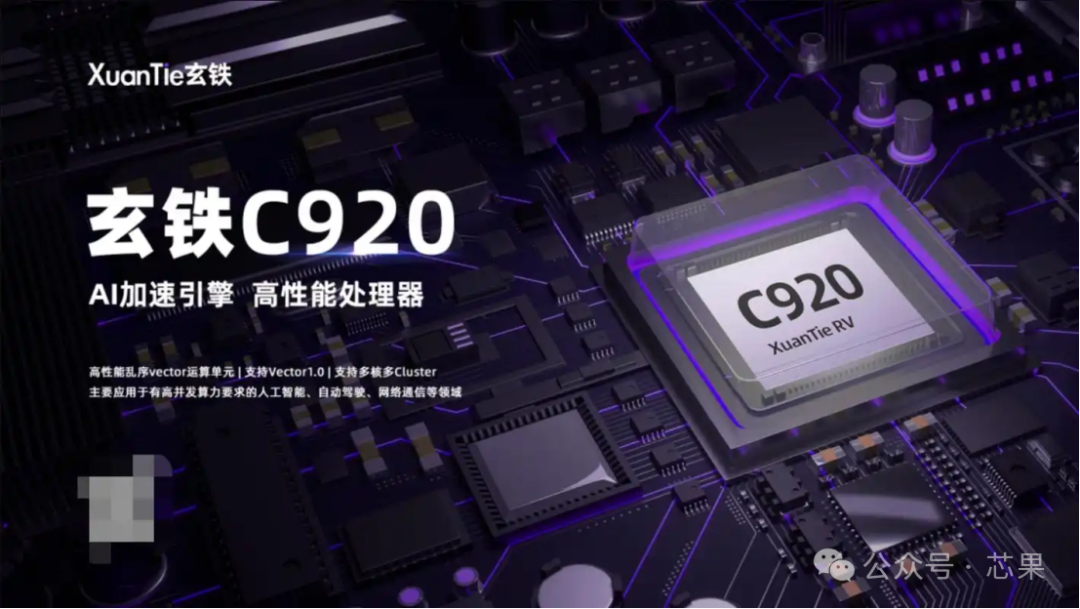
Alibaba’s PingTouGe’s XuanTie C930 processor represents China’s cutting-edge breakthrough in the RISC-V high-performance computing field. This processor, designed with a 6-wide, 16-stage deep out-of-order pipeline, is tailored for server and high-performance computing scenarios.
The XuanTie C930 not only breaks the 3.4GHz frequency barrier but also integrates key extensions such as vector computation, floating-point operations, and AI acceleration. Its core architecture includes 6 integer and branch pipelines, 2 vector and floating-point pipelines, and 3 memory access pipelines. The XuanTie team optimized pipeline efficiency by decoupling branch prediction and employing compressible ROB technology, enabling the RISC-V processor to surpass the 3GHz frequency bottleneck for the first time.
The XuanTie C930 introduces self-developed XuanTie Matrix Extension (AME) and Tensor Processing Engine (TPE), achieving 8 TOPS of int8 computing power and improving GEMM computing power utilization to 96.8%. These technological innovations provide new solutions for high computing demand scenarios such as large model training.
02 International Benchmarking: How SiFive’s P670 Expands AI Boundaries
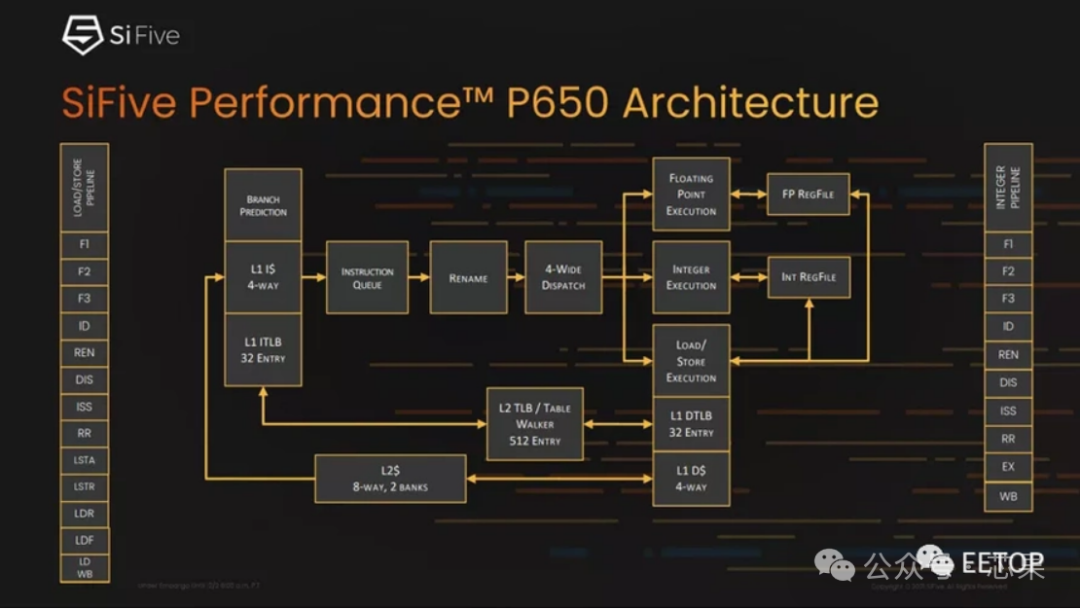
In contrast, the American company SiFive’s P670 processor has chosen a different technological path. The SiFive P670 features a 16-core design, including 12 high-performance P cores and 4 low-power E cores.
The highlight of the SiFive P670 is its AI expansion capabilities. This processor works in conjunction with the Imagination AXT-16-512 GPU and dedicated neural network processors to provide a comprehensive AI acceleration solution.
In the Milk-V Oasis Mini-ITX computer, the SiFive P670 demonstrates its multi-core processing capabilities. This device supports up to 64GB of 128-bit LPDDR5 memory and offers various storage options, including NVMe SSD and SATA interfaces.
SiFive’s product strategy emphasizes ecological co-construction, promoting the implementation of RISC-V in various application scenarios through collaboration with companies across different fields.
03 Chinese Strength: Sifang Technology’s High-Performance SoC Innovation
Sifang Technology, as a significant player in China’s RISC-V field, has adopted a different market strategy from PingTouGe. The company focuses on high-performance SoC design, with its “Fang·Tianshu” processor being the world’s first RISC-V product supporting AI acceleration. Sifang Technology’s core competitive advantage lies in its proprietary intellectual property processor IP cores and SoC chips. These products are widely used in various scenarios, including smart homes, industrial control, and data centers.
In 2023, Sifang Technology shipped 22.5 million RISC-V microprocessors, capturing approximately 15% of the market share. Although PingTouGe’s shipments reached 52.5 million units, accounting for about 35% of the market share, Sifang Technology stands out with its high-performance IP matrix and full-stack delivery capabilities.
Sifang Technology has significantly enhanced its product computing capabilities by introducing vector extension instructions (RVV1.0) and matrix computation acceleration modules. These innovations enable its chips to excel in AI and big data processing capabilities.
04 Architectural Competition: Strategic Choices of Different Technological Paths
PingTouGe, SiFive, and Sifang Technology represent three different technological paths in the development of RISC-V.
PingTouGe has chosen a full-stack development route, comprehensively laying out from processor IP to ecological construction. The XuanTie series processors cover a full range of solutions from low-power MCUs to high-performance servers. SiFive focuses on IP licensing and ecological co-construction. The company does not directly produce chips but allows more enterprises to use its processor designs through technology licensing. Sifang Technology follows a dedicated scenario optimization route, developing high-performance SoC solutions for specific application areas. The RISC-V chips developed by the company have achieved significant energy efficiency improvements in AI inference tasks.
Each of these paths has its advantages and disadvantages, reflecting the resource endowments and market positioning of different enterprises. PingTouGe relies on Alibaba’s ecosystem, possessing strong financial and market advantages; SiFive has gained global customer recognition due to its technological first-mover advantage; Sifang Technology is more flexible and can quickly respond to market changes.
The uniqueness of the RISC-V field lies in the simultaneous existence of fierce competition and deep cooperation among enterprises.
PingTouGe, Sifang Technology, and other RISC-V companies face the common challenge of cultivating the ecosystem. They need to work together to promote the improvement of RISC-V standards, the development of toolchains, and the expansion of the developer community.
However, in terms of market competition, these companies must also showcase their unique capabilities. According to industry research, the global RISC-V chip market size reached $1.7 billion in 2023, with an annual growth rate exceeding 40%, and is expected to reach $92.7 billion by 2030.
In this rapidly growing market, companies must work together to expand the pie while competing for a larger share. This competitive-cooperative relationship has become an important driving force for the development of the RISC-V industry.
05 Challenges and Opportunities: Future Development Path of RISC-V
Despite the broad prospects of the RISC-V market, companies still face multiple challenges.
The issue of ecological fragmentation is a significant obstacle to the development of RISC-V. The incompatibility of different companies’ extended instruction sets leads to difficulties in software porting. Solving this problem requires companies to work together to establish unified standards and specifications.
The shortage of talent is also a crucial factor restricting industry development. As an emerging architecture, RISC-V has relatively scarce specialized talent, and companies need to invest substantial resources in talent cultivation and technological accumulation.
Geopolitical factors are also influencing the development of RISC-V. Against the backdrop of the United States’ technological blockade against China, RISC-V has become an important choice for China’s chip industry to achieve autonomy and control.
Academician Ni Guangnan of the Chinese Academy of Engineering pointed out: “Open-source RISC-V is leading a global transformation of computing architectures, which has far-reaching implications for future technological development.”
As the XuanTie C930 begins delivery to customers, the SiFive P670 showcases performance in Mini-ITX devices, and Sifang Technology continues to expand its AI acceleration chip shipments, 2025 is set to be a key year for the RISC-V ecosystem’s move towards high-performance computing.
The global semiconductor landscape is being reshaped. Open-source and openness are becoming the mainstream direction of technological evolution, and under the dual drive of geopolitical and technological innovation, RISC-V is not just a technical architecture but also a core competitive field for the future computing industry.