On August 29, the China News Service reported that a research team from the Institute of Metal Research, Chinese Academy of Sciences, has recently developed a new post-processing technology for 3D printing (also known as additive manufacturing), producing a titanium alloy material acclaimed for its ‘universal’ fatigue resistance, setting a new world record for the fatigue resistance of metal materials.
This significant research removes a major obstacle for the application of 3D printing technology in high-precision fields and was completed by the research team led by researchers Zhang Zhefeng and Zhang Zhenjun from the Institute of Metal Research, Chinese Academy of Sciences. The related research paper was recently published in the international academic journal Science Advances.
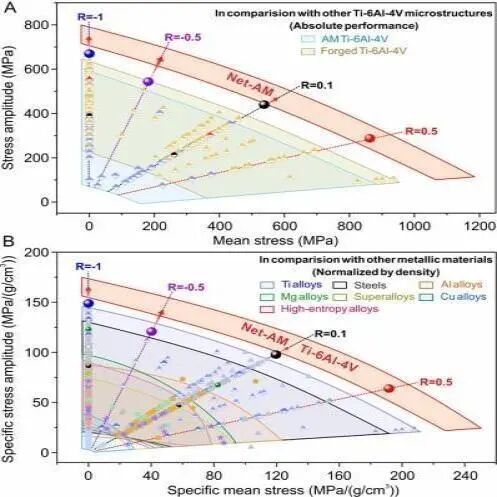
This is a schematic diagram related to the research results. Image provided by the Institute of Metal Research, Chinese Academy of Sciences.
The research team explained that ‘universal’ fatigue resistance refers to the unprecedented ability to resist fatigue under various stress ratio conditions, meaning the ability to withstand repeated stress without damage.
They introduced that 3D printing can easily manufacture complex, lightweight metal parts, which is highly attractive for the new generation of aircraft, spacecraft, and other high-end equipment that pursue weight reduction and integration. However, for a long time, 3D printed metal parts have had a significant drawback—poor fatigue performance, which means they are prone to cracking or even breaking after repeated stress, severely limiting their critical applications.
In early 2024, the research team invented a new process called Net-AM preparation (NAMP), which can precisely control the internal structure and defects of the material. The Ti-6Al-4V (one of the most commonly used titanium alloys) produced by this new process can simultaneously eliminate micropores and coarse structures—both of which are culprits of fatigue. This new material has broken the world record for ‘fatigue strength’ (strength divided by density, a key indicator of lightweight material performance) under cyclic ‘tension-tension’ stress conditions, proving that 3D printed materials can also possess top-level fatigue resistance.
However, in reality, metal parts such as aircraft engine blades and landing gear experience very complex stress conditions, involving not only ‘tension-tension’ but also ‘tension-compression’ scenarios, meaning the stress ratios vary, and different stress ratios can trigger different damage mechanisms within the material. Additionally, traditional titanium alloy microstructural characteristics often exhibit ‘specialization’: they perform well only under certain specific stress ratios, while performing poorly under others. This makes it very challenging to manufacture a material that can perform well under all conditions.
In this study, facing this more complex challenge, the research team analyzed and revealed several weak links in titanium alloys that are prone to fatigue cracking, as well as the stress modes under which they ‘activate’. Based on this, the research team utilized the NAMP process to manufacture a nearly pore-free 3D printed structure, optimizing all these weak links simultaneously. This 3D printed titanium alloy possesses the characteristic of maintaining high fatigue strength under all stress ratio conditions.
Experimental data indicate that in fatigue tests under different stress ratios, the ‘universal’ fatigue-resistant titanium alloy material outperforms all metal materials in terms of ‘fatigue strength’. (Source: China News Service, copyright belongs to the original author; if there is any infringement, please contact for deletion promptly.)