Introduction to Internet of Things Engineering

The Internet of Things (IoT) engineering is an emerging interdisciplinary field that integrates multiple disciplines, involving communication, sensing, networking, RFID, embedded systems, and more. It focuses on core areas such as system design and perception technology, with applications spanning nearly all industries, characterized by a long industrial chain and involvement of multiple industrial clusters.

Graduate
Studies
Majors
1
Computer Science and Technology
IoT System Architecture Design: Explore the architecture, protocol stack, and network layer design of IoT;
Intelligent Data Processing in IoT: Utilize big data, cloud computing, edge computing, and the collection, storage, processing, and intelligent analysis of massive sensor data;
Security and Privacy Shield: Study the relevant theories and protection strategies for device security, communication security, and data security in IoT environments.
Employment opportunities are broad, mainly including computer technology-related work in industries such as the internet, e-commerce platforms, finance, telecommunications, manufacturing, healthcare, and education.
2
Electronic Science and Technology
Intelligent Sensing Technology: Research sensor technology and wireless sensor networks;
Frontiers of Communication Technology: Explore key communication technologies such as Low Power Wide Area Network (LPWAN), RFID, Bluetooth, and 5G/6G, which are critical for IoT.
Employment directions mainly include fields such as electronic information, communication computing, automation, aerospace, and national defense.
3
Control Science and Engineering
Automation and Intelligent Control: Research remote monitoring and automation control systems under IoT;
Hardware and Embedded Systems: Develop intelligent devices and systems that meet IoT requirements.
Employment directions mainly include aerospace, robotics, drones, intelligent manufacturing, new energy vehicles, internet companies, and telecommunications companies.
4
Software Engineering
Software Engineering and Testing: Focus on IoT application development and software performance evaluation;
Platform and Service Innovation: Build IoT cloud platforms and application frameworks, and develop applications in smart cities, smart agriculture, and industrial IoT.
Graduates mainly work in software development, software architecture, software testing, embedded system development, game development, and other related fields.
5
Cybersecurity
Self-Security Strategies and Technologies: Research network security issues in IoT.
Graduates mainly work in network testing, security operations, sample analysis, intelligence expertise, and security attack and defense research across various fields.
6
Network Information and Communication Engineering
Explore the application and development of communication technology in IoT.
Graduates mainly work in communication equipment manufacturers, operators, ICT service companies, and engage in related research, communication technology, product development, network, and project delivery operations.
Review Planning
1
Foundation Stage (3-6 months): Follow the political framework with Xu Tao’s course, memorize English vocabulary and learn grammar, practice basic math problems with Tang Jiafeng, and read through the textbooks for professional courses to understand the framework;
2
Strengthening Stage (7-9 months): Review political chapters using “Xiao’s 1000 Questions”, focusing on the Marxist theory and historical outline sections, learn reading techniques for English comprehension, tackle math modules with Zhang Yu, and practice professional course questions according to the syllabus;
3
Final Sprint Stage (10-12 months): Memorize Xiao’s Four and Eight, supplement current political events, conduct full mock exams for English using essay templates, practice timed math simulation questions, review professional course mock exams and high-frequency exam points.
Recommendations
The overall competitiveness of the graduate entrance examination is above average. The advantage is that there are many enrolling institutions, and some institutions have a high repetition rate of past exam questions; the challenge is that competition among prestigious schools is fierce, with retake lines often exceeding national lines, and professional courses cover a wide range, requiring foundational knowledge for cross-major candidates.
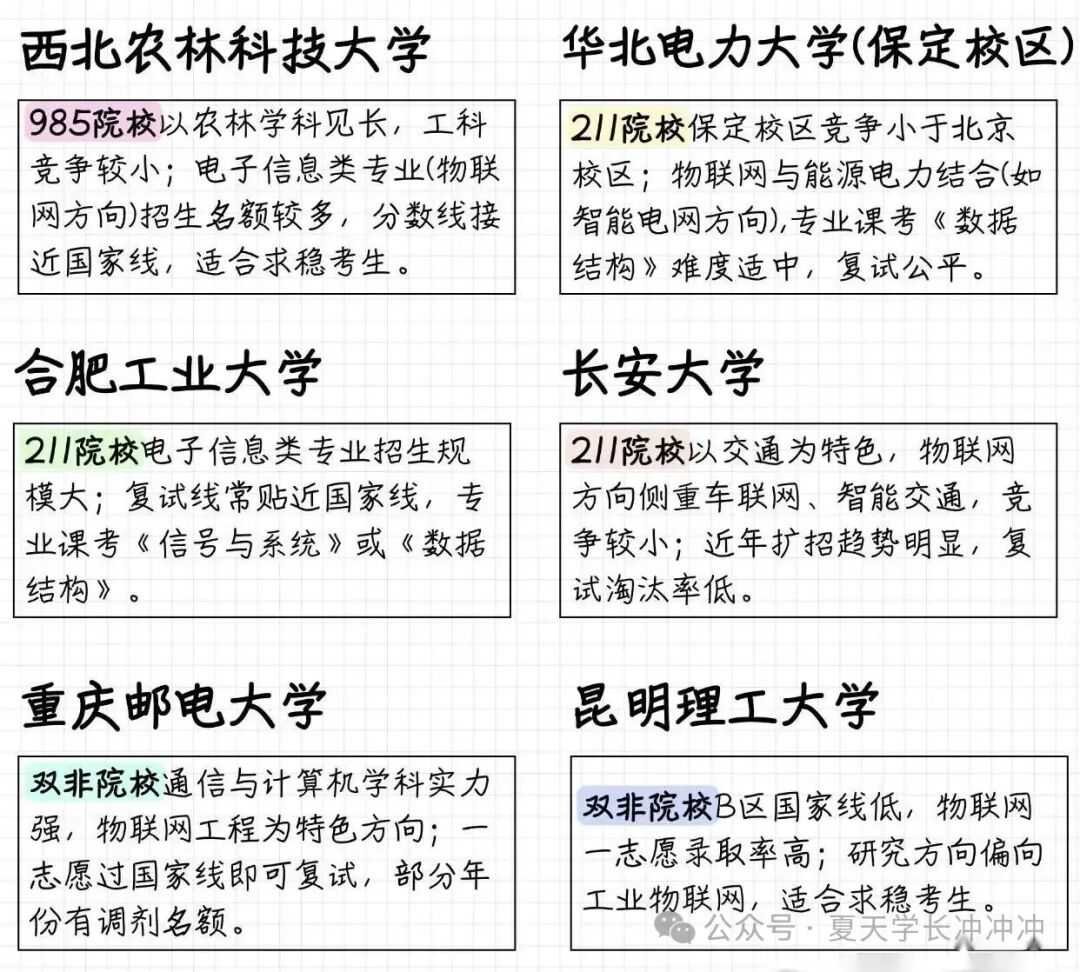
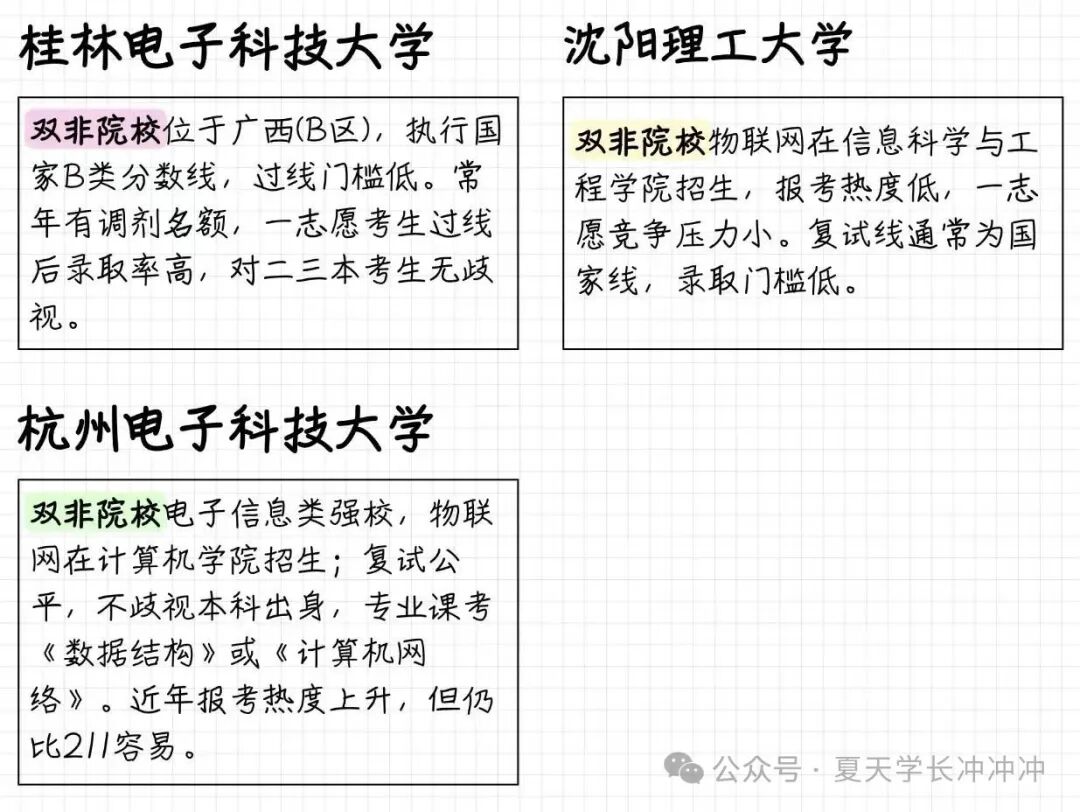
Guilin University of Electronic Technology is a university with a focus on electronic information, and IoT is a provincial key discipline with a low retake line and a past exam question repetition rate exceeding 50%, suitable for candidates from non-prestigious universities with moderate math foundations.Nanjing University of Posts and Telecommunications has strong communication programs, allows for the selection of Math II in the initial exam, emphasizes project experience in the retake, has a low admission score average, and is suitable for candidates with rich practical experience or those switching majors.Hefei University of Technology is a 211 university closely integrating IoT with intelligent manufacturing, has a low retake line, and offers ample adjustment quotas for exam outlines, suitable for those pursuing higher institutional levels but with average score competitiveness.
Employment Directions
1
Vehicle Networking and Autonomous Driving
Popular Tracks: V2X communication, high-precision mapping, vehicle-road collaborative systems, leading companies: Baidu Apollo, Huawei Car BU, Tesla Autopilot
Education Requirements: Master’s degree preferred, must master ROS systems and embedded development
Salary Levels: Algorithm engineers earn an annual salary of 250,000-400,000, technical directors earn in the millions
2
Industrial Internet
Core Positions: Industrial IoT engineers, edge computing developers, predictive maintenance experts
Industry Trends: 5G+AI driven smart manufacturing
Salary Levels: Starting salary 18,000-25,000, senior engineers earn 300,000-500,000 annually
Technical Requirements: PLC programming, OPCUA protocol, industrial protocol analysis, etc.
3
Smart Healthcare
Explosive Fields: Wearable medical devices, home care, remote diagnosis systems, medical big data
Policy Benefits: Elderly-friendly renovations, national health commission’s “Internet + Healthcare” special support
Technical Requirements: Knowledge of FDA/CE certification, medical data privacy protection, etc.
4
Energy IoT
Carbon Neutrality Opportunities: Smart grids, photovoltaic/wind power IoT, energy storage systems
Salary Levels: For example, the State Grid Research Institute offers an annual salary of 200,000-350,000
Technical Requirements: Familiarity with IEC61850 protocol, energy blockchain technology, etc.
5
Demand for interconnectivity across thousands of industries…