 Traditional pressure sensors are mostly made of metal or semiconductor materials, which have disadvantages such as poor toughness, heavy weight, and low sensitivity, making it difficult to meet the demands for portability, lightness, comfort, and accurate measurement with conformal contact. Flexible pressure sensors, due to their mechanical flexibility, can conform to complex surfaces, thus expanding their application scenarios to human-computer interaction interfaces, electronic skin, smart medical care, and other fields, attracting significant attention.

In recent years, with the development of materials science, flexible electronics technology, and nanotechnology, the demand for flexible sensors has been continuously expanding. Research on integrated multifunctional flexible electronic devices with complex sensing capabilities that can simultaneously sense and distinguish external pressure signals, chemical signals, and biological signals is of great significance.
Among them, flexible pressure sensors based on the human sensory system have attracted widespread attention due to their enormous application potential in artificial intelligence, new medical monitoring, biomedical applications, and human-computer interaction interfaces.
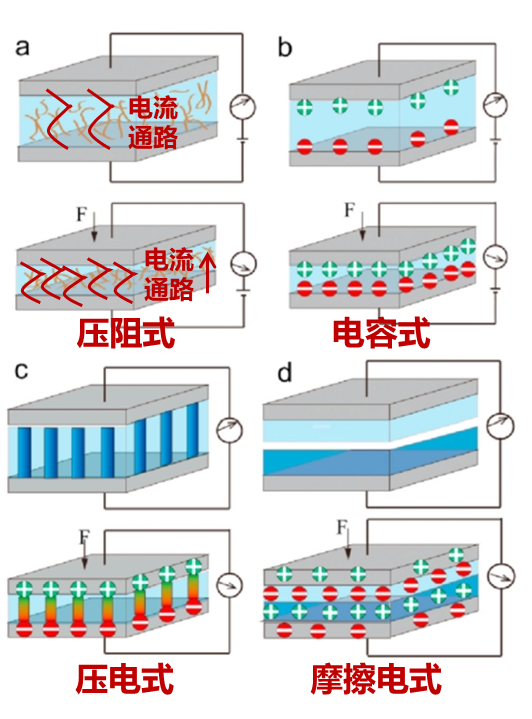
Currently, the signal transmission mechanisms of commonly used flexible pressure sensors can be mainly divided into three types: piezo-resistive, capacitive, and piezoelectric. The mechanism is that after applying pressure, the resistance, capacitance, and voltage of the sensor change, leading to a change in the electrical signal, thus converting the pressure signal into an electrical signal. In addition, new types of flexible pressure sensors such as triboelectric nanogenerators and organic field-effect transistors also show promising research and application prospects.
From a theoretical perspective, piezoelectric flexible pressure sensors are limited by the piezoelectric principle and cannot effectively detect static forces, while capacitive flexible pressure sensors have extremely high sensitivity to small changes and are commonly used to detect small static forces. Compared to the above two types of flexible pressure sensors, piezo-resistive flexible pressure sensors have a wide detection range, simple structure, and can identify both static and dynamic forces.
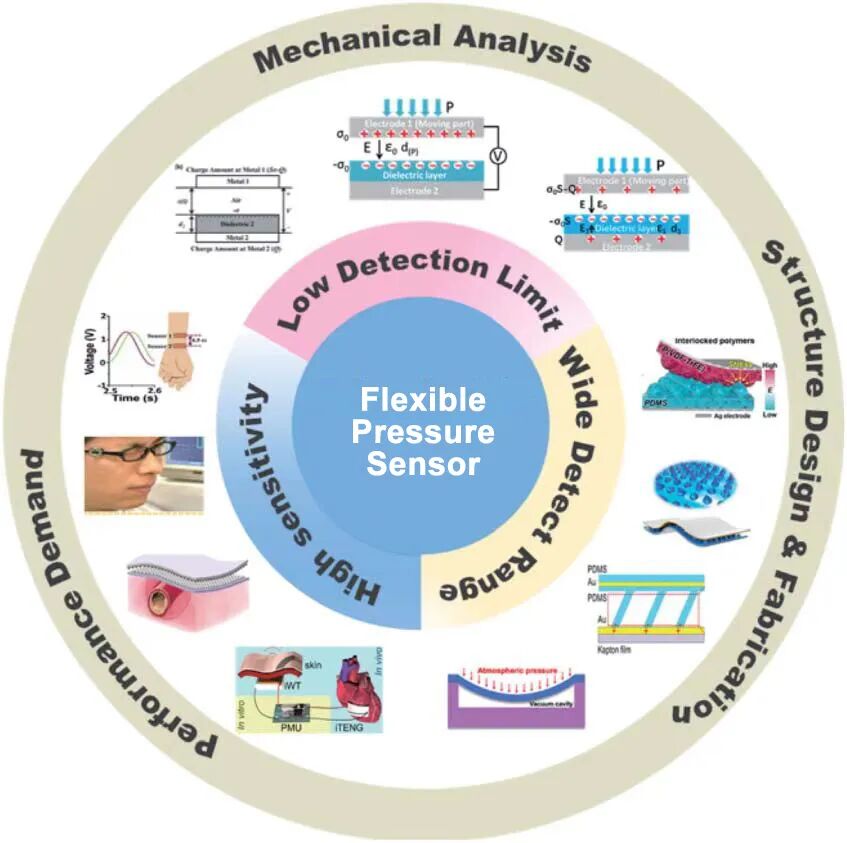
These features meet the emerging demands for pressure sensors, allowing them to be used in the field of artificial intelligence (AI), such as health care, smart homes, digital sports, wireless monitoring in security fields, and AI sensing platforms.
Health Care Applications01
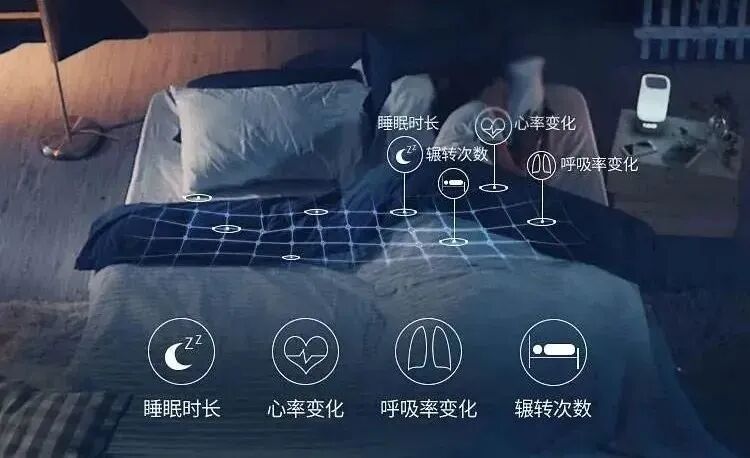
With the aging population and increasing demand for child care, flexible pressure sensors, in the form of electronic skin or integrated into smart mattresses, play an increasingly important role in monitoring patient health conditions and disease prevention by monitoring signals such as blood pressure, pulse, heartbeat, respiration, tremors, and body movements, as well as tactile perception for texture discrimination and Braille.
 Smart Home Electronic Device Applications02
Flexible pressure sensors can be integrated into electronic devices in smart homes, applied in various aspects of life. People can control home electronic devices based on pressing intensity (input and monitoring of keyboard case sensitivity), duration and intervals (compiling Morse code), and smart control (pressure mapping distribution).
 Digital Sports Applications03
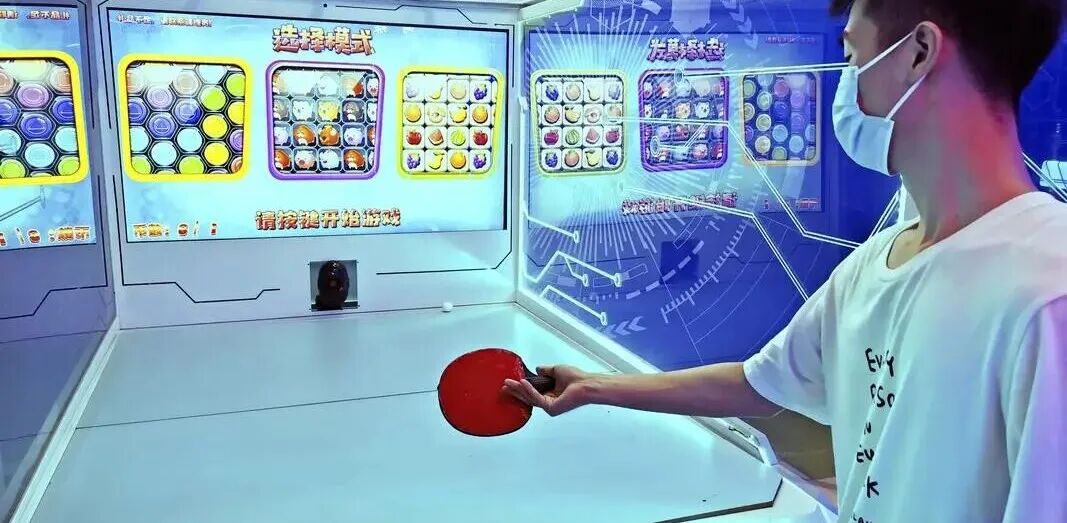
With the rise of modern competitive sports, data collected from sensors can provide athletes with real-time feedback on physiological status and performance. For example, devices can be installed on a ping pong table to count and identify the impact speed, drop position, drop sequence, and probability of drop points, or placed on the top and sides of tables to detect edge balls. Additionally, similar digital sports applications exist in golf, baseball, and other sports. These studies indicate that they can serve as a substitute strategy for high-cost, bulky high-speed cameras.
 Wireless Safety Monitoring Applications04
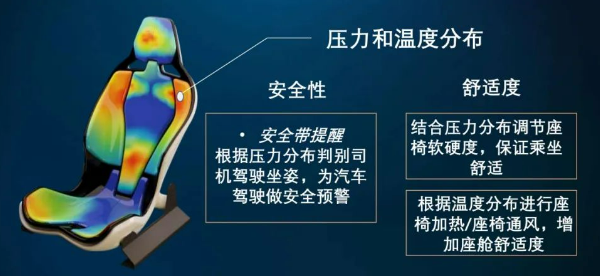
Advancements in microelectronics, computing technology, and wireless communication have propelled the wireless applications of pressure sensors. In wireless safety monitoring, the application of flexible pressure sensors is mainly divided into monitoring infrastructure safety and predicting personal hazards. For example, in smart car cockpits and safety detection of electric bicycles, by integrating alarms into the circuit, the system can not only be used for real-time recording and marking but also for theft prevention and danger alerts.
 Smart Sensing Platform Applications Supporting Machine Learning (ML)05
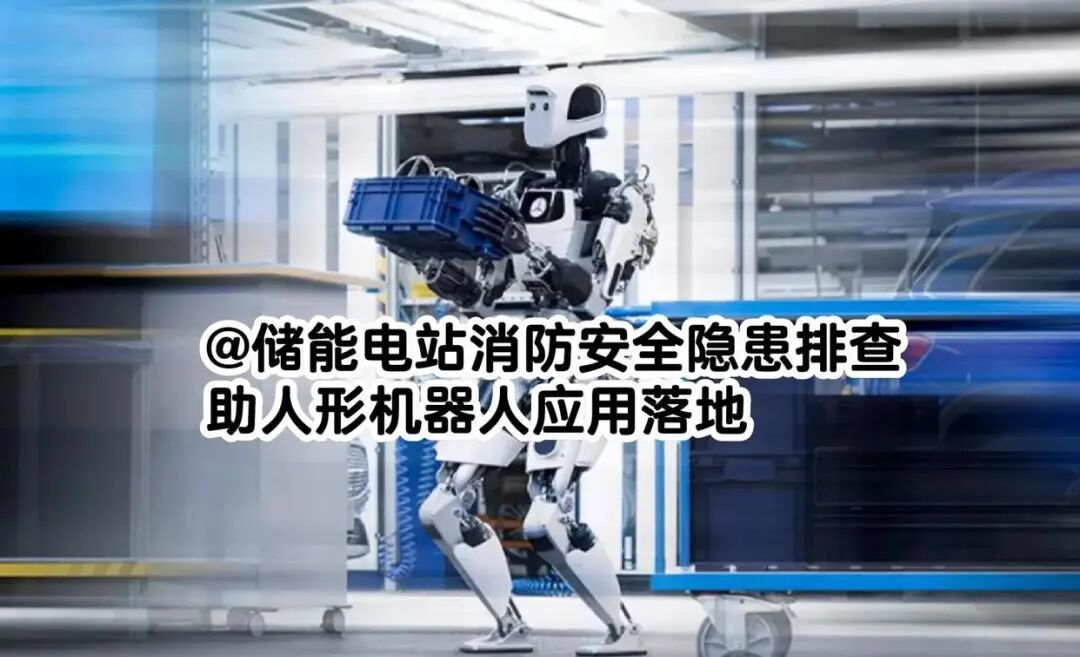
ML is an interdisciplinary field involving statistics, probability, approximation, and algorithm theory. ML includes data collection, data preparation, model selection, training, evaluation, parameter tuning, inference, and prediction. In ML-based computational sensing platforms, well-trained neural network models can form inference computing sensing systems. Based on iterative analysis of data-driven sensing results, various behaviors can be decoded, and related research allows learning from human-computer interaction, extracting motion features, and aiding in the development of robots and prosthetics (manipulating objects and tools, and precisely controlling applied forces), which currently has significant application space in embodied intelligent robots.
In the future, the demand for various intelligent new applications will further increase. As flexible pressure sensors trend towards integration, multifunctionality, and low-power passive designs, they will have broad development potential in ubiquitous IoT, home healthcare, embodied robotics, human-computer interaction, and artificial intelligence. Huiwen Technology, as an innovative intelligent sensing comprehensive service provider, continuously optimizes and explores new materials and sensing mechanisms to prepare more excellent flexible pressure sensors, achieving smarter control in different external environments and further expanding their application boundaries in the market.

Layout | Huiwen Technology
Text and images | Some sources from the internet (infringement deleted)
Company Profile
————
Suzhou Huiwen Nano Technology Co., Ltd. is a national high-tech enterprise specializing in the research, production, and sales of intelligent sensors, while also providing artificial olfaction solutions. The company was established in 2014 by a team of former NASA scientists with many years of experience in sensor research and application. It has developed sensor chips and corresponding detection modules for various toxic and harmful gases, and has established production lines for MEMS gas sensors, thermopile temperature sensors, flexible pressure sensors, infrared CO2 sensor modules, and laser PM2.5 sensors in Kunshan, Jiangsu, and Huzhou, Zhejiang. The company’s developed lithium battery safety monitoring modules and integrated gas, smoke, and temperature multi-in-one battery safety monitoring devices are also widely used in energy storage power stations and new energy engineering vehicles.Currently, the company is jointly undertaking five national key research and development projects with institutions such as the Chinese Academy of Sciences and Tsinghua University, and is collaborating with the Gusu Laboratory on the development of artificial olfaction platform projects, with the company mainly responsible for the research and development of new low-power intelligent sensors; the company has also been selected as a participating unit in the “one-stop” application demonstration of intelligent control components and algorithms in home appliances by the Ministry of Industry and Information Technology, with its segment being components, mainly working on improving the performance and reliability of basic components, which also marks that Huiwen Technology’s intelligent gas sensors have become key basic components in the national new strategic industrial chain and supply chain.
Long press to recognize the QR code and follow us
Suzhou Huiwen Nano Technology Co., Ltd.
99 Jinji Lake Avenue, Suzhou Industrial Park, Jiangsu Province
Building 17, Northwest Area of Nano City, Room 302
Phone: 0512-62749655/62749644
Fax: 0512-65924822 Email:[email protected]