 Search on WeChat
 Technical Training
Weight is an important unit in life, and it is even more crucial in industry.How many kilograms of raw materials are added in the production process? How many kilograms of waste are generated, and so on… these data are essential elements supporting the smooth operation of the entire factory.
So how do we measure weight in industry?We need to use a load cell!
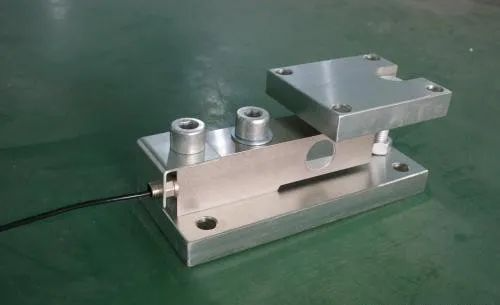
The principle of a load cell is to convert the weight of the object being measured into a measurable output signal in a certain proportion.
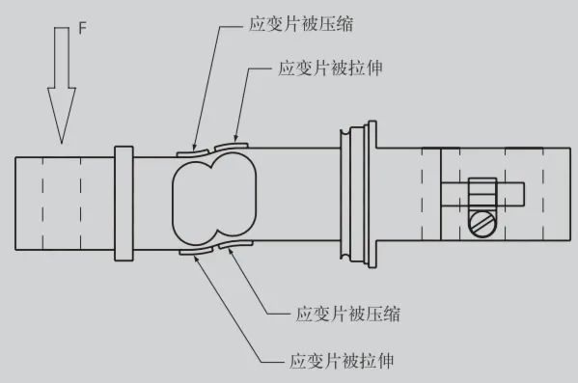
The measurement of Siemens load cells uses a strain gauge principle, where the strain gauge is fixed to an elastic body. The external force causes the elastic body to deform, and the strain gauge on the elastic body also deforms accordingly.
Due to the change in the external shape of the strain gauge, its resistance value also changes. The strain gauges at the top left and bottom right are compressed, reducing the resistance film length and resistance value. The strain gauges at the top right and bottom left are stretched, increasing the resistance film length and resistance value.
For each load cell, at least four strain gauges are connected together to form a Wheatstone bridge. When the sensor is subjected to force causing a change in the resistance of the strain gauges, the bridge becomes unbalanced. With the excitation voltage remaining constant, the magnitude of the output signal is proportional to the force applied to the sensor.
Load cells can generally be connected to a PLC or a secondary display for measurement.
Common industrial sensors are divided into four-wire and six-wire systems;
For four-wire sensors, there are only the four cables shown in black in the diagram below, where EXC+ and EXC- are the excitation provided by the weighing module to the sensor, and SIG+ and SIG- are the output of the load cell; for six-wire sensors, there are two additional red wires, SENSE+ and SENSE-What are their functions?These two wires are used for compensation; when the distance between the sensor and the weighing module is large, these two wires will provide compensation, making the measurement results more accurate.
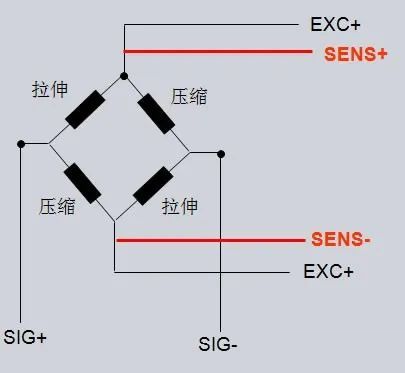
In actual field use, due to complex working conditions, the distance between the load cell and the weighing module may be large. If we assume that the power supply voltage provided by the weighing module to the sensor is 6V, due to line loss, the excitation signal reaching the load cell will be less than 6V. Under the same force, the output signal of the sensor is proportional to the power supply voltage, so the weighing module feeds back the actual power supply voltage at the sensor side to the weighing module through a high-impedance loop, and the weighing module adjusts the output power supply voltage using an internal comparator.
The weighing module can connect both four-wire and six-wire sensors. If connecting a four-wire sensor, it is necessary to short-circuit SENSE+ to EXC+ and SENSE- to EXC+ at the junction box or weighing module side.
For connecting load cells to PLCs in factories, we typically have two methods to achieve this;
1. Using a load cell, a secondary display, and the PLC’s analog input. Why do we need to add a secondary display? Because the sensor generates a millivolt-level voltage signal due to the weight of the object pressing on it, which the PLC cannot read directly, so a secondary display is needed for conversion. Speaking of conversion, we all know that there will be some loss involved; this loss is not significant, but it can greatly affect precise measurements. I once worked on a device with a precision of 10g, and this loss had a significant impact on the results. The advantage of this method is that it is inexpensive and does not place high demands on the PLC system, as 98% of PLCs on the market have analog input capabilities. However, its disadvantage is that it cannot be used in situations requiring high precision.
2. The most precise method, and also the most expensive, is using a load cell with a PLC weighing module for measurement.
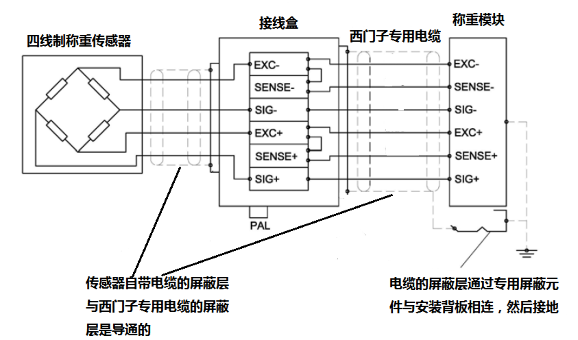
This method is the most accurate because there is no loss when the PLC connects to its own module, and this method also has a very fast reading speed, making it applicable in various complex situations.
However, its disadvantage is that it places high demands on the PLC system; the PLC must use one with a weighing module, and generally, the price of weighing modules is relatively high. Additionally, when using a new weighing system, it must be calibrated, and if the load cell is damaged and replaced, it will also need recalibration. The calibration of Siemens’ various series of weighing modules is not simple and requires certain experience and skills, which we will discuss later; therefore, this technology is not suitable for beginners.
As a unit for precise measurement, its usage methods must also be noted, or it may lead to inaccurate measurements or even damage.
1. Extreme care is needed during installation, or the sensor may be damaged.
The elastic body of the load cell is mainly made of aluminum alloy, so any vibrations or impacts can lead to significant output data errors. For example, if a sensor with a range of 10kg is accidentally subjected to a force of around 15kg, it may be permanently damaged. Therefore, it is essential to handle the load cell gently during installation.
2. Install strictly according to its design requirements.
Depending on the process of the equipment, it can be installed either horizontally or vertically, but the weighing part of the sensor must be in close contact with the object being measured, and the weighing part must not touch any other force points; otherwise, it will lead to inaccurate measurements.
3. Sometimes, three or even more sensors are needed to measure the same object, and the contact surfaces of these sensors with the weighing device must be level;otherwise, uneven force will affect the measurement results. Although slight tilting of the level can be adjusted through the resistors in the junction box, the adjustment capability is limited, and it is not conducive to accurate weighing, so it is best to maintain a level during installation.
Other considerations:
1. Junction box; when using multiple load cells, a junction box is a necessary tool that can unify multiple sets of weighing data together, reducing the workload of the weighing module.
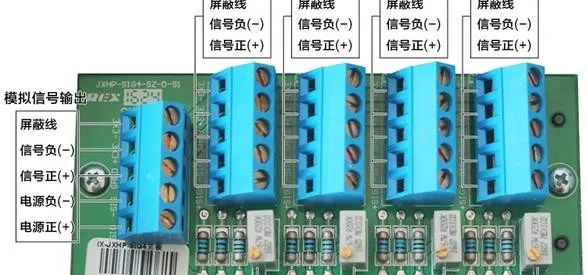
However, it can easily have issues during use.
First, attention must be paid to dust, water, and static electricity prevention, and secondly, it is important to understand the meaning of each terminal, and never connect the wrong wires.
2. Cable connections and shielding
The signals from the sensors are ultimately transmitted through cables, and for such high-precision signals, even a little interference can lead to data instability.
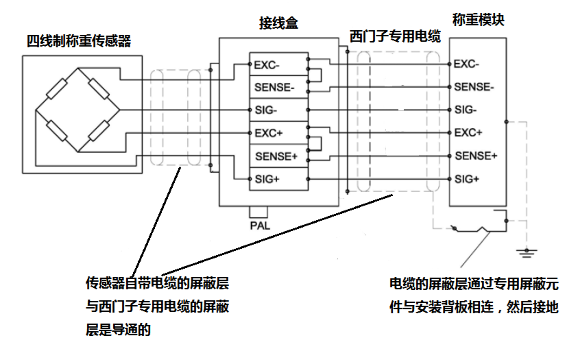
Therefore, connections must be made strictly according to the diagram above.
3. Programming considerations, can filtering be used?
In actual industrial sites, there are many interferences, and many people are accustomed to using programming methods for filtering. This can be applied to weighing, but it should be noted that filtering can produce signal lag. If it is only for observation and measurement, there is no problem, but if calculations or control based on measurement results are involved, it can lead to inaccurate weighing results, which everyone should be aware of.
Alright, today we’ve talked about weighing, and in the future, we will continue to expand on how to connect Siemens PLCs to load cells, as well as calibration and programming. Friends who want to learn PLC and automation knowledge should not miss it.

We Are Serious About Learning Automation!!!

Zero-Basis Introduction to Siemens 200SMART
The book “Zero-Basis Introduction to Siemens 200SMART” is published by Hefei University of Technology,original price 128 yuan, fan exclusive benefit only 15 yuan, free shipping to your home, limited to the first 50 people!
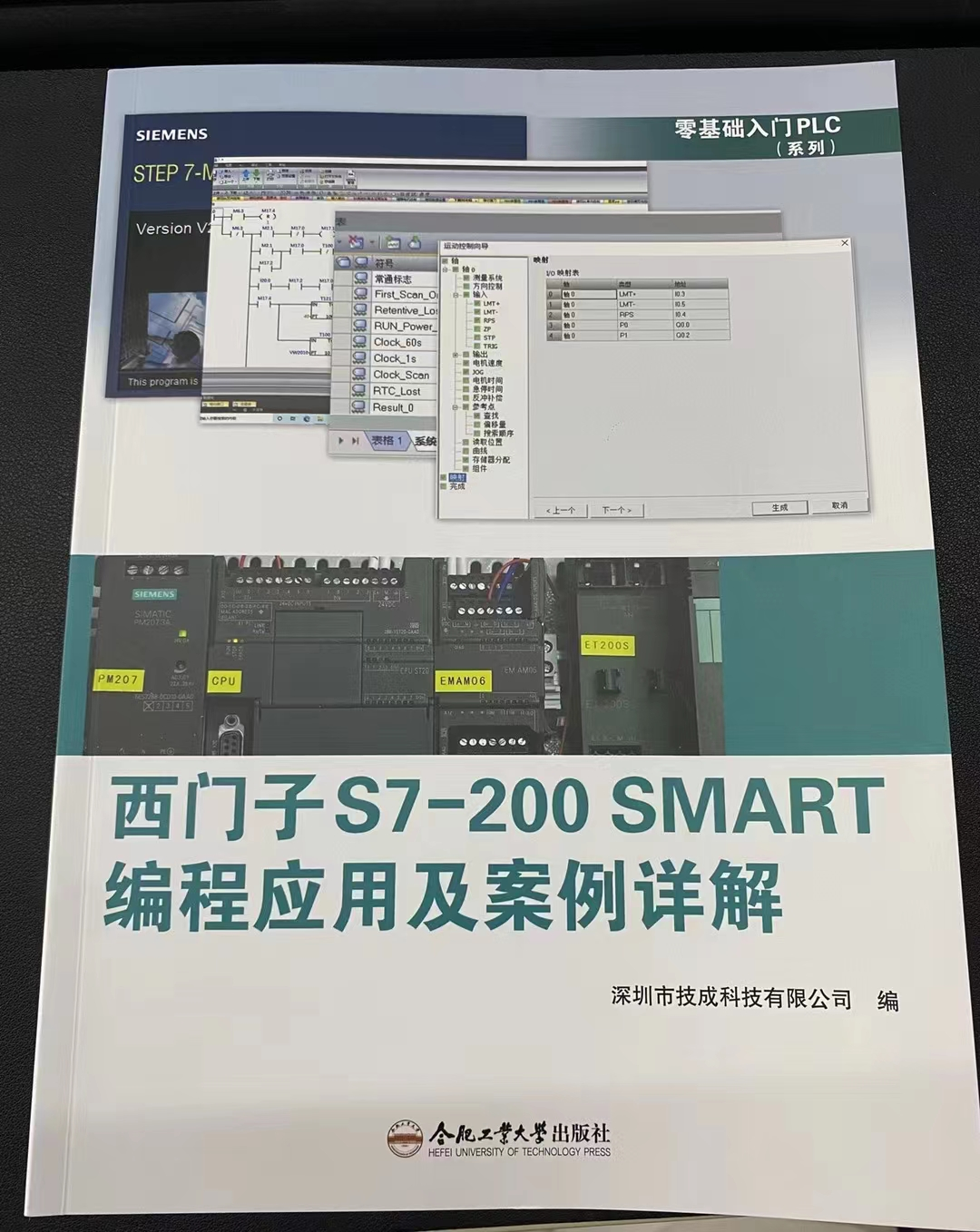
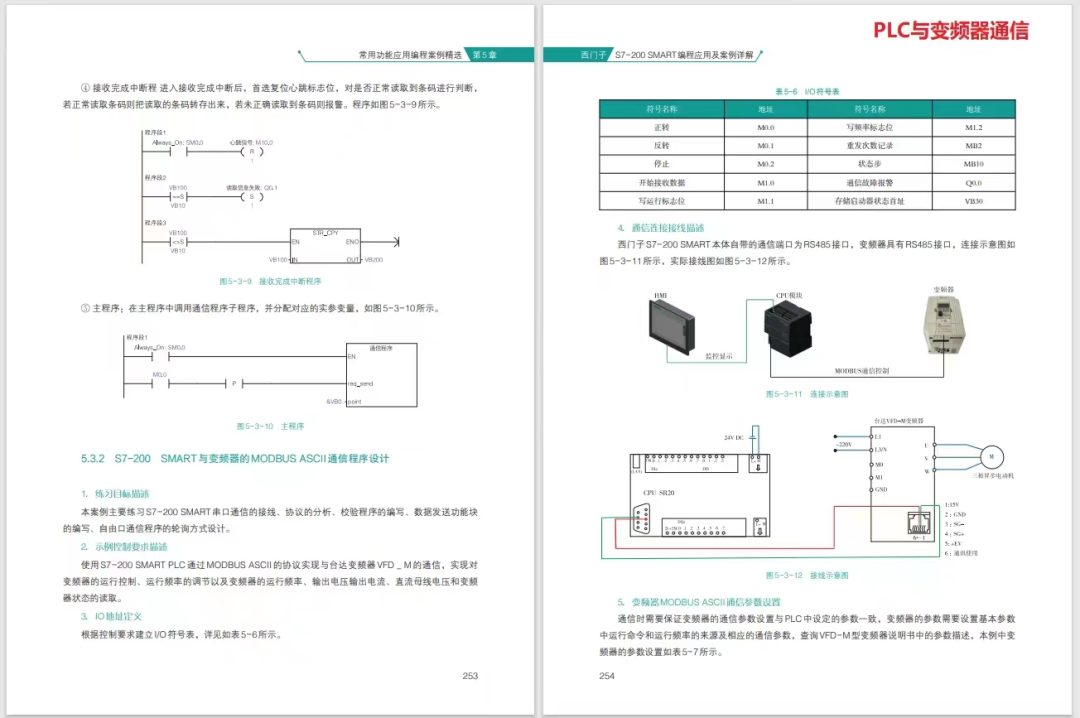
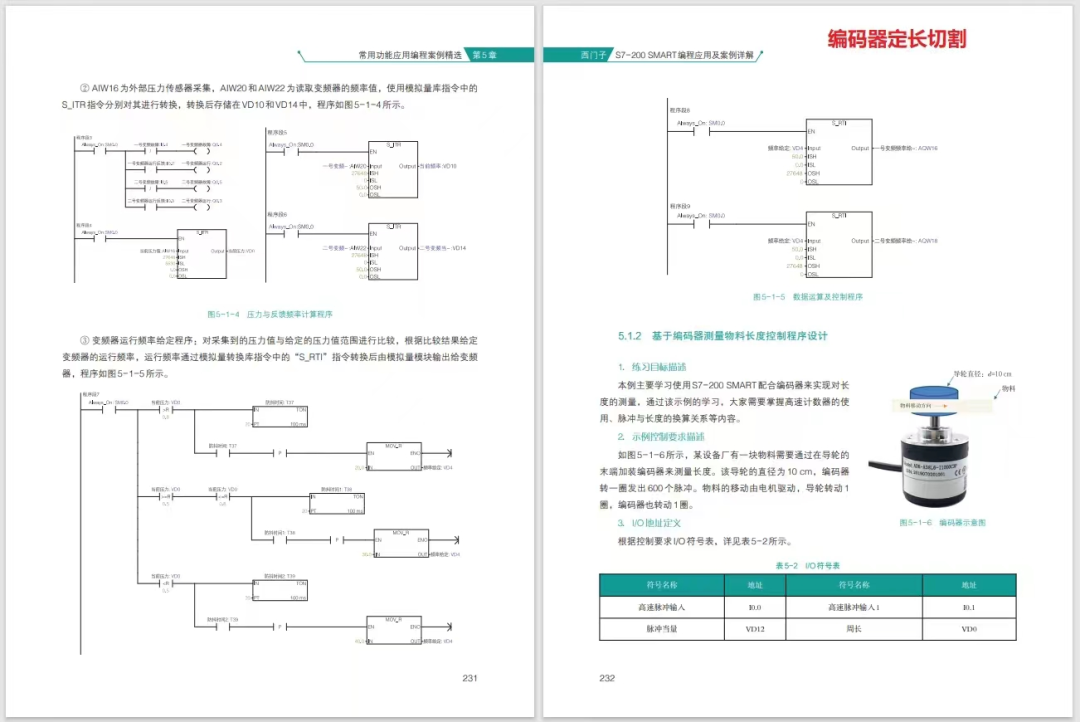
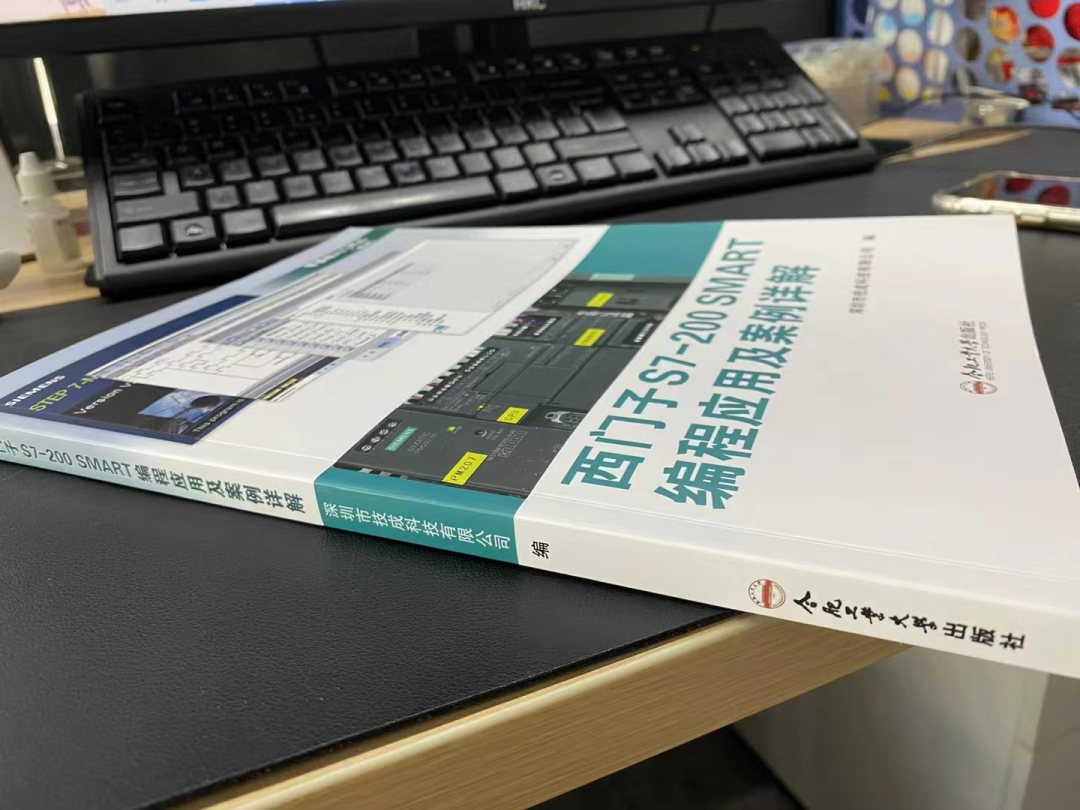
▲Details Display, Click to Enlarge
15 yuan includes: 275 pages of full-color book + 22 video courses + programming software + simulation software + 100GB of learning materials
Limited benefits, what are you waiting for? Hurry and grab it!👇

Disclaimer:This article is reprinted from the internet, and the copyright belongs to the original author. If there are any copyright issues, please contact us in time to delete it, thank you!
HISTORY/Previous Recommendations
2022 Electrical Beginner Exam Question Bank Complete Edition (with Answers)
Three essential tools for electricians, just open with WeChat!
[Collection] The “Path” of a ten-year veteran electrician, the secret to earning over ten thousand a month!
Five major electrical drawing software (CAD, Eplan, CADe_simu…), which one do you pick?
The latest electrical version CAD drawing software, with super detailed installation tutorial!
The latest electrical drawing software EPLAN, with super detailed installation tutorial!
Common issues with beginners using S7-200 SMART programming software (with download links)
Super comprehensive electrical calculation EXCEL sheets, automatically generated! No need to ask for electrical calculations!
Bluetooth headphones, electrician/PLC introductory books available for free? Come and get your electrical gifts!
PLC programming basics: Ladder diagrams and control circuits (with 1164 practical cases of Mitsubishi PLC)
Still can’t understand electrical diagrams? Basic electrical drawing skills, simulation software available, quickly get started with theory and practice!
12 free electrical video courses, 10GB software/e-books, and 30 days of free electrical live courses are available!
Don’t forget to like + check it out!
 Click “Read the Original Text” to learn PLC/electrician courses for free.