
Common Mistakes in Choosing Oscilloscope Probes

In oscilloscope measurements, the choice of probe directly affects the accuracy of the results. The probe acts as a “bridge” between the oscilloscope and the device under test (DUT), and its performance directly determines the accuracy, completeness, and reliability of the oscilloscope measurement results. However, many engineers tend to overlook its importance. Below is a detailed analysis of the first two common mistakes and how to avoid them:
1. The First Mistake:
Not Understanding the Key Technical Specifications of Oscilloscope Probes
If the core technical specifications of the probe are not clear, it will be impossible to match the measurement needs, which may lead to selection deviations.
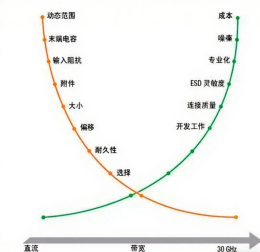
1. Core Impact of Key Specifications: Among various specifications, the relationship between bandwidth and noise is particularly important. Noise is uniformly distributed across frequencies, the higher the probe bandwidth, the more noise is introduced (due to covering a wider frequency range). For example, using a high-bandwidth probe that far exceeds the requirements not only increases costs (high-bandwidth probes are usually more expensive due to higher technical complexity) but also introduces additional noise, interfering with measurement results; at the same time, the operational complexity of high-bandwidth probes may be higher, increasing workload.
2. Key Principles for Selection: Different probes have their own advantages and disadvantages (e.g., passive probes are low-cost but have limited bandwidth, while active probes have high bandwidth but are easily affected by load), and should be selected based on specific testing scenarios. Instead of getting bogged down in lengthy lists of specifications in technical documents, it is better to focus on core specifications (such as bandwidth, loading effect, noise level) and their match with personal needs — understanding the actual impact of specifications on measurements can greatly simplify the selection process.
2. The Second Mistake:
Choosing an Inappropriate Probe Bandwidth
Bandwidth is the core specification of a probe, and an inappropriate bandwidth can lead to loss of signal details or introduce unnecessary noise.
1. Definition of Bandwidth: 3dB Point The essence of probe bandwidth is the “3dB point”, which is the frequency at which the probe output decreases by 3dB relative to the nominal response. For example, when measuring a 1Vpp low-frequency sine wave with a 1:1 probe, the oscilloscope displays a signal consistent with the actual signal; as the frequency increases, the probe output will gradually attenuate until it displays 0.7Vpp (about 70.7% of the original signal), and this frequency is the 3dB point of the probe (since 0.7Vpp relative to 1Vpp has attenuated by 3dB).
2. Calculation of Signal Bandwidth Before selecting the probe bandwidth, the bandwidth of the signal to be measured must first be determined, with the following calculation formulas:
If the signal rise time is measured using the “10%~90% threshold”:Signal Bandwidth (BW) = Rise Time ÷ 0.35
If the signal rise time is measured using the “20%~80% threshold”:Signal Bandwidth (BW) = Rise Time ÷ 0.22
3. Experience in Selecting Probe Bandwidth After calculating the signal bandwidth, the probe bandwidth can be selected based on the following experience:
For analog applications: the probe bandwidth should be 3 times higher than the frequency of the fastest sine wave in the signal;
For digital applications: the probe bandwidth should be 5 times higher than the highest digital clock rate.
4. Relationship Between Bandwidth and Signal Details The higher the bandwidth, the more signal harmonics captured, and the richer the waveform details:
Low-bandwidth probes may miss higher-order harmonics, leading to slower rise times and rounded corners in waveforms (e.g., only capturing the first-order harmonic);
High-bandwidth probes can capture more harmonics such as first, third, fifth, etc., making the rise times steeper and corners sharper, restoring the details at the top and bottom of the signal.
However, it should be noted: excessively high bandwidth can introduce additional noise, and it is not always better to have a higher bandwidth; it must match the signal bandwidth.
In summary, the core to avoiding the first two mistakes is: to clarify the key specifications of the probe (especially the relationship between bandwidth and noise), and to select a matching probe bandwidth by calculating the signal bandwidth, balancing signal details and noise interference.
END

SuZhou Carson Electronics Co., Ltd.
0512-68026115