Word count 1621, approximately 9 minutes reading time
Did you know that the gases we exhale contain secrets about our health? Among them, nitric oxide (NO) serves as a key biomarker that can directly reflect the inflammatory status of the respiratory tract. Recently, a study published in Analytical Chemistry achieved precise detection of extremely low concentrations of NO in breath through a multiperiodic spectral reconstruction neural network, opening new avenues for non-invasive diagnosis of respiratory inflammatory diseases.
Nitric Oxide in Breath: The “Barometer” of Respiratory Health
Exhaled gases act like a mirror, accurately reflecting the physiological and pathological states of the human body. Among various components, exhaled nitric oxide (FeNO) has become the most widely used biomarker in the field of non-invasive diagnosis.
It is primarily produced by epithelial cells in the respiratory tract under inflammatory stimuli, and its concentration levels can sensitively reflect the state of airway inflammation. In healthy individuals, the concentration of exhaled NO is usually below 25 ppb, while patients with respiratory inflammatory conditions such as asthma exhibit significantly elevated FeNO levels.
Limitations of Existing Detection Technologies
Currently, commonly used gas detection technologies include chemiluminescence, electrochemical methods, and photoacoustic spectroscopy, each with its limitations:
Chemiluminescence has high sensitivity but is easily interfered with
Electrochemical sensors are portable but require frequent calibration
Photoacoustic spectroscopy has high sensitivity but is sensitive to temperature and humidity
More importantly, the complexity of exhaled gas components, which include nitrogen, carbon dioxide, water vapor, ammonia, and others, makes precise detection of ppb-level NO exceptionally challenging.
Technical Innovation: Multiperiodic Spectral Reconstruction Neural Network
In response to this challenge, the research team developed a breath NO sensor based on a multiperiodic spectral reconstruction neural network (MSRNN), which includes three key breakthroughs:
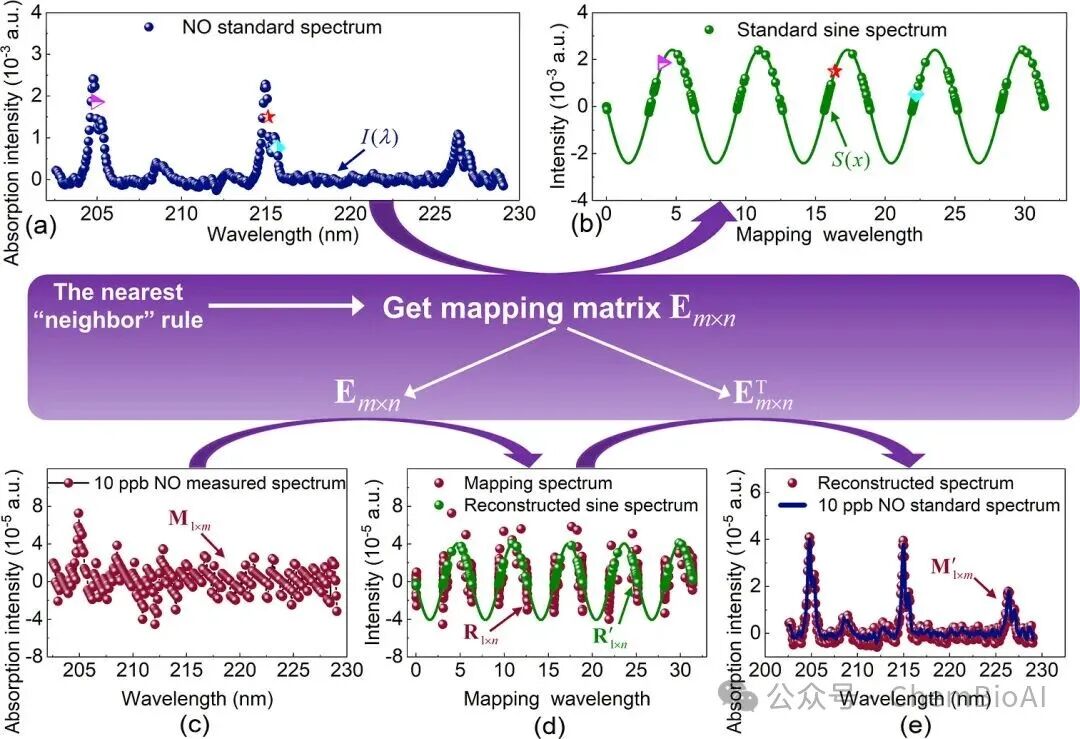
Multiperiodic Spectral Reconstruction: Hearing the Target Sound in a “Noisy Party”
The team innovatively proposed a multiperiodic spectral reconstruction method. This is akin to trying to hear a specific person speaking at a noisy party—traditional methods attempt to filter out all noise directly, while the new method converts the target sound into a more recognizable form.
Specifically, this method transforms the spectrum from the wavelength domain to the intensity domain, enhancing the absorption characteristics of the target gas while discretizing noise and interference signals. Through a carefully designed mapping matrix, the system can accurately extract the characteristic “fingerprint” of NO from complex spectral signals.
UV Segment Fitting Restoration: Eliminating Background Interference
Addressing the discrete single-peak absorption characteristics of NO, the team employed a UV segment fitting restoration method that effectively removed the slowly varying absorption background from the spectrum without affecting the intensity values of the characteristic absorption peaks. This is similar to removing background noise in photo editing to make the subject stand out more.
Convolutional Neural Network: Intelligent Concentration Calculation
The research constructed a specialized convolutional neural network model, establishing an accurate mapping relationship from spectral features to gas concentration through extensive data training. The model consists of two convolutional blocks, each containing three convolutional layers and pooling layers, followed by fully connected layers to output concentration values.
Experimental Validation: Outstanding Performance
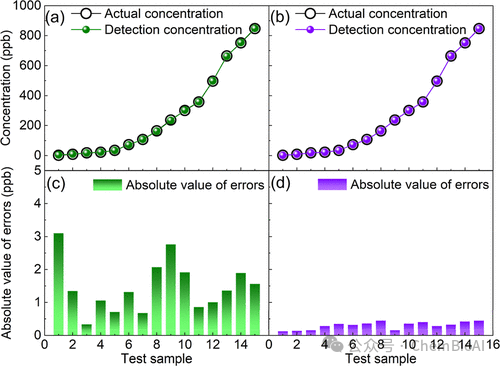
Remarkable Detection Accuracy: Experimental results show that the sensor achieved high-precision detection of NO in the range of 1.63–846.68 ppb, with an average absolute error of only 0.31 ppb and an average absolute percentage error of 0.96%, achieving a detection accuracy of up to 0.63%
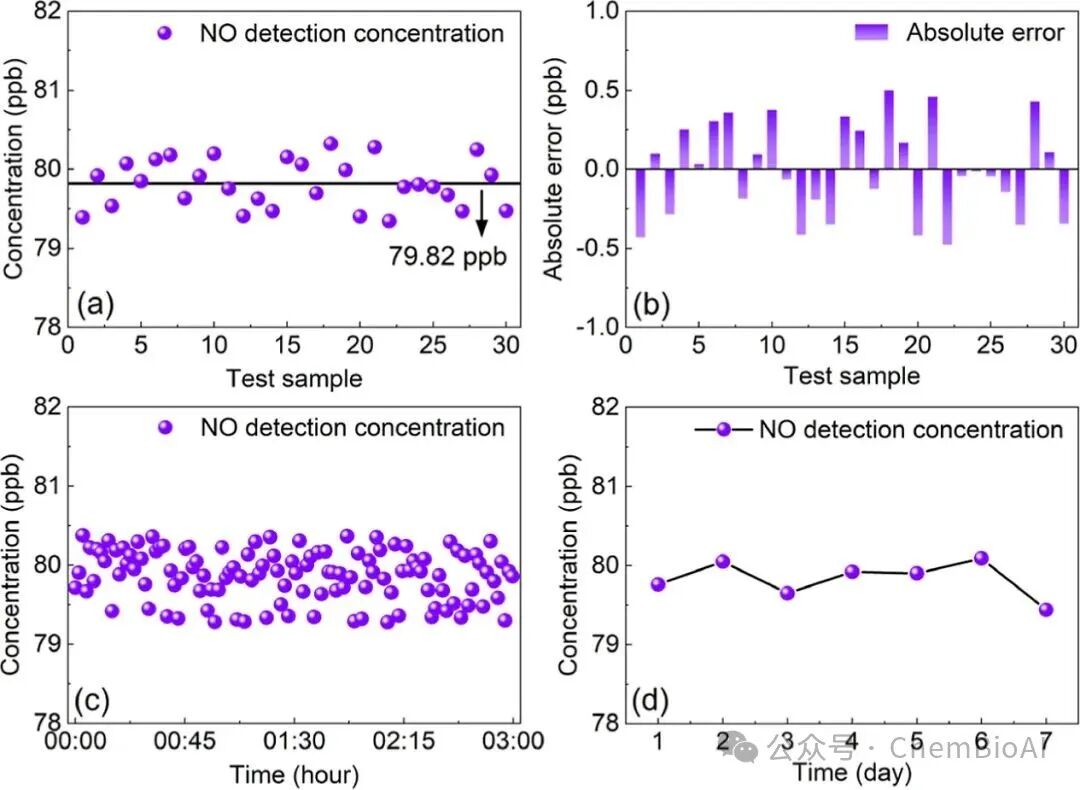
Excellent Stability: In stability tests, the sensor also performed exceptionally well, with a short-term detection coefficient of variation of only 0.40% and a long-term detection coefficient of variation of only 0.29%, showing minimal impact from temperature and humidity changes.
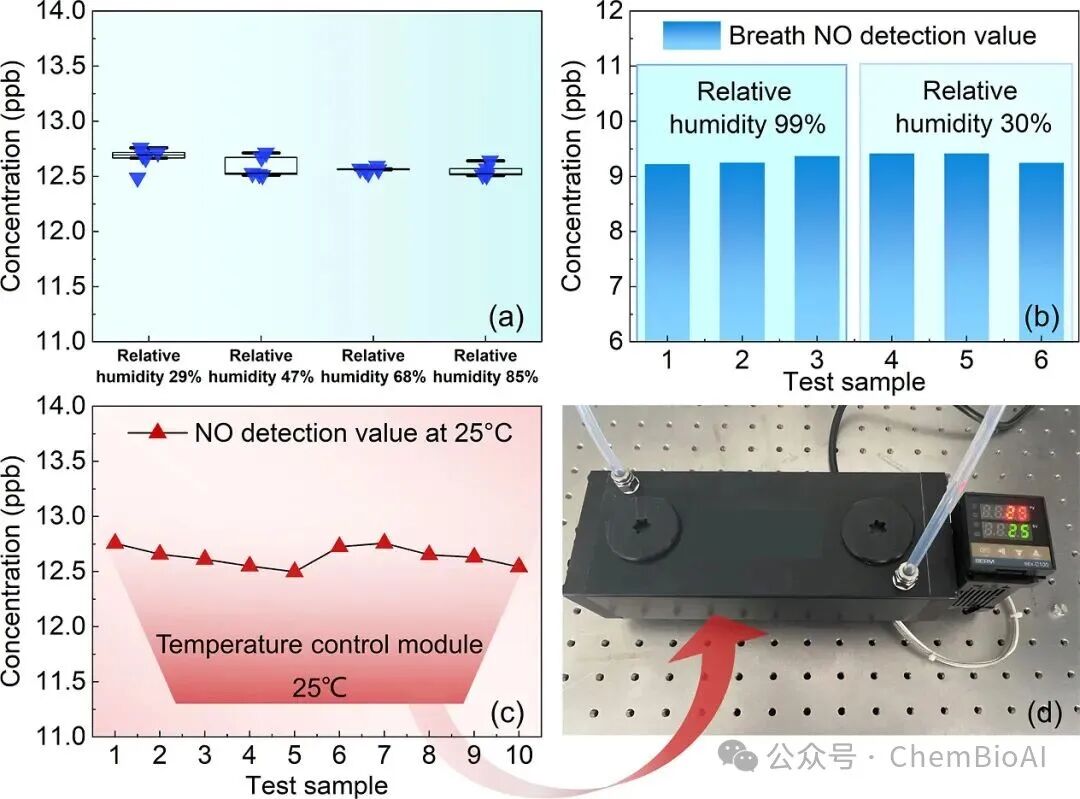
Strong Anti-Interference Capability: To address potential interference gases in exhaled breath, the sensor effectively removes ammonia interference through a SiO2 adsorption device, ensuring accurate and reliable detection results. Under varying humidity conditions, the coefficient of variation of detection results was only 0.66%, demonstrating its good environmental adaptability.
Practical Applications: Distinguishing Between Healthy and Disease States
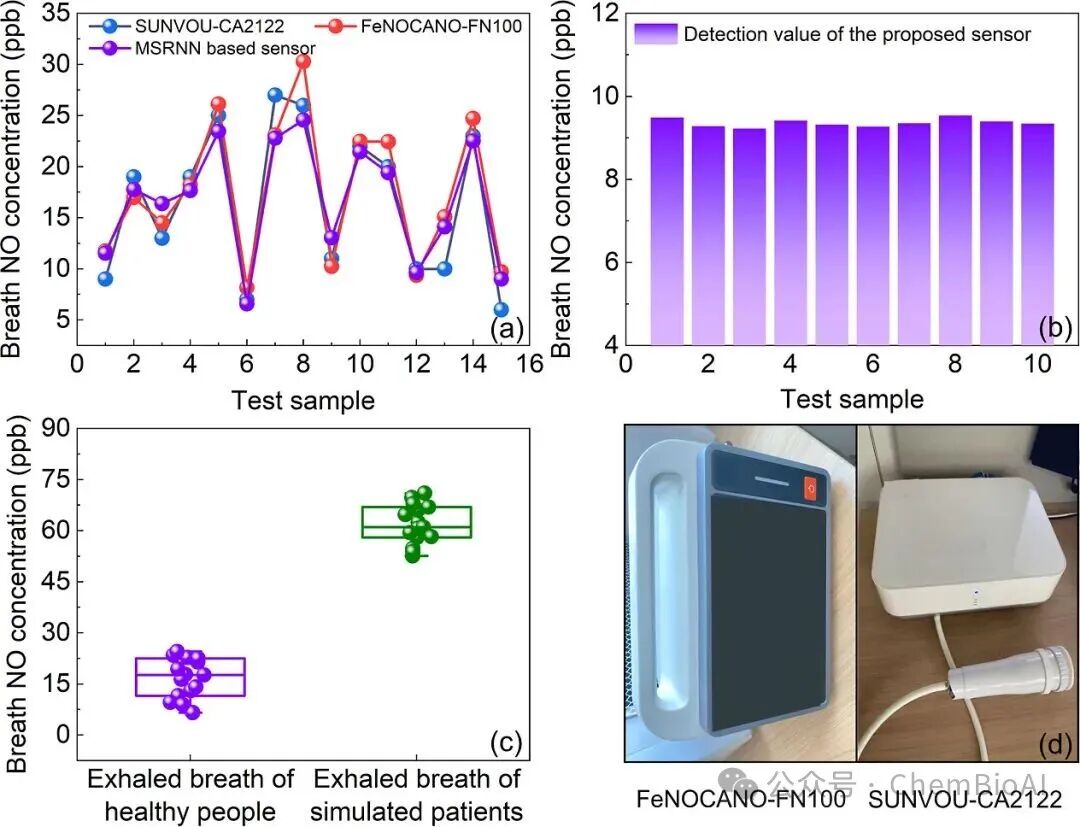
In practical breath experiments, 15 healthy volunteers participated in the tests. Researchers compared the MSRNN-based sensor with two commercial electrochemical sensors, and the results showed a high degree of consistency among the three detection results, proving the reliability of the new sensor.
More significantly, when researchers simulated airway inflammation patients’ exhaled breath by adding standard NO, the new sensor successfully distinguished between healthy individuals and simulated patients’ samples. In ten consecutive tests, the coefficient of variation was only 1.06%, demonstrating excellent repeatability.
Summary of Technical Highlights
Ultra-High Sensitivity: Capable of detecting NO concentrations as low as 1.63 ppb
Strong Anti-Interference Capability: Effectively addresses interference from complex components in exhaled breath
Good Stability: Maintains reliable performance under varying temperature and humidity conditions
Real-Time Online Detection: Achieves rapid analysis of exhaled breath
Looking Ahead
The successful development of this technology provides a powerful tool for the early screening and diagnosis of respiratory inflammatory diseases. Particularly, its non-invasive, rapid, and precise characteristics offer broad application prospects in clinical practice.
In the future, this sensor is expected to become a routine detection device in hospital respiratory departments and even be developed into a portable home device, allowing patients to monitor their respiratory health at home. This will not only provide reliable evidence for doctors’ diagnoses but also facilitate self-management for patients.
Editor’s Perspective
This research achieved precise detection of ppb-level nitric oxide in breath through multiperiodic spectral reconstruction neural network technology, breaking through the limitations of existing technologies. With further refinement and promotion of this technology, we can expect to see its application in more scenarios, bringing revolutionary changes to respiratory health management.
Technological advancements are making once complex medical tests increasingly simple and precise, ultimately benefiting the health of each and every one of us.
References
Zhu, R., Gao, J., Tian, Q., Li, M., Xie, F., Li, C., … & Zhang, Y. (2025). Detection of Breath Nitric Oxide at Ppb Level Based on Multiperiodic Spectral Reconstruction Neural Network. Analytical Chemistry, 97(5), 3190-3197.
https://pubs.acs.org/doi/10.1021/acs.analchem.4c06797