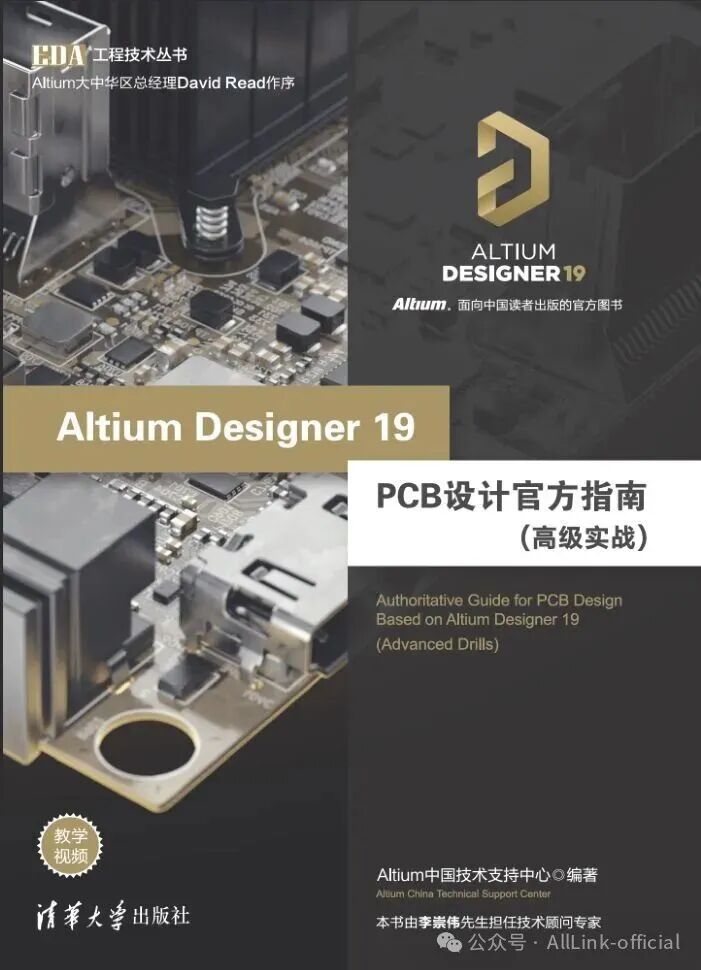
Altium Designer 19 PCB Design Official Guide: Advanced Practice
📘 Altium Designer 19 PCB Design Official Guide (Advanced Practice) – Altium China Technical Support Center
In today’s rapidly evolving landscape of Electronic Design Automation (EDA) and Printed Circuit Board (PCB) design technology, a book that combines theoretical depth with practical experience is particularly valuable and necessary. The “Altium Designer 19 PCB Design Official Guide (Advanced Practice)” (hereinafter referred to as “this book”) is a systematic, in-depth, and practical writing focused on the Altium Designer 19 software version, specifically addressing advanced PCB design. This article will detail the content structure, technical value, and target audience, aiming to assist you in evaluating whether to include it in your research, development, or teaching reference materials.
1. Author and Background
This book is authored by Altium China Technical Support Center. This means that the authors are not only familiar with the official feature set of Altium Designer but also have a deep understanding of the Chinese electronics industry environment, as well as the demands for capabilities and tools in high-speed PCB and complex design. Its content possesses official authority while incorporating characteristics of “localization” and “practicality”.
2. Content Structure and Technical Coverage 🎯
Through the organization of existing materials and a preview of the table of contents, this book mainly includes the following aspects:
-
Advanced Features and System Applications — The first chapter covers the system-level advanced features of Altium Designer 19, advanced schematic features, and advanced applications in PCB layout and design.
-
Experience and Practical Skills — This includes but is not limited to component library management, footprint library design, layout optimization, high-speed/RF/differential pair routing, signal integrity, electromagnetic compatibility (EMC) and interference control, rigid-flex boards, and multilayer lamination structures, addressing common challenges in practical design. Although not all subtopics are fully presented in the table of contents, the focus on practical cases and experience sharing is central to this book.
-
Manufacturing and Processing Export — An indispensable part of advanced practice: from design to Design for Manufacturability (DFM), output of manufacturing files after layout completion, assembly considerations, and communication with production factory interfaces. Although not explicitly listed in the table of contents, this section is typically closely related to “advanced practice”.
-
Standards and Specifications — In practice, engineering standards, component packaging standards (such as IPC, JEDEC, etc.), board materials and copper thickness, impedance, via and blind/buried hole standards, pad shapes, and coverage and solder mask specifications should be specifically discussed in the book to ensure that designs are acceptable to manufacturing, assembly, and testing stages.
-
Optimization of Tools and Workflows — This includes version management, library management, team collaboration, efficient operational processes, and software environment configuration recommendations. These are crucial for freeing designers from basic operations and enhancing efficiency and reliability.
3. Technical Value and Unique Advantages
-
Authority and Reliability: Compiled by the official Altium support team in China, the understanding of Altium Designer 19’s features and tools in this book comes from official resources or frontline support experience, minimizing errors or misguidance due to version discrepancies.
-
Localized Perspective: Addressing the actual environment of the Chinese PCB manufacturing/electronics industry chain (such as board manufacturers, surface treatment, copper laminate costs and availability, manufacturing tolerances, etc.), this book should provide case studies and recommendations that are relevant to the Chinese electronics industry, which is particularly useful for domestic engineers.
-
Integration of Theory and Practice: Not only does it provide tool usage instructions, but it also analyzes problems encountered in actual projects, compares solutions, and discusses the design decision-making process. Exploring aspects such as “why this solution was chosen” and “how to consider losses/gain components” is crucial for enhancing designers’ judgment and design quality.
-
Strong Systematic and Structural Approach: The first chapter systematically unfolds advanced features, while subsequent chapters progress through practical cases and application techniques, making it suitable as both an “advanced reading material” and a part of graduate or engineer training course textbooks.
-
Coverage of Updated Design Standards and Trends: Considering the increasing emphasis on high-speed, high-density, differential pairs, rigid-flex designs, 3D checks, EMC/signal integrity in modern PCB design, this book’s in-depth explanations in these areas can help designers tackle new challenges and avoid issues during actual production/debugging stages.
4. Target Audience and Usage Scenarios
This book is highly suitable for the following types of readers or usage scenarios:
-
PCB designers with a foundation in Altium Designer who wish to enter the field of advanced design (high-speed, complex structures, electromagnetic compatibility, etc.);
-
Instructors and graduate students engaged in electronic engineering, microelectronics, embedded systems, RF/signal processing at universities or research institutes, used as reference material for research topics or design practice courses;
-
Core designers or technical leaders responsible for layout design, DFM/process communication, and production line compatibility in electronic hardware companies;
-
Personnel in manufacturing/testing/assembly plants who need to coordinate with design departments, detect manufacturability issues, and provide feedback to relevant design personnel.
5. Potential Limitations and Reader Considerations
To prepare readers who expect to gain the most benefit, the following suggestions and reminders are provided:
-
Software Version Differences: The main versions of Altium Designer (19 and later versions such as 20, 21, etc.) may have subtle or significant changes in interface, features, and performance. If you are using a newer version, some interface locations/parameter settings may differ.
-
Case Environment Differences: Practical cases typically assume certain manufacturing conditions and equipment capabilities. There may be differences in your actual manufacturing environment (such as materials, copper thickness, tolerances, surface treatment, impedance control capabilities, etc.), which need to be adjusted accordingly.
-
Trade-off Between Depth and Breadth: Due to the “advanced practice” positioning, some very basic functions or background needed by beginners may be less covered. If you are starting from scratch, you may need to supplement with basic tutorials/official documentation.
6. Conclusion and Recommendation Index ⭐⭐⭐⭐⭐
Overall, the “Altium Designer 19 PCB Design Official Guide (Advanced Practice)” is an indispensable tool for engineering technicians/scholars pursuing excellence in PCB design quality and efficiency. It not only enhances design skills but also advances design thinking, significantly benefiting the integration of theory and practice, control of design standards, and improvement of manufacturability and reliability.
https://alllink-navi.blogspot.com/2025/09/altium-designer-19-pcb-authoritative.html