Reference Information
Document Title: A robust organic hydrogen sensor for distributed monitoring applications
Publication Date: January 28, 2025
Journal: Nature Electronics
DOI: 10.1038/s41928-025-01352-y
Research Summary
This study published in Nature Electronics has breakthrough developments in hydrogen sensors based on DPP-DTT organic semiconductors, achieving:
✅ Limit Sensitivity: 192 ppb detection limit (50 times lower than DoE standards)
✅ Lightning Response: 0.84 seconds response time (commercial devices require 5-10 seconds)
✅ All-Weather Operation: Wide temperature range of -20℃ to 120℃, with an ultra-long lifespan of 646 days
✅ Cost Revolution: Screen printing preparation, unit price can be reduced to $40 (commercially $1200)
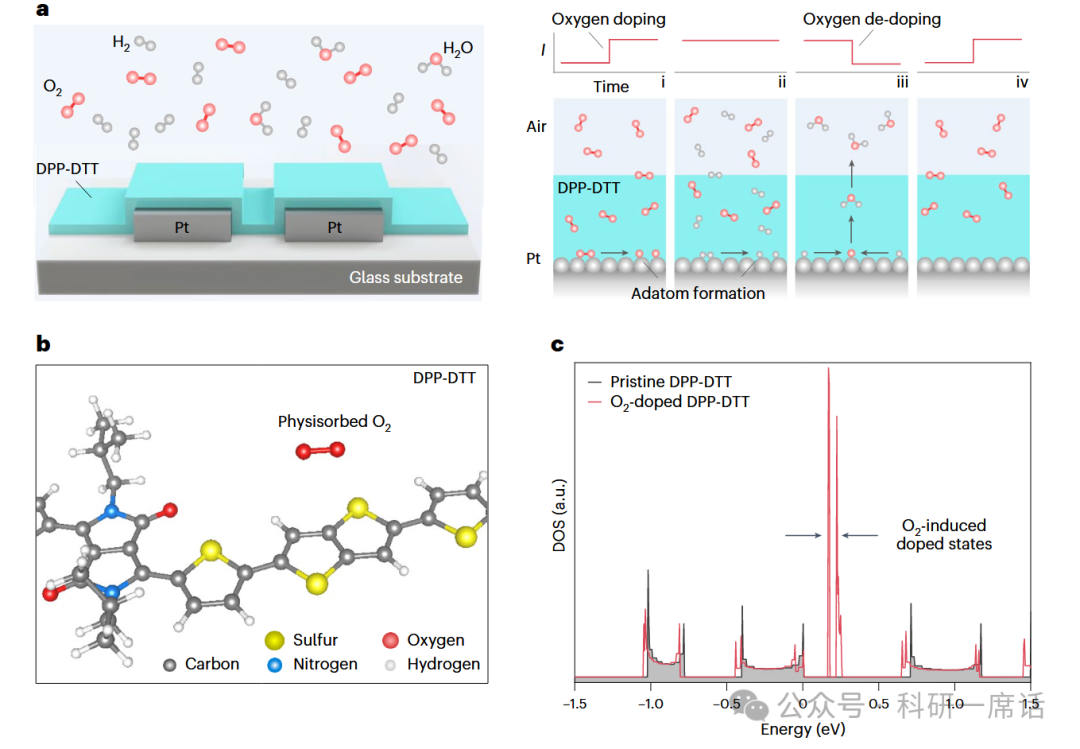
Technical Winning Points:
Dual Material Synergy: Platinum electrode catalyzes the hydrogen-oxygen reaction + DPP-DTT precise carrier control
Self-Recovery Design: Automatic regeneration in air, no manual intervention required
Image Analysis
1. Dynamic demonstration of working principle (Fig. 2a)
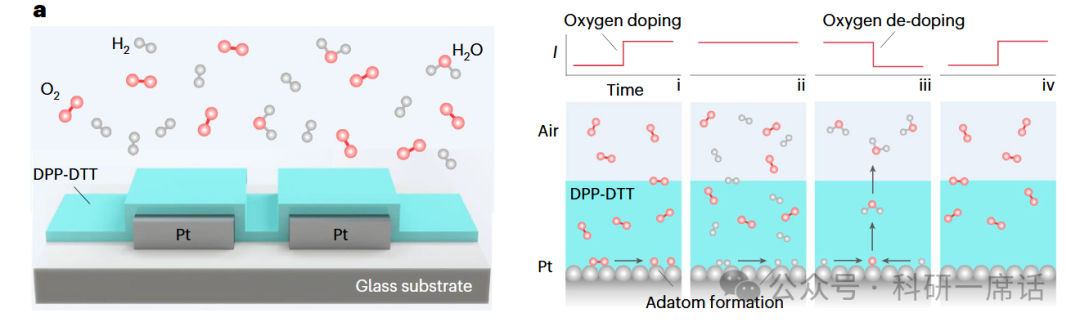
Step 1 (left): O₂ molecules adsorb on the DPP-DTT surface, forming a hole conduction channel
Step 2 (middle): H₂ permeates and reacts with adsorbed oxygen to generate H₂O, blocking the conduction path
Step 3 (right): Current drop triggers an alarm, automatically recovering in air
Key Points: Red arrows indicate electron transfer paths, blue clouds represent gas molecule diffusion
2. Performance comparison radar chart (Fig. 4h-i)
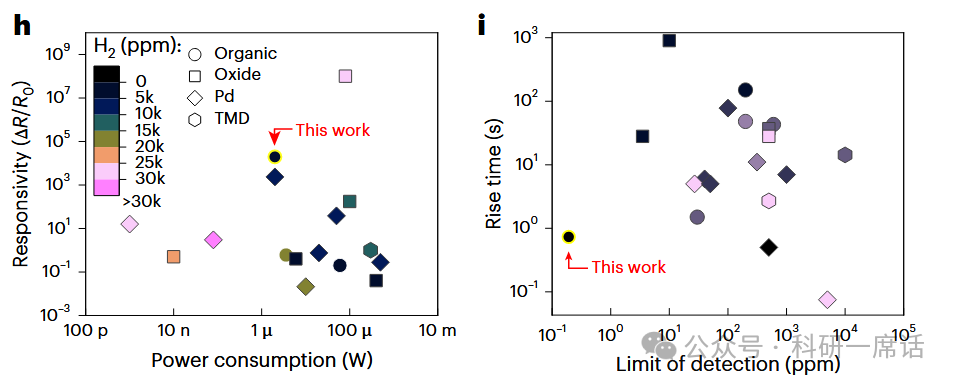
Six-dimensional crushing: Comprehensive surpassing in response (>>10⁴), power consumption (2μW), LOD, etc.:
Metal types (Pd): Power consumption reduced by 1000 times
Oxides (SnO₂): Response speed improved by 20 times
Two-dimensional materials (MoS₂): Cost only 1/10
3. Practical detection scenarios (Extended Data Fig. 10)
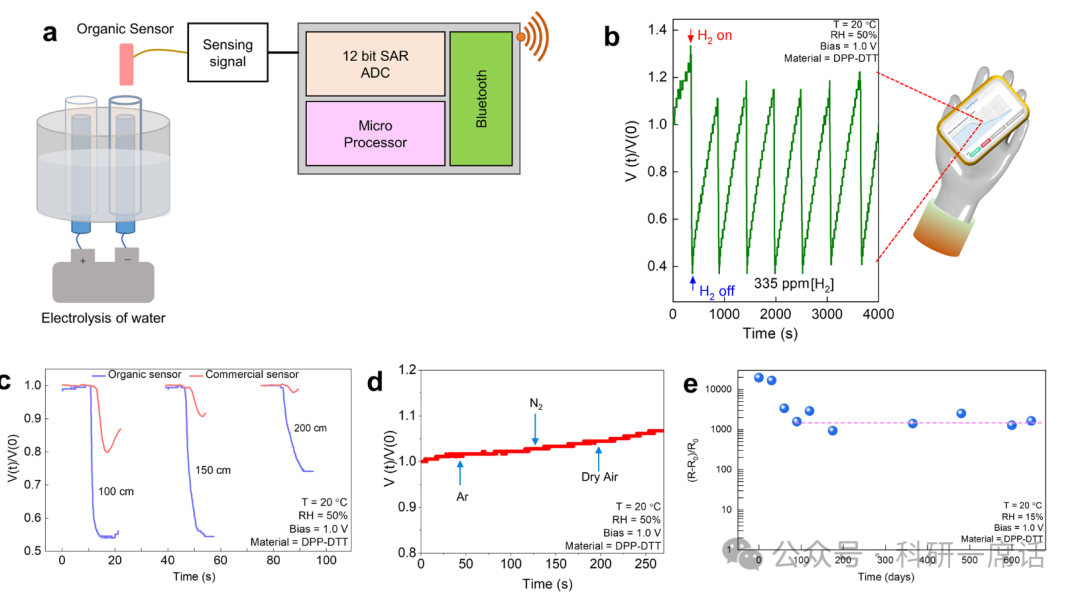
Pipeline inspection: Drone-mounted sensors accurately capture 610 ppm leaks (error <5%)
Indoor monitoring: Identifying 740 ppm concentration from 3 meters away, networking for spatial positioning
Extreme testing: Maintaining >1000 cycles of stability at 80% humidity
Future Prospects
1. Short-term implementation (3-5 years)
Hydrogen energy infrastructure: Real-time monitoring systems for hydrogen stations/transport pipelines
Home safety: Smart home gas alarms (can be integrated into smoke detectors)
Aerospace and military: Rocket fuel leak monitoring (validated at 120℃)
2. Long-term breakthroughs (5-10 years)
🔮 Multifunctional electronic nose: Achieving multi-gas detection (CO₂/CH₄, etc.) by replacing organic materials
🔮 Flexible wearables: Printed on PET substrates, made into patch-type safety monitoring devices
🔮 Self-powered systems: Combining organic photovoltaics to create zero-power sensor networks
3. Challenges to overcome
⚠️ Linearity optimization under ultra-high concentrations of H₂ (>>4%)
⚠️ Long-term stability in complex industrial environments (including corrosive gases like H₂S)
Conclusion
This research not only addresses the “last mile of safety” issue in the hydrogen economy but also pioneers a new paradigm in gas sensing within organic electronics. When traditional technologies fall into the “sensitivity-power consumption-cost” impossible triangle, organic semiconductors provide a perfect answer through clever molecular design. As the authors of the paper state, “This is not just an evolution of sensors, but a revolution in safety monitoring concepts.”