✅ Author Profile: A Matlab simulation developer passionate about research, skilled in data processing, modeling simulation, program design, complete code acquisition, paper reproduction, and scientific simulation.
🍎 Previous Review: Follow my personal homepage:Matlab Research Studio
🍊 Personal Motto: Investigate to gain knowledge, complete Matlab code and simulation consultation available via private message.
🔥 Content Introduction
With the rapid development of Intelligent Transportation Systems (ITS), Vehicle-to-Infrastructure (V2I) communication, as a core component of Vehicle-to-Everything (V2X), has become a key technology for improving traffic efficiency and ensuring driving safety. Millimeter wave (mmWave), with its ultra-wide bandwidth characteristics (supporting data transmission rates exceeding 10 Gbps), can meet the high bandwidth service requirements in V2I scenarios such as high-definition map downloads, real-time video monitoring, and autonomous driving collaboration, making it an important candidate technology for future V2I communication. However, the mmWave frequency band (typically referring to 30 GHz – 300 GHz) faces significant challenges such as high propagation loss, susceptibility to obstruction, and severe Doppler frequency shifts, posing numerous challenges for link layer design. Link layer simulation, as an important means to verify the performance of link layer protocols and optimize network parameters, can assess the feasibility of different solutions before actual deployment, providing theoretical support and technical guidance for the efficient operation of mmWave V2I networks.
Technical Characteristics and Challenges of Millimeter Wave V2I Network Link Layer
The link layer of mmWave V2I networks inherits the basic functions of traditional wireless communication link layers (such as medium access control, error control, flow control, etc.) but requires special design to address the unique propagation characteristics of mmWave and the dynamics of V2I scenarios, facing a series of technical challenges.
Ensuring Link Stability in High-Dynamic Scenarios
In V2I communication, vehicles are in high-speed motion (speeds can exceed 120 km/h), leading to severe Doppler frequency shifts and rapid time-varying fading for mmWave links. For example, when a vehicle is traveling at 100 km/h, the Doppler frequency shift can reach approximately 5.5 kHz in the 60 GHz band, significantly affecting the carrier synchronization performance of the signal and leading to an increase in demodulation error rates. Additionally, the relative motion between vehicles and Roadside Units (RSUs) may cause mmWave signals to experience line-of-sight (LOS) obstruction (e.g., being blocked by other vehicles or buildings) in a short time, resulting in sudden link interruptions (i.e., “block fading”). The link layer needs to design fast link switching and reconnection mechanisms to complete channel sensing and resource scheduling before link quality deteriorates, ensuring continuous transmission of service data.
Optimization of Medium Access Control (MAC) Protocols in High Frequency Bands
The directional transmission characteristics of mmWave (which typically use high-gain directional antennas to compensate for propagation loss) render traditional omnidirectional antenna-based MAC protocols unsuitable. Directional communication exacerbates the “hidden terminal” and “exposed terminal” problems: when two vehicles are located in different directions from the RSU, they may simultaneously send data to the RSU without being aware of each other’s transmissions, causing collisions; or they may incorrectly back off due to sensing transmissions from irrelevant directions, wasting channel resources. Furthermore, while mmWave has abundant available bandwidth resources, the channel is severely fragmented (with significant differences in channel quality across different frequency bands), necessitating MAC protocols with efficient channel access and resource allocation capabilities to achieve coordinated scheduling of multiple users and channels, maximizing spectrum utilization.
Cross-Layer Collaborative Design between Link Layer and Physical Layer
The performance of mmWave links is highly dependent on the channel state of the physical layer, while the protocol design of the link layer (such as retransmission strategies and frame structure design) can also affect the resource consumption of the physical layer. For instance, the Automatic Repeat reQuest (ARQ) mechanism of the link layer needs to dynamically adjust the number of retransmissions based on the Channel Quality Indicator (CQI) feedback from the physical layer: reducing retransmissions to lower latency when channel quality is good; increasing retransmissions to ensure reliability when channel quality is poor. This cross-layer collaborative design can fully utilize the channel characteristics of mmWave but also increases the complexity of link layer simulation, requiring precise characterization of the interaction between the physical layer and link layer in the simulation model.
Key Elements and Model Construction of Millimeter Wave V2I Link Layer Simulation
The core of link layer simulation lies in establishing a simulation model that closely resembles reality, simulating the operating environment and protocol behavior of mmWave V2I networks, and quantifying the performance metrics of link layer protocols (such as throughput, delay, packet loss rate, link availability, etc.). Key elements include channel models, node mobility models, MAC protocol models, and error control models.
Accurate Modeling of Millimeter Wave Channel Models
The channel model is fundamental to link layer simulation and directly affects the accuracy of simulation results. The mmWave V2I channel model must focus on the following characteristics: first, the path loss model, including free-space propagation loss, rain fade, fog fade, and other additional losses; for example, in the 60 GHz band, rain fade can reach 0.1 dB/m – 1 dB/m (depending on rainfall); second, the multipath propagation model, where the short wavelength of mmWave (1 mm – 10 mm) results in weaker reflection and scattering, typically dominated by line-of-sight (LOS) paths, with non-line-of-sight (NLOS) signal strength attenuating by more than 20 dB; third, the shadow fading model, which must consider the obstruction effects of vehicles, buildings, and other obstacles on the signal, which can be described using a Markov chain model to depict the switching process between LOS/NLOS states; fourth, the Doppler frequency shift model, which calculates the frequency shift based on the relative speed and direction between vehicles and RSUs and incorporates it into the signal modulation and demodulation process. Currently, various mmWave channel models have been proposed in academia and industry (such as 3GPP TR 38.901, IEEE 802.11ad models), and appropriate model parameters can be selected based on specific scenarios in simulations.
Node Mobility Models and Scene Topology Construction
The dynamics of V2I scenarios are primarily reflected in the movement trajectories of vehicles, and the node mobility model must accurately reflect the movement characteristics of vehicles under different traffic scenarios (such as highways, urban roads, intersections). Commonly used mobility models include Random Waypoint, Gaussian Markov, and intelligent driving models (such as cooperative driving models based on following theory). For example, in highway scenarios, vehicles have a single driving direction and stable speeds, allowing the use of a linear mobility model based on constant speed; in urban intersection scenarios, vehicles need to turn and wait for traffic lights, resulting in more complex movement trajectories that require the introduction of traffic signal control logic and vehicle lane change rules. Additionally, scene topology construction must consider the deployment locations of RSUs (such as roadside, lamp posts, traffic lights), coverage areas (the directional coverage radius of mmWave is typically 100 m – 300 m), and the distribution of obstacles (such as buildings, trees, and other vehicles), providing a realistic spatial environment for link layer channel access and resource scheduling simulations.
Customized Implementation of MAC Protocol Models
The MAC protocol model for mmWave V2I scenarios is the core content of link layer simulation and must implement the following key functions: first, the beamforming and training mechanism of directional antennas, simulating the beam alignment process between the transmitter and receiver (e.g., achieving beam matching through beam scanning and training sequence exchange) and quantifying the delay overhead of beam training; second, the channel access mechanism, including contention-based random access (such as enhanced CSMA/CA, introducing directional sensing mechanisms) and scheduled centralized access (such as RSU-dominated TDMA/FDMA resource allocation), where simulations must compare the performance of different access methods in terms of throughput and delay; third, the link adaptation mechanism, which dynamically adjusts modulation and coding schemes (MCS), frame lengths, and other parameters based on channel quality; for example, using 256 QAM modulation under LOS links to increase rates, while switching to QPSK modulation under NLOS links to ensure reliability.
Error Control and Flow Control Models
The high error rate characteristics of mmWave links require the link layer to have strong error control capabilities, and simulations must construct ARQ and Forward Error Correction (FEC) models. The ARQ model must simulate mechanisms such as retransmission timeout (RTO) calculation and retransmission count limits, evaluating the impact of different retransmission strategies on link reliability and delay; the FEC model must introduce coding schemes such as convolutional codes and LDPC codes, balancing coding gain and overhead by setting different coding rates (e.g., 1/2, 3/4). The flow control model is used to simulate the service characteristics in V2I scenarios, such as high-definition video streams (constant bit rate CBR, rates up to 50 Mbps) and burst sensor data (variable bit rate VBR), generating data packet flows that conform to service characteristics to evaluate the link layer’s congestion control capabilities under different loads.
Simulation Tools and Performance Evaluation Metrics for Link Layer
Selecting appropriate simulation tools and defining scientific performance evaluation metrics are important prerequisites for conducting research on mmWave V2I link layer simulations.
Comparison and Selection of Mainstream Simulation Tools
Currently, commonly used wireless communication simulation tools include NS-3, OPNET, and MATLAB/Simulink, each with different applicability in mmWave V2I link layer simulations. NS-3, as an open-source simulation platform, offers high flexibility and scalability, supporting custom protocol models, and its built-in mmWave module has implemented basic functions such as mmWave channel models, directional antenna models, and MAC protocol frameworks, making it suitable for protocol innovation and parameter optimization research. OPNET (now integrated into Riverbed) provides a wealth of pre-made models and a visual interface, with high simulation efficiency but poor open-source nature and high customization development costs. MATLAB/Simulink excels in algorithm verification and physical layer modeling, allowing joint simulation with link layer models, making it suitable for performance evaluation of cross-layer designs. In practical research, NS-3 is typically chosen as the main simulation tool, combined with MATLAB for channel characteristic analysis and algorithm prototype verification.
Key Performance Evaluation Metrics
Performance evaluation of mmWave V2I link layers must set metrics around service requirements and technical challenges, mainly including: first, throughput, which is the amount of data successfully transmitted per unit time, reflecting the link layer’s efficiency in utilizing mmWave’s large bandwidth resources; second, end-to-end delay, including transmission delay, queuing delay, retransmission delay, etc., where for real-time services such as autonomous driving control commands, delays must be controlled within 100 ms; third, packet loss rate, which refers to the proportion of data packets lost due to link interruptions, collisions, errors, etc., directly affecting service reliability; fourth, link availability, which is the proportion of time the link is in an available state (e.g., LOS and SNR above threshold), assessing the link layer’s ability to cope with obstructions and fading; fifth, spectral efficiency, which is the throughput per unit bandwidth, measuring the effectiveness of resource allocation strategies. By comparing the changes in metrics under different protocol parameters (such as beam training period, number of retransmissions, channel access contention window size), optimization of link layer schemes can be achieved.
Simulation Research Cases and Optimization Strategies
Through specific simulation cases, the performance bottlenecks of mmWave V2I link layer protocols can be intuitively demonstrated, and targeted optimization strategies can be proposed.
Case 1: Performance Simulation of Directional MAC Protocol in Highway Scenarios
The simulation scenario is set as a bidirectional four-lane highway, deploying 1 RSU (coverage range 200 m), with 10 vehicles traveling at speeds of 80 km/h – 120 km/h, using the 60 GHz band, with the service being high-definition video upload (50 Mbps per vehicle). Comparing the performance of traditional omnidirectional CSMA/CA protocol with the directional sensing-based CSMA/CA protocol: the traditional protocol suffers from a collision rate of up to 30% due to hidden terminal issues in directional communication, with a throughput of only 150 Mbps; while the directional sensing protocol reduces the collision rate to 8% by performing multi-directional beam scanning before transmission to detect potential interference, increasing throughput to 300 Mbps. Further optimization reveals that when the beam training period is set to 50 ms (matching the channel variation period), the protocol performance is optimal—too short a period increases training overhead, while too long fails to track channel changes in time.
Case 2: Simulation of Link Switching Mechanism in Urban Intersection Scenarios
Urban intersections have numerous buildings and vehicles causing obstructions, leading to frequent LOS/NLOS switching of mmWave links. The simulation employs a Markov chain model to simulate LOS/NLOS state switching (average LOS duration 5 s, NLOS duration 2 s), comparing traditional hard switching (reconnecting after link interruption) with predictive soft switching (predicting obstructions based on vehicle trajectories and establishing backup links in advance): hard switching has a packet loss rate of up to 40% in NLOS states, with service interruption times exceeding 1 s; while predictive soft switching, by combining GPS trajectories and RSU deployment locations, switches to backup channels (such as mmWave links from adjacent RSUs or low-frequency auxiliary links) 500 ms in advance, reducing the packet loss rate to 5% and shortening interruption times to under 100 ms.
Summary of Optimization Strategies
Based on simulation results, optimization of the mmWave V2I link layer can be pursued from three aspects: first, designing adaptive beam management mechanisms that dynamically adjust beam training periods based on vehicle speed, shortening periods in high-speed scenarios to combat Doppler effects; second, developing hybrid access MAC protocols that use contention access under light loads to reduce delays and switch to centralized scheduling under heavy loads to improve throughput; third, constructing multi-band collaborative links that utilize the coverage advantages of low-frequency bands (such as 5.9 GHz) as backups for mmWave links, achieving seamless switching during obstructions.
The research on link layer simulation of mmWave V2I networks serves as a bridge connecting theoretical design and practical deployment. By accurately modeling the propagation characteristics of mmWave, the dynamics of V2I scenarios, and the core mechanisms of link layer protocols, it can provide a scientific basis for protocol optimization and parameter configuration. Future simulation research should further integrate emerging directions such as artificial intelligence technologies (e.g., resource scheduling based on reinforcement learning) and multi-node collaborative communication (e.g., collaborative beamforming between RSUs) to enhance the robustness and efficiency of mmWave V2I networks in complex scenarios, laying a solid foundation for the practical application of intelligent transportation systems.
⛳️ Operation Results
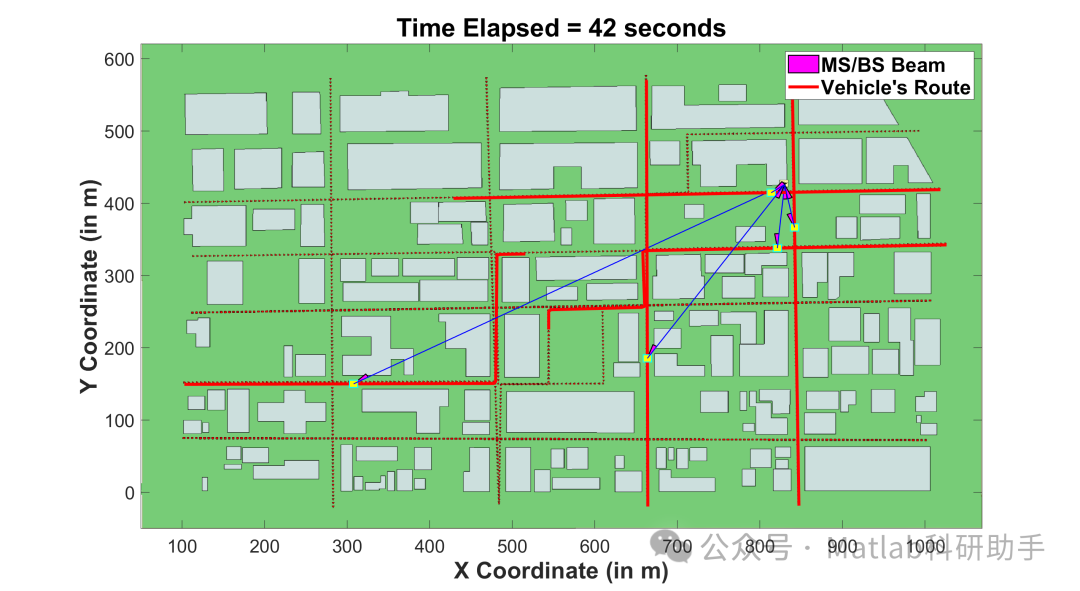
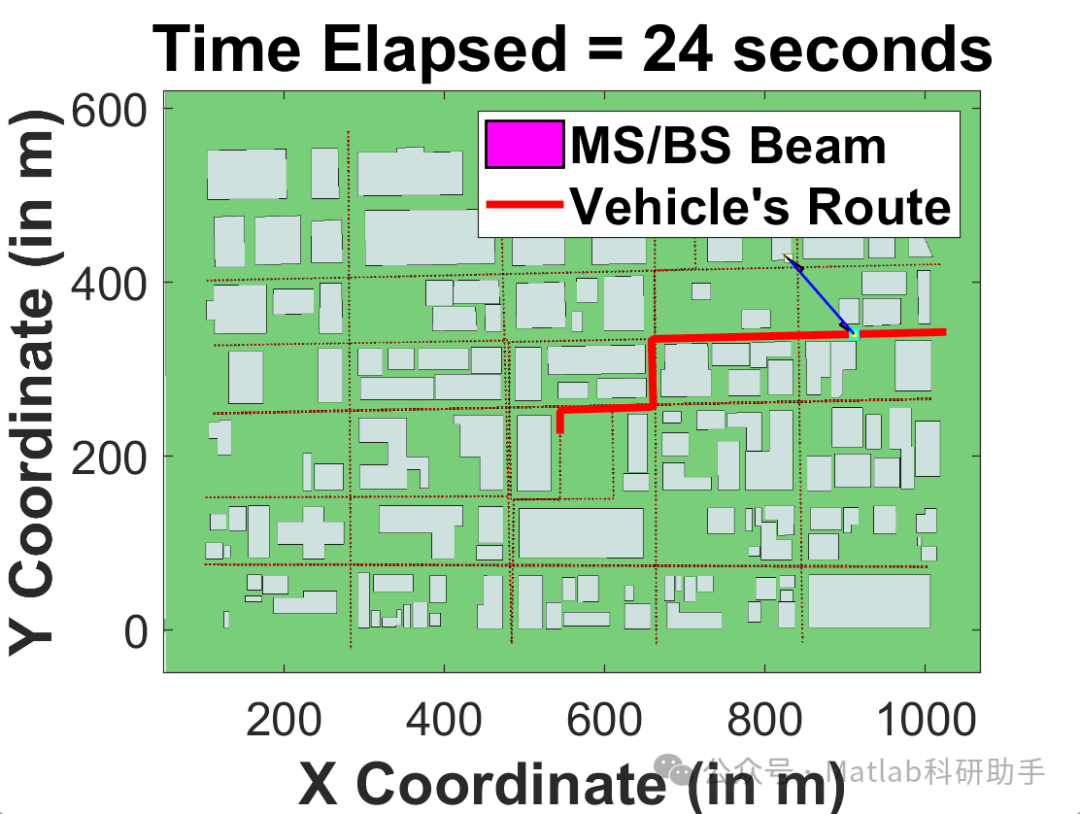
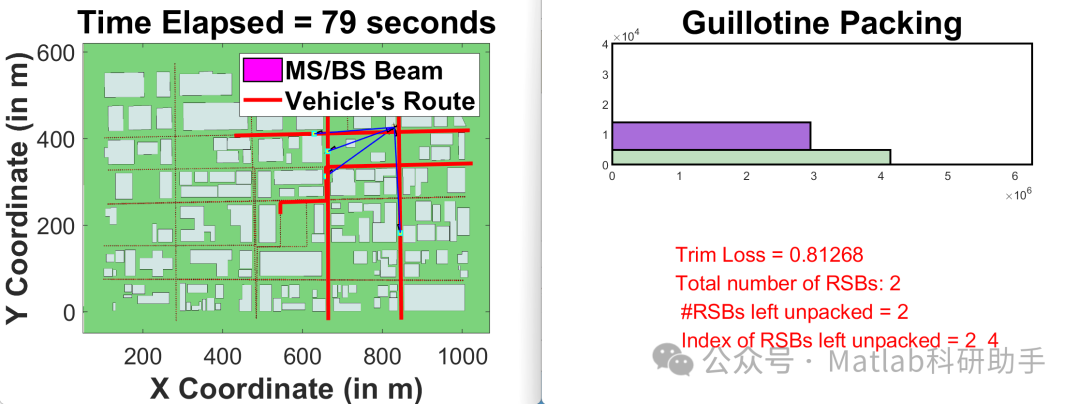
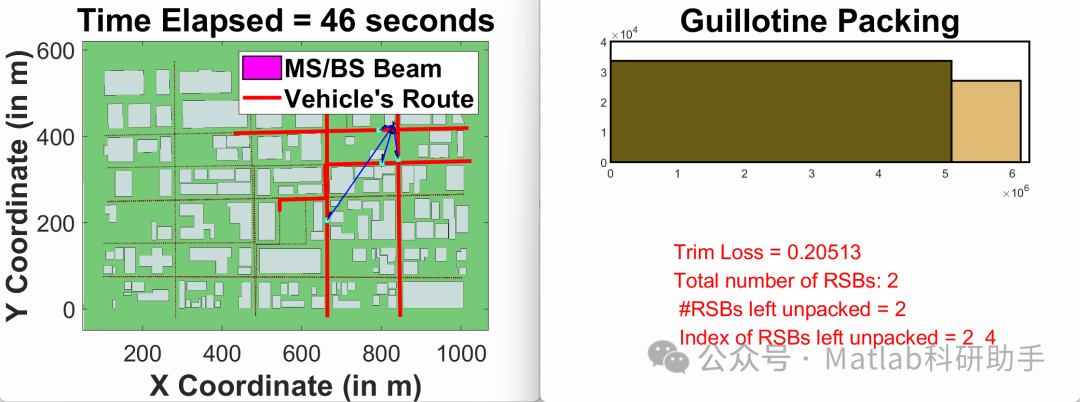
🔗 References
[1] Pan Sheng. Research on Efficient Data Distribution Protocols in Millimeter Wave Vehicle Networks [D]. University of Science and Technology of China, 2023.
[2] Wu Peng. Modeling and Performance Analysis of Ultra-Dense V2I Networks Based on Stochastic Geometry Theory [D]. Harbin Institute of Technology, 2021.
[3] Li Yuze, Li Xinan. Millimeter Wave Beam Selection Algorithm Based on GCNet [J]. Optical Communication Research, 2023(6):72-76. DOI:10.13756/j.gtxyj.2023.06.009.
📣 Partial Code
🎈 Some theoretical references are from network literature; if there is any infringement, please contact the author for deletion.
👇 Follow me to receive a wealth of Matlab e-books and mathematical modeling materials.
🏆 Our team specializes in guiding customized MATLAB simulations in various research fields to support your research dreams:
🌈 Various intelligent optimization algorithm improvements and applications
Production scheduling, economic scheduling, assembly line scheduling, charging optimization, workshop scheduling, departure optimization, reservoir scheduling, three-dimensional packing, logistics site selection, cargo location optimization, bus scheduling optimization, charging pile layout optimization, workshop layout optimization, container ship loading optimization, pump combination optimization, medical resource allocation optimization, facility layout optimization, visual domain base station and drone site selection optimization, knapsack problem, wind farm layout, time slot allocation optimization, optimal distributed generation unit allocation, multi-stage pipeline maintenance, factory-center-demand point three-level site selection problem, emergency life material distribution center site selection, base station site selection, road lamp post layout, hub node deployment, transmission line typhoon monitoring devices, container scheduling, unit optimization, investment portfolio optimization, cloud server combination optimization, antenna linear array distribution optimization, CVRP problem, VRPPD problem, multi-center VRP problem, multi-layer network VRP problem, multi-center multi-vehicle VRP problem, dynamic VRP problem, two-layer vehicle routing problem (2E-VRP), electric vehicle routing problem (EVRP), hybrid vehicle routing problem, mixed flow shop problem, order splitting scheduling problem, bus scheduling optimization problem, flight shuttle vehicle scheduling problem, site selection path planning problem, port scheduling, port bridge scheduling, parking space allocation, airport flight scheduling, leak source localization.
🌈 Machine learning and deep learning time series, regression, classification, clustering, and dimensionality reduction
2.1 BP time series, regression prediction, and classification
2.2 ENS voice neural network time series, regression prediction, and classification
2.3 SVM/CNN-SVM/LSSVM/RVM support vector machine series time series, regression prediction, and classification
2.4 CNN|TCN|GCN convolutional neural network series time series, regression prediction, and classification
2.5 ELM/KELM/RELM/DELM extreme learning machine series time series, regression prediction, and classification
2.6 GRU/Bi-GRU/CNN-GRU/CNN-BiGRU gated neural network time series, regression prediction, and classification
2.7 Elman recurrent neural network time series, regression prediction, and classification
2.8 LSTM/BiLSTM/CNN-LSTM/CNN-BiLSTM long short-term memory neural network series time series, regression prediction, and classification
2.9 RBF radial basis function neural network time series, regression prediction, and classification
2.10 DBN deep belief network time series, regression prediction, and classification
2.11 FNN fuzzy neural network time series, regression prediction
2.12 RF random forest time series, regression prediction, and classification
2.13 BLS broad learning system time series, regression prediction, and classification
2.14 PNN pulse neural network classification
2.15 Fuzzy wavelet neural network prediction and classification
2.16 Time series, regression prediction, and classification
2.17 Time series, regression prediction, and classification
2.18 XGBOOST ensemble learning time series, regression prediction, and classification
2.19 Transform various combinations of time series, regression prediction, and classification
Covering wind power prediction, photovoltaic prediction, battery life prediction, radiation source identification, traffic flow prediction, load forecasting, stock price prediction, PM2.5 concentration prediction, battery health status prediction, electricity consumption prediction, water body optical parameter inversion, NLOS signal identification, precise prediction of subway stops, transformer fault diagnosis.
🌈 Image processing aspects
Image recognition, image segmentation, image detection, image hiding, image registration, image stitching, image fusion, image enhancement, image compressed sensing.
🌈 Path planning aspects
Traveling salesman problem (TSP), vehicle routing problem (VRP, MVRP, CVRP, VRPTW, etc.), three-dimensional path planning for drones, drone collaboration, drone formation, robot path planning, grid map path planning, multimodal transport problems, electric vehicle routing problem (EVRP), two-layer vehicle routing problem (2E-VRP), hybrid vehicle routing problem, ship trajectory planning, full path planning, warehouse patrol.
🌈 Drone application aspects
Drone path planning, drone control, drone formation, drone collaboration, drone task allocation, online optimization of drone safe communication trajectories, vehicle collaborative drone path planning.
🌈 Communication aspects
Sensor deployment optimization, communication protocol optimization, routing optimization, target localization optimization, Dv-Hop localization optimization, Leach protocol optimization, WSN coverage optimization, multicast optimization, RSSI localization optimization, underwater communication, communication upload/download allocation.
🌈 Signal processing aspects
Signal recognition, signal encryption, signal denoising, signal enhancement, radar signal processing, signal watermark embedding and extraction, electromyography signals, electroencephalography signals, signal timing optimization, electrocardiogram signals, DOA estimation, encoding and decoding, variational mode decomposition, pipeline leakage, filters, digital signal processing + transmission + analysis + denoising, digital signal modulation, bit error rate, signal estimation, DTMF, signal detection.
🌈 Power system aspects
Microgrid optimization, reactive power optimization, distribution network reconstruction, energy storage configuration, orderly charging, MPPT optimization, household electricity.
🌈 Cellular automata aspects
Traffic flow, crowd evacuation, virus spread, crystal growth, metal corrosion.
🌈 Radar aspects
Kalman filter tracking, track association, track fusion, SOC estimation, array optimization, NLOS identification.
🌈 Workshop scheduling
Zero-wait flow shop scheduling problem (NWFSP), Permutation flow shop scheduling problem (PFSP), Hybrid flow shop scheduling problem (HFSP), zero idle flow shop scheduling problem (NIFSP), distributed permutation flow shop scheduling problem (DPFSP), blocking flow shop scheduling problem (BFSP).
👇