Vic Market Research (Guangzhou Quanlong Information Consulting Co., Ltd.) is a global leader in market research, industry research, enterprise research, and niche market research services. Focused on global niche market research, it analyzes product market size, production capacity, output, sales, value, price, cost, profit, and more.
Introduction:In today’s highly industrialized and intelligent era, precision measurement technology has become a key support for the development of various fields. Laser triangulation sensors, as the “secret weapon” in the field of precision measurement, are quietly transforming various aspects of industrial production, scientific exploration, and daily life. With their unique working principles and outstanding performance advantages, they play an irreplaceable role in numerous measurement tasks, becoming an indispensable part of modern technological development. Today, let us delve into the fascinating world of laser triangulation sensors, exploring their principles, applications, and market development trends.
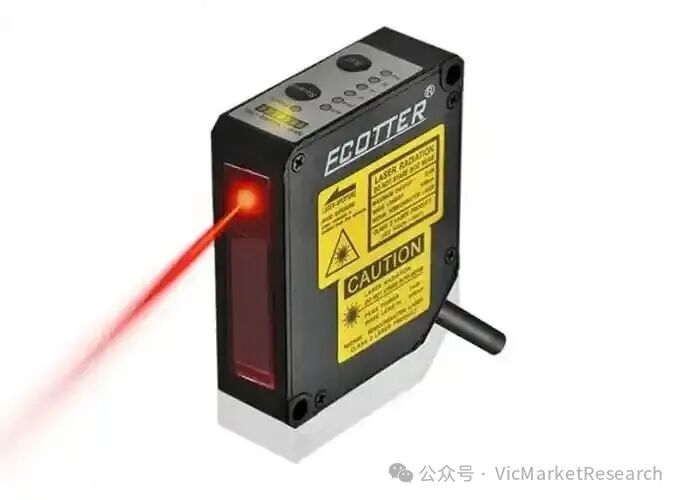
Working Principle
The working principle of laser triangulation sensors is essentially a perfect combination of the propagation characteristics of light and geometric principles. The core lies in utilizing the directionality and monochromaticity of laser light, as well as the geometric relationship of similar triangles to achieve precise distance measurement.
Specifically, when a laser triangulation sensor operates, it first emits a high-intensity laser beam from its internal laser emitting device. This beam of laser light is directed towards the target object’s surface in nearly parallel lines, similar to a straight beam emitted from a flashlight. When the laser beam encounters the target object, reflection occurs, and part of the reflected light returns to the sensor along a specific path.
At this point, the receiving device within the sensor begins to function. The receiving device typically employs high-sensitivity CCD (Charge-Coupled Device) or CMOS (Complementary Metal-Oxide-Semiconductor) detectors, which can accurately capture the reflected laser signals. This involves the principle of similar triangles, where the laser emission point, the receiving point, and the laser reflection point on the target object form a large triangle, while a small triangle is formed inside the sensor from the receiving lens to the imaging point on the CCD or CMOS detector. These two triangles are geometrically similar.
Since the distance between the laser emitting device and the receiving device is a fixed known value, referred to as the baseline distance, and the focal length of the receiving lens is also a fixed parameter, when the distance to the target object changes, the imaging position of the reflected light on the CCD or CMOS detector will also change accordingly. By accurately measuring the change in the imaging position of the reflected light on the detector, and combining it with the known baseline distance and lens focal length, the distance between the target object and the sensor can be accurately calculated using the proportional relationship of similar triangles.
For example, assuming the baseline distance is L, the focal length of the receiving lens is f, and the offset of the reflected light on the detector is x, the distance D between the target object and the sensor can be calculated using the formula D = f * L / x. This measurement method based on light and geometric principles allows laser triangulation sensors to achieve extremely high measurement accuracy within short distances, typically reaching micrometer-level precision, providing reliable measurement means for numerous applications with stringent accuracy requirements.
Technical Highlights
The reason laser triangulation sensors are favored in the field of precision measurement is due to a series of outstanding technical highlights that make them stand out among numerous sensors, becoming the preferred tool for achieving high-precision measurements in various industries.
(1) High Precision Measurement, Capturing Subtle Differences
High precision is one of the most prominent advantages of laser triangulation sensors. In many industrial production and scientific research scenarios, the accuracy requirements for distance measurement are extremely high, and even minor errors can lead to serious consequences. Laser triangulation sensors, with their unique working principles, can achieve micrometer-level measurement accuracy, meaning they can accurately detect extremely subtle distance changes.
For example, in electronic chip manufacturing, the width of the electrical traces on chips is often at the micrometer or even nanometer level. During the chip manufacturing process, precise measurements of the thickness of silicon wafers, the spacing of chip pins, etc., are required. Laser triangulation sensors can easily handle these high-precision measurement tasks, ensuring the quality and performance of chip manufacturing. In the grinding process of optical lenses, the precision requirements for the curvature radius and surface flatness of the lenses are extremely high. Laser triangulation sensors can monitor the processing status of the lenses in real-time, providing data support for precise control of the processing technology, thus producing high-quality optical lenses.
(2) Fast Response, Adapting to Dynamic Changes
In modern industrial production, many measurement scenarios involve rapidly moving objects or dynamically changing environments, which require measurement devices to have fast response capabilities. Laser triangulation sensors have extremely fast response speeds, capable of completing distance measurements and outputting data in a short time, meeting the demands of high-speed dynamic measurements.
For example, on automated production lines, components move quickly on high-speed conveyor belts, requiring real-time measurement and detection of their positions and dimensions. Laser triangulation sensors can complete measurements in an instant and feed the data back to the control system, achieving precise control over the production process. In robotic motion control, robots need to quickly adjust their positions and actions based on changes in the surrounding environment. Laser triangulation sensors, acting as the “eyes” of the robots, can quickly perceive the distance and positional information of surrounding objects, helping robots make timely and accurate decisions for efficient and flexible operations.
(3) Wide Measurement Range, Meeting Diverse Needs
Laser triangulation sensors not only have high precision and fast response but also possess a wide measurement range, capable of meeting the diverse measurement distance requirements of different application scenarios. From measuring small objects at close range to long-distance measurements of several meters or even tens of meters, laser triangulation sensors can provide reliable measurement results.
In precision instrument manufacturing, the measurement range for small components may only require a few millimeters to several tens of millimeters, and laser triangulation sensors can achieve high-precision measurements within this range. In construction, logistics, and other fields, measuring and locating large objects may require measurement ranges of several meters or even over ten meters, and laser triangulation sensors can also meet these needs, providing accurate data support for operations in these fields.
(4) Insensitive to Material and Color, Enhancing Applicability
Unlike some other measurement sensors, laser triangulation sensors are relatively insensitive to the material and color of the target object. Whether the target object is made of metal, plastic, ceramic, or wood, and regardless of whether its color is bright or dull, laser triangulation sensors can operate stably and obtain accurate measurement data.
This characteristic makes laser triangulation sensors widely applicable in various complex industrial environments and diverse application scenarios. In the automotive manufacturing process, it is necessary to measure the dimensions of body parts and detect surface defects, where the materials and colors of body parts vary. Laser triangulation sensors can provide uniform and accurate measurements of components with different materials and colors, ensuring the quality and craftsmanship of automobile manufacturing. In the logistics industry, it is necessary to measure the volume and position of packages made of various materials and colors, and laser triangulation sensors can quickly and accurately complete these tasks, improving the efficiency and accuracy of logistics operations.
Diverse Applications
With their outstanding performance, laser triangulation sensors play a key role in numerous industries, becoming an indispensable “measurer” in industrial production. From automotive manufacturing to electronics and photovoltaics, from logistics to aerospace, their presence is ubiquitous, providing strong support for efficient and precise production across various industries.
(1) Automotive Manufacturing: Creating Precise Car Bodies
In the automotive manufacturing field, high-precision processing of components and assembly of car bodies are key to ensuring the quality and performance of vehicles. Laser triangulation sensors play a crucial role in this process, acting as a stringent quality inspector, precisely measuring and monitoring every aspect of automobile production.
During the production of automotive components, sensors can monitor the size, shape, and position of parts in real-time. For example, the machining precision of critical components such as engine blocks and cylinder heads directly affects the performance and reliability of the engine. Laser triangulation sensors can accurately measure parameters such as hole diameter, flatness, and cylindricity of these components, ensuring that each part meets strict design standards. If any size deviation exceeds the allowable range, the system will immediately issue an alarm, prompting staff to make adjustments, effectively avoiding production delays and increased costs due to non-compliant components.
In the car body assembly stage, laser triangulation sensors play an indispensable role. They can be used to detect the gaps and flatness between various body parts, ensuring the precision and sealing of the car body assembly. For instance, if the gap between the door and the body is too large or too small, it will affect the smoothness of the door’s opening and closing, as well as the vehicle’s sound insulation and waterproof performance. By installing multiple laser triangulation sensors on the production line, comprehensive measurement and monitoring of various parts of the car body can be achieved, enabling automated and intelligent control of the assembly process. In BMW’s production lines, laser triangulation sensors are extensively used to accurately detect the fit of body parts, ensuring that every BMW car produced has exceptional quality and craftsmanship.
(2) Electronics and Photovoltaics: Supporting Chip Manufacturing and Solar Panel Production
In the electronics and photovoltaics industries, laser triangulation sensors also shine, providing high-precision measurement solutions for critical processes such as chip manufacturing and solar panel production.
In chip manufacturing, processes such as photolithography and etching require extremely high precision, as even minor deviations can lead to decreased chip performance or even scrapping. Laser triangulation sensors can be used to measure parameters such as the thickness and flatness of silicon wafers and the spacing of chip pins, providing important data for precise control of the chip manufacturing process. For example, during the photolithography process, it is necessary to accurately coat photoresist on the surface of the silicon wafer and transfer circuit patterns onto the wafer using photolithography equipment. Laser triangulation sensors can monitor the position and surface state of the silicon wafer in real-time, ensuring the accuracy and consistency of the photolithography process, thereby improving the yield of chip manufacturing.
In solar panel production, laser triangulation sensors are primarily used to detect the thickness, flatness, and surface defects of solar panels. The quality of solar panels directly affects their power generation efficiency and lifespan, so strict quality control is required during the production process. Laser triangulation sensors can quickly and accurately measure various parameters of solar panels, promptly identifying and adjusting any issues during production. For instance, when defects such as bumps or depressions on the surface of solar panels are detected, the system can immediately issue an alarm to notify staff for repairs, ensuring the quality and performance of the solar panels. In large solar panel manufacturing companies like LONGi Green Energy, laser triangulation sensors have become indispensable testing equipment on production lines, providing strong support for improving production efficiency and product quality.
(3) Logistics Industry: Intelligent Warehousing and Efficient Sorting
With the rapid development of the logistics industry, intelligence and automation have become the trends in logistics warehousing and sorting. The application of laser triangulation sensors in this field provides key technical support for achieving intelligent warehousing and efficient sorting.
In logistics warehousing, laser triangulation sensors can be used for measuring the volume of goods and inventory management. By installing sensors on warehouse shelves or conveyor belts, the length, width, and height of goods can be quickly measured, and their volume calculated, with this data transmitted in real-time to the inventory management system. This not only improves the efficiency of storage and management but also optimizes the utilization of warehouse space. For example, in JD Logistics’ smart warehouse, laser triangulation sensors are widely used for measuring the volume of goods and inventory counting, achieving intelligent and automated warehouse management, significantly improving the efficiency and accuracy of logistics operations.
In sorting systems, laser triangulation sensors can be used to detect the position and orientation of goods, providing accurate positional information for sorting robots, enabling fast and accurate sorting of goods. As goods move on conveyor belts, sensors can monitor their position and shape in real-time, controlling sorting robots to accurately sort goods into the corresponding areas based on preset sorting rules. In SF Express’s automated sorting center, laser triangulation sensors work closely with sorting robots to achieve high-speed and accurate sorting of packages, greatly improving the efficiency and accuracy of express sorting while reducing the workload and error rate of manual sorting.
Market Dynamics
(1) International Giants Compete, Domestic Forces Rise
In the laser triangulation sensor market, international brands occupy an important position due to their deep technical accumulation and long-term market cultivation. Japan’s Keyence, as a globally renowned sensor manufacturer, is known for its laser triangulation sensor products that offer high precision, high stability, and ease of use, making them popular in the industrial automation sector. For example, Keyence’s LK-G3000 series employs advanced CMOS image sensors to achieve high-resolution displacement measurements, with measurement ranges from 50mm to 1050mm, adapting to different scene requirements, and a sampling rate of up to 50 kHz, with a measurement resolution of 0.0004 mil, enabling real-time monitoring on high-speed production lines. Panasonic also demonstrates strong capabilities in the laser triangulation sensor market, leveraging its extensive experience and technical accumulation in electronic product manufacturing, with its products widely used in automotive and industrial sectors.
Germany’s SICK is also a leader in this field, with its laser distance sensors playing an important role in automation production lines and logistics systems due to their high precision and reliability. In automated production lines, SICK’s sensors can accurately detect the position and dimensions of components, providing data support for precise control of the production process.
However, in recent years, domestic companies have rapidly risen, showing strong development momentum. Hesai Technology focuses on the research and production of LiDAR and has achieved significant results in technologies related to laser triangulation sensors. Its products are not only widely used domestically but are also gradually entering international markets, injecting new vitality into the development of China’s laser distance sensor industry. In the field of autonomous driving, Hesai Technology’s LiDAR products provide high-precision environmental perception information for vehicles, with laser triangulation sensor technology playing a key role in helping vehicles achieve precise identification and distance measurement of surrounding obstacles. Additionally, many domestic companies are increasing R&D investment, continuously improving product performance and quality, striving to secure a place in the market, and driving the rapid development of the domestic laser triangulation sensor industry.
(2) Market Scale Continues to Expand, Bright Prospects Ahead
With the rapid development of industrial automation and smart manufacturing, the market demand for laser triangulation sensors continues to grow, and the market scale is constantly expanding. According to relevant data, the global market size for laser distance sensors in 2023 is approximately 14.2 billion RMB, and it is expected to reach 31.4 billion RMB by 2030, with a compound annual growth rate (CAGR) of 11.6% from 2024 to 2030. Laser triangulation sensors, as a major sub-product of the laser distance sensor market, hold about 54% market share, indicating a broad growth prospect.
From the perspective of application fields, the automotive industry is one of the main application areas for laser triangulation sensors, accounting for about 30% of the market share. In automotive manufacturing, precise measurements are essential from component processing to car body assembly, which also drives the growth of the sensor market. The demand for laser triangulation sensors is also increasing in aerospace and military, industrial manufacturing, electronics, and photovoltaics, further expanding the market space.
The Chinese market, as one of the important global markets, is showing rapid growth. In 2023, the market size of laser distance sensors in China accounted for a certain proportion of the global market, and it is expected that in the coming years, China will become one of the largest markets globally. With the continuous upgrading of China’s manufacturing industry and the increasing level of industrial automation, the demand for laser triangulation sensors will continue to rise. In the electronics and photovoltaics industries, China is a significant production base globally, and as the industry scale continues to expand and technology upgrades, the demand for high-precision laser triangulation sensors is also rapidly increasing, which will bring tremendous development opportunities for domestic related enterprises.
Future Outlook
Looking ahead, the development prospects for laser triangulation sensors are bright, as they will achieve breakthroughs and innovations across multiple dimensions, injecting strong momentum into the development of Industry 4.0 and smart manufacturing.
In terms of technological breakthroughs, miniaturization and integration will become important development directions. With continuous advancements in manufacturing processes, the size of laser triangulation sensors will become increasingly smaller, while various functional modules within them will achieve high levels of integration. This not only facilitates the installation and application of sensors in various complex devices and confined spaces but also reduces the overall system cost and power consumption. Future laser triangulation sensors may be integrated into small electronic products such as smartphones and wearable devices, providing users with more convenient distance measurement functions, such as achieving precise measurements of object sizes on smartphones for quick measurement and planning during interior decoration.
Further improvements in precision and speed are also inevitable trends. Researchers will continuously optimize the optical systems, signal processing algorithms, and detector performance of sensors to achieve higher measurement accuracy and faster response speeds. In industrial manufacturing, higher precision means the ability to produce more precise components, further enhancing product quality and performance; faster response speeds can meet the real-time measurement needs of high-speed production lines, improving production efficiency and automation levels. For example, in the aerospace field, the precision requirements for the machining of aircraft components are extremely high, and future laser triangulation sensors are expected to achieve nanometer-level measurement accuracy, providing stronger technical support for the development of aerospace endeavors.
Intelligence and networking will also be important features of the future development of laser triangulation sensors. With the rapid development of IoT and artificial intelligence technologies, laser triangulation sensors will possess stronger intelligent analysis and data processing capabilities. Sensors will not only be able to collect distance data in real-time but also intelligently analyze this data, automatically making decisions and adjustments based on preset rules and algorithms. Additionally, through network connections, sensors can transmit data in real-time to the cloud or other devices, enabling data sharing and remote monitoring. In smart factories, laser triangulation sensors can interconnect with other devices and systems, forming an efficient smart production network that realizes intelligent management and optimized control of the production process.
For Industry 4.0 and smart manufacturing, laser triangulation sensors will play an even more critical role. They will become important sensing elements in smart manufacturing systems, providing precise data support for automated control, quality inspection, and robotic operations in production processes. In the context of Industry 4.0, by deeply integrating laser triangulation sensors with big data, cloud computing, and artificial intelligence technologies, the production process can be digitized, intelligentized, and made flexible, improving production efficiency, reducing production costs, and enhancing the competitiveness of enterprises. In intelligent automotive manufacturing factories, numerous laser triangulation sensors are distributed along production lines, monitoring the machining and assembly processes of components in real-time, and through data analysis and intelligent decision-making, optimizing and adjusting the production process to ensure that every vehicle has high quality and consistency.
As a key technology in the field of precision measurement, laser triangulation sensors are at the forefront of technological development, continuously innovating and breaking through. It is believed that in the future, they will bring new opportunities and transformations to the development of various industries with even more outstanding performance and broader applications, driving human society towards a more intelligent and efficient direction.
 This report focuses on the global and Chinese markets for laser triangulation sensors, including production capacity, output, sales volume, sales revenue, prices, and development prospects. It mainly discusses the product characteristics, specifications, prices, sales volume, sales revenue, and market shares of major competitors in the global and Chinese markets. Historical data covers 2020 to 2024, while forecast data covers 2025 to 2031.Consultation Hotline: 020-31521856Customer Service WeChat: 153 2333 5301Email: [email protected]Website: www.vicmarketresearch.com