A proton polymer electrolyte based on polybenzimidazole has been proposed for hydrogen sensors operating at room temperature in air. The potential response in inert gas containing hydrogen conforms to the Nernst equation. In air, the electromotive force is a mixed potential resulting from the combined effects of hydrogen oxidation and oxygen reduction. Regardless of the hydrogen concentration range from 10-3 to 1 atmosphere, the response time is approximately 30 seconds.
1. Introduction
Researchers have proposed various proton polymer electrolytes for hydrogen sensors, such as hydrogen uranyl phosphate, antimonic acid, and Nafion. All solid proton conductors used for hydrogen sensors at room temperature have been reviewed by Miura and Yamazoe. Recently, a novel proton polymer electrolyte based on polybenzimidazole (PBI) has been proposed for fuel cells. Its main advantage over Nafion is that it maintains conductivity even at low water activity and has high thermal stability. Therefore, this material is expected to operate in environments ranging from ambient temperature to high temperatures, in both humid and dry gases. This paper presents some preliminary results demonstrating that acid-doped PBI can serve as an electrolyte for electrochemical sensors detecting hydrogen at room temperature in air, with a particular focus on hydrogen concentrations near the explosive limit. This paper reports the potential response of this material in inert gas containing hydrogen and in air. In air, the potential response of the sensor is analyzed in relation to the typical shape of the polarization curve at the Pt/acid-doped PBI interface, resulting from hydrogen oxidation and oxygen reduction.
2. Experiment
2.1 Preparation of Acid-Doped Polybenzimidazole Membrane
The preparation method for the acid-doped polybenzimidazole membrane is described in references 5 and 6. PBI (Hoechs-Celazole) is dissolved in dimethylacetamide. A film approximately 100 micrometers thick is obtained by evaporating the solvent in air at 40°C for 3 days. The film is then immersed in concentrated phosphoric acid for 24 hours for doping. The room temperature conductivity measured under vacuum is 2×10⁻⁵ S/cm, which increases in air. Typically, the conductivity values observed in air range from 10-3 to 5×10⁻³ S/cm, depending on the environmental relative humidity. Thermogravimetric analysis indicates that the acid-doped PBI membrane is stable below 615°C, consistent with the results of Samms et al.
2.2 Electrode Preparation
Platinum electrodes are deposited on both sides of the acid-doped PBI membrane by radio frequency (RF) sputtering, with a thickness of approximately 100 nanometers.
2.3 Sensor Response Testing
The sensor response is tested using a dual-atmosphere experimental setup. A porous nickel plate is used as a current collector, mechanically pressed against the platinum film to ensure good electrical contact. The sample gas is prepared from a mixture of hydrogen, argon, and oxygen. The hydrogen partial pressure in the measurement chamber varies from 10-3 to 1 atmosphere in argon or air. Pure hydrogen is used in the reference chamber. Potential measurements are conducted using a high input impedance millivoltmeter (Tacussel-Radiometer SA Aries 20000). Polarization curves are obtained in a single-atmosphere experimental setup using a three-electrode cell, with platinum serving as the potential probe. Measurements are performed using a Voltalab.TM 32 electrochemical analyzer (Radiometer SA). No correction for ohmic drop is applied.
All measurements are conducted at room temperature, at 25±2°C.
3. Results and Discussion
3.1 Potential Response to Hydrogen Concentration Changes
Figure 1 shows the change in electromotive force with varying hydrogen concentrations in argon. The theoretical curve calculated according to the Nernst equation is also indicated in the figure. The Nernst law is well obeyed within the studied hydrogen partial pressure range. In argon, regardless of the hydrogen concentration variation, the 90% response time after rapid changes in hydrogen concentration is less than 15 seconds.
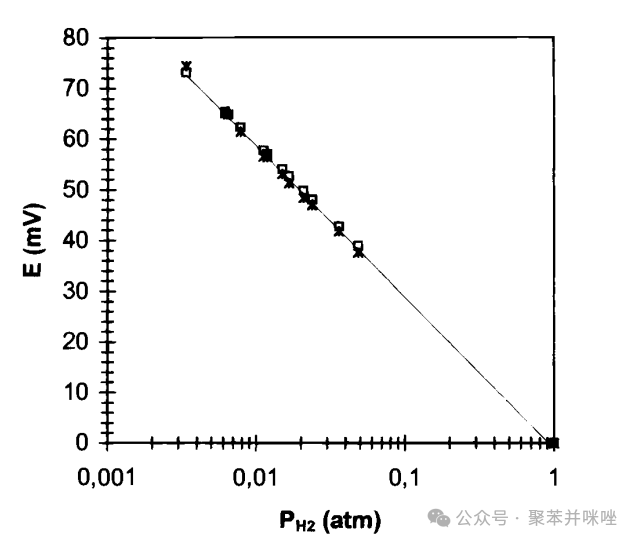
Figure 1. Potential response of the acid-doped PBI-based sensor to changes in hydrogen concentration in argon. (*) Experimental points, (-) theoretical points calculated according to the Nernst equation.
In dry air, the response time is 30 seconds. Figure 2 shows the relationship between the change in electromotive force and the logarithm of hydrogen partial pressure when the hydrogen concentration approaches the explosive limit in dry air. A linear relationship is presented, with a slope of 104 mV/dec. The sensor’s sensitivity is sufficiently high to detect changes in hydrogen concentration near the explosive limit.
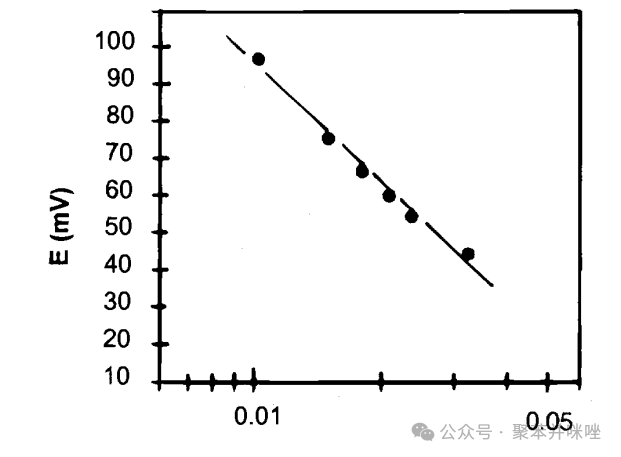
Figure 2. Potential response of the acid-doped PBI-based sensor to changes in hydrogen concentration in dry air, with hydrogen concentration approaching the explosive limit.
3.2 Validation of the Mixed Potential Model
Researchers have observed super-Nernst behavior and explained it using the concept of mixed potential. To validate this, the shape of the polarization curves for hydrogen oxidation and oxygen reduction was determined. Figure 3 shows the typical polarization curve for hydrogen oxidation at the Pt/acid-doped PBI interface in argon. The potential is measured relative to the Pt/H2 reference electrode (hydrogen partial pressure equal to 1.4×10⁻³ atm) and calculated according to the Nernst equation relative to the reversible hydrogen electrode (PH2 = 1 atm).
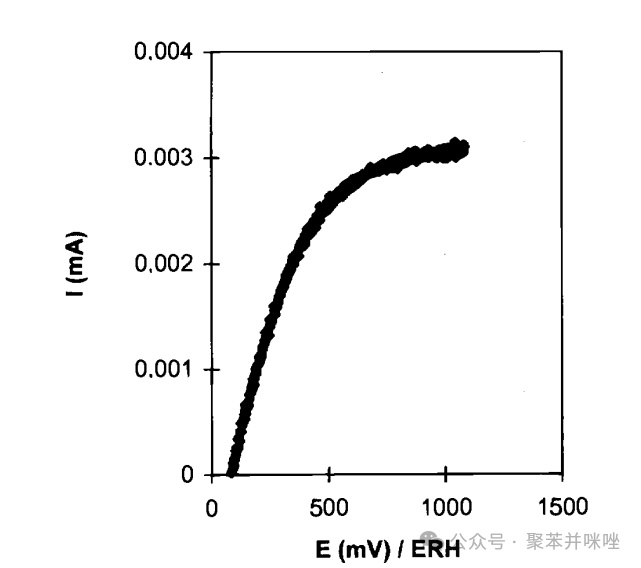
Figure 3. Polarization curve for hydrogen oxidation at the Pt/acid-doped PBI interface in argon. The hydrogen partial pressure in argon is equal to 1.4×10⁻³ atm. The electrode potential is calculated relative to the reversible hydrogen electrode (PH2 = 1 atm).
At low polarization, the shape of the curve can be explained by the contribution of ohmic drop. At high polarization, the limiting current I is reached. It was found that I is a function of hydrogen partial pressure. As expected, I increases with increasing hydrogen partial pressure. It can be inferred that the hydrogen oxidation process is controlled by hydrogen diffusion.
Figure 4 shows the cathodic polarization curve for oxygen reduction when the oxygen concentration is nearly equal to that in air. The potential is measured relative to the Pt/O2 electrode (oxygen partial pressure equal to 0.26 atm). Tafel-like behavior is observed. In the overpotential range of 0 to 300 millivolts, the following equation is followed:
E(O2) = a + b log I
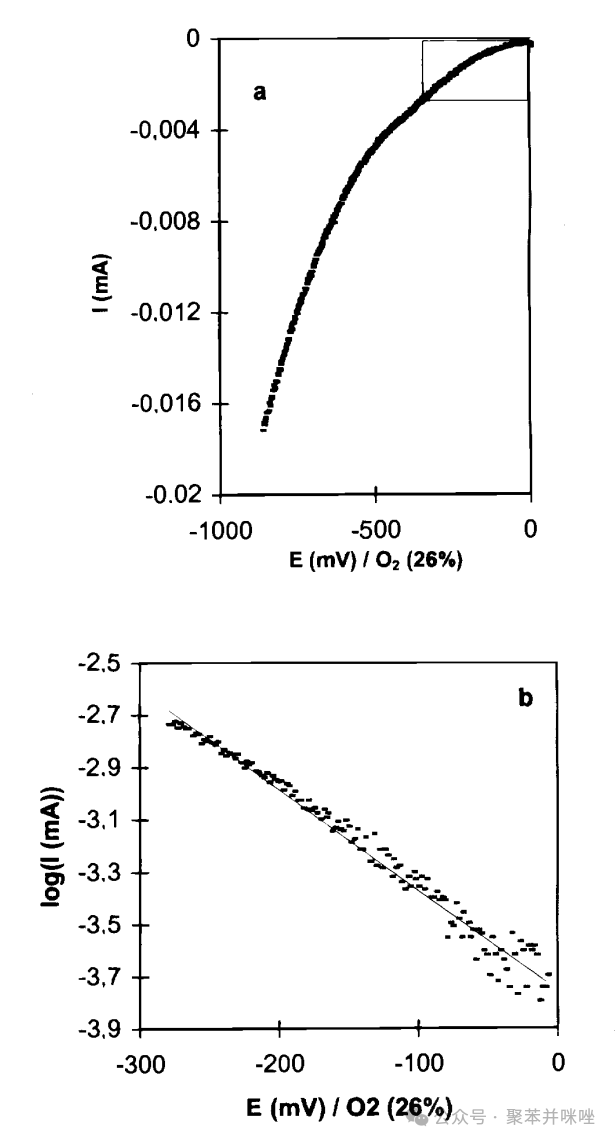
Figure 4. Polarization curve for oxygen reduction at the Pt/acid-doped PBI interface. The oxygen partial pressure in argon is 0.26 atm. The electrode potential is measured relative to the Pt electrode in the same atmosphere. (a) I-E plot and (b) Tafel plot.
Where a and b are constants. The value of b is equal to 110 mV/dec. This may indicate that the oxygen reduction process is controlled by kinetics. At high polarization, deviations from this linear dependence are observed. This may be due to contributions from ohmic drop or changes in the nature of the rate-limiting step.
The shape of the polarization curves and the slope of the E(O2) versus log I curve (oxygen reduction in air) are consistent with the slope of the E versus log PH2 curve (potential response in dry air), indicating that the mixed potential model proposed by Miura and Yamazoe can be used to explain the potential response of the Pt/acid-doped PBI interface to hydrogen in air. The electrode potential may be generated by the simultaneous occurrence of hydrogen oxidation and oxygen reduction. Consistent with the description by Miura and Yamazoe, the electrode’s response to hydrogen in air will exhibit a linear dependence on hydrogen partial pressure, with a slope equal to the Tafel slope for oxygen reduction.
3.3 Conclusion
From these preliminary results, it can be concluded that acid-doped PBI can be used as a membrane for hydrogen sensors detecting hydrogen at room temperature, even in dry air. The potential response of the sensing electrode is based on the concept of mixed potential.