Antibody-Drug Conjugates (ADCs) are considered the “star” drugs in the field of tumor therapy and are currently experiencing explosive growth. To date, 17 ADCs have received regulatory approval, with 13 approved by the U.S. Food and Drug Administration (FDA), and over 300 ADCs are in clinical development. These drugs are often likened to “precision missiles,” delivering cytotoxic payloads directly to tumor cells through the specificity of antibodies, thereby expanding the therapeutic window of chemotherapy.
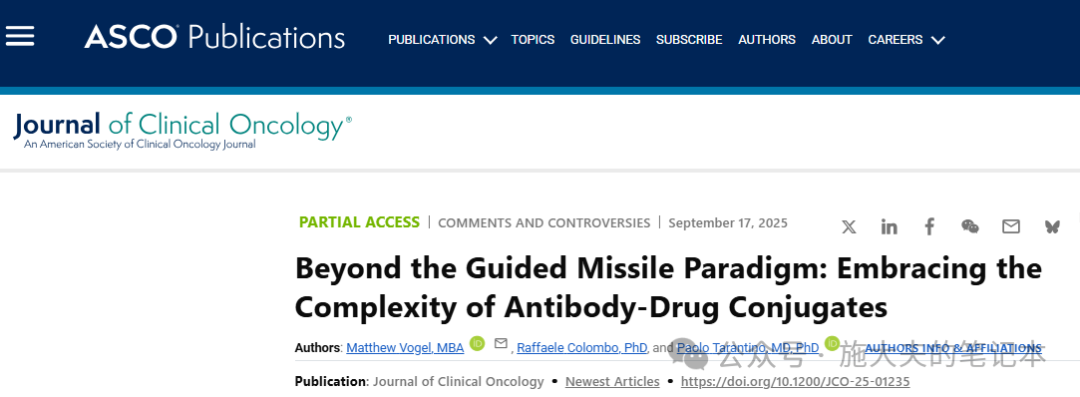
However, a recent review article published on September 17, 2025, in the Journal of Clinical Oncology titled “Beyond the Missile Paradigm: Embracing the Complexity of Antibody-Drug Conjugates” challenges this oversimplified description. The article points out that the mechanisms of ADCs are far more complex than imagined, and their “frenzied growth” does not solely rely on precise targeting but involves multiple factors such as continuous release in circulation, complex interactions within the tumor microenvironment (TME), and immune modulation. As young physicians, we need to move beyond superficial understanding and delve into the complexities of ADCs to guide clinical practice, avoiding blind optimism or oversimplification.
The development of ADCs traces back to the early 20th century with Paul Ehrlich’s concept of the “magic bullet,” which aimed to precisely kill cancer cells through targeted delivery of toxins (interestingly, the term “magic bullet” has been firmly embedded in our clinical templates for nearly a decade).

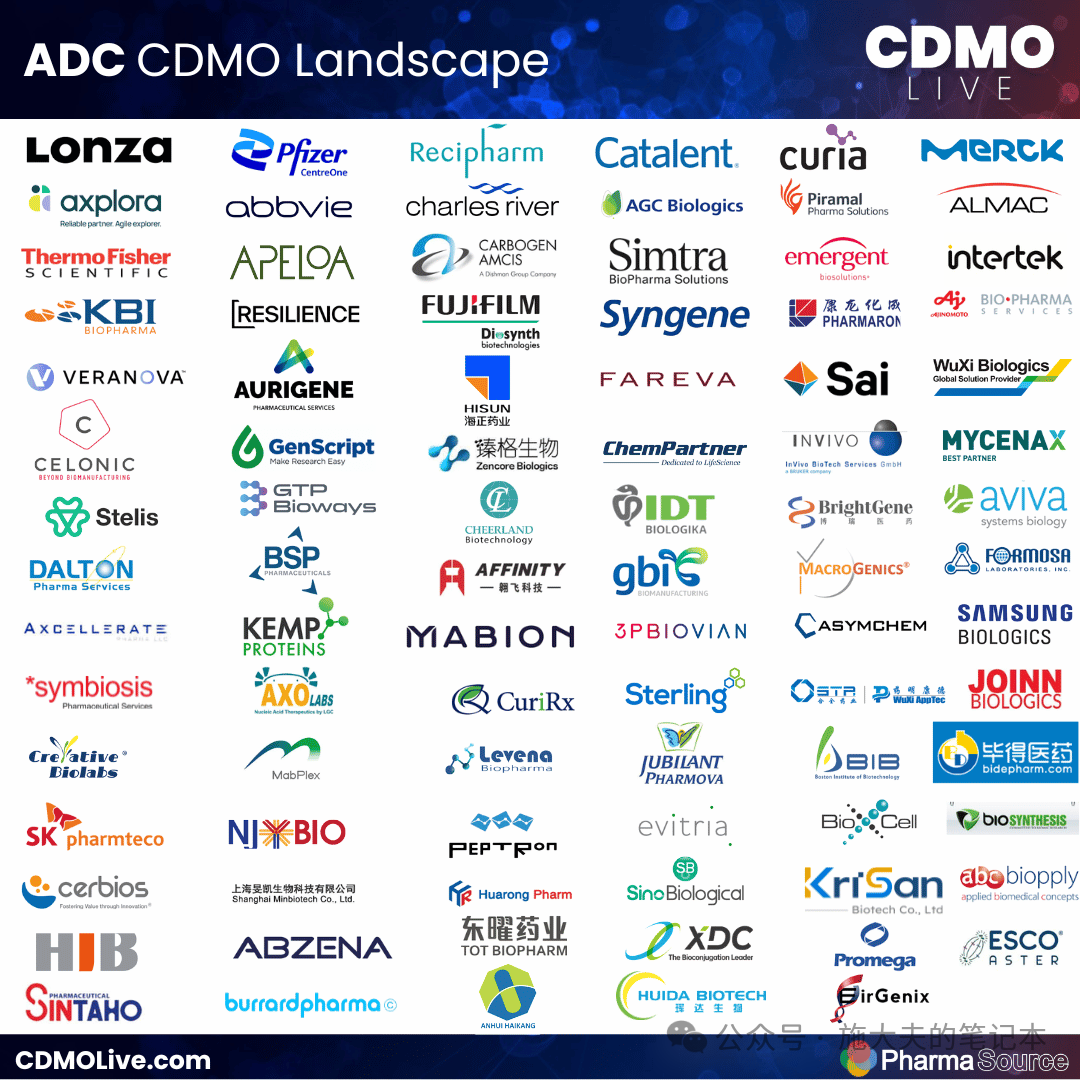
The concept was not realized until the 1970s, with early ADC attempts using mouse antibodies and simple chemotherapy drugs failing due to immunogenicity and low efficacy. In 2000, the first ADC—Mylotarg (gemtuzumab ozogamicin)—was approved by the FDA for acute myeloid leukemia but was withdrawn in 2010 due to toxicity and efficacy controversies, only to be reapproved in 2017, marking a turning point from “proof of concept” to clinical application. The pharmaceutical industry has noted that the 40-year development has been filled with lessons: from heterogeneous ADCs (such as uneven drug-antibody ratios due to random conjugation) to site-specific designs, the ADC market is projected to grow from $11.1 billion in 2025 to $42.2 billion by 2033, with a CAGR of 23% (Yahoo Finance market analysis, August 2025). However, real voices within the industry point out that the “frenzied growth” of ADCs, while resulting in 15 approved drugs (such as the commercial success of Enhertu), still faces unresolved issues of manufacturing complexity, toxicity, and resistance. Pharmaceutical giants like Pfizer and Merck are investing billions, but commentators warn that ignoring complexity may lead to high clinical failure rates (Nature Reviews Drug Discovery, July 2025). For example, Iwan Bertholjotti from Lonza (June 2025, Drug Target Review) emphasized proactive planning to avoid delays; a KPMG report (July 2025) noted that ADCs are changing the game but require clearer guidelines and biomarker-driven patient selection.
This article presents a Q&A format, focusing on habitual misconceptions, erroneous understandings, and cognitive blind spots in the development of ADCs, helping young physicians recognize that ADCs are not solely advantageous; their toxicity, complexity, and potential risks also require vigilance.
Q&A: Habitual Misconceptions, Erroneous Understandings, and Cognitive Blind Spots of ADCs
Q1: ADCs are viewed as “precision missiles”; does this mean their efficacy entirely depends on high antigen expression and internalization by tumor cells? (Common misconception: oversimplifying ADC mechanisms)
A: Misconception: Many believe that ADCs function like missiles, requiring only high antigen expression and internalization by tumor cells to precisely kill cancer cells. Actual situation: This analogy overlooks the continuous release in circulation and extracellular mechanisms; less than 1-2% of ADCs actually reach the tumor, with the rest distributed to normal tissues, leading to unexpected toxicity, such as increased toxicity of T-DXd in obese patients. In the tumor microenvironment, tissue protease L can promote extracellular payload release, allowing T-DXd to be effective even in HER2-negative tumors, but it may also spread non-targeted toxicity, such as interstitial lung disease. Furthermore, the heterogeneity of ADCs (e.g., uneven drug-antibody ratios) exacerbates clearance and resistance issues. Recommendation: Young physicians should adopt quantitative biomarkers, such as mRNA testing, to avoid misjudgment.
Q2: The antibody backbone of ADCs is merely a “delivery tool” and does not produce additional toxicity? (Erroneous understanding: ignoring immune modulation effects)
A: Misconception: Many believe that antibodies are just “couriers” for the payload and do not cause additional issues. Actual situation: The Fc region of antibodies has immune activation functions that can enhance efficacy, such as phagocytosis, but may also trigger additional toxicity, such as thrombocytopenia from T-DM1 or interstitial lung disease from T-DXd due to macrophage interactions. Emerging Fc-silenced designs can reduce these toxicities but may sacrifice some efficacy. Immune-stimulating ADCs (such as ISACs) further amplify immune effects but are prone to induce autoimmune responses. Dual payload ADCs, while promising, often face manufacturing complexities that lead to aggregation, increasing non-targeted toxicity and affecting immune cells. Recommendation: Clinical monitoring of immune-related adverse events is essential to avoid arbitrary combination therapies.
Q3: ADC resistance is solely due to the loss of target antigens; using ADCs with different targets can resolve this? (Cognitive blind spot: underestimating payload-related resistance)
A: Misconception: Many think resistance is simply due to the loss of target antigens, and switching to ADCs with different targets will solve the problem. Actual situation: Payload-related resistance is more common, such as mutations in topoisomerase 1 inhibitors leading to cross-ADC failure (e.g., poor prognosis after using SG following T-DXd). High expression of drug efflux pumps can also shorten survival, with significant risks in sequential use (e.g., decreased PFS and OS after T-DXd following TROP2 ADC). The heterogeneity of ADCs further accelerates these issues. Diversifying payloads is key, but emerging types like radioligands often fail due to high toxicity. Degradant-antibody conjugates (DACs) can block escape pathways, but toxicity may accumulate. Recommendation: Prioritize ADCs with different payloads and use computational modeling to optimize sequences.
Q4: ADCs are safer than traditional chemotherapy because their targeting avoids systemic toxicity? (Habitual misconception: ignoring hydrophobicity and aggregation issues)
A: Misconception: Many believe that the targeting of ADCs makes them much safer than chemotherapy, avoiding systemic toxicity. Actual situation: Lipophilic payloads can increase the hydrophobicity of ADCs, leading to rapid clearance and aggregation, which can induce toxicity in HER2-negative cells (including immune cells). A high drug-antibody ratio may appear powerful in vitro, but in vivo efficacy often diminishes. Unstable linkers can amplify systemic toxicity, similar to chemotherapy-related fatigue and hair loss. Dual payload ADCs complicate manufacturing, further increasing aggregation risks. Lessons from 40 years of development indicate that stability remains a blind spot. Recommendation: assess patient body fat distribution and monitor toxicity reactions throughout.
Q5: New ADCs like dual payloads or ISACs will completely resolve resistance and toxicity issues? (Future cognitive blind spot: manufacturing and clinical challenges)
A: Misconception: Many assume that new designs like dual payloads or immune-stimulating ADCs can permanently solve old problems. Actual situation: Dual payload ADCs can simultaneously target resistance pathways, but orthogonal chemistry and ratio control are complex, often leading to aggregation and increased immunogenicity. Immune-stimulating ADCs (ISACs) or degradant ADCs (DACs) can activate immunity but have high clinical failure rates, with toxicity easily accumulating. While computational modeling can accelerate optimization, ignoring the heterogeneity of the tumor microenvironment can lead to predictive biases. After 15 approved ADCs, linker and release mechanisms remain blind spots. The unresolved mechanistic mysteries of 40 years of development are similar to traditional chemotherapy. Recommendation: Actively participate in clinical trials, focusing on patient-centered approaches and avoiding blind pursuit of new technologies.
Conclusion
We have revealed the misconceptions behind the “frenzied growth” of ADCs: from simplified mechanisms to underestimated toxicity, and cognitive blind spots regarding resistance. Young physicians must embrace complexity and promote mechanism-driven practice. We recommend reading the full article for a deeper understanding.