
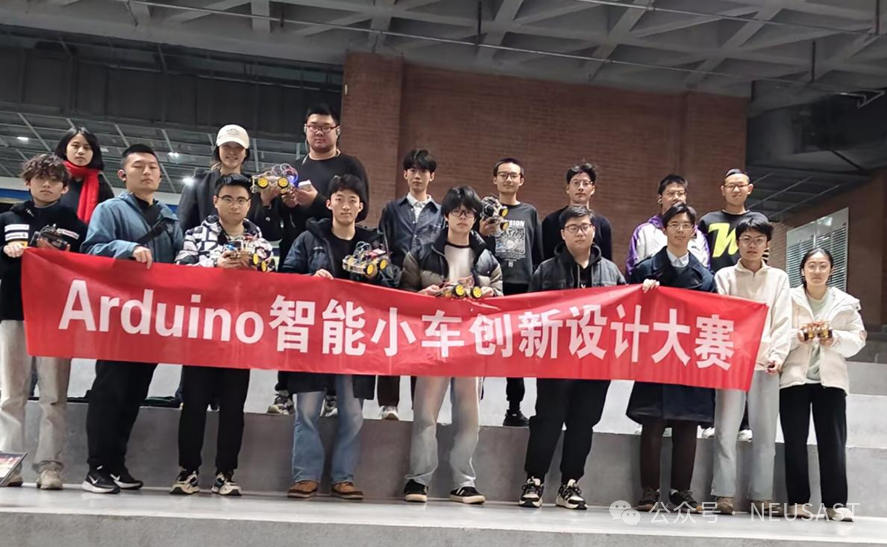
In response to the development needs of electronic information technology and intelligent control, and focusing on the cultivation of core competencies in the discipline, the Arduino Smart Car Innovative Design Competition, hosted by the Innovation and Entrepreneurship College of Northeastern University and organized by the Student Science and Technology Association of the School of Robotics Science and Engineering, has successfully concluded. This competition aimed to “solidify programming fundamentals and hone engineering practice” through a dual-track model of “theoretical assessment + practical competition,” providing students with a practical platform for “learning and application transformation,” helping them enhance key skills such as computer programming, hardware debugging, and teamwork, thereby laying a solid foundation for talent cultivation in the discipline and preparing for higher-level competitions.
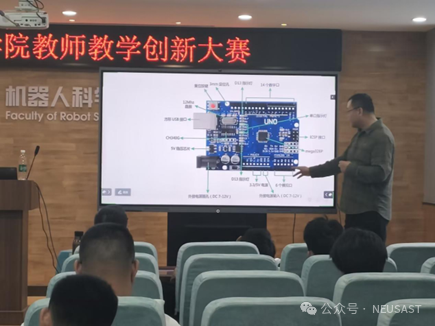
The competition process was divided into two stages: the qualifying round and the final. It systematically assessed the theoretical foundation and practical innovation capabilities of the participating teams. The qualifying round, held on October 26, focused on an online C language knowledge assessment, constructing a layered and multi-dimensional question bank system that comprehensively covered key knowledge points such as programming fundamentals and logical algorithms. Various question types were used to comprehensively test the theoretical reserves and code implementation capabilities of the participating teams. After a rigorous selection process, 20 teams stood out from 140 registered teams and successfully advanced to the finals. To assist the advancing teams in improving the quality of their projects, the Student Science and Technology Association provided basic materials needed for car production after the preliminary round and specially invited Teacher Wen from the School of Robotics to conduct specialized training on Arduino cars, answering students’ questions and imparting key technologies.
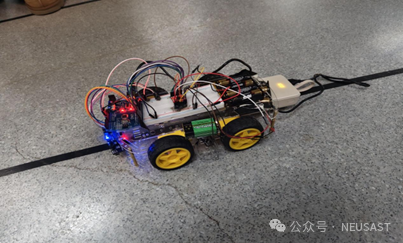
The finals officially commenced on November 16, focusing on practical competitions involving Arduino car line-following driving, with carefully designed competition tasks and venue rules centered around “accuracy, stability, and efficiency.” Before the competition, the organizers completed the construction of the competition venue, setting up various types of curves and opening the venue for contestants to conduct pre-competition debugging. The track not only tested the car’s line-following and turning capabilities but also thoroughly examined the contestants’ hardware design and production levels.
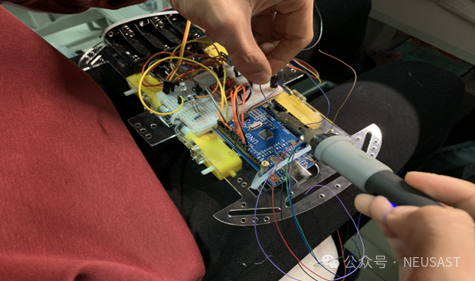
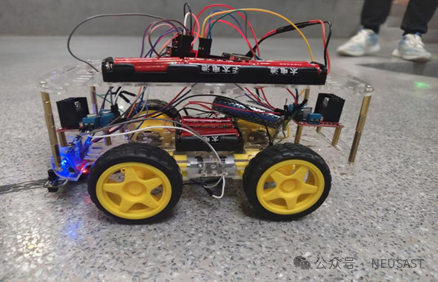
The atmosphere at the finals was lively, with 20 teams successfully completing their projects and participating in the on-site competition. The overall completion rate of the participating works was high, with many teams boldly innovating on the basic materials, incorporating features such as robotic vision technology for line-following and equipping multiple line-following sensors, fully demonstrating solid technical foundations and active innovative thinking. A comprehensive evaluation was conducted based on the completion rate and speed of the car’s line-following, ultimately awarding 1 first prize, 3 second prizes, and 4 third prizes.
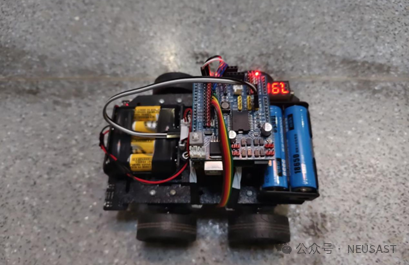
This competition stood out in its organizational format and activity design, constructing a competition system that deeply integrates “theory and practice.” The preliminary round focused on basic ability screening, while the finals emphasized practical ability competition, forming a virtuous cycle of “promoting learning through assessment and practicing through competition,” ensuring both breadth of participation and depth of competition. The successful hosting of this event not only effectively stimulated students’ enthusiasm for technological innovation but also cultivated a group of backbone talents with solid foundations and practical abilities, creating a good academic atmosphere of “valuing innovation and daring to practice,” and accumulating valuable experience for the construction of the college’s discipline competition system, becoming a vivid practical case of “education through competition.” In the future, the college will continue to build high-quality practical platforms to help students steadily advance on the path of technological innovation, delivering more outstanding talents for the development of related fields.

Reviewed by | Liu Yucen
Edited by | Zhang Zhixin
Source | Student Science and Technology Association of the School of Robotics Science and Engineering, Northeastern University
For more exciting content, please follow
【NEUSAST】 【Northeastern University QQ】【Northeastern University Innovation and Entrepreneurship WeChat】
▼