Author: Zhao XiaofeiIoT Think Tank Original
Recently, NVIDIA officially launched the new generation computing platform designed for physical AI and humanoid robots – NVIDIA Jetson Thor, which Huang Renxun described as “the ultimate supercomputer that opens the era of physical AI and general robotics.” Currently, many well-known domestic robot manufacturers have already adopted Jetson Thor, including United Imaging Healthcare, Wanji Technology, UBTECH, Galaxy Universal, Yushu Technology, Zhongqing Robot, and Zhiyuan Robot. While the media has extensively reported and analyzed the superior performance and specifications of Jetson Thor, I noticed a piece of news regarding the Jetson Thor ecosystem, where the overseas cellular IoT company Telit Cinterion’s 5G module products have completed verification testing with the Jetson Thor platform, including the validation of the RedCap module. High reliability and performance connectivity is a prerequisite for humanoid robots, and cellular IoT technology is becoming a competitive option for humanoid robot connectivity, providing strong support for embodied intelligence across various industries.
Cellular IoT Connectivity in the NVIDIA Jetson Thor Platform Ecosystem
The Jetson Thor released by NVIDIA not only boasts its own performance but also reveals some ecosystem information, including AI and system software and development services, as well as servers, edge devices, industrial PCs, carrier boards, sensors, etc. Among these, connectivity partners are also an important component of the ecosystem.
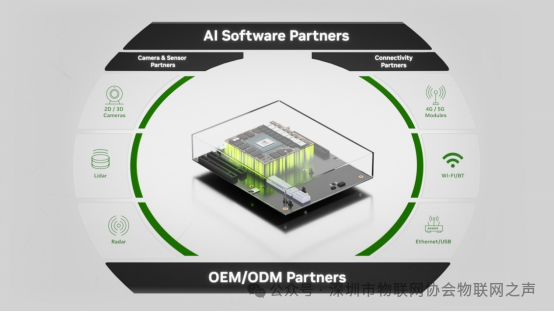
According to the Jetson Thor ecosystem partners announced on NVIDIA’s official website, the main connectivity technology partners are four companies: Infineon, Silex Technology, Telit Cinterion, and U-blox. Among them, Infineon and Silex Technology mainly provide WiFi solutions, while Telit Cinterion and U-blox primarily offer 4G/5G solutions.
In Telit Cinterion’s press release, it specifically mentioned the completion of verification testing with Jetson Thor for its 5G product portfolio, including the FE920C04 model, which is a 5G RedCap cellular IoT module designed to meet the connectivity needs of humanoid robots when paired with the Jetson Thor platform. Telit Cinterion stated that this integration will expand its support for the NVIDIA Jetson ecosystem, providing high-performance connectivity for the next generation of autonomous machines and mobile AI systems. In terms of application scenarios, NVIDIA’s official website indicates that it is mainly used in IoT, transportation, and healthcare robotics.
As we know, as the “new brain of robots,” the Jetson Thor computing platform integrates CPU, GPU, memory, connectivity, and power management modules. In terms of computing power, its single AI computing power reaches 1035 TFLOPS, and despite a significant performance increase, the overall power consumption of Jetson Thor is between 40 to 130 watts, achieving an energy efficiency ratio (AI computing power/power consumption) that is 3.5 times that of the previous Orin. With this high-performance brain, edge AI is set to experience rapid development. Although robots possess a powerful brain, they still need to interact with the cloud and among themselves, which heavily relies on wireless communication technology solutions. At this point, mature solutions such as WiFi, Bluetooth, and cellular networks become essential, which is also why NVIDIA is promoting wireless communication verification alongside the release of the Jetson Thor computing platform.
The Prominent Role of Cellular IoT in the Development of Embodied Intelligence
The explosion of artificial intelligence has also led to a surge in communication demands, with both aspects complementing each other. High-definition and 3D audio and video, XR glasses, smart connected vehicles, and intelligent agent applications will bring new impacts to all aspects of our lives. The normal practice of these applications creates new demands on wireless communication networks; at the same time, high-performance, high-reliability, and secure wireless communication will also accelerate the pace of industrial and production life intelligence. Whether it is the continuously evolving wireless local area networks or the commercialized 5G-A and the upcoming 6G networks, they will achieve comprehensive and in-depth integration with AI development.
Taking the development of humanoid robots as an example, the communication technology in this field is divided into internal and external communication. Internal communication typically uses technologies such as CAN (Controller Area Network) bus, FlexRay bus, and Ethernet to tightly connect the robot’s brain with various components to ensure internal coordination and efficiency; while external communication is achieved through wireless communication technologies, including WiFi, cellular networks, and cloud interactions, enabling the robot to interact with the outside world, including collaborative tasks and feedback.
Currently, embodied intelligence is a hot development area in artificial intelligence, and its application fields are not limited to humanoid robots but can support intelligent applications across various sectors of the national economy, including industry, logistics, transportation, and healthcare. Many scenarios face complex wireless environments, requiring intelligent IoT (AIoT) to connect more objects and provide richer applications, where various mature and cutting-edge connectivity technology solutions can find a place in the development of embodied intelligence.
Cellular IoT has formed multiple levels of connectivity solutions, especially as 5G begins to embrace compatibility with various connectivity technologies, providing support for the implementation of embodied intelligence at the wide-area connectivity level. Cellular IoT plays an important role in the cloud-edge-end collaboration of embodied intelligence, mainly including:
1. Data interaction between the server side and the cloud side.Embodied intelligence terminal models require multi-modal data support for algorithm iteration, including training text, images, audio and video, and various sensor data. Reliable external communication channels are needed for data upload and download between the cloud and the embodied intelligence physical entity, especially when it is in large-scale mobility and various complex environments, where cellular IoT channels become essential.
2. Providing stable channels for over-the-air (OTA) upgrades of embodied intelligence carriers.Smart connected vehicles commonly use OTA upgrades to quickly fix system defects and achieve firmware iteration. In other scenarios of embodied intelligence during commercialization, software algorithms need continuous updates and iterations, which can be achieved through cellular networks for OTA upgrades.
3. Supporting remote monitoring and control of embodied intelligence systems.Considering the safety and efficiency factors of the working state and hardware indicators of embodied intelligence physical entities, cellular IoT communication networks can empower remote management of behaviors such as location monitoring, operational faults, maintenance, and task supervision, enhancing the efficiency of embodied intelligence systems.
4. Supporting information exchange and collaboration between different intelligent agents.As the application scenarios of embodied intelligence diversify, their tasks often involve multiple intelligent agents, which require efficient information fusion and collaborative operation to complete tasks together. In this process, a highly reliable communication network becomes particularly important.
Cellular IoT has formed a broad technical system that can support various types of devices to connect, especially since 5G has begun to promote inclusive development of various types of technologies, including passive IoT, NB-IoT supporting massive low-power, low-cost devices, RedCap supporting mid-rate devices with certain performance requirements, and high-speed, low-latency, high-reliability communication guarantees. At the same time, with the freezing of the 5G NTN standard in the 3GPP R17 version, communication connection services relying on geostationary satellites are also gradually maturing. With the commercialization of 5G-A and the advancement of 6G research, features such as immersive communication, massive-scale connectivity, ultra-high reliability and low latency, AI and communication integration, synesthetic integration, and ubiquitous connectivity will provide broader support.
The application range of embodied intelligence is extensive, and different embodied intelligence systems have varying requirements for external communication in terms of bandwidth, latency, mobility, connection scale with various external devices, and reliability. Various cellular IoT technologies can provide support as needed. The recent verification testing of NVIDIA’s Jetson Thor platform and 5G IoT, especially the RedCap module, indicates that RedCap can meet various communication needs in many scenarios supporting humanoid robot external communication. In various industry scenarios, due to operational environments and task requirements, different technologies such as passive IoT, NB-IoT, or eMBB, uRLLC can meet the specific needs of embodied intelligence systems.
Although wireless networks are not the core module of the embodied intelligence brain, they are a prerequisite for the effective operation of embodied intelligence systems. The testing and verification of NVIDIA’s Jetson Thor platform and 5G IoT modules reflect the feasibility of integrating humanoid robots with cellular IoT technology. As embodied intelligence is applied more deeply across various fields, cellular IoT will also become an important component of the embodied intelligence ecosystem.