01
Educational resources should dynamically adapt to frontline teaching needs
Making good use of digital educational resources is a systematic project that involves various aspects of education and teaching, including the educational concepts and technological perspectives of teachers and students, information technology literacy, as well as curriculum reform and teacher training. It also involves the services provided by digital educational resource providers, such as technical support, operational management, and the overall top-level design and governance strategy for the digital transformation of education. The construction and application of digital educational resources require comprehensive governance, holistic reform, coordinated planning, and collaborative action. The iceberg model can summarize the overall development ideas of educational resources (see the figure below).
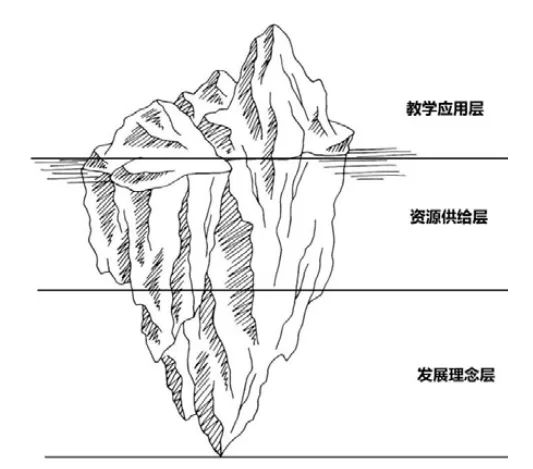
Diagram of Educational Resource Construction and ApplicationThe application of educational resources in teaching is the part of the iceberg model that floats on the “water surface”. This part can be felt most directly and is often the focus of concern and discussion; it is also the ultimate service purpose of educational resource construction. To support the entire iceberg, it is more important to focus on the “underwater” work of resource supply. The arduous labor of educational resource builders “underwater” is substantial, and I refer to them as unsung heroes. Fundamentally, the development philosophy layer at the bottom influences the development of educational resources across the country. Although this is something we usually “cannot see,” it plays a guiding role and determines the development path and direction of educational resources.From the feedback of teacher practices, the “last mile” problem encountered in the construction and application of digital educational resources at all levels may be stuck in service. Currently, the main offerings to teachers and students nationwide are “product services,” including articles, lesson plans, PPTs, course videos, and virtual experiments. When teachers and students use these already productized high-quality resources, they cannot dynamically generate to meet their needs, while the teaching and learning activities of teachers and students require personalized “dynamic services.” The key to solving the “last mile” problem in the construction and application of educational resources is how to transform educational resources from fixed products into “dynamic services” that can adapt to frontline teaching needs.02
Ways for Frontline Teachers to Utilize Digital Educational Resources Effectively
The characteristic of educational “dynamic services” is that educational resources can dynamically provide resource services that meet user needs based on the specific scenarios and demands of each teacher and student in teaching activities. After nearly two years of practice, teachers across various regions have combined national and provincial educational resources with their own classroom teaching, transforming digital educational resources into services suitable for their classroom teaching through different methods. For example: (1) Teachers perform secondary processing on existing digital educational resources to convert them into content suitable for their classroom teaching. This is currently the most common way for teachers to utilize digital educational resources. During training to enhance teachers’ information technology literacy, the most favored content among frontline teachers is how to search for and download educational resources, as well as how to process and edit images, videos, documents, and other resources to create their own teaching PPTs and micro-course videos, reflecting the strong demand of teachers to transform digital educational resources into their own teaching services. (2) Using digital educational resources as learning materials for teacher professional development. This is a practice adopted by many young teachers who love education and are committed to continuously improving their teaching skills. They often transfer excellent teaching examples they see from digital educational resource platforms and various online platforms into their own teaching. (3) Teachers directly use course videos from digital educational resource platforms to teach students in class, supplemented by their explanations. This method is currently widely used in schools in rural or remote areas where teacher resources are relatively scarce. Due to the practical achievements of previous national projects like “Connecting Every School,” most rural and remote schools now have the conditions to use digital educational resources in class, although factors such as teacher training and overall quality influence whether they adopt this method for digital teaching. (4) The latest development is the application of generative artificial intelligence in digital teaching. Teachers combine digital educational resources with generative artificial intelligence, cleverly transforming learning content from digital educational resource platforms into dynamically generated services, allowing students to experience a completely different learning experience compared to merely watching course videos.03
Generative Artificial Intelligence as an Intelligent Assistant
As the application of digital educational resources deepens, we further recognize that digital educational resources provide not only products but also need to offer “dynamic services” that suit teaching needs. How can we make digital educational resources suitable for personalized teaching needs in a “generative” manner? This “last mile” problem has been troubling us. Today, generative artificial intelligence is like a roaring wave of the 21st-century industrial revolution that completely overturns our understanding of computers and educational resources; this will be an important milestone on the path of educational resource development. The difference between generative artificial intelligence and all previous information technologies applied in education is that the generative AI model, pre-trained on massive data, can generate personalized content in response to each interaction with students, precisely addressing the “last mile” shortcomings of digital educational resources built on the internet and multimedia technology. Teachers from primary schools in various regions, such as the Old Fort Qiang Township Central Primary School in Pingwu County, Sichuan Province, and the Fourth Primary School in Hezuo City, Gansu Province, have combined the national smart education public service platform with generative artificial intelligence, guiding students to interact with generative AI while learning course videos, thus transforming generative AI into an intelligent teaching intermediary that connects digital educational resource products with the “dynamic services” needed by teachers and students (Agent, or referred to as intelligent assistant).04
Teachers and Students are Both Consumers and Builders of Resources
To solve the “last mile” problem in the construction and application of digital educational resources with generative artificial intelligence, the key is to improve the accuracy of the information output by generative artificial intelligence. Therefore, constructing and applying high-quality, education-focused data training models is essential to reduce content creation bias and enhance the accuracy of educational knowledge generation, appropriateness for subject segments, and controllability and safety of ideologies; this is the necessary path for generative artificial intelligence to empower the digital transformation of education. Currently, notable developments include Retrieval-Augmented Generation (RAG) and Human-in-the-Loop (HITL) technologies, known as “hybrid augmented generation technology,” which will address the accuracy challenges of generative artificial intelligence output. Retrieval-Augmented Generation technology combines pre-trained parameters with non-parametric memory for language generation, dynamically retrieving relevant information from external knowledge sources provided by users to offer professional and up-to-date background information for large language models, guiding the generation process and improving the accuracy and relevance of responses. Human-in-the-Loop technology is a way of human and AI collaborative work and learning, embedding human roles into AI systems, combining human higher-order thinking abilities with the powerful computing and storage capabilities of computers to form a hybrid intelligent system with humans in the loop, where human intervention becomes part of the operation of intelligent systems, achieving the best effect of human-machine wisdom collaboration.
Based on the application of large models using Retrieval-Augmented Generation technology and the hybrid intelligent system with humans in the loop, the construction of digital educational resources will change the construction philosophy and operational mechanism of digital educational resources, transforming them into a two-way service: not only do digital educational resources serve teachers and students, but teachers and students also provide wisdom services for the construction of digital educational resources, shifting from being one-way resource consumers to resource builders and wisdom contributors.
Content Source │ People’s Education, 100 People in Educational InformatizationSource │ Information Technology Education in Primary and Secondary SchoolsTypesetting | Yi Dan Initial Review | Xu JingchengRe-examination | Lu Qiuhong Final Review | Su Jinzhuzhu