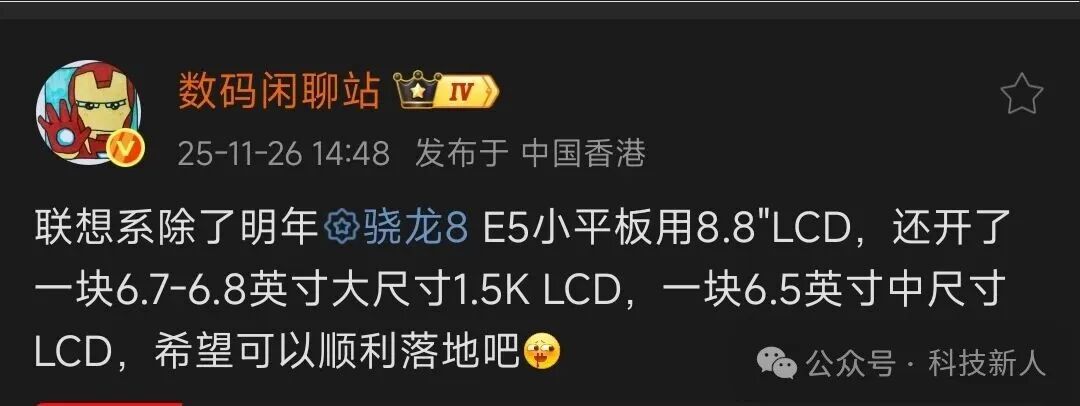
For many years, the slogan “LCD will never be a slave” has echoed in the digital community. Just when everyone was about to lose hope, Lenovo suddenly stepped up: “Comrades, I have brought the goods!” Indeed, according to digital bloggers, Lenovo has not only revealed the previously announced 8.8-inch Snapdragon 8E5 tablet but has also secretly prepared two additional LCD screens.
It feels like ordering a dish at a restaurant, expecting just one main course, only to be served a full banquet.
Three-Pronged Approach: Lenovo’s LCD “Naval Warfare Strategy”
Let’s take a look at how extravagant Lenovo’s move is: an 8.8-inch flagship tablet, a 6.7-6.8 inch 1.5K large screen, and a 6.5-inch medium-sized screen. This covers all sizes from small tablets to large-screen phones, indicating Lenovo’s commitment to LCD technology! Among these, the most drool-worthy is undoubtedly the 6.7-6.8 inch 1.5K LCD screen. It is known that when the screen size increases to around 6.8 inches, the improvement in clarity with a 1.5K resolution is quite significant. Moreover, this screen is likely the top-tier LCD screen released by BOE in September, boasting stunning specifications: a pixel density of 446 PPI, peak brightness of 1500 nits, a refresh rate of 144Hz, and it has resolved the longstanding issue of LCD motion blur. These specifications are competitive even within the OLED camp. Lenovo is truly pushing LCD to its limits!
Legion Y700 Iteration: The “Performance Monster” Tablet
Of course, the most anticipated is the 8.8-inch Snapdragon 8E5 tablet, which is likely the next generation of the Legion Y700. It is rumored that this tablet will not only feature the Snapdragon 8 Elite Gen5 processor but also potentially increase the battery capacity to 9000mAh, supporting a high refresh rate of 165Hz. Imagine a powerful, long-lasting small tablet—it’s a dream device for mobile gamers. The current Y700 already comes with an 8.8-inch LCD screen, a resolution of 3040×1904, supporting a 165Hz refresh rate and a 360Hz touch sampling rate. The new model will further improve screen-to-body ratio, heat dissipation, and thinness.
Why is Lenovo Going Against the Tide? What are the Advantages of LCD?
In today’s OLED-dominated market, why is Lenovo choosing to “go against the historical trend”? The answer is simple: there is still a large user base with a strong preference for LCD screens. LCD screens have advantages that OLED cannot match: lower flicker, longer lifespan, and relatively lower costs. For users sensitive to eye strain, the DC dimming feature of LCD screens can effectively reduce visual fatigue. 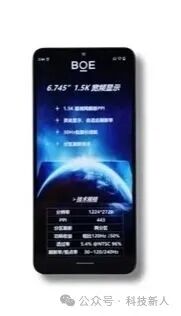 Recently, Lenovo’s released moto g100 and g100s phones both feature 6.72-inch LCD screens, supporting a 120Hz refresh rate and full DC dimming, clearly targeting the “eye protection” market.
What Will Future LCD Devices Look Like?
In the comments section of the leak, some users inquired whether there would be an iteration of the LCD screen tablet with SIM card support, especially with a battery capacity of over 9500mAh. The blogger responded that they would consider user feedback. If this idea comes to fruition, it would be the ultimate dream for digital enthusiasts—large battery, expandable storage, top-tier LCD screen, and flagship performance; such a device could last for many years. However, some netizens mentioned the development prospects of MicroLED technology, suggesting a shift towards more advanced display solutions. The blogger indicated that the application of MicroLED in mobile devices still requires time, with initial production expected no earlier than the end of 2027, and mass production possibly waiting until 2028. Therefore, LCD still has a few years of golden development ahead.
What is Lenovo’s Strategy Behind This Move?
Lenovo’s combination of LCD products may seem to go against the trend, but it is actually quite clever. While everyone is chasing OLED, Lenovo is committed to providing high-quality options for LCD users, which not only wins the favor of a specific user group but also creates a competitive advantage in niche markets.  From the product layout, Lenovo’s goals are clear: the 6.5-inch and 6.8-inch screens are likely intended for mobile products, while the 8.8-inch screen is for small tablets, covering nearly all mainstream mobile device size requirements. Especially the 6.8-inch 1.5K LCD screen, if paired with a next-generation flagship chip, could create quite a stir in the cost-performance market.
Conclusion: Is the Spring for LCD Fans Finally Coming?
These past years have indeed been tough for LCD fans. Every time they wanted to change their phone, they had to search through a plethora of OLED models to find the few LCD options, often with unsatisfactory specifications. However, Lenovo’s recent move undoubtedly provides a strong boost for LCD fans. With three different sizes of LCD screens covering various usage scenarios from phones to small tablets, it clearly shows Lenovo’s commitment to the LCD market. If these products can be successfully launched at reasonable prices, then “LCD will never be a slave” will no longer be just a slogan, but a tangible choice. However, currently, this information is still in the leak stage, and specific parameters will need to wait for official announcements. Regardless, having options is always a good thing. For users long blinded by OLED, Lenovo’s new LCD products are undoubtedly worth looking forward to. So, LCD fans, are your wallets ready? Perhaps next year will truly be our “spring”! The pressure is now on other phone manufacturers; Lenovo has made its move, will you follow suit?