The world is developing too quickly, and we must keep pace; otherwise, we will be left behind. We must learn to adapt. Many things that have formed a fixed impression in everyone’s mind are no longer what they used to be. For example, the general impression of Bluetooth is that as long as you turn on your phone’s Bluetooth, you can transfer songs and videos, and connect Bluetooth headphones to listen to music and make calls. However, that is not the most powerful aspect of Bluetooth. Today’s Bluetooth has evolved from the initial classic Bluetooth (commonly BLE 2.1 and BLE 3.0) to the current low-energy Bluetooth (BLE 4.0, BLE 4.1, and BLE 4.2). Currently, the most widespread application of low-energy Bluetooth modules is in smart homes and indoor positioning.
Since BLE Bluetooth modules can be applied in smart homes and indoor positioning, their role is naturally significant. What powerful features does the “BLE Bluetooth Module” actually possess? Please see the following real-time explanation from the editor:
1. Low Power Consumption
For the industrial and smart home sectors, the role of Bluetooth modules is mostly to be placed in a smart device or control device, powered by a button battery, and then transmit and control data wirelessly. Most of these smart devices need to be used for long periods, so power consumption is crucial. Many mainstream low-energy Bluetooth modules on the market can achieve power consumption below 1mA (milliamp) in broadcast mode, and can even reach below 200μA (microamp) in low-power mode. The power consumption of low-energy Bluetooth modules must remain within this range to ensure long-term use of button batteries. Of course, it is also necessary to ensure that the Bluetooth module operating at such low power can be quickly awakened. For example, when you get home from work and want to wake up the device loaded with the Bluetooth module using your phone, you need to quickly wake up these devices. Nowadays, power consumption is increasingly becoming a priority in selecting a low-energy Bluetooth module.
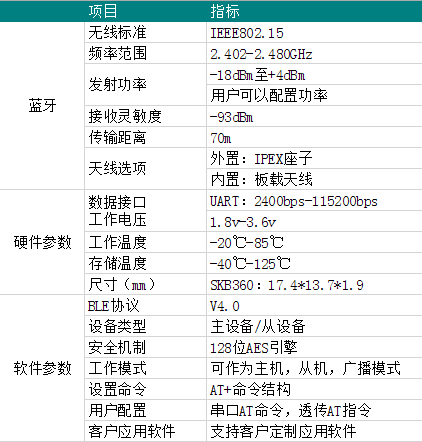
SKB360/SKB361/SKB362 from Tiangong Measurement and Control are all low-energy Bluetooth modules
Functional Overview: TTL Serial Port and Bluetooth Data Transparent Transmission
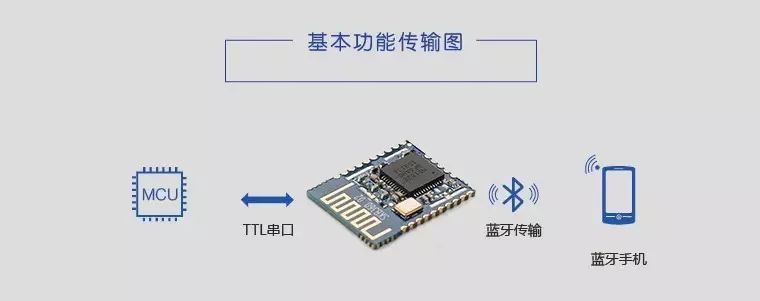
SKB360 is a low-energy BLE module that supports Bluetooth v4.0 BLE protocol, allowing traditional serial devices or MCU-controlled devices to perform wireless data transmission.
Multiple Configuration Methods
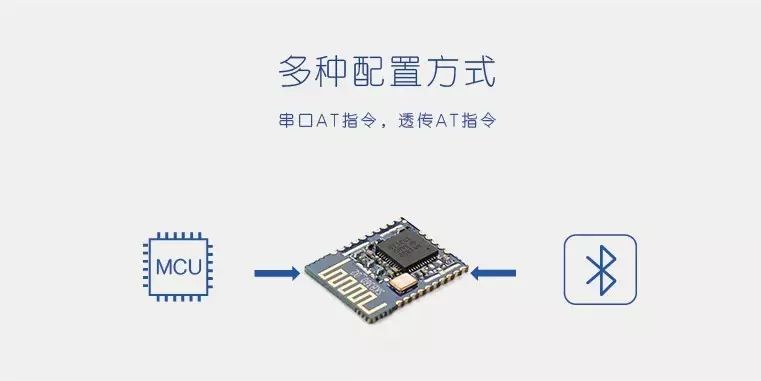 Supports both TTL serial port and Bluetooth configuration methods.
2. Master-Slave Integration
The Bluetooth module can act as both a master and a slave. The master can search for other Bluetooth modules and actively establish connections, while the slave cannot actively establish connections and can only wait for others to connect to it. The master-slave integration feature allows the serial Bluetooth module to be used as both a master and a slave. Although this feature seems very ordinary, its application value is significant. In the industrial sector, we only need simple data transparent transmission functionality, without constantly dealing with Bluetooth protocols. Therefore, in master-slave mode, we set one serial Bluetooth module as the master device and another as the slave device. Once connected, data can be transmitted transparently without any protocol.
SKB360 can also act as a master or slave, master-slave integration
Master-Slave Integration
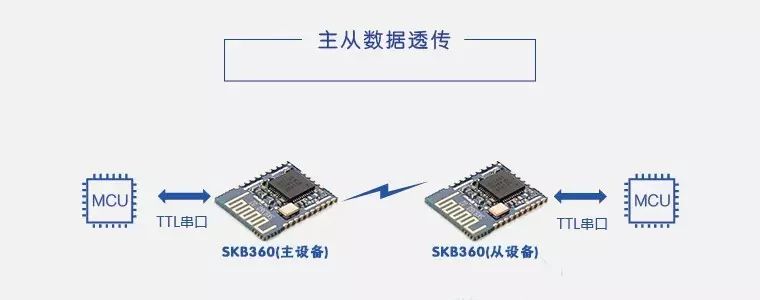 This Bluetooth module has master-slave integration (default slave mode) and can use a master-slave configuration for data transparent transmission.
Industrial Grade
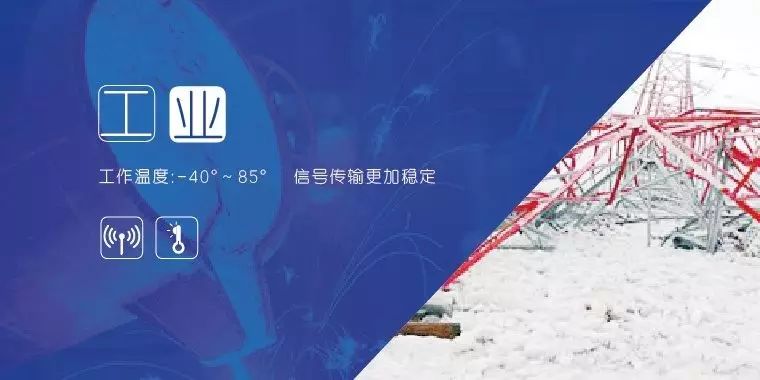 Complies with industrial-grade standards and can adapt to various harsh environments, with a working temperature range of -40 to 85℃.
3. Bluetooth Mesh Networking
Bluetooth modules have often been criticized for their short transmission distances and poor networking capabilities. Therefore, their application in the smart home sector is relatively weak. However, mesh networking technology precisely addresses these two major shortcomings of Bluetooth. The mesh networking method utilizes the characteristics of Bluetooth broadcasting, allowing data transmission without needing to connect. This way, we can use the mesh distribution of multiple Bluetooth modules to enhance Bluetooth wireless coverage and data transmission distance, combined with Bluetooth’s low power consumption, low cost, and high security advantages, making it easy to apply in various fields.
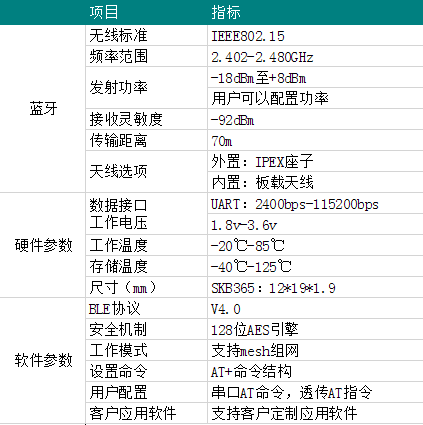
Tiangong Measurement and Control’s SKB365 is a mesh networking Bluetooth module
Self-organizing Mesh
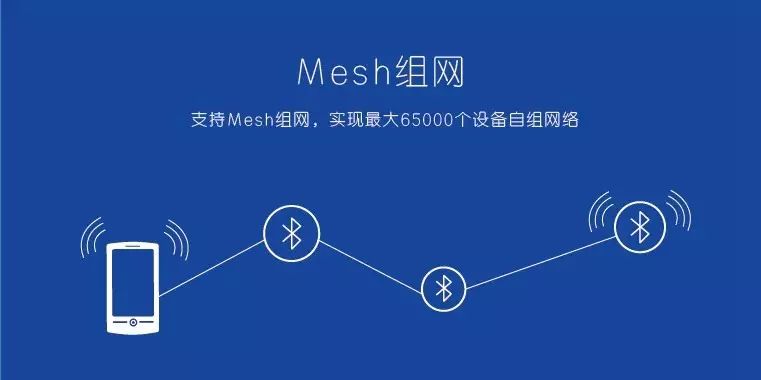 SKB365 supports mesh networking functionality, enabling over 65,000 devices to form a self-organizing network.
Data Transparent Transmission Replacing Data Cables
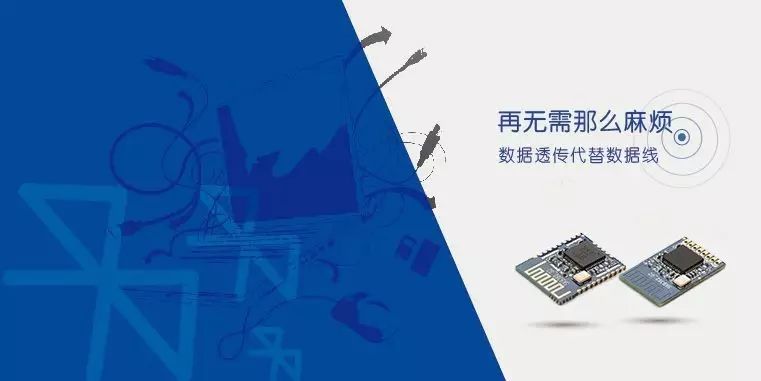 Utilizing the master-slave integration and mesh networking features of Bluetooth modules, we can replace complex wiring with Bluetooth wireless!
4. Bluetooth Beacon
A beacon is a broadcasting protocol built on the basis of the low-energy Bluetooth protocol, and it is also a low-energy Bluetooth device (slave) that possesses this protocol. As a beacon device, it is typically placed in a fixed position indoors, continuously broadcasting to the surroundings, but it cannot connect with any low-energy Bluetooth master. All broadcast data is arranged according to specific rules. In applications, Bluetooth beacons can also be used for indoor positioning. By placing the Bluetooth module in a fixed location indoors, when a phone turns on Bluetooth and uses an app, it can obtain its location. The information push function allows the other party to push some pre-set information to our phone when we walk near the Bluetooth module. Moreover, WeChat’s shake feature has also integrated beacon functionality. For example, when we are dining in a restaurant, turning on Bluetooth and shaking WeChat can provide us with various information about the restaurant. Bluetooth beacons represent a very novel interactive method, with a broad prospect in the smart field.
The SKYLAB Beacon configuration is a mobile application developed by the SKYLAB R&D team specifically for the “SKYLAB Beacon.” This application allows users to connect their phones to the “SKYLAB Beacon” and modify parameters such as UUID, Major, Minor, Beacon name, etc. These parameters will be broadcast as information once the broadcast mode is activated, making it used for product promotions in large shopping malls!
Built-in iBeacon Protocol
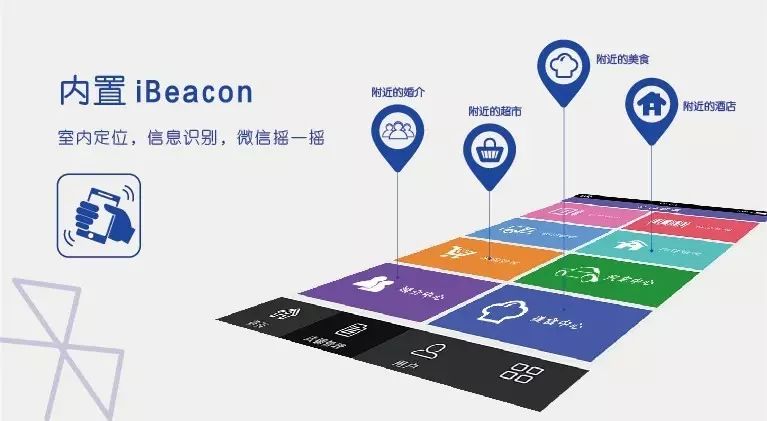
In broadcast mode, it supports iBeacon functionality, widely applied in: indoor positioning, near-field information push, identity recognition, WeChat shake nearby, Bluetooth anti-lost devices, etc.
Bluetooth Positioning Applications

Applicable for indoor positioning, underground positioning, etc.
Examples of underground applications: using Bluetooth to send alarms, operations, etc., and view underground locations in real-time.
Summary:
The SKYLAB BLE Bluetooth module is already comprehensive enough! As an industrial-grade low-energy Bluetooth module, it possesses: ultra-low power consumption, long-distance transmission, and a wide voltage range. Supported functionalities include: v4.0 BLE protocol, master-slave integration, battery detection, encrypted transmission, multiple configuration methods, mesh networking, one-to-many broadcasting, and iBeacon protocol.