Sony Semiconductor Solutions has officially launched the new mobile image sensor LYTIA 901, which, with its ultra-high resolution of 200 megapixels and groundbreaking dynamic range performance, is expected to significantly enhance the imaging systems of next-generation smartphones.
As the successor to the LYTIA 900, the new sensor shows a clear evolutionary path in its specifications. The LYTIA 901 features a 1/1.12-inch sensor size, slightly smaller than the previous generation’s 1/0.98-inch, but its pixel count has dramatically increased from 50 million to 200 million, with individual pixel sizes reduced to 0.7 microns.
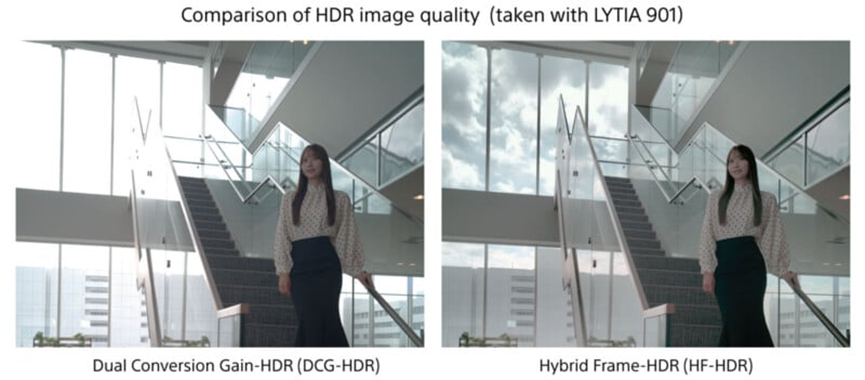
Despite the smaller pixel size, Sony has achieved a leap in dynamic range performance by introducing a new “Hybrid Frame HDR” technology. Official data indicates that the dynamic range performance of HF-HDR technology can exceed 100dB, potentially translating to nearly 17 stops in actual imaging, which is more than double the performance of traditional DCG-HDR technology. Comparison images show that the new technology effectively suppresses highlight clipping and enhances shadow detail, making the final images closer to what the human eye perceives.
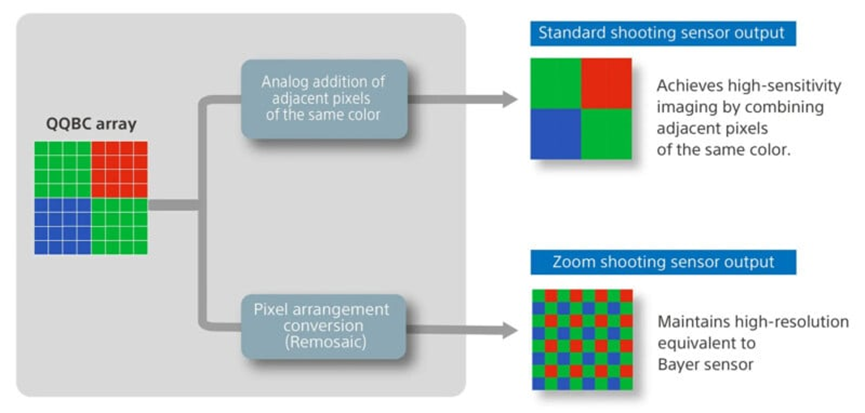
Another core innovation of the sensor is its new “Quad Bayer” pixel array. This design aggregates 16 same-color pixels into a single super pixel unit, functioning as a large pixel under normal shooting conditions to ensure light intake and sensitivity, while during zoom shooting, it can reallocate signals to simulate a higher resolution Bayer array output, thus achieving a better balance between resolution and sensitivity.
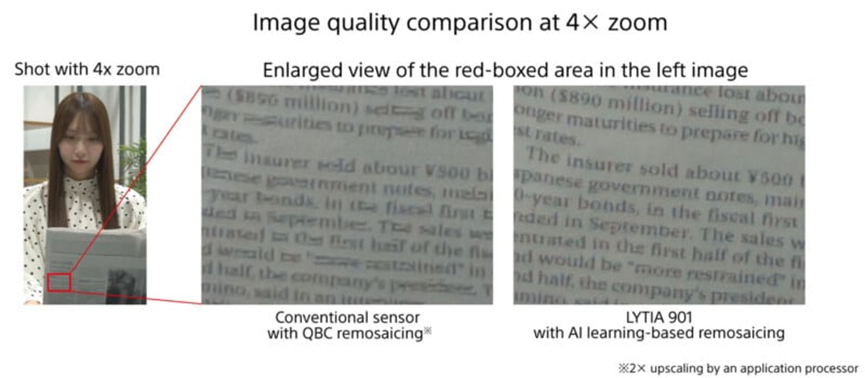
This complex signal processing requires high computational power, which is why the LYTIA 901 integrates dedicated AI processing circuits within the sensor for the first time. This allows the sensor to process high-frequency detail signals in real-time and apply AI-based demosaicing algorithms, ultimately maintaining high-quality image reproduction at 30fps during 4x zoom 4K video shooting. Comparison images show that its clarity significantly surpasses that of traditional sensors when processing fabric textures and small text details.
In terms of basic performance, the LYTIA 901 supports full-resolution 200-megapixel RAW format photo capture, with a maximum continuous shooting speed of 10fps; it can also output 50-megapixel images, achieving 30fps continuous shooting. In terms of video capabilities, it supports recording specifications of 8K 30p and 4K 120p, providing a professional imaging foundation for mobile devices.
Sony has announced that the LYTIA 901 image sensor is now available on the market and is expected to be featured in new flagship smartphones from various brands in the near future.
What will Canon’s next move be? Several new EOS R models and lenses may already be on the way.Panasonic has launched significant updates for the LUMIX S1 II and S1R II, greatly extending video recording times.Will the Fujifilm X-T6 debut in 2026? The layout of the sixth-generation model remains uncertain.Rumors about the Sony FX8 suggest a 12K sensor may pave the way for the A7R6, with 4K120p cropping drawing attention.2999 euros? The Sony A7V is expected to be released on December 2, with key features like 14-bit RAW and 30-frame continuous shooting revealed.Arri’s lighting business is being divested, possibly paving the way for a merger with Canon.Follow + star to receive article notifications promptly, thank you for reading; if you like it, please click 【like】+【read】 in the lower right corner and share it with those around you.