
Research Background
Flexible strain sensors have wide applications in electronic skin and health monitoring, capable of detecting signals such as pulse, heartbeat, blood pressure, muscle movement, vocalization, and even facial expressions. Numerous studies on flexible strain sensors based on nano materials like silver nanowires, carbon nanotubes, and graphene have been conducted, enhancing their sensitivity and stretchability through various aspects such as piezoresistive principles, sensor structure design, and elastomer encapsulation layers. However, a significant challenge remains in developing strain sensors that possess both conductivity and large stretchability, as conductive materials and pathways are prone to breakage during stretching, or neighboring nano materials may lose contact, leading to sensor failure.
Research Content
Recently, the team led by Associate Professor Jian Yang at Wuyi University developed a flexible strain sensor using UV-curable acrylate laurate and hydroxybutyl acrylate. This sensor, made through a transfer printing process with silver nanowires, can achieve a gauge factor of 97 while measuring under a tensile strain exceeding 50%, enabling precise 360-degree monitoring of wrist movements through parallel and vertical full-bridge circuit designs.
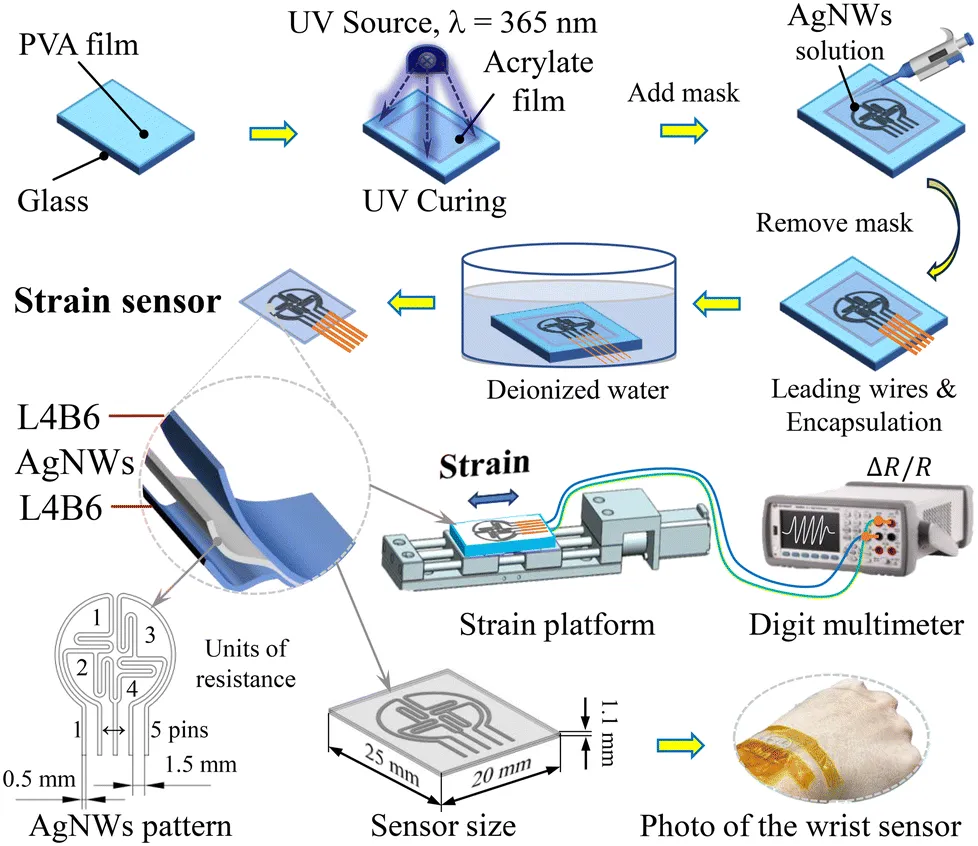
- Figure 1. The manufacturing, structure, dimensions, and applications of this flexible strain sensor.
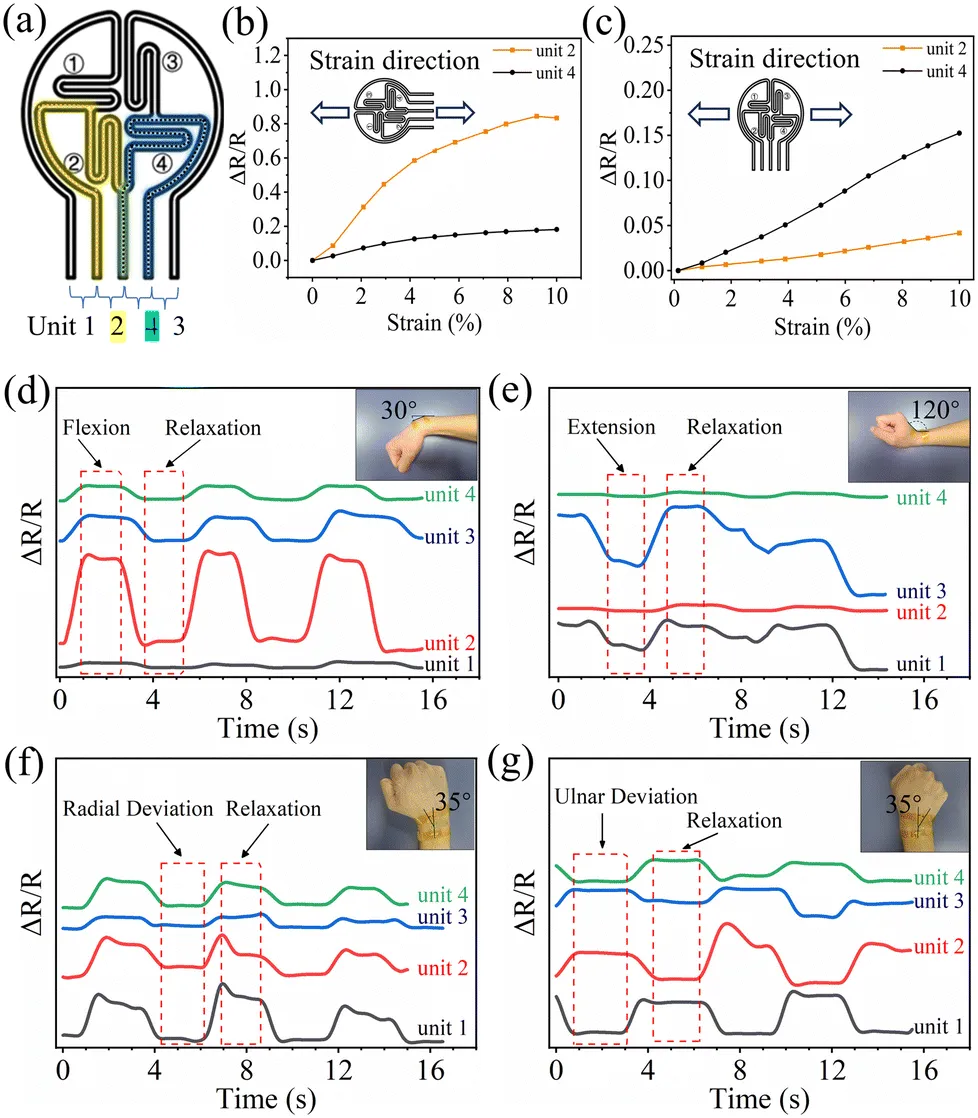
- Figure 4. (a) Schematic diagram of the electrodes of this flexible strain sensor. The sensor’s resistance response to AgNW needle electrodes in (b) parallel and (c) vertical stretching directions. During wrist joint (d) flexion, (e) extension, (f) radial, and (g) ulnar deviation, the relative resistance changes of the parallel and vertical sensor units with respect to the strain direction.
- This work utilizes simple acrylate monomers to fabricate a binary acrylate copolymer elastomer with stretchability exceeding 300%, whose elastic modulus is significantly lower than that of PDMS, making it closer to the elasticity of human skin.
- By encapsulating silver nanowires through the transfer printing process to produce flexible strain sensors, the resistance change rate exhibits characteristic regional variations as strain increases, maintaining stable repeatability within the strain range of 0% to 10%.
- Through the full-bridge circuit design of parallel and vertical units, the sensor can effectively utilize the longitudinal and transverse effects in the strain direction, improving sensitivity and enabling detection of co-directional bending and multi-axis motion.
These results provide new ideas and application insights for the design of flexible strain sensors and human motion monitoring. This achievement, titled “Flexible strain sensors based on silver nanowires and UV-curable acrylate elastomers for wrist movement monitoring” (《基于银纳米线和紫外固化丙烯酸酯弹性体的柔性应变传感器监测手腕运动》), was published in the journal of the Royal Society of Chemistry, RSC Applied Interfaces.

Paper Information
-
Flexible strain sensors based on silver nanowires and UV-curable acrylate elastomers for wrist movement monitoring
Shuhao Li (Li Shuhao, Wuyi University), Wenjin Wu, Yu Chang, Weiquan Chen, Yijie Liu, Zifeng He, Yan Pu, Ivan S. Babichuk*, Terry Tao Ye, Zhaoli Gao, and Jian Yang* (Yang Jian, Wuyi University)
RSC Appl. Interfaces., 2024, 1, 684-688 https://doi.org/10.1039/D4LF00081A
Part of the Authors
Li Shuhao Master’s StudentWuyi University
The first author of this paper, a master’s student at Wuyi University, engaged in the preparation and performance testing of flexible sensors. Li Shuhao designed, experimented, and wrote this research work.
Yang Jian Associate ProfessorWuyi University
The corresponding author of this paper, Associate Professor at Wuyi University, a master’s supervisor, mainly engaged in teaching and research in fields such as flexible sensors, wearable electronics, and micro-nano fabrication technology, has published nearly 30 SCI papers and holds 5 domestic and foreign invention patents (2 authorized), participated in the Guangdong Province Key Area R&D Program Project (2021). Yang Jian designed, wrote, revised, and guided this research work.
Paper link:
https://doi.org/10.1039/D4LF00081A
(Click the lower left corner “Read the original text” to access the original text directly)
Source: RSC
For submissions, reprints, and collaborations, please contact WeChat:MatResFron001

Welcome to leave a message and share your views.Support the authors by clicking the lower right “Like”” and “Looking”↓↓↓