Monitoring the health status of batteries and predicting potential risks is a core technological support for ensuring the safe operation of battery packs. Current mainstream battery risk management solutions are limited by the complex and unique electrochemical behaviors of different battery chemical systems, often resulting in unclear warning indicators and untimely responses, making it difficult to effectively avoid accidents. To address this, this paper proposes an innovative solution that integrates multifunctional sensors into the battery packaging foil, aiming to endow lithium-ion batteries (LIBs) with real-time perception and intelligent warning capabilities.
The fully printed sensor array in this solution is manufactured using a nano-manufacturing process with sensing ink, featuring three core advantages: first, extreme lightweight, with a total weight of only 49 mg, which has a negligible impact on battery energy density; second, strong environmental tolerance, exhibiting excellent resistance to multi-dimensional disturbances such as temperature and mechanical stress; third, outstanding long-term stability, enabling reliable long-term monitoring as an integrated system. With this sensor array, it is possible to obtain real-time multi-dimensional characteristic parameters of thermal, mechanical, and chemical behaviors during battery operation. These parameters can serve as quantitative assessment indicators for various degradation behaviors of the battery, covering typical failure scenarios such as overcharging/over-discharging, high/low temperature/high-rate cycling, internal short circuits, structural rupture, and thermal abuse, thus providing timely assurance for the safety of the battery throughout its entire lifecycle.
Additionally, to address key risk points for battery safety, the sensor array is specifically designed with sensors for combustible gases and electrolyte leakage, which can directly trigger alarms upon detecting anomalies, efficiently conveying warning information even in complex service environments. As a significant breakthrough in the field of intelligent energy storage management, this monitoring platform demonstrates good universality and can flexibly adapt to different types of battery systems and various packaging specifications.
In the current context of energy transition, efficient and reliable energy management for different application scenarios is a key prerequisite for the widespread application of rechargeable batteries. Since its introduction in the early 1990s, lithium-ion batteries have completely reshaped human daily energy usage patterns over the decades, with applications expanding from personal electronic devices and communication fields to large-scale grid energy storage, as well as the electrification of diverse transportation means such as cars, airplanes, railways, and cargo ships [1-3]. However, LIBs used in these scenarios typically exist in large capacity module forms ranging from 10³ to 10⁶ Wh, which brings severe challenges to their operational safety.
Especially when LIBs using highly active electrode materials are subjected to harsh working conditions (such as extreme temperatures, mechanical compression, and severe vibrations), or experience high-intensity cycling such as fast charging and discharging [4], significant heterogeneity can easily develop within the battery, manifested as lithium ion concentration gradient imbalances, lithium metal deposition on graphite surfaces, exacerbated parasitic reactions, and abnormal growth of solid electrolyte interphase (SEI) films. These phenomena can lead to irreversible consumption of lithium ion inventory and electrolyte, forcing the battery reactions to deviate from the designed electrochemical pathways, ultimately resulting in continuous performance degradation and potentially unpredictable catastrophic safety incidents [5,6].
The aforementioned safety challenges highlight the urgent need for precise, real-time monitoring, assessment, and prediction of the health status (SOH) of batteries at the chemical level — only by timely capturing the microscopic changes and aging trends of internal battery components can effective safety warnings be achieved. Generally speaking, the complex multi-path degradation mechanisms within batteries stem from their inherent microscopic heterogeneity, and complex cycling conditions further exacerbate the accumulation of this heterogeneity.
This nanoscale degradation process can gradually lead to rapid capacity decay, mechanical failures (such as severe swelling, gas leakage, electrolyte leakage), and even trigger thermal runaway (such as fire or explosion). Therefore, the deterioration of battery safety performance urgently requires an efficient assessment solution: developing multifunctional sensor arrays capable of simultaneously capturing multi-dimensional key parameters. Such sensor arrays must meet two core requirements: on one hand, they must be integrated into the battery with minimal weight and volume cost, avoiding any impact on the core performance of the battery; on the other hand, they must possess efficient collaborative working capabilities to construct a complete intelligent monitoring system, providing comprehensive data support for battery safety management.
Currently, various technologies have been developed in academia to assess the operational status of lithium-ion batteries (LIBs), with different characteristics in performance and applicability:
In the field of optical monitoring, fiber optic sensing technology occupies an advantage due to its excellent measurement precision [7-11], especially suitable for studying the basic reaction mechanisms inside batteries in laboratory settings. However, its application heavily relies on precise and complex signal decoding equipment [12,13], and the size and operational complexity of the equipment limit its large-scale promotion to commercial batteries.
Acoustic monitoring technology achieves high sensitivity, non-invasive detection of battery status by detecting the propagation speed and amplitude attenuation of sound waves within the battery body [14,15]. However, this technology faces challenges in miniaturization — it is difficult to reduce the detection device to a size that matches a single battery while ensuring long-term stable service [13], which also restricts its practical application scenarios.
Moreover, existing research often focuses on the mechanisms of single influencing factors on battery performance, which deviates from actual application scenarios. In real service environments, the battery status is influenced by multiple coupled factors, and only by accumulating a large number of battery samples can statistically significant state assessments and fault predictions be achieved.
More critically, although some sensing technologies have matured, integrating them into the battery often has significant negative impacts on the core performance of the battery: on one hand, it leads to decreased energy density and reduced cycling stability [16]; on the other hand, issues such as rising manufacturing costs and increased energy consumption for on-site monitoring [12,13] (the original text “12,12,13” appears to be a typographical error and has been corrected) are prominent. Additionally, the dynamic changes in the local environment within the battery (such as temperature and electrolyte concentration) can easily cause sensor signal drift and crosstalk, further reducing monitoring accuracy.
Based on the aforementioned challenges, developing a multifunctional sensor array that can be “tattooed” integrated into the battery is of great significance. Such sensor arrays must simultaneously meet two core demands: first, they must have multi-parameter synchronous monitoring capabilities to provide comprehensive data support for intelligent battery health status (SOH) analysis; second, their impact on key operational performances such as battery energy density and cycle life must be negligible, truly achieving efficient compatibility with commercial batteries.
This paper proposes a disturbance-resistant sensor array that combines mechanical flexibility, stretchability, ultra-thin characteristics, and conformal fitting capabilities, which can be efficiently integrated with lithium-ion batteries (LIBs) and achieve intelligent operation through a distributed artificial intelligence (AI) system. This multifunctional sensor array is seamlessly printed onto the surface of the packaging foil of sealed batteries, forming an Integrated Intelligent Sensor Array System (IISAS), providing a non-invasive solution for battery management that enables multi-parameter synchronous and selective monitoring.
As shown in Figure 1a, this platform, centered on distributed AI technology, can conduct comprehensive real-time dynamic analysis of battery operation and provide quantitative monitoring indicators. On one hand, through deep learning algorithms, it can systematically evaluate the conventional operational behaviors of the battery, achieving precise state estimation; on the other hand, combined with the degradation mechanisms of the battery under aging, overcharging, and over-discharging conditions, it can accurately diagnose various fault types (including overcharging/over-discharging, low-temperature failures, internal short circuits, mechanical damage, and thermal runaway). Additionally, the array includes dedicated sensors for combustible gases (hydrogen, H₂), dimethyl carbonate (DMC) vapor, and electrolyte leakage, which can directly trigger alarms upon detecting anomalies, enabling the battery management system to quickly initiate AI-driven emergency responses in complex scenarios.
The reliable performance of IISAS relies on the multi-dimensional characteristic parameters extracted from temperature, pressure, strain, H₂ gas, DMC vapor, and liquid electrolyte sensors (Figure 1b). Through a combination of “printable tattoo” additive and subtractive manufacturing processes, this embedded sensor array effectively balances the technical contradiction between “precisely monitoring battery health status” and “avoiding interference with battery electrochemical performance” [8,11,16]: on one hand, the weight and spatial proportion of the sensors are minimized to reduce their impact on battery energy density; on the other hand, since the sensors are arranged close to the battery body, not only is the signal detection accuracy and sensor durability improved, but also the gradient transmission loss of thermal and mechanical sensor signals is reduced, effectively filtering out noise interference caused by device vibrations [13,20].
By further integrating optimized sensor signal processing circuits (Figures 1c, d), the collected analog signals undergo refined analysis in an analog-to-digital converter (ADC), and are then wirelessly transmitted by a microcontroller unit (MCU) through a Bluetooth module, ultimately completing data decoding and state assessment in conjunction with intelligent algorithms. This practical IISAS successfully fills the existing technological gap between “reliable feature extraction of batteries” and “real-time state assessment.”
This highly integrated intelligent LIB monitoring system demonstrates significant advantages in reliability, cost-effectiveness, real-time monitoring, and intelligent analysis, which are crucial for the practical application scenarios of large-capacity (>10³ Wh) LIBs. Furthermore, the device manufacturing and system integration solutions reported in this paper exhibit good portability and compatibility for batteries of different forms and chemical systems, laying the foundation for their further promotion as a universal tool in practical scenarios.
The detailed manufacturing process of the multifunctional sensor array is shown in Supplementary Figure 1a. Specifically, a CO₂ laser generator is first used to etch grooves on the aluminum (Al) composite outer foil used for battery packaging, forming a groove structure. The pattern of the grooves strictly follows the interconnection layout designed for the sensors, with a precise etching depth controlled at 20 μm. This laser etching process has significant advantages in spatial occupation and weight control, maximizing the reduction of the sensor array’s impact on battery energy density and electrochemical performance.
Additionally, the sensor array is integrated into a polyethylene terephthalate (PET) layer through an embedded design (see Supplementary Figure 1d), which effectively enhances the detection accuracy and long-term durability of the sensors. Notably, the printed sensor array embedded in the aluminum-polymer composite foil substrate can conform closely to the battery’s bending shape, adapting to the expansion and contraction changes of soft-pack batteries during cycling, thus maintaining a stable monitoring state.
The close contact between the sensors and the battery body not only helps to reduce signal transmission gradients and enhance detection sensitivity but also eliminates deformation interference caused by uneven pressure — this is crucial for avoiding localized stress concentration in the battery body during electrochemical processes and ensuring safe operation of the battery [21]. After completing the groove etching, the grooves need to be thoroughly cleaned with anhydrous ethanol and further polished through ultraviolet ozone (UV-O₃) treatment, followed by plasma and ultraviolet treatment to significantly enhance the wettability of the foil surface, laying the groundwork for subsequent printing processes.
The electrode patterns and interconnection lines of the sensor array are first prepared using conductive silver (Ag) paste through a printing process (as shown in Figure 2). From the microscopic structure, it can be seen that the conductive silver layer achieves a close fit with the composite substrate, with no heterogeneous connection gaps, ensuring stable transmission of electrical signals. The complete process parameters and operational details for sensor manufacturing have been detailed in the “Experimental Methods” section.
To ensure the long-term stable operation of the sensors, an isolation layer and functional film are encapsulated on their surface: the outermost layer uses a hydrophobic polyurethane (PU) film as protective packaging, effectively isolating external environmental interference and preventing sensor failure due to aging, oxidation, and moisture intrusion. For the special requirements of gas sensors — ensuring that target gases can smoothly penetrate the encapsulation layer and contact the sensing elements — a waterproof and breathable polytetrafluoroethylene (PTFE) membrane is specifically selected as the encapsulation material; simultaneously, to achieve a rapid response to liquid electrolyte leakage, a porous hydrophobic polyvinylidene fluoride (PVDF) layer is set as an intermediate adsorption layer within the sensor, enhancing the sensitivity and response speed of electrolyte detection.
To verify the advantages of the sensor array prepared in this study, comparative experiments were conducted: commercially available thermistors, pressure sensors, and strain gauges were directly attached to the surface of soft-pack batteries (as shown in Supplementary Figure 2), and comparisons were made with the printed sensor array in terms of weight, volume, and stability (see Figures 1b, 3). The results show that the printed sensor array exhibits overwhelming advantages in weight increment and spatial occupation: the total weight of the sensor array integrated with interconnection lines only increases by 0.049 g, which is negligible compared to commercially available sensors (1.762 g, Supplementary Figure 1c) or the battery body weight (22.348 g), especially significant in large-capacity battery application scenarios; simultaneously, the spatial volume of the printed sensor array is only 16.844 mm³, occupying very little space in the battery packaging.
Moreover, this manufacturing process exhibits high flexibility and compatibility, allowing for adaptive adjustments based on different battery configurations (such as soft-pack, cylindrical, prismatic) and packaging specifications, and can flexibly customize the types and quantities of sensors according to the monitoring needs of actual application scenarios, demonstrating good potential for large-scale applications. More importantly, stability test results (Supplementary Figure 5) show that the printed sensor array has stronger resistance to various interference factors (such as temperature fluctuations and mechanical vibrations); in contrast, commercially available sensors, due to their fixed structure and poor compatibility with the battery body, struggle to synchronize with the thermal expansion and mechanical deformation of the battery during electrochemical cycling, leading to signal drift or stability issues.
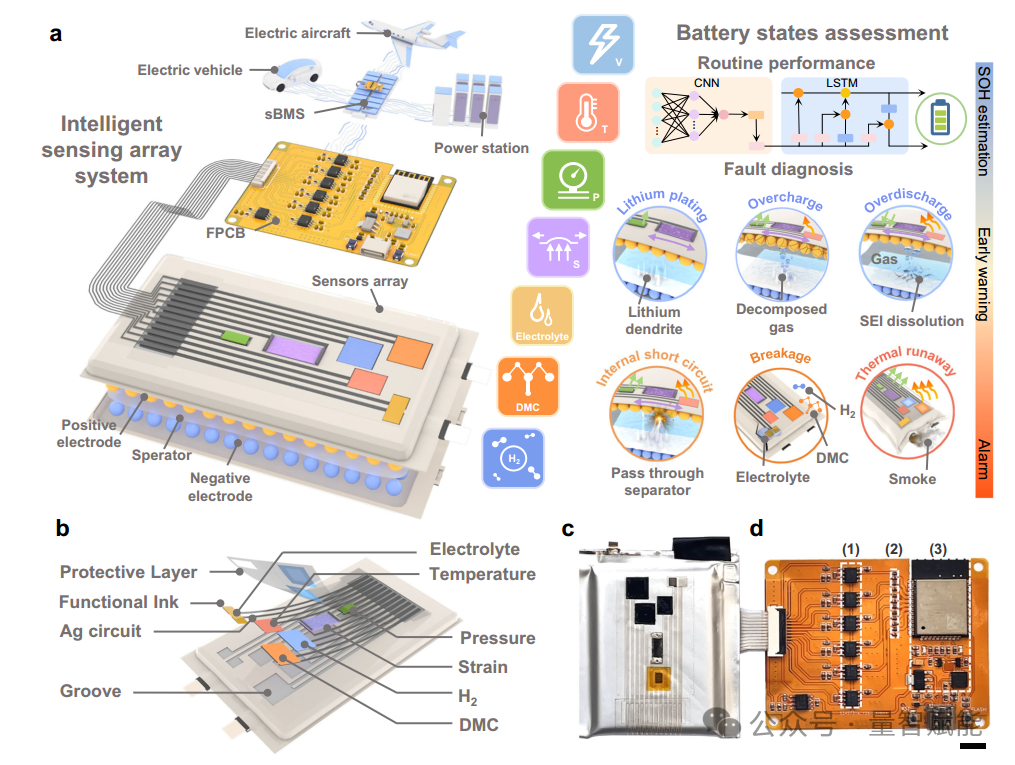
Figure 1B shows the specific layout diagram of various types of sensors inside the soft-pack battery. In the sensor layout design, in addition to ensuring functional matching, the installation position of each sensor is highly aligned with the physical distribution pattern of the battery characteristic parameters to achieve precise in-situ (Operando) monitoring.
Temperature Sensor: Deployed 2 cm below the positive electrode tab. This area, due to the high reactivity of the positive electrode and relatively concentrated current density, is usually the area where temperature increases most significantly within the battery plane [22], allowing for precise capture of temperature changes at the core heating points of the battery.
Strain Sensor: Fixed in the center area of the soft-pack battery. During the cycling process, the expansion and contraction of the jelly roll structure mainly concentrate in the center position, where mechanical stress changes are most pronounced [23], effectively reflecting the structural deformation state within the battery.
Pressure Sensor: Set in the center area on the negative electrode side. Research indicates that this area is the preferred site for lithium deposition (the original text “liquefaction” is presumed to be a deviation in expression for “lithiation” or “lithium deposition,” corrected here according to battery mechanisms) within the battery, where lithium deposition is accompanied by volume changes and internal pressure fluctuations, thus this position can provide rich and critical information on internal pressure changes.
Liquid Sensor: Strategically placed near the electrode tab. The connection point between the battery packaging foil and the tab is a structural weak point, where the sealing strength is relatively low, making it prone to aging failure during long-term use, increasing the risk of electrolyte leakage; this layout can quickly capture electrolyte leakage signals.
H₂ Gas and DMC Vapor Sensors: Both located near the sealing edge of the battery. The sealing edge is the main channel for the leakage of gaseous substances (such as H₂ generated from side reactions within the battery and volatile DMC solvent); deploying gas sensors here allows for rapid response and precise detection of gaseous leaks.
This sensor layout design based on the physical and chemical behavior patterns within the battery maximizes in-situ monitoring efficiency, enabling comprehensive and efficient capture of multi-dimensional characteristic parameters during battery operation, providing reliable data support for subsequent state assessment and fault diagnosis.
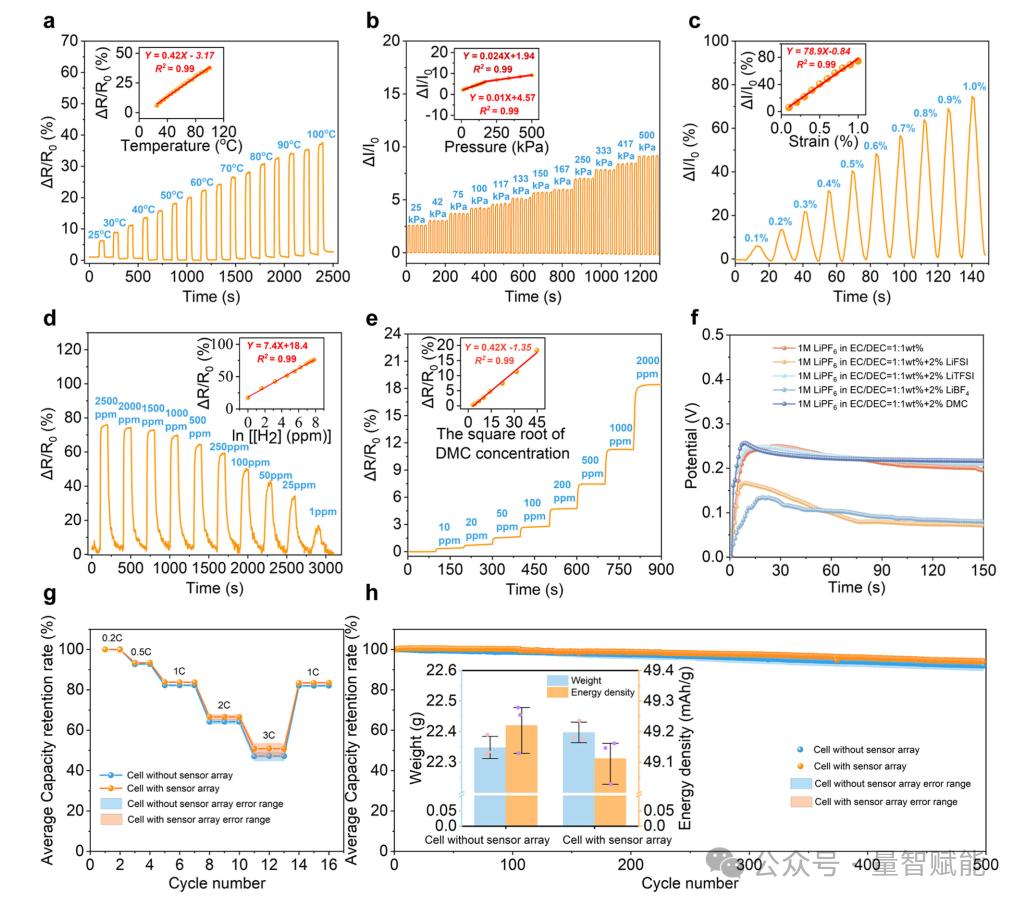
Temperature Sensor Performance: The resistance response characteristics of the temperature sensor were tested in the temperature range of 20–100 °C (Figure a), showing a stable linear relationship with temperature changes, allowing for precise temperature measurement within this range. The inset shows the calibration curve of the temperature sensor, further verifying its measurement accuracy and reliability.
Pressure Sensor Performance: In the pressure range of 25.0–500.0 kPa, the current response of the pressure sensor exhibits good sensitivity and repeatability (Figure b), accurately capturing dynamic changes in internal battery pressure. The inset shows the calibration graph of the pressure sensor, providing a basis for quantitative calculations of pressure in actual monitoring.
Strain Sensor Performance: For the strain range of 0.1–1.0%, the current response of the strain sensor shows a clear trend of change (Figure c), effectively identifying minor deformations of the battery jelly roll structure. The inset shows the calibration curve of the strain sensor, ensuring the accuracy of strain measurements.
H₂ Gas Sensor Performance: In the concentration range of 1–2500 ppm for H₂ gas, the resistance response of the H₂ gas sensor shows a regular change with increasing concentration (Figure d), demonstrating wide range and high sensitivity detection capabilities, allowing for timely capture of abnormal H₂ gas generation within the battery. The inset shows the calibration graph of the H₂ gas sensor, clarifying the relationship between resistance changes and gas concentration.
DMC Vapor Sensor Performance: For DMC vapor concentrations of 10–2000 ppm, the resistance response of the sensor exhibits good concentration dependence (Figure e), enabling rapid response to the volatile leakage of electrolyte solvents. The inset shows the calibration curve of the DMC vapor sensor, supporting quantitative analysis of vapor concentrations.
Electrolyte Leakage Sensor Performance: The electrolyte leakage sensor shows rapid response characteristics to the target electrolyte (formulation of 1 mol/L LiPF₆ dissolved in EC/DEC/DMC (mass ratio 1:1:1), with the addition of 2% lithium bis(fluorosulfonyl)imide (LiFSI), lithium bis(trifluoromethanesulfonyl)imide (LiTFSI), and lithium tetrafluoroborate (LiBF₄)) (Figure f), enabling instant detection of electrolyte leakage.
Impact of Sensor Array on Battery Performance: To assess the impact of sensor array integration on battery performance, comparative tests were conducted between soft-pack batteries with integrated sensor arrays and those without:
Rate Performance: The normalized average rate capability test results show (Figure g) that the rate discharge characteristics of both are nearly identical, indicating that the sensor array has no significant impact on the battery’s rate performance.
Cycling Stability: The cycling stability test results indicate (Figure h) that the battery with the integrated sensor array maintains a capacity retention rate similar to that of the original battery, confirming that the sensor array does not accelerate battery performance degradation.
Weight and Energy Density: The inset compares the weight and energy density of the two types of batteries, showing that the weight increment after integrating the sensor array is negligible, and the energy density remains at the original level (data presented as mean ± standard deviation).
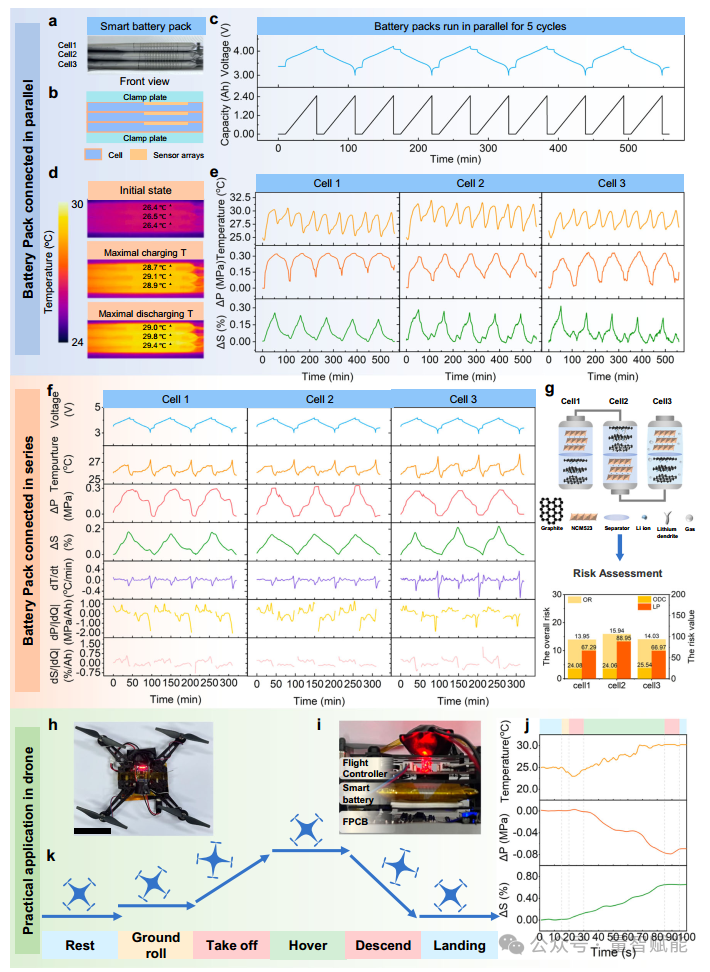
Basic Characteristics of Intelligent Soft-Pack Batteries: Figure a shows a physical photo of the intelligent soft-pack battery, Figure b presents its structural diagram, clearly demonstrating the integration method of the sensor array with the battery body; Figure c shows the electrochemical performance curve of the intelligent battery pack, indicating that the battery still maintains excellent electrochemical characteristics after integrating the sensor system; Figure d is an infrared (IR) thermal imaging of the battery pack in working condition, visually observing the temperature distribution on the battery surface, providing a visual basis for thermal state monitoring.
In-Situ State Monitoring of Battery Packs: During the charge and discharge cycling of the battery pack, real-time collection and recording of the dynamic changes in temperature, pressure, and strain of each intelligent battery were conducted (Figure e), with data clearly reflecting the evolution of the internal state of the battery during the electrochemical process; Figure f presents a performance correlation analysis chart constructed based on in-situ monitoring data, achieving parameter linkage tracking under the collaborative working state of multiple batteries, providing data support for the consistency assessment of the battery pack.
Risk State Assessment of Battery Packs: By analyzing the monitoring data of individual batteries in a series battery pack, risk values for the state assessment of each battery were calculated (Figure g), allowing for precise identification of weaker performance and higher risk individual batteries within the battery pack, providing key basis for balanced management and safety warnings of the battery pack.
Integration and Testing of Drone Power Supply Systems:
Hardware Integration: Figure h shows a physical photo of the intelligent soft-pack battery pack mounted on a quadcopter (scale: 5 cm); Figure i presents the physical integration of the intelligent battery power supply system with the drone’s flight controller, where the core circuit board is printed using flexible polyimide foil (FPCB), effectively reducing the overall weight of the system and avoiding impacts on the drone’s load capacity.
Flight State Monitoring: Figure j records the key performance parameters (such as voltage, current, temperature) changes of the intelligent battery during different working stages of the drone (stationary, ground taxiing, takeoff, hovering, descent, landing), with data indicating that the battery maintains stable output under complex conditions; Figure k is a real-time record of the complete flight process of the drone, verifying the reliability and practicality of the intelligent battery power supply system.
Sun, N., Rong, Q., Wu, J. et al. Fully printable integrated multifunctional sensor arrays for intelligent lithium-ion batteries. Nat Commun 16, 7361 (2025). https://doi.org/10.1038/s41467-025-62657-22025 Empowering IntelligenceCommitted to building world-class technological strength, [Lyonzine Group] is a comprehensive provider of technical solutions encompassing software development, algorithm design, technical consulting, etc. Its main products include the MES system for smart factories, intelligent product customization solutions, industrial big data mining, and more. When reprinting, please indicate the source. Stay tuned for more updates.