After the announcement of the failed Phase III study HERTHENA-Lung02 of HER3 ADC at this year’s ASCO, what does it matter if you win the world? Discussing the HER3 ADC HERTHENA-lung02 study [2025 ASCO], I thought that the drug Patritumab Deruxtecan might have come to a halt. Unexpectedly, while reading literature recently, I found that this drug seems to have found a new hope.Now, let’s take a look at this article: First, let’s look at the main content:
Background:
Patritumab deruxtecan (HER3-DXd; MK-1022) is a targeted HER3 antibody-drug conjugate, composed of a humanized IgG1 monoclonal antibody (patritumab) targeting HER3 linked via a cleavable peptide-based linker to a topoisomerase I inhibitor payload, which has shown sustained anti-tumor activity in previously treated EGFR mutation advanced NSCLC patients.
This study extends these observations to advanced NSCLC patients with other or undetected driver genomic alterations.
Methods:
Included were advanced squamous or non-squamous NSCLC patients without EGFR mutations, who had previously received treatment including platinum-based therapy, immune checkpoint inhibitors, and targeted therapy(for patients with actionable genomic alterations) and experienced disease progression after treatment. Patients received HER3-DXd 5.6 mg/kg intravenously, every 3 weeks, with the primary endpoint being confirmed ORR (cORR).
Results:
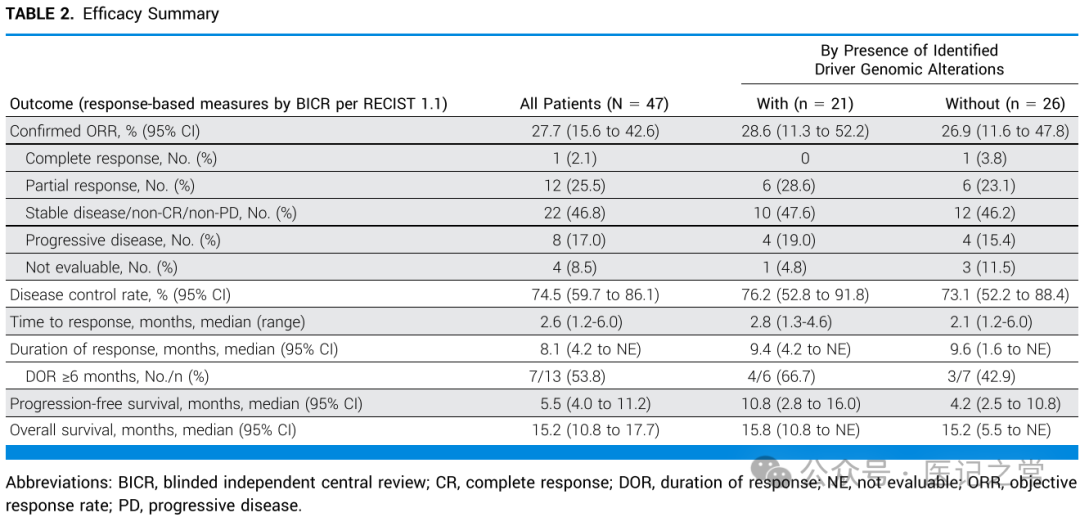
A total of 47 patients received HER3-DXd treatment (median treatment duration was 4.2 months[range,0.7-19.8]). cORR was 27.7% (95% CI, 15.6%-42.6%), with a median duration of response (DoR) of 8.1 months (95% CI,4.2- not evaluable). The median PFS was 5.5 months (95% CI,4.0-11.2), and the overall median OS was 15.2 months (95% CI,10.8-17.7).
Similar efficacy was observed in NSCLC patients with known driver gene alterations and those without such genetic features.
Adverse events related to treatment discontinuation (TEAEs) occurred at a rate of 12.8%. The incidence of ≥3 grade TEAEs related to the study drug was 51.1%, with 12.8% being serious events (no deaths reported). Five patients (10.6%; all grade 1 or 2) experienced treatment-related interstitial lung disease.
Conclusion:
The efficacy and safety of HER3-DXd in heavily pre-treated patients with other subtypes of advanced NSCLC are similar to those previously reported in EGFR mutation patients, warranting further clinical evaluation in the future.
So, friends, do you see? Although the Phase III study failed after resistance in EGFRm (referring to common mutations or sensitive mutations, namely 19del and 21 L858R), exploration continues in NSCLC patients with other EGFR mutations and rare mutations, as well as those without mutations, and this data has been published in JCO.
Let’s take a look at what mutations are present:
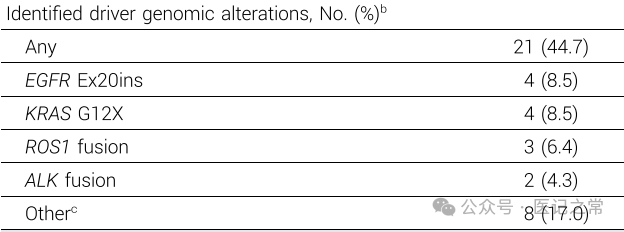 In terms of efficacy, the population without mutations has good results in both ORR and PFS, OS:
 So, don’t lose heart; perhaps in this field, HER3 ADC still has hope.However, there are also issues, such as safety: the incidence of ≥3 grade TRAE is 51.1%, and this is just the data for a single agent. Remember, the AE of the four-drug combination in ORIENT31 was not much different. Additionally, the interstitial lung disease (ILD) associated with ADC drugs cannot be overlooked, with an incidence of 10.6% in this study.But in any case, there may still be hope. Let’s continue to pay attention!
Please open in the WeChat client