Introduction
The Wenkang Huang team from the School of Intelligent Science and Technology at the National University of Defense Technology published research in Mechanical Systems and Signal Processing, proposing a new method for blade vibration parameter identification based on dual-sensor full waveform analysis and an improved grey wolf optimization algorithm (IGWO). This method does not rely on prior information such as vibration frequency or order, achieving accurate identification of single-mode vibration parameters with just one circle of data, and solving the dual-mode vibration problem with four circles of data, providing key technical support for the implementation of online BTT monitoring systems.
1. What Does the Paper Discuss?
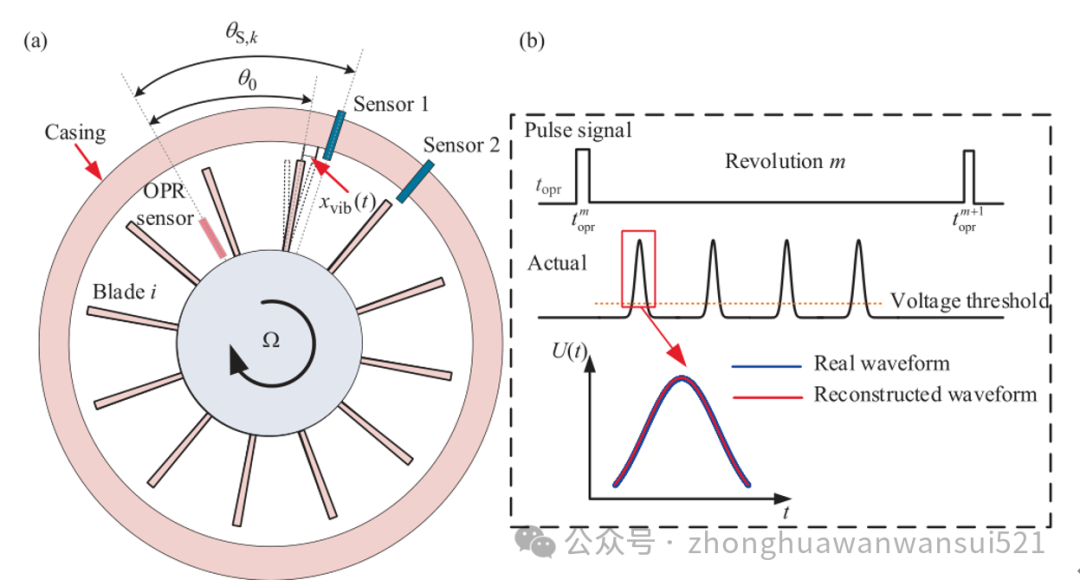
In core equipment such as aircraft engines and gas turbines, rotating blades are subjected to extreme conditions of high temperature, high pressure, and high speed, and their vibration state directly determines the equipment’s lifespan and operational safety. Traditional contact monitoring methods (such as strain gauges) are invasive and have poor durability, making them difficult to meet requirements. Meanwhile, mainstream non-contact blade tip timing (BTT) technology relies on sparse time of arrival (TOA) data, falling into the dilemma of “information compression”—simplifying the complete voltage waveform generated by sensors into a single discrete point, leading to signal undersampling and frequency aliasing, especially in multi-frequency vibration scenarios where identification accuracy significantly decreases. The core goal of this paper is clear: to address the issues of traditional BTT technology, which suffers from “excessive information loss, inaccurate identification, and reliance on experience.” The entire study revolves around three questions: “how to gather more information, how to effectively integrate data, and how to calculate accurately,” ultimately demonstrating the effectiveness of the method through experiments.
The research primarily accomplished the following three tasks:
- Changing the Data Acquisition Method: Instead of only using TOA discrete points, the complete voltage waveform captured by the sensors is utilized. When the blade passes the sensor, details such as how the voltage rises and falls, and where the peaks are, are all preserved.
- Assigning Weights to Dual Sensors: Two sensors are used to measure data, but the noise from each sensor may differ (for example, one is closer to the blade, and the other is farther away). Directly averaging the data would lower accuracy. They developed a “noise adaptive weighting” strategy: the sensor with better data quality (less noise) is given a higher weight, allowing good data to have a greater impact.
- Improving the Algorithm for Accurate Calculations: In blade vibration parameters, amplitude and phase are continuous numbers, while “engine order” and “vibration frequency” are integers. Traditional algorithms struggle with this “mixed variable” problem. The team improved the “grey wolf optimization algorithm (IGWO)” to handle both continuous and integer variables simultaneously, without needing prior knowledge of vibration frequency or order; the algorithm can find the correct answers on its own.
Finally, they validated their approach through simulations (testing five vibration scenarios from single-frequency to three-frequency) and physical experiments (setting up a real blade rotation platform using strain gauges as a benchmark): single-frequency vibration can be accurately identified with just one circle of data, while dual-frequency vibration can meet engineering requirements with four circles of data, significantly reducing data requirements compared to traditional methods while achieving higher accuracy.
2. Core Innovations
Many graduate students struggle with the question of “how to highlight innovations” in their papers. The three core innovations of this paper exemplify the approach of “breaking down old problems and addressing them specifically,” which is worth examining closely:
1. From Capturing Discrete Points to Using Full Waveforms
The Achilles’ heel of traditional BTT is “information compression,” which transforms the complete waveform into a single TOA point, resulting in the loss of vibration details. This paper takes the opposite approach by modeling directly with the “full voltage waveform”: as the blade moves, the voltage changes accordingly, and the peaks, widths, and trends in the waveform become the basis for judging vibrations.
This is not merely about gathering more data; it fundamentally addresses the undersampling issue at the source. For instance, previously, measuring multi-frequency vibrations was prone to mixing two frequencies into one due to insufficient information; now, with the full waveform, each frequency corresponds to different waveform characteristics, allowing the algorithm to easily separate them.
2. Adaptive Weighting for Dual Sensors
Many studies also use multiple sensors, but most simply average the weights, treating both sensors’ data equally. However, in reality, the noise from sensors can vary significantly; for example, one may have an SNR of 30dB, while another has 10dB, and averaging would drag down the good data.
This paper’s solution is pragmatic: first, calculate the “noise variance” for each sensor (determined through waveform fitting residuals). The lower the noise, the greater the weight. For example, if sensor A has less noise, it might have a weight of 0.8, while sensor B, with more noise, might have a weight of 0.2. The resulting fused data is much more accurate than the “averaging” approach, especially in harsh environments (e.g., when sensors are interfered with by oil contamination), where the advantages are even more pronounced.
3. Improved IGWO Algorithm
The identification of blade vibration parameters is essentially a mixed-integer nonlinear programming (MINLP) problem, where amplitude and phase are continuous numbers (e.g., amplitude 0.08mm, 0.09mm), while engine orders are integers (e.g., 3rd order, 4th order). Traditional algorithms can either only handle continuous variables or require prior knowledge of “approximately how many frequencies and order ranges” and are heavily reliant on experience.
This paper’s IGWO algorithm specifically addresses this issue: for continuous variables (amplitude, phase), it uses the traditional grey wolf algorithm’s “leader wolf guidance” strategy; for integer variables (order, frequency), it employs “probability updates” (e.g., if the deviation is large, it adjusts with high probability; if the deviation is small, it adjusts less), and also incorporates a “dynamic narrowing of the search range” technique to avoid wasting time on irrelevant values in later stages.
Crucially, it does not require any prior information; the algorithm does not need to be told in advance “it might be 3rd order vibration” or “the frequency is approximately 300Hz”; it can find the correct parameters from the data itself. This is extremely important for engineering applications, as in real-world conditions, no one can predict how the blades will vibrate in advance.
References:
[1] HUANG W K, WANG Y, HU H F, et al. Parameters identification of blade vibration based on dual-sensor full waveform and improved grey wolf optimizer algorithm[J]. Mechanical Systems and Signal Processing, 2025, 239: 113275. https://doi.org/10.1016/j.ymssp.2025.113275