Hello everyone, today I would like to share an article published in J. Am. Chem. Soc. titled “Site-Specific Chemoselective Cyclization and Fluorogenic Modification of Protein Cysteine Residues: From Side-Chain to Backbone.” The corresponding author is Professor Sun Xiaolong from Xi’an Jiaotong University, who mainly researches fluorescent probes. In this article, the authors focus on the site-specific chemoselective cyclization and fluorogenic modification of protein backbone cysteine residues.

Protein modification plays an indispensable role in a wide range of biological processes, and various strategies have been developed to study protein modifications. However, most of these strategies focus on side-chain or terminal modifications. Very few studies have addressed backbone modifications, primarily due to the chemical inertness of amide bonds under physiological conditions and the difficulty in achieving site selectivity due to the abundance of amide bonds.
The protein backbone is the structural basis for the correct folding of proteins. Under natural conditions, post-translational modifications can occur, leading to backbone cyclization, which regulates protein activity and endows proteins with functions such as antibacterial and antitumor properties. However, the artificial introduction of backbone cyclization structures through chemical means remains challenging. In this article, the authors focus on the inherent high nucleophilicity and low abundance of cysteine, investigating how to facilitate cysteine’s involvement in backbone cyclization.
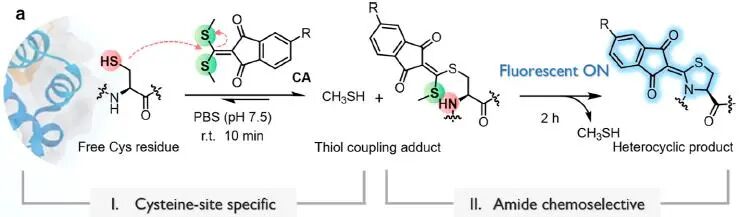
The authors found that a photoluminescent conjugate acceptor (CA) can undergo addition-elimination with the thiol group of cysteine, followed by intramolecular attack by the adjacent backbone amide nitrogen, forming a five-membered S-N heterocycle. This reaction can occur in neutral aqueous solution at room temperature without the need for a catalyst, and the resulting heterocyclic structure exhibits significant UV-visible absorption and fluorescence, making it suitable for real-time optical detection of modifications. Initially, the authors conducted reactions between CA and N-acetylcysteine methyl ester at the small molecule level, demonstrating that the reaction can occur and produce a fluorophore, followed by theoretical calculations to elucidate the reaction mechanism.
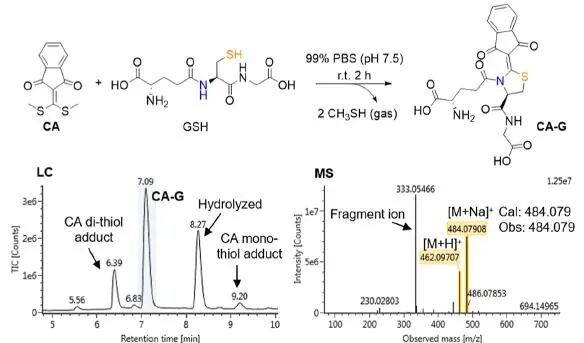
Next, the authors used mass spectrometry to demonstrate the modifications formed by CA in glutathione, insulin B chain, and cyclic neuroendocrine peptide somatostatin.
The authors found that the modified insulin B chain showed a significant decrease in α-helix content and an increase in random coil, indicating the impact of backbone modifications on protein folding, conformational-dependent functional regulation, and molecular recognition.
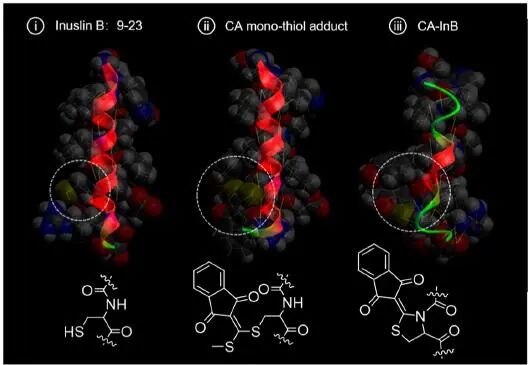
In summary, this article develops a fluorescent probe for achieving backbone modifications of cysteine. Compared to side-chain modifications, introducing heterocyclic structures into the backbone can disrupt natural hydrogen bonds, leading to local conformational twists at the modification site, providing a valuable tool for studying protein structure and function.
Author: WYJ
Editor: LYC
DOI: 10.1021/jacs.5c08837
Original link: https://doi.org/10.1021/jacs.5c08837