First Author: Jiangnan Lv, Institute of Materials Science, Shanxi Normal UniversityCorresponding Authors: Xiaohong Xu, Institute of Materials Science, Shanxi Normal University; Yang Liu, Department of Materials Science, Fudan University
Research BackgroundNitrates (NO₃⁻) are one of the major pollutants in water bodies, and traditional biological/membrane separation methods are energy-intensive and produce many by-products. Electrochemical nitrate reduction (NO₃⁻RR) can convert NO₃⁻ into high-value ammonia (NH₃) at room temperature and pressure, combining wastewater treatment with the potential for green ammonia synthesis. Two-dimensional transition metal dichalcogenides (TMDs) are promising due to their abundant edge active sites, but their inherent low activity and poor stability limit their application. Metal-support interactions (MSI) have been shown to modulate electronic structures and optimize intermediate adsorption, yet systematic studies in NO₃⁻RR are scarce.
Research ObjectiveThis paper constructs Ni atomically doped WS₂ nanosheets (Ni-WS₂), utilizing the strong MSI between Ni and WS₂ to enhance NO₃⁻RR activity and selectivity, achieving high NH₃ yield and long-term stability. The MSI promotion mechanism is revealed through experiments and DFT calculations, providing a new paradigm for designing efficient NO₃⁻RR catalysts.
Experimental MethodA two-step solution method was employed: first synthesizing WS₂ nanosheets, followed by cation exchange to introduce Ni (~0.5 at%). An H-type three-electrode system (1 M KOH + 0.1 M KNO₃) was used to evaluate activity; MEA electrolyzer (−400 mA cm⁻²) tested industrial-grade stability; in situ ATR-FTIR, DEMS, and EPR were used to capture intermediates; DFT calculations were performed for ΔG, charge transfer, and RDS energy barriers.
Main Findings
-
Record NO₃⁻RR Performance – At −0.3 V vs RHE, the Faradaic efficiency for NH₃ reached 91.7%; at −0.7 V, the yield was 23.3 mg h⁻¹ cm⁻², three times higher than undoped WS₂ and superior to most TMD-based catalysts. – In MEA, continuous operation for 100 h maintained an NH₃ yield of approximately 32 mg h⁻¹ cm⁻², with negligible decay.
-
MSI-Driven Charge and Structural Optimization – XPS/XANES: Ni gained electrons (−0.5 eV chemical shift), W lost electrons (+0.3 eV), and the Ni−S bond length shortened by 0.05 Å, confirming strong electronic coupling. – EPR and radical trapping: MSI facilitated H₂O dissociation to generate activeH, accelerating the hydrogenation step; addingH scavenger t-BuOH reduced NH₃ yield by 50%.
-
Reaction Pathway and RDS Determination – In situ FTIR/DEMS captured key intermediates such as *NO₂, *NH, *NH₂; *NH₂→NH₃ was identified as the RDS. – DFT: The RDS energy barrier for Ni-Sv-WS₂(010) surface dropped to 0.31 eV (vs 0.55 eV for Sv-WS₂), with moderate H adsorption, inhibiting competitive HER.
-
Scalable Application—Zn-NO₃⁻ Battery – A flow battery with Ni-WS₂ as the positive electrode and Zn as the negative electrode achieved an open-circuit voltage of 1.32 V, peak power density of 1.65 mW cm⁻², NH₃ Faradaic efficiency of 85.1%, and specific energy of 7.02 Wh g⁻¹, maintaining performance over >200 cycles.
Figure Interpretation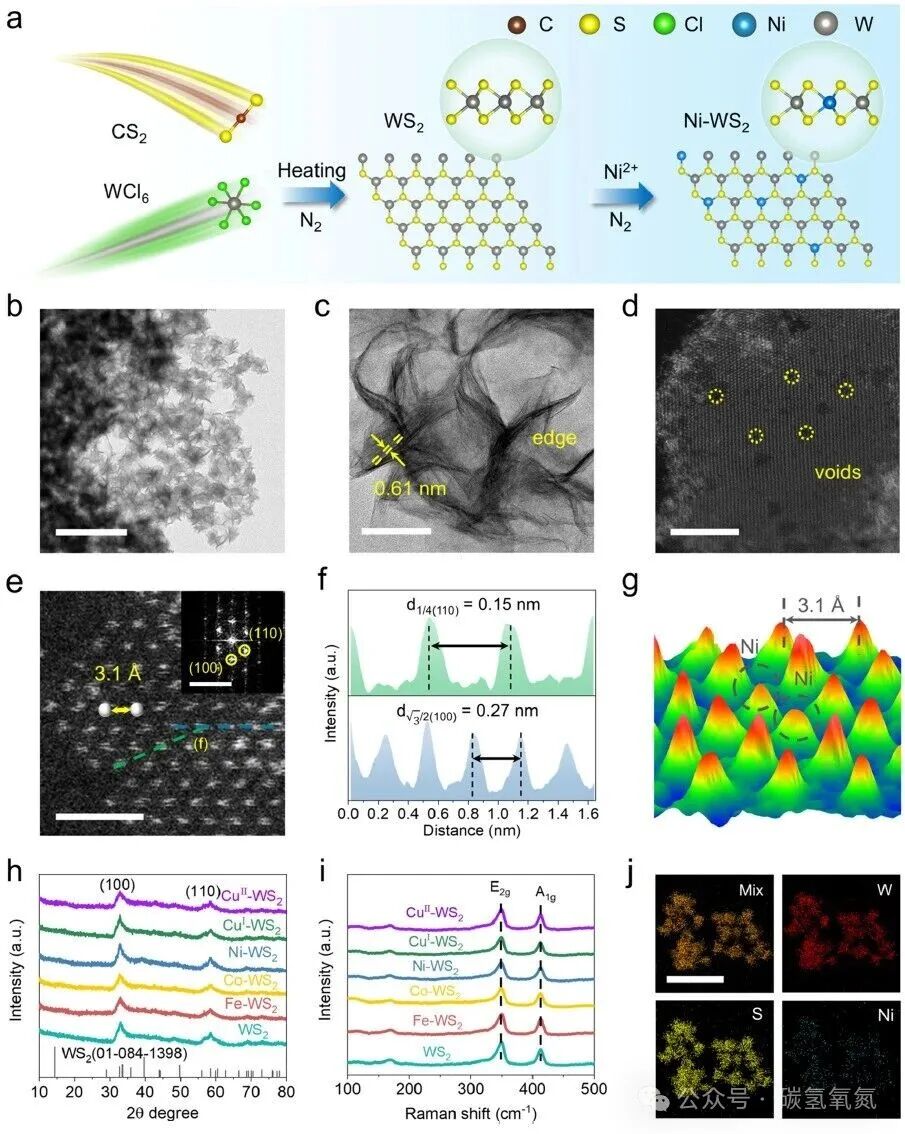
Figure 1 | Synthesis and Structural Characterization of the Catalysta) Schematic of the two-step synthesis of Ni-WS₂ nanosheets: first liquid-phase synthesis of WS₂, followed by cation exchange to introduce Ni.b) TEM: The nanosheets consist of ultrathin nanosheets, approximately 500 nm in size.c) Side view HRTEM: Interlayer spacing of 0.61 nm, corresponding to WS₂(002) plane.d,e) AC-STEM: Visible atomic-level holes and lattice, (110) plane spacing of 0.15 nm, (100) plane spacing of 0.27 nm.f) Intensity line scan: Confirms lattice parameters consistent with 2H-WS₂.g) 3D atomic topology: Ni signal weaker than W, indicating atomic-level dispersion of Ni.h) XRD: Peaks at 32.7° and 58.4° correspond to WS₂(100) and (110), with no shift in peak position after Ni doping.i) Raman: 349 cm⁻¹ (E₂g) and 412 cm⁻¹ (A₁g) maintain the characteristics of 2H-WS₂.j) EDS elemental distribution: Ni, W, and S are uniformly distributed, with no nanoparticles or clusters.
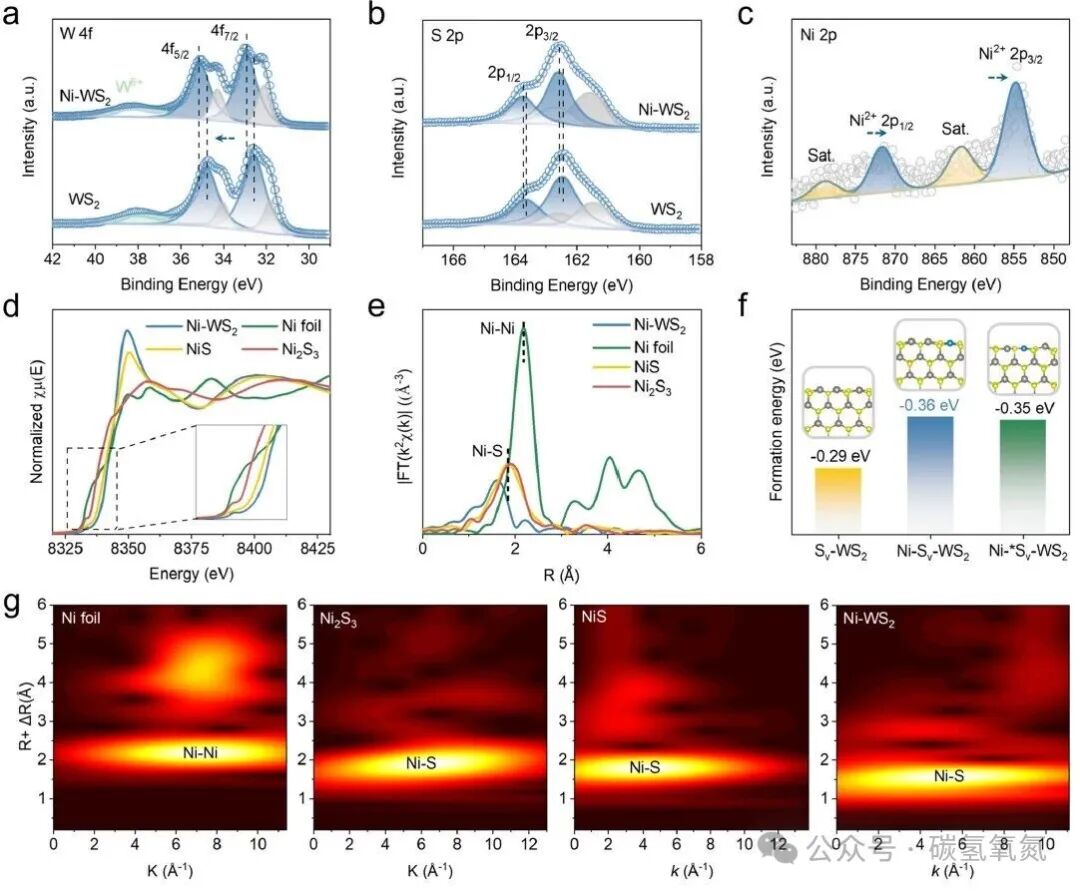
Figure 2 | X-ray Spectroscopy Analysisa) W 4f XPS: The binding energies of W 4f₇/₂ and 4f₅/₂ in Ni-WS₂ shifted positively by 0.3 eV, indicating W lost electrons.b) S 2p XPS: No significant shift in S²⁻ peak position.c) Ni 2p XPS: The binding energies of Ni²⁺ 2p₃/₂ and 2p₁/₂ shifted negatively by 0.5 eV, indicating Ni gained electrons.d) Ni K-edge XANES: The absorption edge position is close to NiS, with a valence state of approximately +2.e) Ni K-edge FT-EXAFS: The first shell Ni−S bond length is 1.61 Å, shorter than the standard NiS, confirming MSI-induced bond contraction.f) DFT formation energy: Ni adjacent to S vacancy (Ni-Sv-WS₂) has the lowest energy (−0.36 eV).g) WT-EXAFS: Ni−S signal is consistent with NiS, with no Ni−Ni metallic bonds, confirming atomic-level dispersion.
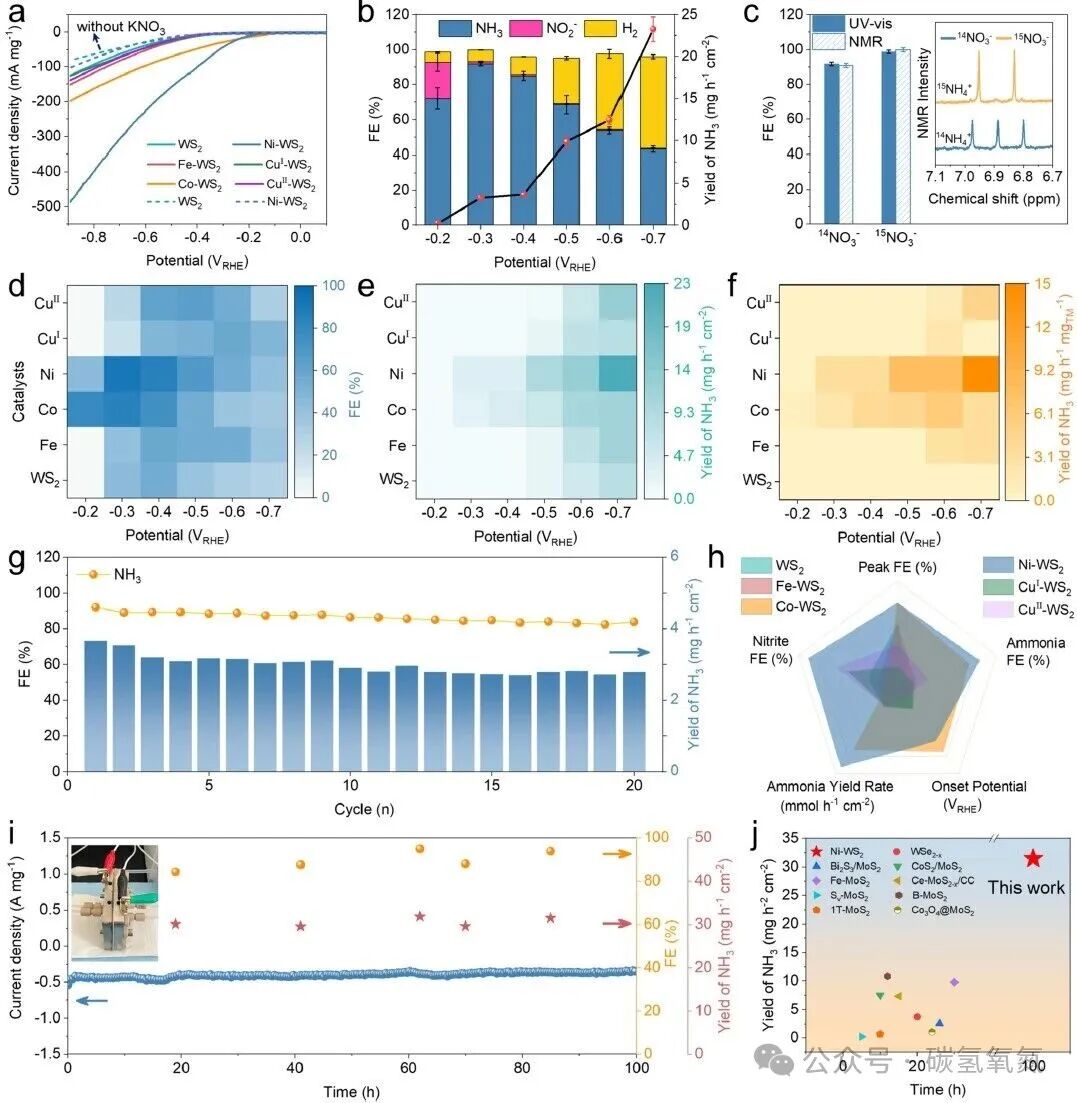
Figure 3 | Electrocatalytic NO₃⁻ Reduction Performancea) LSV: Ni-WS₂ exhibited the highest current density in KNO₃ electrolyte.b) FE and yield: At −0.3 VRHE, NH₃ FE reached 91.7%; at −0.7 VRHE, yield was 23.3 mg h⁻¹ cm⁻².c) ¹H NMR: Using ¹⁵NO₃⁻ showed ¹⁵NH₄⁺ double peaks, while ¹⁴NO₃⁻ showed ¹⁴NH₄⁺ triplet peaks, confirming NH₃ originated from NO₃⁻.d) NH₃ FE heat map: Ni-WS₂ consistently exhibited the highest FE across all potentials.e) NH₃ yield heat map: The yield of Ni-WS₂ increased with negative potential shift.f) Metal mass normalized yield: Ni-WS₂ achieved 15.3 mg h⁻¹ cm⁻², far exceeding other metal-doped samples.g) Cycling stability: There was almost no decay in FE and yield after 20 cycles.h) Performance radar chart: Ni-WS₂ exhibited the highest FE, lowest onset potential, and lowest NO₂⁻ by-product.i) Long-term MEA testing: At −400 mA cm⁻² for 100 h, yield was approximately 32 mg h⁻¹ cm⁻², with low decay.
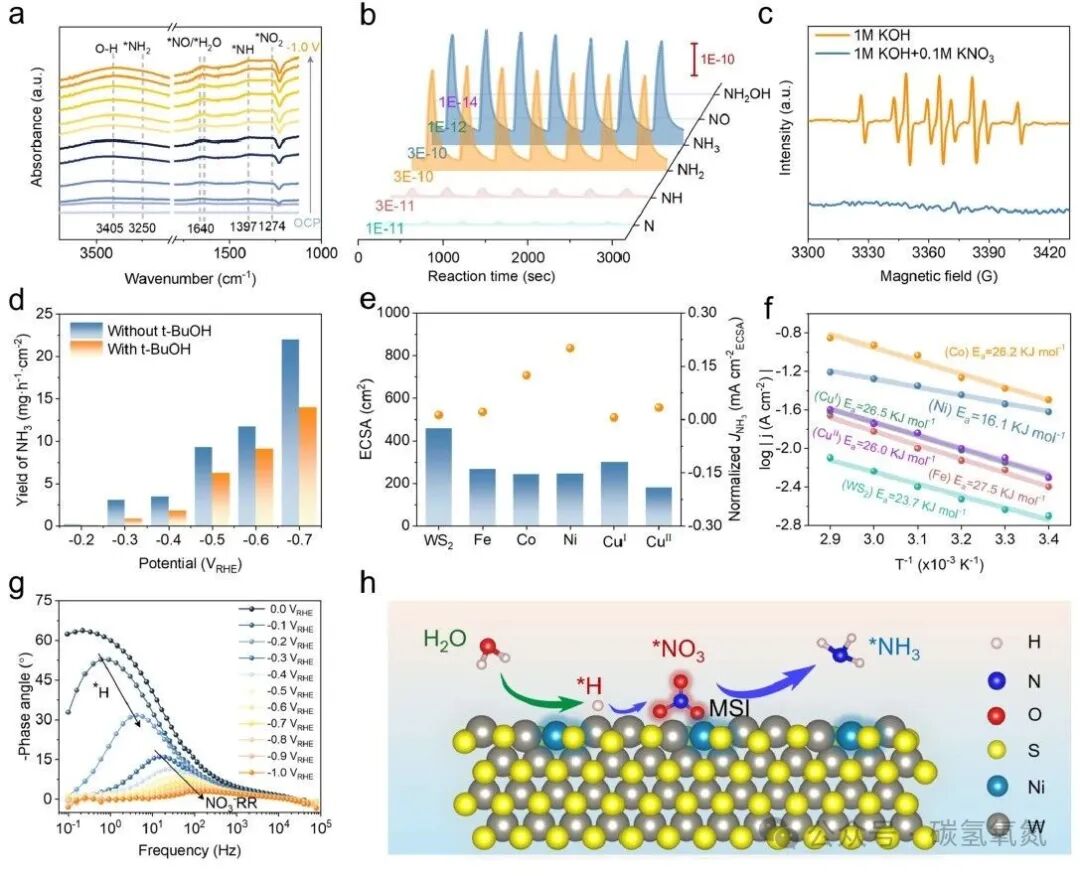
Figure 4 | Reaction Mechanism Studya) In situ ATR-FTIR: Detected intermediates such asNO₂ (1274 cm⁻¹),NH (1397 cm⁻¹),NH₂ (3250 cm⁻¹).b) DEMS: Captured signals of NO, NH, NH₂, NH₃, with Ni-WS₂ showing much higher intensity than WS₂.c) Operando EPR: Strong DMPO-H signal without NO₃⁻, which disappeared upon adding NO₃⁻, indicatingH was rapidly consumed.d) t-BuOH scavengingH: NH₃ yield decreased by ~50%, verifying the key role ofH.e) ECSA normalized current: Ni-WS₂ exhibited the highest intrinsic activity.f) Arrhenius plot: Ni-WS₂ Ea=16.1 kJ mol⁻¹, the lowest.g) Bode plot: Ni-WS₂ H peak at 1 Hz, low phase angle, indicating fast reaction kinetics.h) Schematic of MSI mechanism: Interfacial charge transfer promotesH generation, lowering the RDS energy barrier.
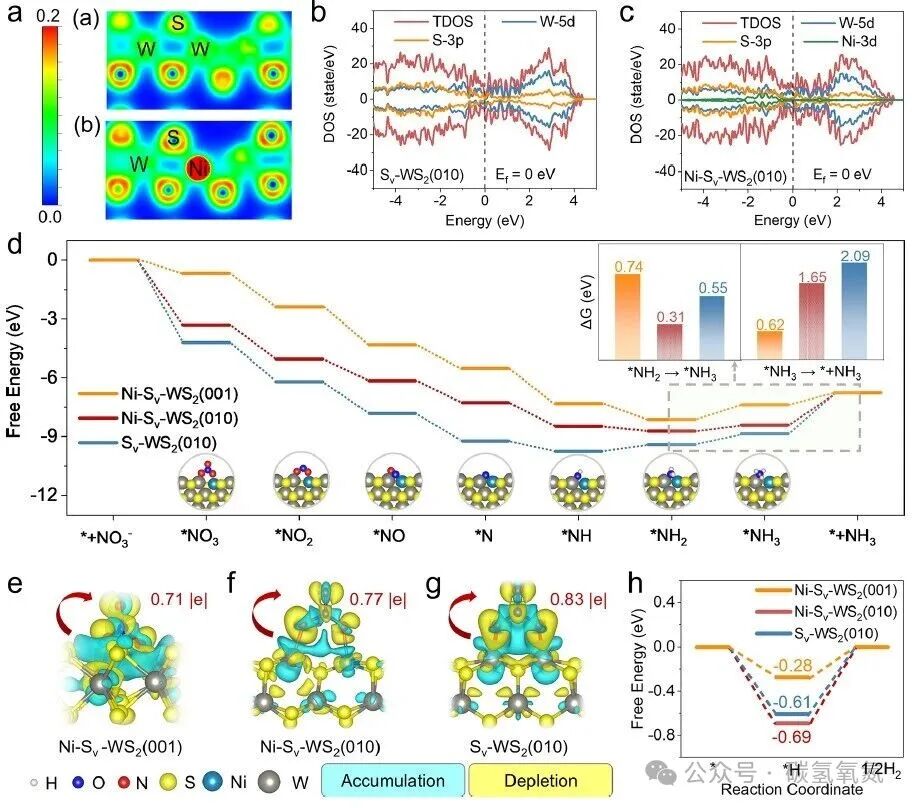
Figure 5 | DFT Calculationsa) Charge density map: Electrons are enriched around Ni, while W loses electrons.b,c) TDOS: Ni-Sv-WS₂(010) shows increased density of states near the Fermi level, enhancing conductivity.d) Free energy diagram: The RDS (*NH₂→NH₃) energy barrier is 0.31 eV, the lowest.e-g) Bader charge: Ni-Sv-WS₂(010) transfers 0.77 e⁻ to NO₃⁻, with moderate adsorption strength.h) HER free energy: Ni-Sv-WS₂(010) has weak adsorption forH, inhibiting H₂ evolution.
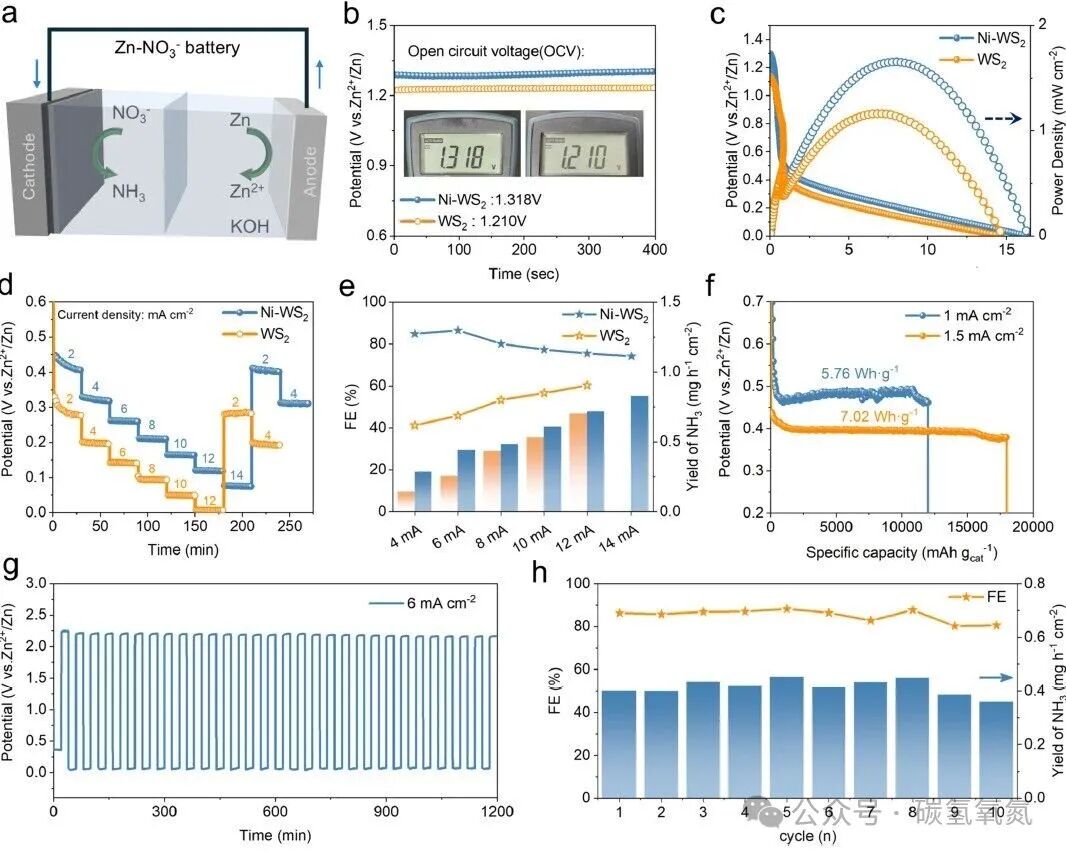
Figure 6 | Zn-NO₃⁻ Battery Performancea) Battery configuration schematic: Ni-WS₂ positive electrode, Zn negative electrode, 6 M KOH.b) OCV: Ni-WS₂ reached 1.32 V, higher than WS₂ (1.21 V).c) Discharge polarization and power density: Ni-WS₂ peak power of 1.65 mW cm⁻².d) Discharge curve: Ni-WS₂ maintained higher voltage at various current densities.e) NH₃ FE and yield: At 6 mA cm⁻², FE was 85.1%, and at 14 mA cm⁻², yield was 0.8 mg h⁻¹ cm⁻².f) Specific capacity: 1.0/1.5 mA cm⁻² reached 12,000/18,000 mAh g⁻¹, energy density of 5.76/7.02 Wh g⁻¹.g,h) Long cycling: >200 cycles at 6 mA cm⁻², with small fluctuations in FE and yield, demonstrating excellent stability.
Conclusion and OutlookThis work constructs Ni atomically doped WS₂ nanosheets through a two-step solution method, utilizing strong metal-support interactions (MSI) to simultaneously enhance nitrate electroreduction activity, selectivity, and stability. The MSI-induced interfacial charge rearrangement promotesH generation, lowering the NH₂→*NH₃ energy barrier to 0.31 eV, while suppressing HER side reactions, achieving 91.7% FE and >100 h of industrial-grade stable ammonia production. MEA and Zn-NO₃⁻ battery tests validate its scalability and energy storage application potential. This strategy provides a new approach for developing efficient, durable NO₃⁻RR catalysts and distributed green ammonia synthesis systems.
Reference: Lv, J., Yang, Q., Liang, T., Sun, X., Rong, W., Dai, Q., Gao, Y., Wang, L., Xu, X., & Liu, Y. (2025). Accelerating nitrate electroreduction to ammonia via metal–support interactions in Ni-WS₂ catalysts. Journal of the American Chemical Society, 147, 27708–27719. https://doi.org/10.1021/jacs.5c06333