
Recently, the research team of Liu Qian and Zhang Yunxiang from the Department of Chemistry at Fudan University published a study titled “Enhanced Single-Molecule Imaging via Intersystem Crossing Suppression” in the Journal of the American Chemical Society. This research addresses the long-standing issues of “photobleaching” and “photoblinking” that have troubled researchers in single-molecule imaging, proposing a novel molecular design approach.— By introducing electron-withdrawing groups at the meso position of the cyanine dye, intersystem crossing is suppressed at the source, significantly reducing the formation of triplet states, thereby greatly enhancing the stability and imaging performance of the fluorescent probes.
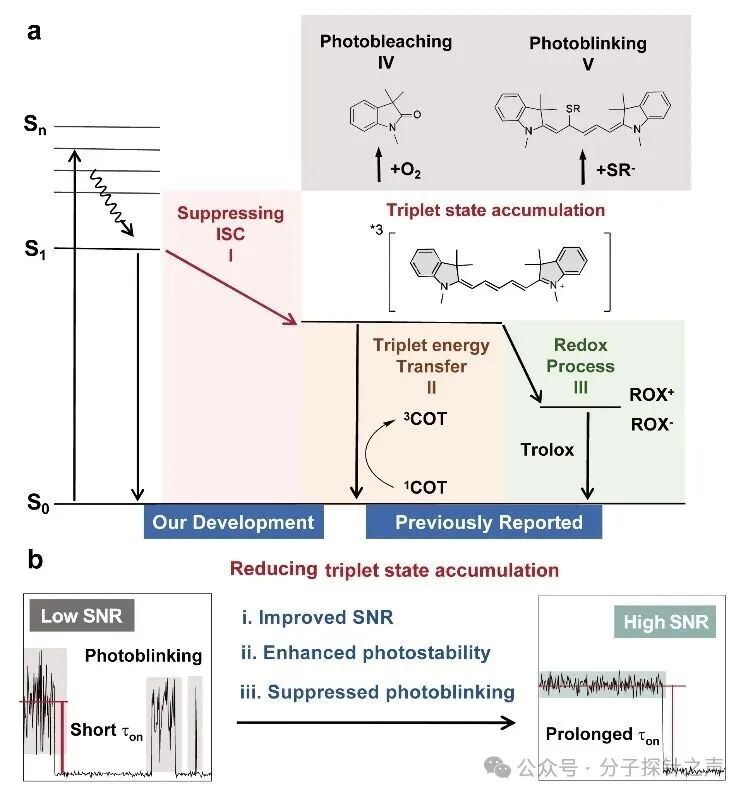
Single-Molecule Imaging (SMI) technology has become an important tool for elucidating life processes due to its ability to directly track the dynamic behavior of single molecules within living cells with nanometer spatial resolution and millisecond temporal resolution. However, labeled molecules face two major challenges during imaging: photobleaching and photoblinking. Cyanine dyes, represented by Cy5, are prone to entering long-lived triplet states under excitation light, reacting with oxygen in the solution to generate reactive oxygen species, leading to irreversible photobleaching; molecules in the triplet state may also be attacked by nucleophiles, causing intermittent interruptions in luminescence and significantly degrading signal quality. Traditional solutions often rely on oxygen scavenging systems and triplet state quenchers. Although these methods extend the dye’s lifetime to some extent, the additional components may introduce noise and exhibit biotoxicity, limiting their application in live-cell imaging.
The research team focused on reducing the generation of triplet states directly from the molecule itself without relying on external protective agents. They designed and synthesized a series of meso-Cy5 derivatives by introducing strong electron-withdrawing groups at the meso position of Cy5. Theoretical calculations indicated that the electron-withdrawing groups could effectively increase the singlet-triplet energy level difference, reducing the probability of intersystem crossing. Transient absorption spectroscopy experiments directly demonstrated a significant reduction in triplet state signals for these novel single-molecule imaging probes. Through this “source control” strategy, the formation of triplet states under excitation conditions was significantly reduced, thereby suppressing photobleaching and photoblinking. The compound Cy5-N, which performed the best, exhibited a 790% improvement in photostability and a 2.3-fold improvement in signal-to-noise ratio compared to traditional Cy5. Furthermore, this derivative maintained stable continuous luminescence even in the presence of the nucleophile β-ME, demonstrating strong resistance to nucleophilic attack.
The research team further applied Cy5-N in live-cell imaging. Without adding any external protective agents, they successfully achieved continuous single-molecule tracking of the epidermal growth factor receptor (EGFR) in U2OS cells for up to 30 seconds, while traditional Cy5 could only maintain tracking for about 10 seconds. Even more excitingly, when the imaging power was further reduced, the tracking time of Cy5-N could be extended to the minute level, capturing a more complete transition process of molecular motion states. This breakthrough provides new technical support for studying complex cellular signal transduction and membrane protein dynamics.
The study first demonstrated that suppressing ISC through molecular design can significantly enhance the photostability and signal-to-noise ratio of single-molecule imaging probes. The meso-Cy5 derivatives not only achieved significant improvements in photophysical properties but also provided a solid tool for long-term, high-precision live-cell single-molecule imaging. This “intersystem crossing suppression” molecular design strategy is universal and is expected to be applied to other types of organic fluorescent molecules, opening new pathways for the development of next-generation imaging probes. This achievement provides researchers in life sciences with more powerful imaging tools and demonstrates the critical role of chemical design in advancing cutting-edge biological imaging technologies.
The corresponding authors of the paper are Young Researcher Liu Qian and Young Researcher Zhang Yunxiang, with the first author being Ding Fan, a PhD student from the 21st cohort of the Department of Chemistry at Fudan University. This research was strongly supported by the National Natural Science Foundation and key projects from the Ministry of Science and Technology.
References
Enhanced Single-Molecule Imaging via Intersystem Crossing Suppression, Fan Ding, Song Chen, Fei Du, Congfu Shen, Kuangshi Sun, Tianli Zhai, Yao Tang, Fei Zhao, Yunxiang Zhang,* and Qian Liu*, J. Am. Chem. Soc. https://doi.org/10.1021/jacs.5c02236