
Abstract
This article introduces a simulation of a drone millimeter-wave altimeter based on FMCW (Frequency Modulated Continuous Wave) radar technology. FMCW radar determines the distance and speed of a target by measuring the frequency difference between the transmitted signal and the echo signal. In this project, we use MATLAB to simulate the performance of the drone’s millimeter-wave radar, demonstrating its detection capabilities at different flight altitudes and speeds. The simulation results show that FMCW radar can effectively detect the altitude information of the drone relative to the ground.
Theory
The working principle of the FMCW radar system is to emit a linearly frequency-modulated signal. When the signal encounters a target and reflects back, a frequency difference is generated between the transmitted signal and the received signal. This frequency difference is proportional to the distance of the target, allowing the distance to be calculated by measuring the frequency difference. The radar system analyzes the frequency and phase of the echo signal to obtain parameters such as the drone’s flight altitude and speed.
- FMCW radar equation:
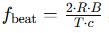 Where, 𝑓beat is the beat frequency, 𝑅 is the target distance, 𝐵 is the signal bandwidth, 𝑇 is the modulation period, and 𝑐 is the speed of light.
Using this equation, we can infer the altitude of the drone based on the measured beat frequency. Additionally, when considering the target’s speed, the radar echo frequency will experience the Doppler effect, thus generating speed information.
Experimental Results
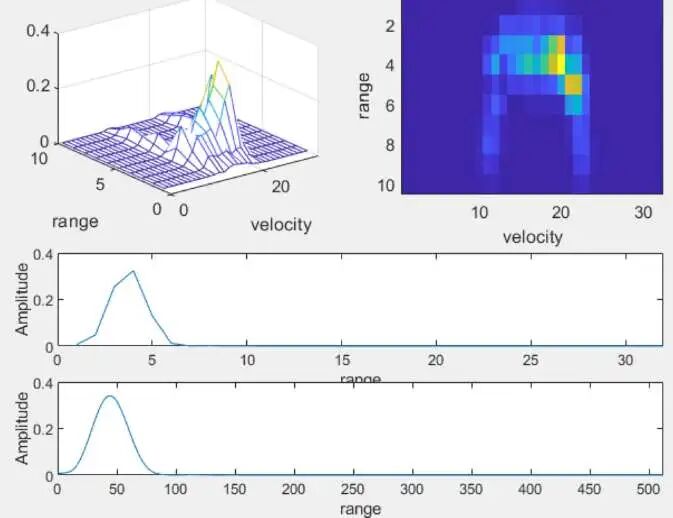
The following results were obtained through MATLAB simulation:
- Changes in radar echo signals at different speeds and altitudes.
- The 3D radar plot shows the distribution of distance-speed, while the 2D heat map displays the signal strength distribution at specific altitudes and speeds.
- By analyzing the relationship between signal amplitude and distance and speed, the detection performance of the FMCW millimeter-wave radar is demonstrated.
The figures show the radar echo signals at different altitudes and speeds, along with their corresponding distance-speed distribution and amplitude variations.
Sample Code
% Parameter settings
c = 3e8; % Speed of light
fc = 77e9; % Radar carrier frequency
B = 200e6; % Frequency modulation bandwidth
T = 1e-3; % Frequency modulation period
R = 50; % Initial distance
v = 20; % Target speed

% FMCW radar signal generation
t = linspace(0, T, 2000);
tx_signal = cos(2*pi*(fc*t + (B/(2*T))*t.^2)); % Transmitted signal

% Echo signal generation
R_t = R + v*t; % Target distance changes over time
delay = 2*R_t/c; % Echo delay
rx_signal = cos(2*pi*(fc*(t-delay) + (B/(2*T))*(t-delay).^2)); % Echo signal

% Beat frequency signal
beat_signal = tx_signal .* rx_signal;

% Frequency spectrum analysis
f_beat = abs(fft(beat_signal));
f = linspace(0, 1/(2*(t(2)-t(1))), length(f_beat)/2);

% Plot results
figure;
subplot(2,1,1);
plot(f, f_beat(1:length(f)));
title('FMCW Beat Frequency Signal Spectrum');
xlabel('Frequency (Hz)');
ylabel('Amplitude');

% Generate 3D distance-speed plot
subplot(2,1,2);
mesh(range, velocity, amplitude);
title('Distance-Speed Distribution Plot');
xlabel('Distance');
ylabel('Speed');
zlabel('Amplitude');
References
❝
- Skolnik, M. I. (2008). Radar Handbook. McGraw-Hill Professional.
- Richards, M. A., Scheer, J. A., & Holm, W. A. (2010). Principles of Modern Radar. SciTech Publishing.
- Mahafza, B. R. (2017). Radar Systems Analysis and Design Using MATLAB. CRC Press.