In traditional control circuits, such as forward and reverse control, star-delta starting, etc., the start, forward, and reverse buttons used in these circuits are all normally open contacts, while the stop button uses normally closed contacts.

However, after learning about PLCs, you will encounter a question: Should the stop or emergency stop button of a PLC use normally open contacts or normally closed contacts? What are the differences?
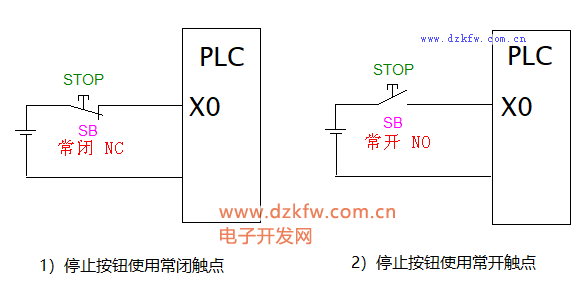
1) From a logical functionality perspective, both types of connections are the same; either can achieve the function of stopping the PLC operation! After all, stopping is controlled by the program we write.
The difference lies in that when the stop button uses normally closed (NC Normal Close contact is conductive), pressing the stop button (0 signal) indicates a stop; when the stop button uses normally open (NO Normal Open contact is disconnected), pressing the stop button (1 signal) indicates a stop.
2) From a safety perspective, using normally open contacts for the stop or emergency stop button poses significant safety risks.
Reason analysis:
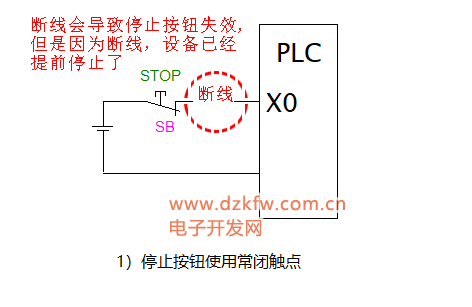
If the stop button uses normally closed contacts, then when the stop button circuit is powered off (0 signal), it indicates a stop; if the stop button circuit is disconnected for unknown reasons, and we are unaware of it! At this point, the 0 signal indicating a stop is present, and we cannot start the PLC.
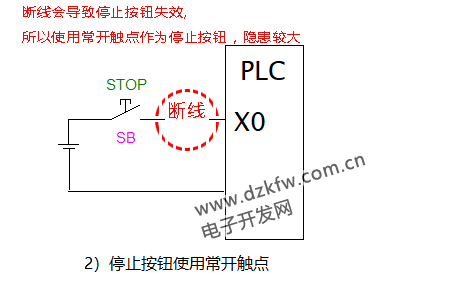
If the stop button uses normally open contacts, then when the stop button circuit is powered (1 signal), it indicates a stop; similarly, if the stop button circuit is disconnected for unknown reasons, and we are unaware of it! At this point, it is a 0 signal, and we can start the PLC without any issues. The problem arises when a serious fault or accident occurs that requires an immediate stop of the PLC; you will find that when the stop button is pressed, it cannot stop the PLC operation because the stop button circuit is disconnected and cannot produce a 1 signal.
Stop Button Connected to Normally Closed Contacts
The stop button in electrical control circuits is typically connected to normally closed (NC) contacts. This design ensures that the circuit remains conductive when the button is not pressed, and disconnects when pressed, thereby reliably cutting off the power supply to the equipment.
Wiring Principles and Advantages
Normally closed contacts are closed under normal conditions and open when pressed. Their core advantages include:
- Fault Safety: If the button or circuit fails (e.g., disconnection), the circuit automatically disconnects, forcing the equipment to stop and preventing accidental operation.
- Logical Intuition: In traditional contactor control, the stop button is connected in series with the control circuit, and the normally closed contact directly cuts off the power supply to the contactor coil, causing the equipment to stop immediately.
Therefore, the stop or emergency stop button of a PLC typically uses normally closed contacts!