Abstract:This article introduces an energy-saving transformation system for frequency converters based on Siemens touch screens and PLC closed-loop control. The use of touch screens and PLCs in closed-loop controlled frequency energy-saving systems allows operators to directly set target values (such as pressure and temperature) on the touch screen. The PLC compares these with actual values (measured by sensors) and directly issues operational commands (analog signals) to the frequency energy-saving system to adjust the output frequency of the frequency converter. It also enables real-time monitoring of the actual values of the controlled system and various parameters within the frequency converter, achieving functions such as alarms and recording.
The application of Siemens touch screens combined with Siemens PLCs in closed-loop controlled frequency energy-saving systems is a trend in automatic control. The use of touch screens and PLCs allows operators to directly set target values (such as pressure and temperature) on the touch screen, compare them with actual values (sensor measurements) through the PLC, and issue operational commands (analog signals) to adjust the output frequency of the frequency converter. It also enables real-time monitoring of the actual values of the controlled system and various parameters within the frequency converter, achieving functions such as alarms and recording. A typical closed-loop controlled frequency energy-saving system using a PLC and touch screen is shown in the figure below.
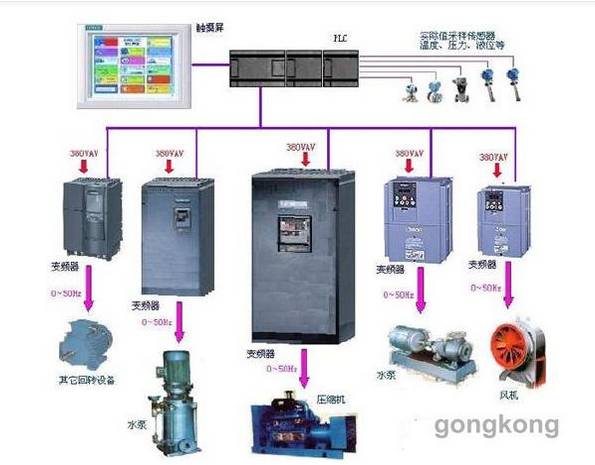
Figure 1: Schematic Diagram of Frequency Energy-saving System Controlled by Touch Screen and PLC
Applications of Closed-loop Controlled Frequency Energy-saving SystemsClosed-loop controlled frequency energy-saving systems have a wide range of applications. The drive modes and control methods of frequency energy-saving systems vary in different scenarios, and specific applications should be designed based on actual conditions. Some examples include: Central air conditioning energy saving: chilled water pumps, cooling pumps, main units, cooling tower fans, fan coil units, etc. Constant pressure water supply: primary and secondary pumps in water plants, booster pumps in water supply networks, building water supply pumps, etc. Boilers: induced draft fans, supply fans, feed pumps, etc., where the control adjustment pre-treatment signals are provided by the boiler automatic control system, DCS, or multi-impulse control systems. Turbines: circulation pumps, condensate pumps, etc., where the control adjustment pre-treatment signals are provided by the turbine automatic control system and DCS. Pure water treatment systems: softening pumps, booster pumps, etc. Clean rooms: booster fans, FFU group control, etc.
Components of the Entire Closed-loop Controlled Frequency Energy-saving System and Their Functions(1) PLC: The SIEMENS S7-200 series is chosen, consisting of CPU224XP, DI/DO modules, and AI/AO modules. The PLC serves as the control unit and is the core of the entire system. Its main functions include: ① Collecting various data from the system and converting digital signals to analog signals and vice versa. ② Performing logical control and PID adjustment calculations for the entire system. ③ Providing the collected and processed data to the touch screen and executing various commands issued by the touch screen. ④ Converting PID calculation results into analog signals as control signals to adjust the output frequency of the frequency converter. ⑤ Completing reading and writing of internal parameters of the frequency converter through communication cables and USS4 protocol. (2) Touch Screen: The SIEMENS MP370 is used, with main functions including: ① Real-time display of the operating status of devices and systems. ② Sending commands and data to the PLC through touch input, with the PLC controlling the system or devices. ③ Creating multiple monitoring screens, replacing traditional electrical operation panels and display recording instruments, and offering more powerful functions. (3) Frequency Converter: The SIEMENS 440 series is adopted, which can adjust the internal parameters via the touch screen through PLC using USS4 protocol, based on the data (analog values) sent from the PLC to adjust the speed of pumps or fans and feed back the internal operating parameters to the PLC. (4) Sensors for pressure, temperature, etc.: These convert the actual parameter values of the controlled system (water or air system) into electrical signals uploaded to the PLC. (5) Electrical components: These provide power to the PLC, touch screen, frequency converter, and sensors, completing various operations and drives.
Touch Screen Interface DesignThe touch screen interface is designed using dedicated software such as ProTool, then debugged via a programming computer before being downloaded to the touch screen. The total number of screens should be within the storage capacity, and screens should allow for mutual and forced switching as much as possible. (1) The main screen design can use a welcome screen or the main system screen of the controlled system as the main screen, which can lead to various sub-screens. Each sub-screen can return to the main screen in one step. If the main system screen is used as the main screen, it should display some key parameters of the controlled system for a general understanding. (2) Control screen design: This type of screen is mainly used to control the start and stop of the controlled equipment and display internal parameters of the frequency converter, with parameter settings also included. This type of screen occupies the majority of the screens on the touch screen, with the specific number of screens determined by the actual controlled equipment. (3) Parameter setting page design: This page is mainly for setting the internal parameters of the frequency converter and should also display the status of parameter setting completion. During actual production, encryption issues should also be considered. (4) Real-time trend page design: This page primarily displays real-time status of controlled values and major working parameters of the frequency converter (such as output frequency) in the form of curve records. (5) Information recording page design: This page mainly records possible device damages, overloads, out-of-range values, and system emergency stops, among other faults. Additionally, it can record the start and stop operations of various devices as evidence. (6) Energy-saving page design: This page mainly records and displays the cumulative electricity consumption of the frequency converter and real-time energy-saving status to showcase the benefits of frequency energy-saving to users, and it can also be used for comparison with other energy-saving measurements.
PLC Program DesignThe PLC program is designed using dedicated S7-200 programming software, then downloaded to the PLC for online debugging, and can be used once qualified. Before programming, the addresses of various functional program segments should be planned to avoid reusing the same address, which could cause misoperation. (1) Logic function design: This part of the program mainly completes the start and stop, linkage, interlocking, and automatic switching functions of various frequency converters, water pumps (or fans), etc. Generally, software logic function testing can be completed in offline mode. (2) PID function design: The PID adjustment program can be completed using the PID wizard in S7-200, with specific applications depending on the actual controlled equipment and sampling devices. (3) Sampling program design: When using standard configurations for sampling elements, attention should be paid to whether the specific data after AD conversion matches the PID and display programs; actual production should also consider multiple related sampling scenarios. (4) PLC and frequency converter communication program design: Communication between SIEMENS S7-200 PLC and SIEMENS 430 frequency converters typically uses USS4 protocol, aimed at monitoring the real-time operating status of the frequency converter. (5) Other auxiliary program design: During actual programming, the PLC program should consider patching some programs to minimize program vulnerabilities, repeatedly refining and summarizing improvements.
ConclusionUsing touch screens in closed-loop controlled frequency energy-saving systems allows users to intuitively monitor the entire central air conditioning frequency energy-saving system and its associated devices and systems, enhancing the automation level and hardware quality of the entire controlled system and enterprise.
ClickRead the Original to learn about electrical engineering, PLC, frequency servo, CNC robots, and more.