Daryl Khoo
Vice President of Embedded Processing Marketing Division
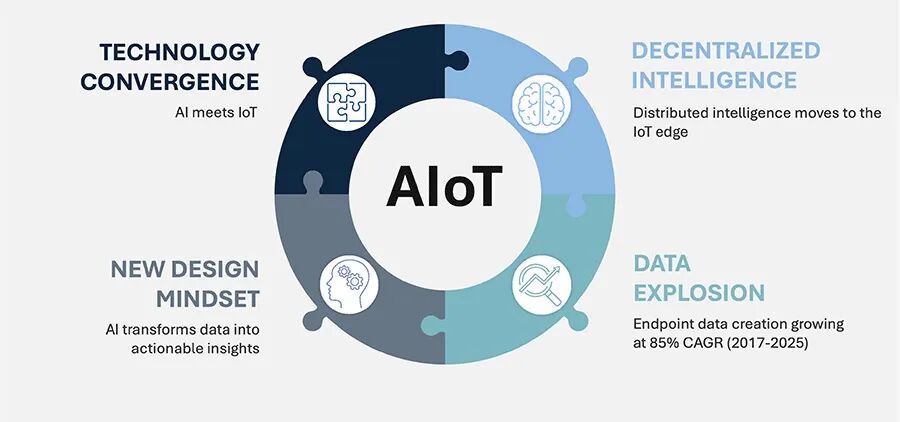
Artificial Intelligence (AI) applications at the IoT edge are redefining how interconnected devices collect, process, and analyze data across various consumer and industrial scenarios to achieve actionable decision outcomes. Unlike cloud AI servers, which must prioritize power consumption, data latency, and security management, AIoT pushes intelligent processing capabilities to the data source, enabling real-time on-site decision-making while enhancing privacy protection and reducing energy consumption.
Despite the promising outlook, AI applications at the IoT edge face significant engineering challenges. Traditional AI models require substantial computational power, memory, and energy support, which are difficult to sustain for resource-constrained IoT devices that typically rely on battery power and have limited processing capabilities. Therefore, designers urgently need highly optimized, lightweight neural network models that can efficiently run on microcontrollers, microprocessors, and other low-power hardware without sacrificing performance and accuracy.
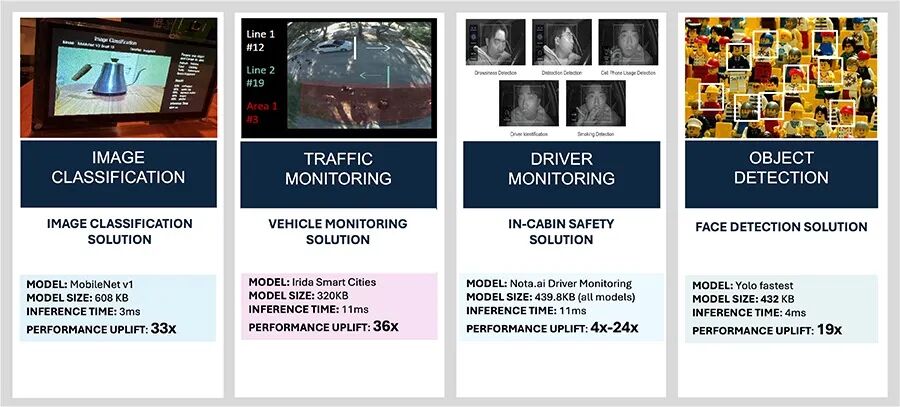
Managing AIoT Processing with TinyML Models
Due to the inherently decentralized nature of AIoT, it not only reduces reliance on cloud servers but also allows for immediate action based on real-time analysis results, enhancing security by storing data locally. This characteristic makes it easier to equip factory equipment with predictive maintenance capabilities: machine learning (ML) models can be embedded in local sensors to detect anomalies or failures without waiting for cloud analysis. Smart home devices with AI-enhanced voice interfaces can achieve instant keyword recognition and natural language understanding without transmitting sensitive audio data over the network.
Similar to the emerging technological trends in AI data centers, edge AIoT is also evolving to cope with the surge in inference models. If data is the “fuel” for achieving intelligent, real-time decisions, then AI inference is the “engine” that directly processes pre-trained machine learning models on edge devices.
AI inference modeling in data centers has unique computational demands, typically relying on powerful parallel processors to train large language models (LLMs) with billions of parameters. On the other end, edge AIoT technologies (such as TinyML) minimize memory requirements and computational overhead, enabling battery-powered IoT endpoint devices to perform real-time analysis. Additionally, TinyML inference modeling supports multimodal applications, integrating voice, visual, and sensor data for advanced applications such as environmental monitoring and autonomous navigation.
Real-time data processing is another critical challenge faced by edge AIoT, constrained by multiple factors such as memory capacity, limited energy budgets, and thermal conditions. Many consumer and industrial applications, such as smart home voice recognition and autonomous sensors, require ultra-low latency responses. However, due to network latency, cloud-based AI struggles to meet these demands, making device-side inference crucial. Simultaneously, engineers must ensure data security and privacy by embedding robust encryption and root-of-trust mechanisms directly on the endpoint.
Tools like TinyML play a key role in overcoming these barriers: they enable compact machine learning models to run efficiently on IoT hardware while significantly extending battery life.
Renesas Launches New MCUs and MPUs
Optimized for Edge AIoT
To better serve edge AIoT applications, Renesas has recently expanded its processor product lineup, introducing a series of high-performance, low-power new MCUs and MPUs. These processors integrate dedicated neural processing units (NPUs) specifically designed for AI computational tasks.
The 32-bit Renesas RA8P1 MCU is designed for voice and visual edge AI applications, featuring dual Arm® cores—1GHz Cortex®-M85 and 250MHz Cortex-M33—along with an Arm Ethos-U55 NPU, providing up to 256 GOPS of AI computing power. In terms of security, this new MCU supports Arm TrustZone® secure execution environment, hardware root of trust, secure boot, and advanced encryption engines, ensuring secure deployment in critical edge applications.
Renesas also released the 64-bit RZ/G3E MPU for high-performance edge AIoT and human-machine interfaces. This processor integrates a quad-core Arm Cortex-A55 CPU, Cortex-M33 core, and advanced graphics processing capabilities. The RZ/G3E embeds an Arm Ethos-U55 NPU, providing up to 512 GOPS of AI computing power to offload the main CPU for tasks such as image classification, voice recognition, and anomaly detection.
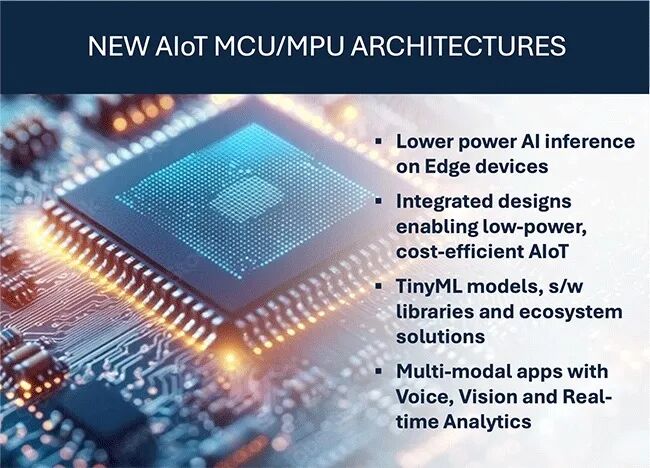
Arm NPU Precisely Matches AIoT’s Power and Performance Needs
The Arm Ethos-U55 NPU supports popular neural network models such as ResNet, DS-CNN, and Mobilenet, achieving up to 35 times faster inference speed compared to pure CPU processing. Unlike GPUs, which can consume tens or even hundreds of watts for high-throughput parallel computing, the Ethos-U55 can achieve hardware-accelerated inference at milliwatt-level power consumption, making it an ideal choice for IoT edge devices.
The Arm NPU supports compressed and quantized neural networks, reducing memory and computational overhead for real-time, localized AI processing. In contrast, while GPUs excel in training large models, their size, cost, and high power consumption make them impractical for edge deployment.
Integrating RUHMI Framework with e² studio
Simplifying Edge AI Development
Renesas’ new MCUs and MPUs are supported by the e² studio integrated development environment and incorporate Renesas’ RUHMI framework to accelerate edge AIoT design. RUHMI (Robust Unified Heterogeneous Model Integration) is an end-to-end toolset and Renesas’ first comprehensive framework for MCUs/MPUs, designed to simplify AI workloads on resource-constrained devices. RUHMI supports mainstream machine learning (ML) formats such as TensorFlow Lite, PyTorch, and ONNX, enabling developers to import and optimize pre-trained models for high-performance, low-power edge AI deployment.
The RUHMI framework is further enhanced by Renesas’ e² studio, which provides intuitive tools, rich example applications, and powerful debugging capabilities. Together, they help developers more easily preprocess image and audio data, perform inference on the NPU, and post-process results in a unified environment.
Edge AIoT Relies on Low-Power, High-Compute Density Processors
According to a report by Grand View Research, the global edge AI market is expected to exceed $20 billion in 2024 and approach $66.5 billion by 2030, driven primarily by strong demand for real-time data processing and analysis at the network edge.
Today, MCUs and MPUs are increasingly becoming the preferred solution for edge AIoT visual and voice applications due to their low power consumption, localized processing capabilities, and cost-effectiveness. Unlike GPUs, which rely on cloud connectivity and have higher power consumption, MCUs and MPUs can process data directly on endpoint devices, achieving real-time inference and decision-making without network latency. Additionally, by keeping sensitive data on-device, these processors significantly enhance system security and privacy protection, avoiding the need for continuous cloud communication.
This perfect combination of speed, energy efficiency, and data security makes MCUs and MPUs ideal choices for wearable devices, smart homes, and industrial edge AI systems.
Future Focus on High-Definition Vision,
Security Assurance, and Robust IoT Supply Chain Development
While providing just-in-time support for the processor ecosystem with efficient TinyML models, Renesas is also developing MPUs for Vision Transformer (Vi-T) networks. This deep learning technology applies the Transformer model, originally designed for natural language processing, to the field of computer vision, but unlike high-power GPUs, Vi-T can process high-resolution images and videos without the need for cooling fans.
Renesas is also developing contactless security solutions, such as post-quantum cryptography (PQC), which can withstand attacks from both classical and quantum computers, thereby better defending against the increasing number of cyber threats.
While promoting the development of AI-accelerated hardware, software, and toolchains, Renesas remains committed to supporting traditional (non-AI) products and maintaining the open-source software environment that powers many IoT systems today. By closely collaborating with the partner ecosystem, we keep pace with the rapidly changing IoT landscape, helping customers develop more sustainable, smarter, and more secure interconnected systems.
(For related information, you can scan the QR code below or copy the link to your browser to view.)
RA8P1 MCU
https://www.renesas.cn/zh/products/ra8p1

RZ/G3E MPU
https://www.renesas.cn/zh/products/rz-g3e

e² studio
https://www.renesas.cn/zh/software-tool/e-studio

RUHMI Framework
https://www.renesas.cn/zh/software-tool/ruhmi-framework

END
Need Technical Support?
Renesas Engineering Community has a wealth of technical resources. If you have any questions while using Renesas products, you can scan the QR code below or copy the URL into your browser to access the Renesas Engineering Community for answers and online technical support.

https://community-ja.renesas.com/zh/forums-groups/
Renesas Electronics (TSE: 6723)
Technology makes life easier, committed to building a safer, smarter, and sustainable future. As a global supplier of microcontrollers, Renesas Electronics integrates expertise in embedded processing, analog, power, and connectivity to provide complete semiconductor solutions. The successful product portfolio accelerates the market launch of automotive, industrial, infrastructure, and IoT applications, empowering billions of connected smart devices to improve people’s work and lifestyles. For more information, please visit renesas.com