In the memories of embedded or hardware engineers, the name Allwinner was initially associated with white-label tablets and TV boxes. Ten years ago, with the A10, A13, and other powerful chips, Allwinner broke through the red ocean of consumer electronics and was hailed as the “King of Tablets”.
Especially the A13, with its extremely low price and relatively open documentation, rode the wave of the rise of open-source hardware and makers at that time, and was widely used in many extremely cheap Linux development boards or DIY projects, becoming a blessing for many students in DIY smart hardware.
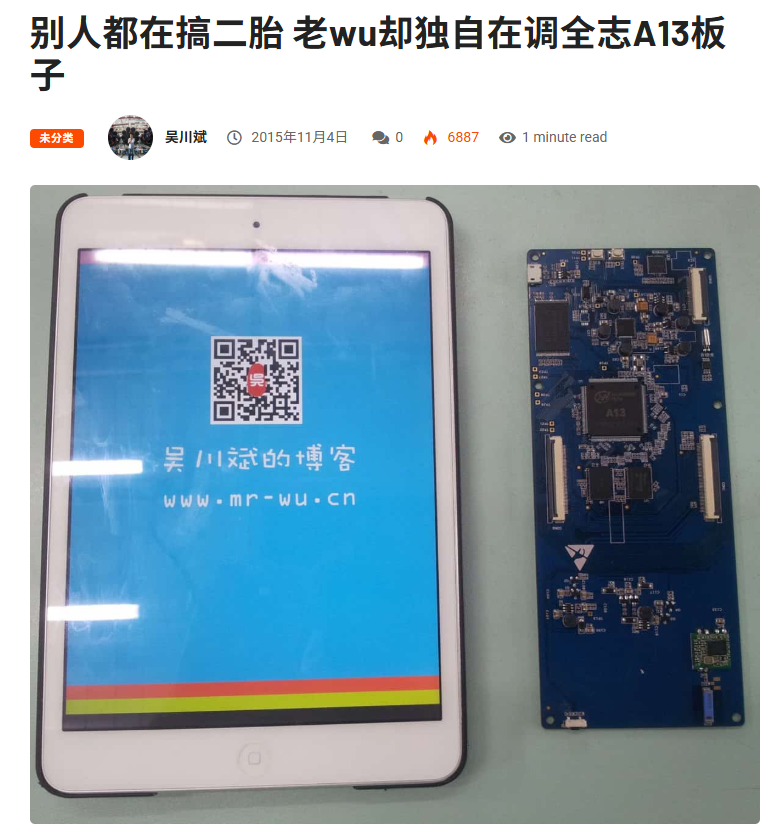
Old Wu still remembers sharing the scene of debugging the A13 late at night on his blog ten years ago. 
Of course, the era of cheap tablets and TV boxes is now a thing of the past.Suddenly looking back, Allwinner has quietly changed its track (or added new ones).
Today, when you open smart meters, disassemble commercial robots, or check the BOM list of in-vehicle central control systems, you increasingly see the presence of Allwinner’s T series chips. From the consumer-grade chip track to the industrial-grade chip track, this is not just a simple extension of the product line; Allwinner has been quietly cultivating the industrial chip market for many years.
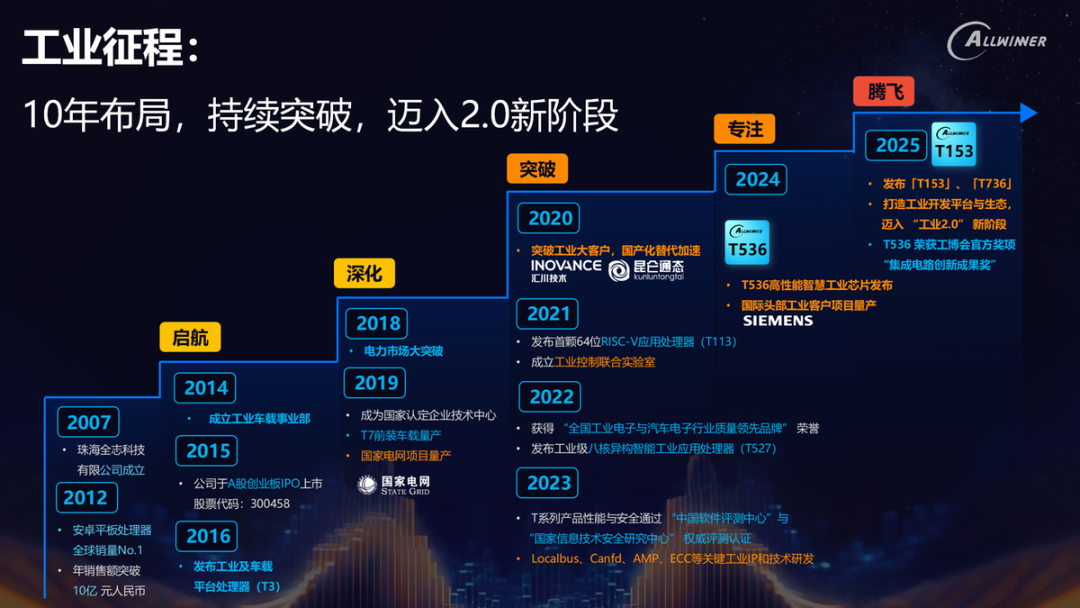
The image above clearly summarizes Allwinner’s layout in the industrial track over the past decade. As early as 2014, Allwinner established the “Industrial Vehicle Division” to focus on the research and development and market application of industrial-grade chips. In 2016, Allwinner launched its first dedicated processor for the industrial field, the T3.
In Allwinner’s product line,the “T” series (Transportation/Target Industry) targets the industrial market, which has essential differences from the consumer market:
-
Consumer-grade: Competes on performance, benchmark scores, and has a short lifecycle (1-2 years).
-
Industrial-grade: Competes on stability, temperature range, and has a long supply cycle (over 10 years).
Allwinner’s strategy is not to “start from scratch” but to “migrate core capabilities”. They have keenly captured a new trend in industrial equipment:screening and intelligence. Today’s industrial devices increasingly resemble “sturdy tablets in a shell”. This is precisely the field where Allwinner excels—video encoding/decoding + Android/Linux system adaptation.
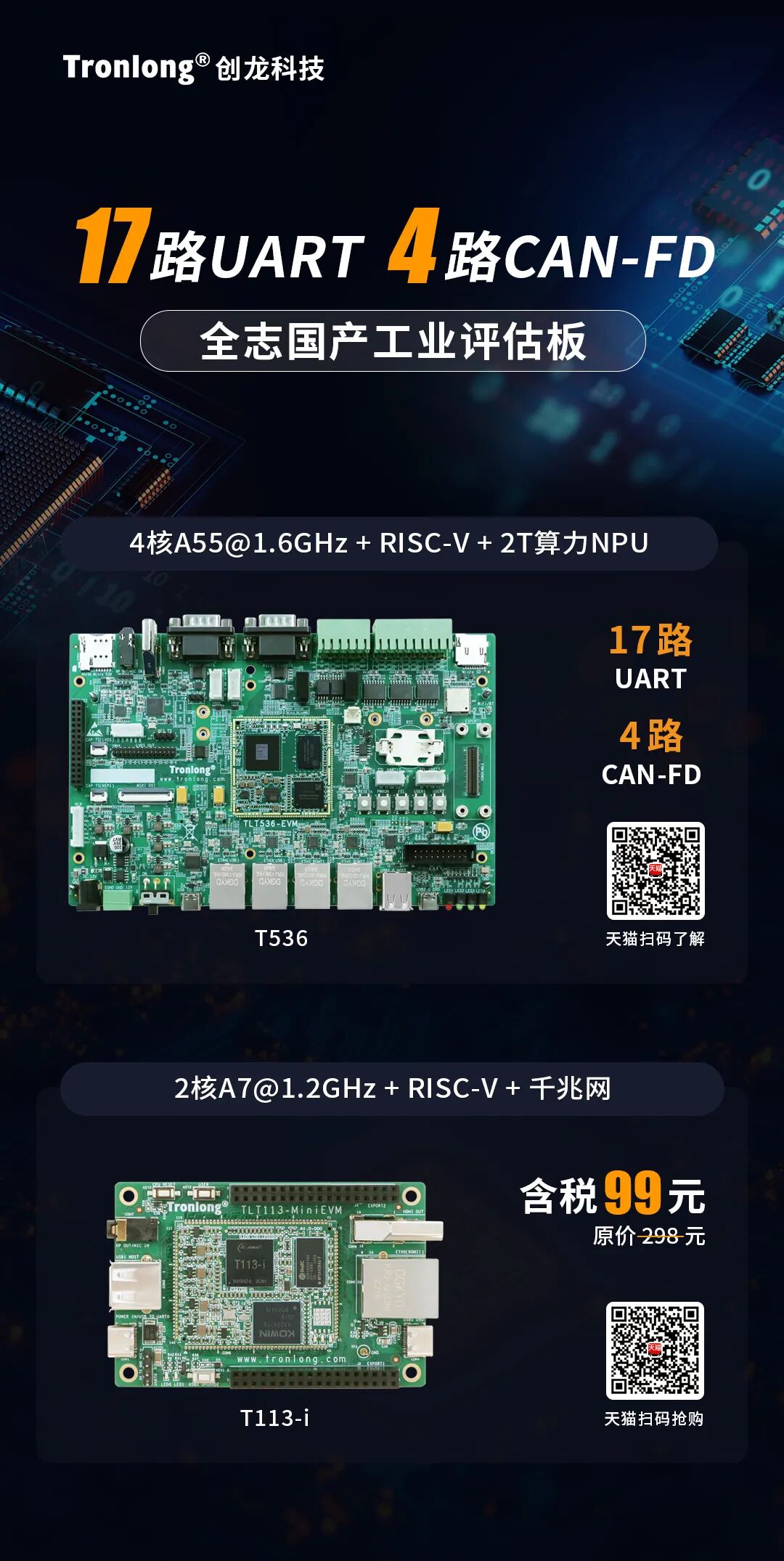
Here, Old Wu uses the Chuanglong Technology launched T536,T113-i development boards as an example. PS: Those interested in their development boards can learn more and purchase by scanning the QR code on the poster below.
⬇⬇⬇⬇⬇
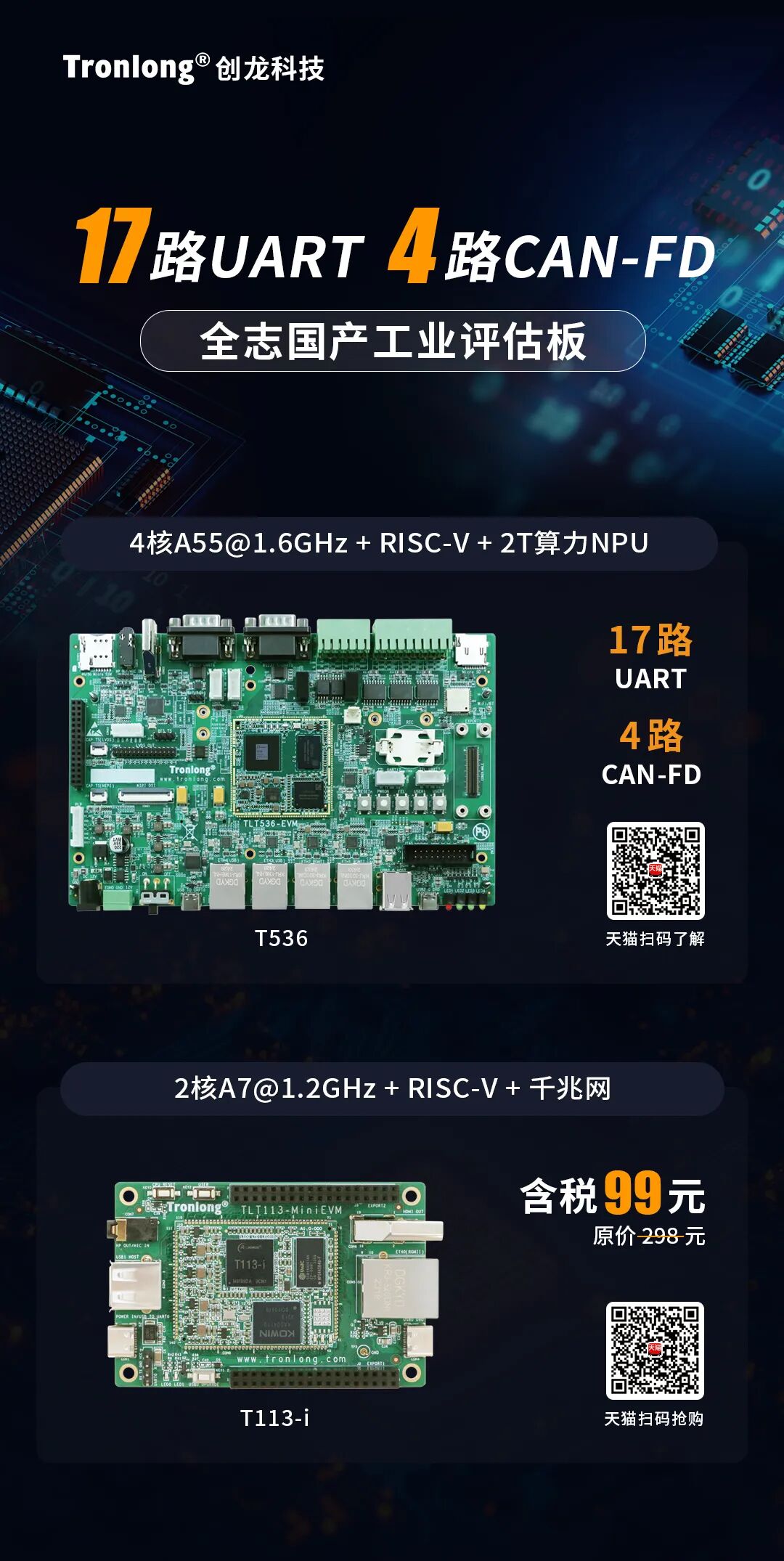
These two boards represent two typical strategies of Allwinner in the industrial track, showcasing how Allwinner has successfully transitioned its core competencies from making tablets to the industrial field.
T113-i
If the A13 of the past was the “price butcher” of the tablet world, then the T113-i is the “cost-performance monster” in today’s industrial HMI (Human-Machine Interface) field.
When debugging Chuanglong’s T113-i board, my biggest impression is thatit is simply the A13 dressed in work clothes and wearing a hard hat, of course, with a BGA package instead of its original form. 
In terms of computing power, it uses a dual-core Cortex-A7 + 64-bit Xuantie C906 RISC-V coprocessor. This configuration struggles a bit with the latest versions of Android, but it runs Linux and RT-Smart like a breeze. Allwinner understands very well that many industrial gateways and instruments do not need an 8-core CPU; they need extreme power efficiency and fast boot times.
The “industrial transformation” of interfaces is the key. What did consumer-grade chips lack back then? They lacked CAN interfaces and multiple UARTs. The T113-i natively supports 2 CAN buses, which directly opens up the “meridians” to automotive electronics and industrial PLCs.
Allwinner also equipped it with a HiFi4 DSP and powerful video decoding capabilities, making it suitable not only for data collection but also for use as an industrial panel, capable of displaying data, smoothly playing instructional videos, and even enabling simple voice interactions.
T536
In terms of computing power, the T536 features a 4-core Cortex-A55 + RISC-V MCU + 2T NPU architecture. It is one of the few mid-range chips with a built-in 2 TOPS NPU. Allwinner understands that in industrial settings, data collection is not enough; edge computing is also necessary for tasks like facial recognition and defect detection, and this chip can handle it.
In terms of interfaces, it can be described as an“encyclopedia of industrial-grade interfaces”, providing up to 17 UARTs and 4 CAN-FD! High-speed serial communication interfaces such as Gigabit Ethernet, USB, PCIe, and LVDS are also fully equipped! This means you can easily mount high-speed SSDs or connect 5G modules, instantly transforming it into a high-performance industrial edge gateway.
While debugging these T series boards, Old Wu sometimes feels a sense of temporal dislocation.
The familiar sunxi architecture is still visible in the code, the familiar register definitions are still present in the Datasheet, and even the burning tool is still the handy PhoenixSuit.
But the difference is that Allwinner’s quality control standards are getting higher and higher. 
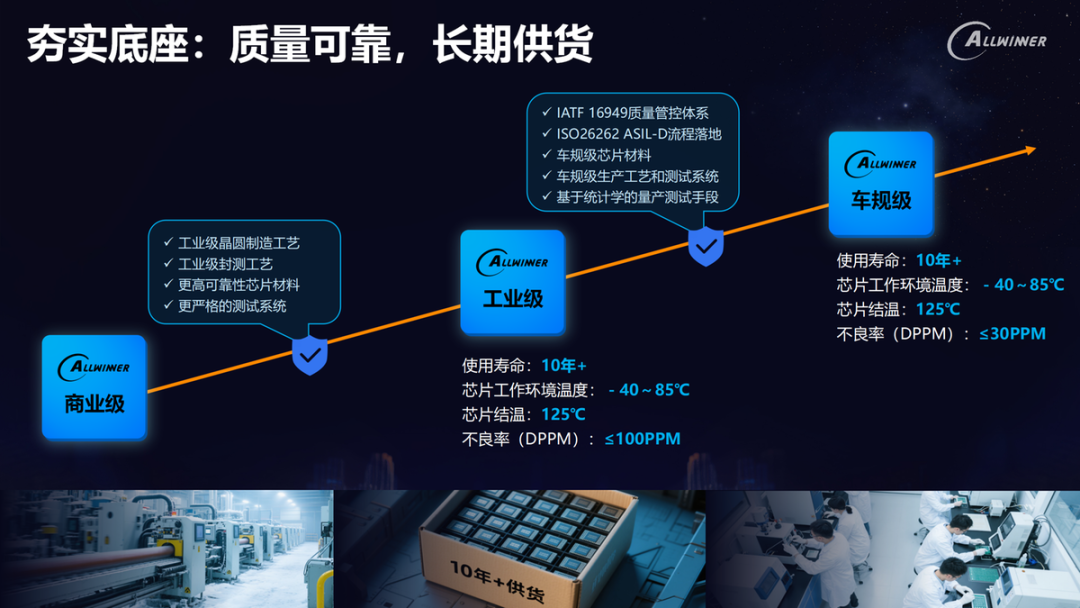
-
Operating temperature: Evolved from the consumer-grade 0-70℃ to a true industrial-grade wide temperature range of -40℃ to +85℃.
-
Lifecycle: A commitment to a supply period of over 10 years, no longer just “one shot and done”.
-
Quality control: Evolved from merely lighting up to automotive-grade standards.
Allwinner has changed, yet it has not changed.
It is no longer the “youth” that only competed on price in the red ocean of Huaqiangbei; it has donned work clothes and entered the smart grid, new energy vehicles, and automated factories.
For us embedded engineers, this is indeed a fortunate development.
Of course, Old Wu also hopes that Allwinner can become a bit more open, at least in terms of the availability of information on the industrial-grade T series, by directly posting reference designs on their official website. 
If you are selecting components for an industrial embedded project or are interested in Allwinner’s development ecosystem and wish to quickly evaluate based on development boards, Chuanglong Technology’s development boards are quite good; those interested can learn more by scanning the QR code on the poster below.
⬇⬇⬇⬇⬇