As we begin to explore the vast world of operating systems, the name “Linux” repeatedly comes up. Faced with hundreds of different “versions” (which we call distributions), many students feel confused: which one should I start with?
Don’t worry, this article will clear up the fog for you. My core advice is very clear: For computer science students in Chinese universities, starting with distributions from the RHEL, CentOS, Rocky Linux, or AlmaLinux series is currently the best and most practical choice.
Now, let’s unravel the reasons step by step.
1. First, understand a core concept: the Linux kernel and distributions
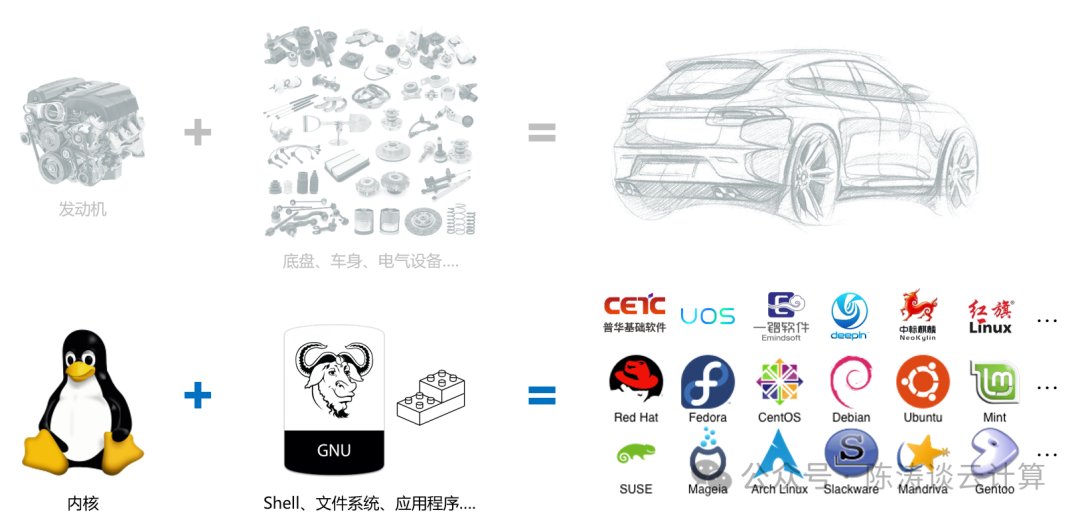
Before making a choice, we must first understand what Linux really is.
-
The Linux kernel is like the engine of a car In fact, Linux itself is not a complete operating system; it is merely the “kernel” of the system. We can use a real-life analogy: The Linux kernel is like the engine of a car. An engine alone cannot make a drivable car; it also needs a clutch, chassis, tires, seats, and electrical systems. Similarly, a usable operating system requires more than just a kernel; it also needs components like a file system, hardware drivers, applications, a shell, and a user interface. These components, packaged together with the Linux kernel, constitute a complete and usable “operating system,” which is what we call a distribution.
-
Distributions are like different brands of cars or different types of noodles The differences between various Linux distributions are akin to using the same engine (the Linux kernel) but pairing it with different gearboxes, chassis, and interiors to create different brands and models of cars, some of which prioritize comfort, while others focus on off-road capabilities. Another way to understand this is that different Linux distributions are like different types of noodles, such as hand-pulled noodles, braised noodles, and knife-cut noodles. They differ in appearance, texture, and preparation methods, but fundamentally, they are all made from flour (the Linux kernel).
Once you understand this, you’ll realize that choosing a distribution is essentially selecting a set of “accessory packages” that suit your needs.
2. Why do textbooks and courses in universities generally favor the RHEL series?
When you open most textbooks on “Linux Operating System Basics” or “Linux System Administration” in China, you will likely see explanations based on Red Hat Enterprise Linux (RHEL) or CentOS. This is not a coincidence, but rather determined by several reasons:
-
The absolute mainstream in the enterprise market (employment-oriented) In the enterprise market in China and globally (such as finance, telecommunications, government, and cloud service providers), RHEL is the de facto standard. The fundamental goal of education, especially in vocationally oriented courses, is to cultivate employable skills. Learning the RHEL series means that the skills you acquire can seamlessly integrate into the server environments of most enterprises, achieving the highest efficiency of “learning for application”.
-
Extreme stability and long lifecycle Each major version of RHEL offers up to 10 years of technical support. This is a significant advantage for teaching. Schools can use the same version of textbooks and experimental environments for many years, avoiding the chaos caused by frequent changes. This stability is unmatched by newer distributions like Ubuntu, making it very suitable for foundational learning.
-
Authoritative certification drive RHCE (Red Hat Certified Engineer) is globally recognized as a top Linux certification. Many textbooks are written around the RHCSA/RHCE certification syllabus. Being exposed to this system during your studies lays a solid foundation for obtaining high-value certifications in the future and enhances your resume’s competitiveness.
3. An indispensable practical consideration: your textbooks and exams
This is a very practical reason: It is likely that the textbooks, experimental guides, classroom demonstrations, and final exam content specified by your school are all based on the RHEL/CentOS environment.
To keep up with the class pace, complete experimental assignments, and achieve good grades in exams, using a distribution consistent with the teaching environment is the wisest choice. This avoids the troubles of differing package names and configuration file paths due to distribution differences, allowing you to focus your energy on mastering the core concepts of Linux itself rather than wasting it on resolving environmental discrepancies.
4. The evolution of the “RHEL family”: from CentOS to Rocky/AlmaLinux
You may have heard names like CentOS and Rocky Linux; what is their relationship with RHEL? Here is a key history:
- RHEL is a commercial product from Red Hat, stable and reliable, but requires a paid subscription.
- CentOS was originally a community free replica of RHEL. It is 100% compatible with RHEL, provided free to the world after removing trademarks, and became the first choice for universities and enterprises.
- Changes At the end of 2020, Red Hat announced it would stop maintaining stable CentOS and instead promote CentOS Stream. CentOS Stream can be understood as the “beta version” of RHEL, positioned upstream of RHEL (new features are tested here before flowing into RHEL), making it unsuitable for stable production environments and teaching.
- “New King” ascends The community quickly created Rocky Linux (initiated by the original CentOS founder) and AlmaLinux to continue the mission of providing a free and stable option. They perfectly inherit the legacy of traditional CentOS, becoming the next generation of free replicas of RHEL.
Therefore, today when you learn “CentOS,” the system you should actually install is Rocky Linux or AlmaLinux. They are currently the best free platforms for learning the RHEL system.
5. Looking to the future: the cornerstone of domestic production and the “Xinchuang” industry
As a Chinese computer student, it is also important to understand a significant national strategy—the Xinchuang industry (Information Technology Application Innovation Industry). Its goal is to achieve self-control in key information technology fields.
Currently, the vast majority of domestic operating systems that meet Xinchuang requirements (such as Kylin Software, Tongxin UOS, etc.) have their underlying core derived from Linux and maintain a high degree of compatibility with the RHEL/CentOS series. This means that if you master the management and operation skills of the RHEL series now, you can smoothly transition to these domestic operating systems in the future, contributing to the country’s information technology self-innovation. This opens another broad door for your career development.
Summary and Action Guide
| Distribution | Role | Recommendation Rating | Learning Suggestions |
|---|---|---|---|
| RHEL | Commercial version, enterprise standard | ★★★★★ (Goal) | Understand its position, used in enterprise environments |
| Rocky Linux / AlmaLinux | Free replica of RHEL, the first choice for learning | ★★★★★ (Practice) | Install it now! as your learning and experimental environment |
| CentOS Stream | Development upstream of RHEL, rolling updates | ★★☆☆☆ | Not suitable for beginners, suitable for developers to participate in testing |
Action Suggestions:
- Install the system Do not install directly on a physical machine! Use free virtual machine software (such as: VMWare Workstation Pro/VirtualBox) to install a Rocky Linux or AlmaLinux on your Windows or macOS. This way, you can experiment freely, and if the system crashes, you can quickly recover.
- Embrace the command line Do not get addicted to the graphical interface. Open the terminal and start practicing with the most basic commands like
<span>ls</span>,<span>cd</span>,<span>vim</span>,<span>grep</span>, etc. - Combine with textbooks Follow the school’s course schedule and complete each experimental operation in the virtual machine.
Remember, distributions are just tools; the core is mastering the Linux philosophy and general skills. Choosing the RHEL series as a starting point is a well-validated path by countless predecessors, balancing theoretical learning and future employment. I wish all students an enjoyable exploration in the world of Linux and success in their studies!