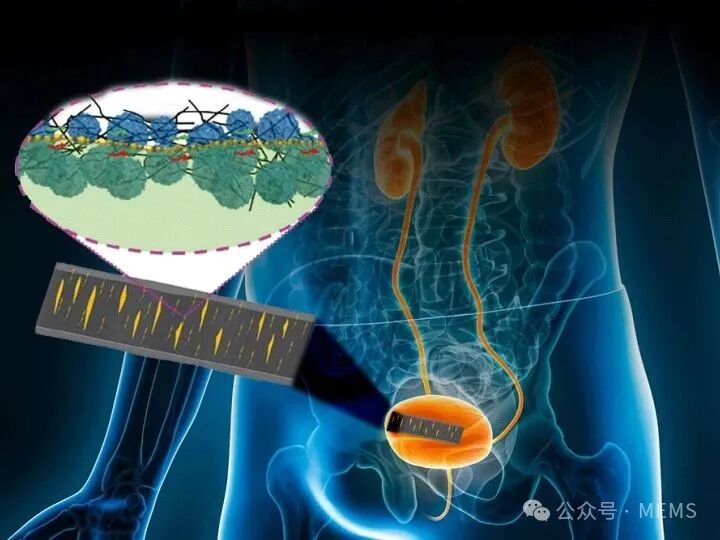
According to a report by Maims Consulting, an international research team led by researchers from Pennsylvania State University has developed a new type of bionic skin sensor that can help doctors monitor vital signs more accurately, track postoperative healing, and even assist patients with urinary incontinence.
The bionic skin sensor can be attached to the skin or implanted in the body to measure physical movements and electrical signals. It is made from soft, stretchable materials that mimic human skin and is designed to operate for extended periods without losing performance.
“When combining two different materials to achieve the best characteristics of both, trade-offs are usually necessary,” said Professor Huanyu Cheng from the Department of Engineering Science and Mechanics at Pennsylvania State University. “Our design avoids this issue. We achieve low contact resistance, high sensitivity, stretchability, and long-term stability in a single device.”
Most sensors rely solely on conductivity, which transmits electrons through metals or carbon materials. However, this bimodal skin sensor combines two different types of conductive properties: electronic conduction and ionic conduction, the latter of which moves charged atoms through liquids. This mixture helps it interface more naturally with the human body, especially for internal applications where the environment is moist and rich in ions.
“Ionic conduction is more compatible with the body,” Professor Cheng said. “It allows the sensor to adhere better, especially internally, and provides us with higher quality signals.”
The team constructed the sensor using a combination of flower-shaped metal-organic frameworks, carbon nanotubes, and soft rubber-like materials filled with ionic liquids. This combination gives the sensor high performance and flexibility while helping to reduce internal wear over time.
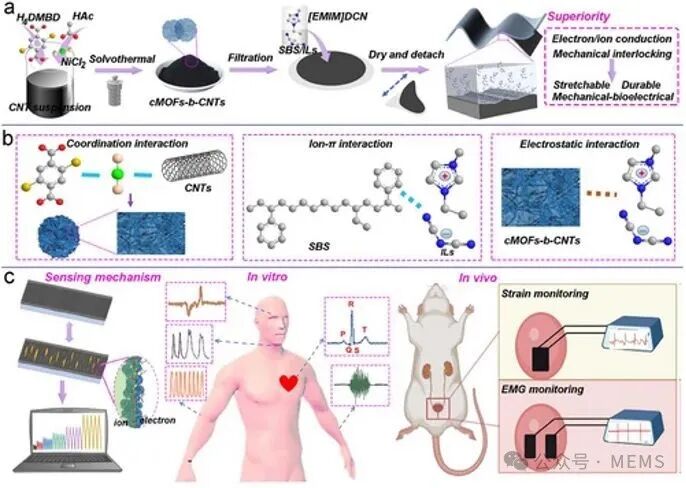
A major advantage of this design is that it can detect both large movements (such as bending the wrist) and very small movements (such as subtle muscle vibrations). It can also record electrical activities such as heart signals or brain waves. This gives it a wide range of potential medical and health applications, particularly noteworthy is its application in bladder function monitoring. The team tested the sensor on rodent models, measuring bladder stretching and the electrical activity of surrounding muscles.
“With this skin interface, we can obtain information from the surface of the bladder and have the potential to provide electrical stimulation,” Professor Cheng said. “This means we can monitor issues while simultaneously providing treatment, which could help patients with urinary incontinence.”
Since the sensor can operate in both dry and wet environments, it can be used directly on the skin or implanted in the body without the need for different materials or designs.
“Therefore, we do not need to choose different materials for in vitro and in vivo applications,” said Professor Songfang Zhao from the School of Materials Science and Engineering at Jinan University, a co-author of the study. “The sensor performs well under both conditions.”
Tests have shown that the sensor can withstand thousands of stretches without losing performance. It can accurately capture common movements such as wrist bending, knee bending, and even throat movements during speaking or swallowing. Compared to commercial sensors, it performs equally well or better in measuring heart, muscle, and eye movement activities.
Looking ahead, the researchers plan to expand the sensor’s functionality beyond monitoring; they hope to create a system that not only senses problems but also actively provides treatment.
“If we can enhance the ability to deliver electrical stimulation, we can form a closed loop of monitoring and treatment,” Professor Cheng explained regarding how future research will achieve broader applications. “By detecting signals with the sensor, deciding what action to take, and triggering responses such as nerve stimulation or cardiac pacing. With this sensor, we can shift from merely collecting health data to truly helping the body self-repair.”
Paper link:
https://doi.org/10.1002/adfm.202501122