1. Core Advantages of PCIe Technology: Why is it the Cornerstone of Communication Networks?
PCIe[Peripheral Component Interconnect Express] is a high-speed serial point-to-point dual-channel bus standard, whose technical characteristics perfectly meet the high bandwidth and low latency requirements of modern communication networks:
1. Full-duplex communication architecture allows each device to have independent transmit (TX) and receive (RX) channels, supporting bidirectional synchronous data transmission. For example, PCIe 3.0 achieves a single-channel rate of 8Gbps, and an x16 link can provide 128Gbps bidirectional bandwidth, far exceeding traditional PCI buses.
2. Layered protocol stack design adopts a physical layer, data link layer, and transaction layer similar to the OSI model, supporting packet verification, error retransmission, and end-to-end reliable transmission.
3. Flexible scalability is achieved through PCIe Switch chips, enabling multi-level topological interconnections, allowing a single system to expand to hundreds of terminal devices, meeting the high-density I/O requirements of network devices.
Figure 1: Comparison of PCIe vs Traditional Bus Architecture
Traditional PCI Bus: Shared bandwidth (multiple devices competing) → Bandwidth bottleneck
PCIe Bus: Point-to-point dedicated channel → Parallel data flow without conflict
2. Core Application Scenarios in Communication Networks
(1) High-Speed Network Interface Cards (NIC)
· Smart NIC: A 100Gbps network card based on PCIe 4.0 x16, achieving zero-copy packet transmission through Direct Memory Access (DMA) technology, reducing CPU load. For example, Intel’s E810 series network cards offload TCP/IP protocol processing using PCIe channels.
· Time-Sensitive Networking (TSN) support: The deterministic latency characteristics of PCIe (in microseconds) meet the real-time requirements of industrial communication, used for 5G fronthaul network cards.
(2) Data Center Acceleration Hardware
· FPGA Acceleration Cards: Xilinx Kintex-7 FPGA achieves network encryption/compression hardware acceleration through PCIe 3.0 x8 interface (6.6GB/s bandwidth), such as the signal processing card 3 in the PXIe chassis from Jianyi Technology.
· GPU Network Computing: NVIDIA BlueField DPU combines PCIe 4.0 to achieve Network Function Virtualization (NFV), enhancing the data plane processing efficiency of cloud servers.
(3) High-Density I/O Systems
· Video Stream Processing Servers: For example, the Corvid88 PCIe I/O card supports 8 BNC interfaces for independent configuration, with each channel programmable as input/output, enabling real-time processing of multiple 4K video streams.
· Telecom-grade Signal Acquisition: The NI PCIe-6537 digital I/O card achieves 200MB/s bidirectional throughput through PCIe 2.0, used for 5G base station signal analysis.
3. Key Technological Breakthroughs: How PCIe Solves Communication Bottlenecks?
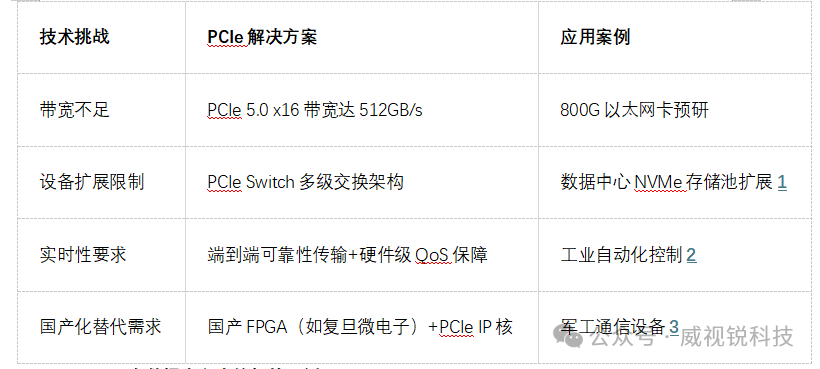
Figure 2:
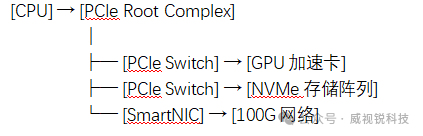
4. Future Trends: PCIe 6.0 and CXL Empowering the Communication Revolution
1. New Features of PCIe 6.0
1) PAM4 modulation technology doubles the bandwidth to 256GT/s
2) Low Latency Architecture (LLC) meets the needs of URLLC scenarios
2. CXL (Compute Express Link) Protocol Achieves memory consistency interconnect based on the PCIe physical layer, breaking through the memory wall limitations of traditional network devices, suitable for DPU/FPGA heterogeneous computing.
Conclusion
PCIe, with its point-to-point serial architecture, flexible bandwidth allocation, and layered error control mechanisms, has become the underlying interconnect standard for 5G, AI data centers, and the Industrial Internet. With the integration and evolution of PCIe 6.0 and CXL, it will further play a core role as the “data highway” in future communication networks, promoting the implementation of national strategic infrastructure such as East Data West Computing and computing power networks.
