01
Technical Overview
1.1 What is ADC?
ADC, short for Antibody-Drug Conjugate, can be understood as a “biological missile” or “Trojan horse”.
Antibody: is the “guidance system” or “shell of the Trojan horse”. It can accurately identify and bind to specific antigens (targets) on the surface of cancer cells.
Drug: is the “warhead” or “soldiers inside the Trojan horse”. This is a potent cytotoxin responsible for ultimately killing cancer cells.
Linker: is the “connecting device” or “rope”. It stably connects the antibody and the drug together.
The design concept of ADC is very clever: it utilizes the high specificity of antibodies to deliver highly active cytotoxins precisely into tumor cells, thereby efficiently killing cancer cells while avoiding “collateral damage” to normal cells, overcoming the drawbacks of traditional chemotherapy where “killing a thousand enemies also harms eight hundred of your own”.
1.2 What is “Conjugation Technology”?
Conjugation technology refers to the core technology of how to safely, reliably, and quantitatively install the “warhead” (drug) onto the “missile carrier” (antibody) through the “connecting device” (linker). This process is not simply about “sticking together”; it requires extremely high precision and stability, which are key to the success or failure of ADC drugs.
1.3 Why is ADC/XDC technology needed?
The main drawback of traditional chemotherapy is the narrow therapeutic window: the effective dose and the toxic dose are very close.
Highly effective toxins: There are drugs that can effectively kill cancer cells (such as microtubule inhibitors, DNA damaging agents), but they are too toxic. If administered systemically, they can cause severe damage to other rapidly dividing normal cells (such as bone marrow cells, gastrointestinal cells) before reaching the tumor, leading to intolerable side effects.
Targeted delivery: ADC technology solves this problem. By using antibodies to “target deliver” toxins to the tumor site, it greatly increases the local concentration of the drug while reducing the amount of toxin exposure throughout the body, thus widening the therapeutic window and allowing these potent toxins to be clinically applied.
1.4 Core Components and Technical Challenges of ADC
1) A successful ADC requires the perfect synergy of three major elements:
Antibody specificity: must efficiently bind to tumor cell-specific or highly expressed target antigens.
Internalization: After binding, it must be effectively “internalized” by the cell to release the drug.
Linker stability in circulation: must be absolutely stable in the bloodstream and not release toxins prematurely, otherwise it will lead to systemic toxicity.
Efficient intracellular release: Once the ADC is internalized into the cell, it must rapidly cleave and release the active toxin under lysosomal (acidic environment, rich in enzymes) conditions.
Toxin/load high toxicity: must be a highly potent cytotoxic drug (usually microtubule inhibitors or DNA disruptors), with efficacy 100 to 1000 times that of traditional chemotherapy drugs.
Modifiability: must have a chemical site (such as amino or thiol groups) for linker attachment, and must not lose activity after linkage.
2) Technical challenges (DAR and heterogeneity):
DAR value: refers to the drug-to-antibody ratio, i.e., how many drug molecules are attached to each antibody molecule on average. A DAR that is too high (>8) may lead to ADC aggregation and rapid clearance; a DAR that is too low (<2) may result in insufficient efficacy. The ideal DAR is usually 3-4.
Heterogeneity: Traditional conjugation techniques (especially early techniques) randomly attach drugs to lysine or cysteine on the antibody. This results in a mixture of molecules with different DAR values and attachment sites, leading to heterogeneity. Heterogeneous products are difficult to ensure batch-to-batch consistency, and different components may have different pharmacokinetic and toxicity characteristics, posing significant challenges for production and regulation.
1.5 The Core of the Core: The Evolution of Conjugation Technologies
This is the origin of the “XDC” concept. XDC represents the extension of ADC technology, where “X” can be an antibody (Antibody) or other targeting carriers, such as peptides, small molecules, oligonucleotides, radioactive nuclides, etc. However, the core principles of conjugation technology are similar. The history of the development of conjugation technology is a history of overcoming heterogeneity and improving uniformity.
1) Early random conjugation
Lysine conjugation: The antibody surface has a large number of lysines, whose ε-amino groups can participate in reactions. However, there are too many sites and it is difficult to control, leading to high heterogeneity of the products.
Cysteine conjugation (partial reduction): Utilizing interchain disulfide bonds (e.g., IgG1 has 4 pairs of interchain disulfide bonds), they are partially opened with a reducing agent to generate reactive thiol groups (-SH), which are then linked to the drug. This method is somewhat more controllable than lysine methods, but still has site heterogeneity. The first generation of ADCs mostly used this method.
2) Site-Specific Conjugation – Current Technological Frontier
To obtain uniform ADCs with a defined DAR, scientists have developed various precise site-specific conjugation technologies:
Engineered cysteine: By genetic engineering techniques, a non-paired cysteine is introduced at a specific site on the antibody (e.g., position 239 of the heavy chain), which carries a thiol group for specific linkage, such as Seagen/Genentech’s Thiomab technology.
Non-natural amino acids: Specific codons are introduced into the antibody gene, inserting a naturally non-existent amino acid (e.g., para-acetylphenylalanine) during protein expression. This amino acid carries a unique reactive group (e.g., ketone), which can undergo highly specific click chemistry reactions with corresponding linkers, such as Ambrx’s technology.
Enzymatic conjugation: Utilizing the specificity of certain enzymes to catalyze the linkage. For example: Sortase A transpeptidase: recognizes the LPXTG motif and cleaves the linkage. Formylglycine-generating enzyme: introduces an aldehyde-containing formylglycine, which can specifically react with the linker.
Glycoengineering conjugation: Modifying the glycan chains of the antibody Fc region to oxidize and generate aldehyde groups, or using glycosidases and glycosyltransferases to introduce specific click chemistry reaction sites.
Click chemistry: Mainly refers to copper-catalyzed azide-alkyne cycloaddition and copper-free strain-promoted azide-alkyne cycloaddition. The reaction efficiency is extremely high, with few side reactions and good biocompatibility, making it a powerful tool for achieving site-specific conjugation, often used in conjunction with other technologies (such as non-natural amino acids, glycoengineering).
The advantages of site-specific conjugation: the ADC produced has good uniformity, stable quality, superior pharmacokinetic properties, and a wider therapeutic window.
1.6 From ADC to XDC: Expanded Applications
The concept of “XDC” means that the application of conjugation technology goes far beyond antibodies.
PDC: Peptide-Drug Conjugates. Using peptides instead of antibodies as targeting heads, with smaller molecular weight and stronger penetration, but possibly shorter half-lives.
RDC: Radioactive Nuclide Conjugated Drugs. Connecting radioactive isotopes to targeting molecules for diagnosis (e.g., PET imaging) or treatment (targeted radiotherapy).
SMDC: Small Molecule-Drug Conjugates. Using small molecule ligands (e.g., folic acid) as targeting heads.
AOC: Antibody-Oligonucleotide Conjugates. For targeted delivery of RNAi, ASO, and other oligonucleotide drugs.
1.7 Summary and Outlook
ADC/XDC conjugation technology is a revolutionary platform technology in the biopharmaceutical field, perfectly integrating the specificity of biological targeting with the killing power of potent small molecule toxins.
1) Its core development trajectory is:
Conceptual innovation: from the “carpet bombing” of chemotherapy to the “precision strike” of targeted therapy.
Technological iteration: from random conjugation (high heterogeneity, uncontrollable DAR values) to site-specific conjugation (good uniformity, controllable DAR values).
Application expansion: from ADC to the broader world of XDC.
2) Future challenges and directions:
Discover new targets: Finding more antigens that are specifically expressed on tumor cells and have high internalization capabilities.
Develop new payloads: Exploring toxins with new mechanisms of action to overcome resistance.
Optimize linkers: Designing smarter and more stable linkers, such as those that can cleave and release in the tumor microenvironment (rather than only intracellularly).
Overcome resistance: Addressing potential resistance issues that may arise after ADC treatment.
Expand indications: Extending applications from tumors to areas such as autoimmune diseases and antibiotic-resistant bacterial infections.
Currently, ADC drugs have become one of the hottest areas in global cancer drug development, with many products successfully launched and achieving significant commercial and clinical success, representing an important direction for future drug development.
02
Application Overview
2.1 ADC Conjugation
1) Conjugation Technologies
Amino Conjugation: Directly conjugating the amino groups on the antibody surface with small molecules.
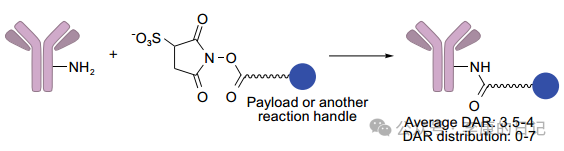
Advantages: Simple reaction steps.
Disadvantages: Some lysine residues that are crucial in antibody-antigen interactions may be modified, leading to reduced affinity.
Therefore, ADCs constructed using this conjugation method tend to have a heterogeneous mixture, which may potentially affect efficacy.
Lysine conjugation has low reproducibility and is difficult to ensure control over the DAR value distribution within the target range.
Thiol Conjugation: Reducing the interchain disulfide bonds of the antibody and then conjugating with small molecules.
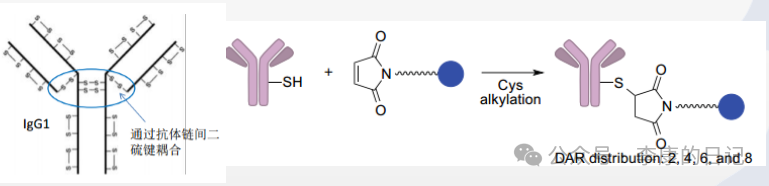
Advantages: The four interchain disulfide bonds are usually not critical for the structural stability of IgG1, and can be selectively reduced under mild conditions,
resulting in 2/4/6/8 free thiols while maintaining the integrity of 12 intrachain disulfide bonds.
Disadvantages: Requires an additional reduction step.
Disulfide Bridge Conjugation: After reducing the antibody, it reacts with a bifunctional small molecule linker, allowing two interchain disulfide bonds
to be simultaneously linked to a small molecule drug, producing an ADC with an average DAR of 4.
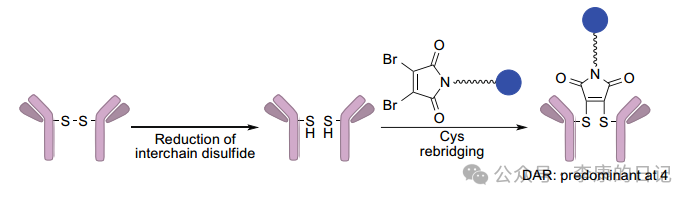
Advantages: Does not require modification of the antibody, does not affect the spatial structure of the antibody molecule; site-specific conjugation, better uniformity; higher stability.
Disadvantages: Prone to forming thiol bridge mismatched isomers.
Engineered Cysteine Conjugation (Thio-Mab): The concept of Thio-Mab was first proposed by Genentech, based on phage display methods, screening reactive cysteine mutation sites on the Fab surface of the antibody, using tris(2-carboxyethyl)phosphine (TCEP) to only open the interchain disulfide bonds of the antibody, and allowing the thiol group of the mutated cysteine to be in a free state, then using CuSO4 or dehydroascorbic acid (dhAA) to reconnect the interchain disulfide bonds, and finally reacting the free thiol with the drug linker to achieve site-specific conjugation of the antibody drug.

Advantages: Conversion rate greater than 90%; uniform DAR value of 2.
Disadvantages: Requires one reduction step and one oxidation step.
2) Analytical Methods
Hydrophobic Interaction Chromatography (HIC-HPLC): HIC-HPLC is a liquid chromatography system composed of a polar stationary phase and a non-polar mobile phase, which is a separation technique based on the relative hydrophobicity of proteins in solution. This technique can provide high separation efficiency, capable of separating substances with subtle hydrophobic differences, including those with different drug/antibody ratios (DAR) of ADCs.
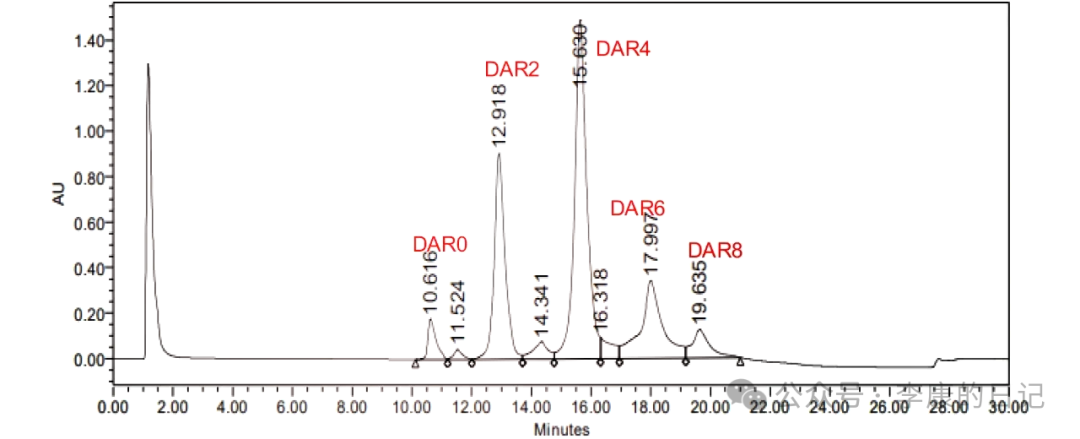
Reversed-Phase High-Performance Liquid Chromatography (RP-HPLC): In contrast to HIC-HPLC, RP-HPLC is a liquid chromatography system composed of a non-polar stationary phase and a polar mobile phase, which is a separation technique based on the relative hydrophobicity of proteins in solution. Generally, the least hydrophobic proteins will elute first. RP-HPLC can effectively measure substances with subtle hydrophobic differences and determine the DAR of ADCs.
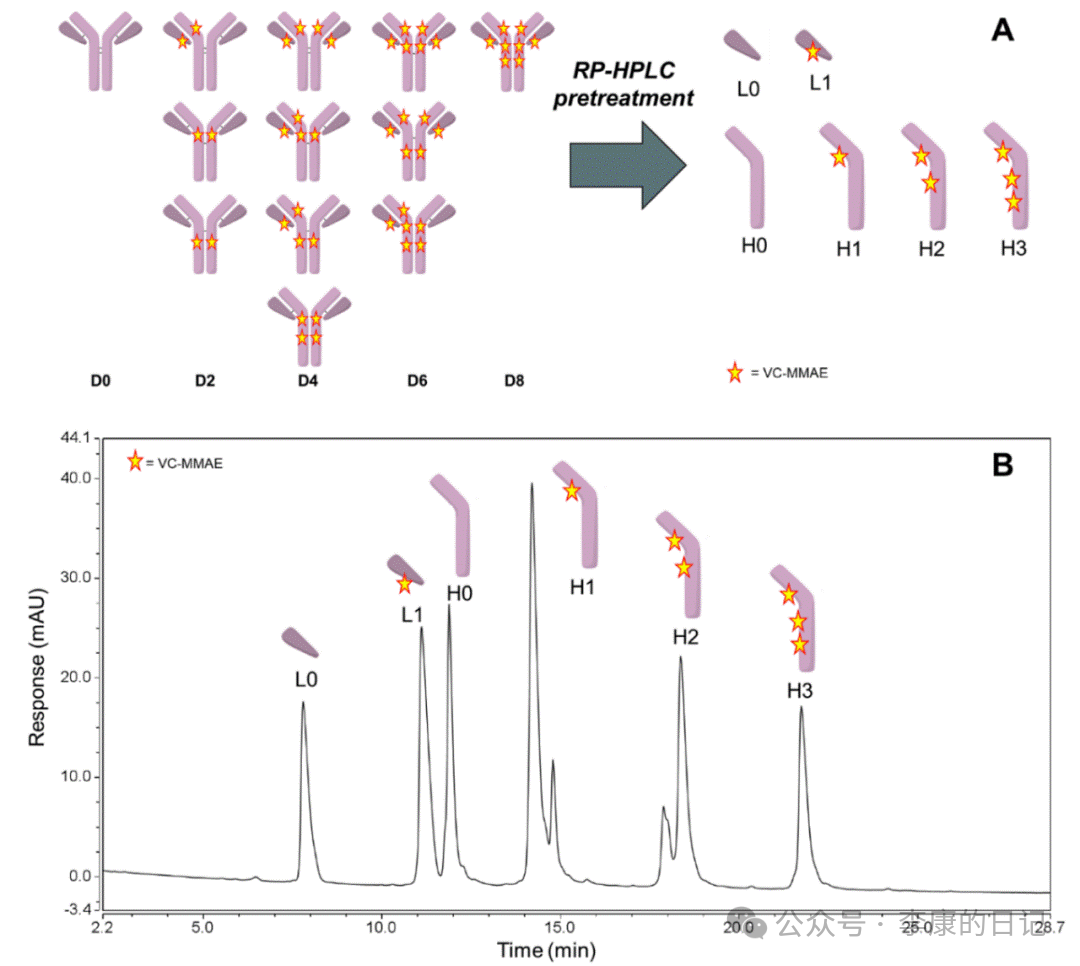
Size Exclusion Chromatography (SEC-HPLC): SEC-HPLC is a method of chromatographic separation based on the different sizes of biomolecules in solution, where the largest molecules are eluted first. SEC-HPLC can effectively detect the content of monomers and aggregates, determining the purity of antibodies.
Free Toxin Measurement (C18-HPLC): Free toxins refer to small molecule toxins that are not conjugated to antibodies and are free in the ADC storage buffer. The detection process involves first using a C18 column and high-performance liquid chromatography (HPLC) to detect samples of small molecules at pre-prepared concentrations, plotting a secondary regression equation based on the peak area in the HPLC analysis, and finally calculating the content of small molecule toxins based on the peak area of free small molecule toxins in the ADC using the derived standard binary regression curve equation.
3) Purification Methods
Ultrafiltration Purification: The principle is to utilize the characteristics of a semi-permeable membrane, which prevents large molecular ions from passing through while allowing small molecules to pass, thus achieving the purpose of separating large molecules in the solution. When the solution passes through the ultrafiltration centrifuge tube, large molecules are retained inside the tube while small molecules leak out through the semi-permeable membrane funnel, achieving separation.
Desalting Column Purification: The principle is to utilize the gel beads in the gel column to form a porous structure with different pore sizes. When the sample solution passes through the gel column, small molecular substances can enter the pores of the gel beads, while large molecular substances cannot enter, thus large molecular substances will pass through the gel column faster, while small molecular substances will remain in the gel column longer, achieving separation. In protein purification, salts and other small molecular substances will be retained in the gel column, while large molecular proteins will flow out faster, achieving desalting.
Activated Carbon Purification: Activated carbon has a highly developed pore structure and a large specific surface area, which allows it to be fully exposed to gases or solutions, providing more adsorption sites and enhancing its adsorption capacity. Additionally, the surface of activated carbon contains rich functional groups, such as hydroxyl and carboxyl groups, which can chemically react with adsorbates, further increasing the adsorption capacity of activated carbon for specific substances. The pore sizes of activated carbon vary, and its adsorption performance also differs. Microporous (less than 2nm) activated carbon has a huge specific surface area and a strong adsorption capacity for small molecular substances. When adsorbing large molecules such as proteins, mesoporous (2-50nm) allows protein molecules to partially enter, and then through diffusion, small molecules can enter the micropores to be adsorbed. Macroporous (greater than 50nm) is mainly used for adsorbing large molecular substances or providing a rapid channel for the adsorption process, allowing large biomolecules such as enzymes and viruses to enter the activated carbon first.
2.2 XDC Conjugation
1) Fluorescent Reagents for Flow Cytometry – Probe Molecules
Synthesis Route of Probe Molecules:
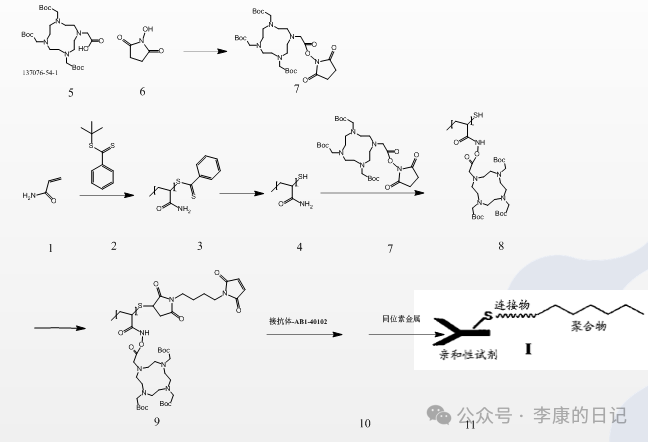
2) Intracellular Internalization Efficiency Detection Reagents – Protein Conjugated Small Molecules
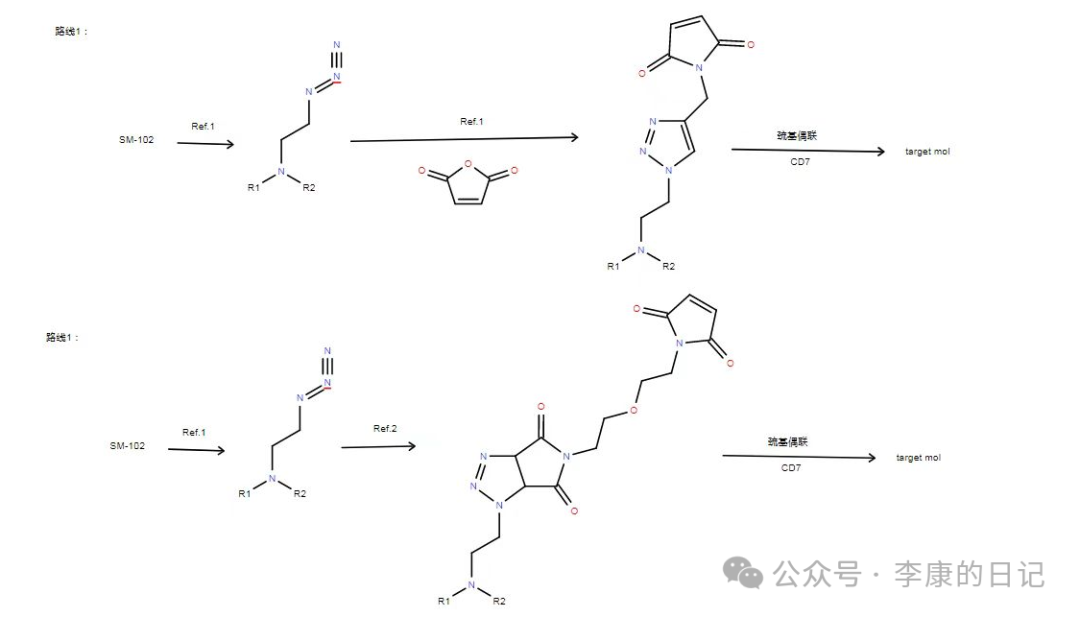
3) Antibody Conjugated Plasmids
Synthesis Route of Plasmid Molecules:
References
[1] Fang Luo. “Magic Bullets” in Precision Cancer Therapy – Antibody-Drug Conjugates (ADC Drugs) [J]. Drugs and People, 2024, 10: 30-32.
[2] Kyoji Tsuchikama, Zhiqiang An. Antibody-drug conjugates: recent advances in conjugation and linker chemistries [J]. Protein & Cell, 2018, 9, 33–46.