
Recently, the research team led by Professor Huang Zhengren from the Shanghai Institute of Ceramics, Chinese Academy of Sciences, successfully overcame a technical challenge, allowing 3D printed silicon carbide ceramics to maintain excellent performance even at extremely high temperatures, no longer “dropping the ball” due to high temperatures. This breakthrough will provide strong technical support for the stable operation of high-end equipment in harsh environments in fields such as semiconductors and new energy.
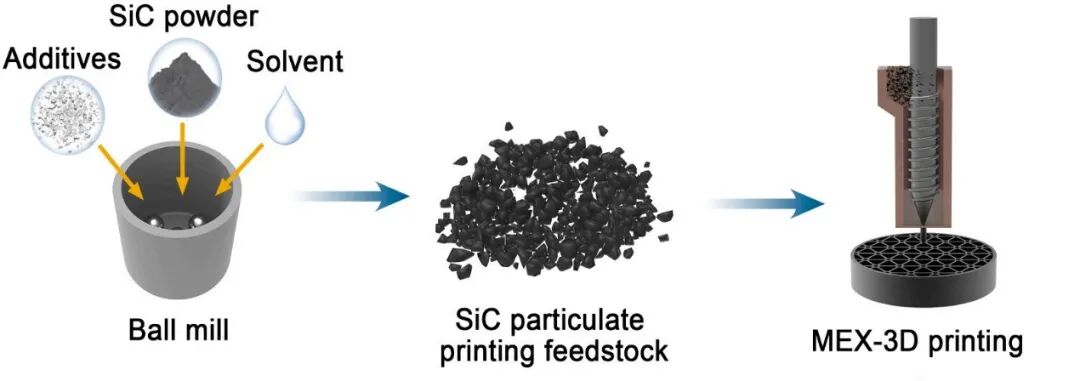
MEX-3D Printing SiC Ceramic Process Flowchart
Silicon carbide ceramics are materials with outstanding performance, high hardness, and excellent heat resistance, commonly used in manufacturing core components of high-end equipment such as lithography machines and photovoltaic devices. However, due to their inherent hardness and brittleness, traditional methods struggle to process complex-shaped parts. Although 3D printing technology can solve the problem of forming complex shapes, the performance of previously printed ceramic materials significantly decreased at temperatures exceeding 1410 degrees Celsius, limiting their widespread application.
In response to this challenge, the research team innovatively combined three processes to form a completely new composite manufacturing method. In simple terms, it is like injecting a special liquid into the 3D printed porous ceramic “skeleton,” which, after heating treatment, transforms into countless tiny silicon carbide particles, forming a strong “support network” within the material.
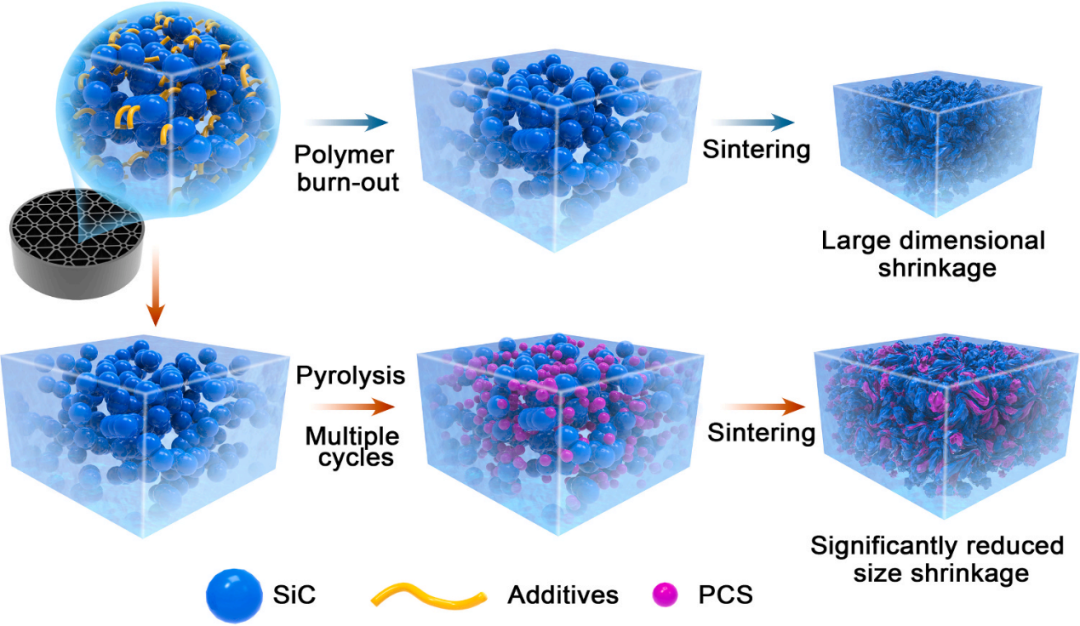
PIP Process Suppresses MEX Combined Atmospheric Pressure Solid-State Sintering of SiC Ceramics’ Dimensional Shrinkage
This “support network” brings two major benefits: first, it significantly reduces the shrinkage deformation of ceramics during the high-temperature sintering process, making the dimensions of complex parts more precise and less prone to cracking; second, it completely eliminates the generation of low-melting-point substances, fundamentally enhancing the material’s high-temperature resistance.
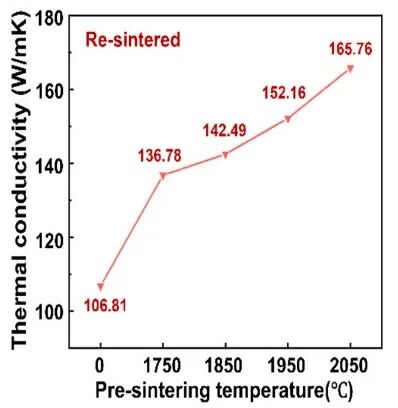
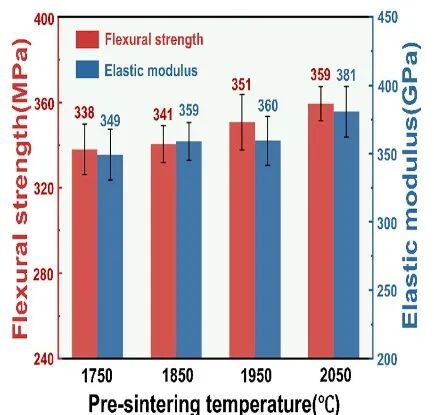
Thermal and Mechanical Properties of 3D Printed Atmospheric Pressure Solid-State Sintered SiC Ceramics
Experiments have shown that silicon carbide ceramics manufactured using this new method not only have high density and strength but also maintain excellent performance at high temperatures of 1500 degrees Celsius, with almost no decrease in strength and outstanding thermal conductivity.
This technology achieves a full-chain innovation from materials to processes, marking a key step for our country in the field of 3D printing of high-performance ceramics. Related results have been published in the internationally authoritative academic journal “Additive Manufacturing” and multiple national invention patents have been applied for.
In the future, this technology is expected to be applied in high-end equipment such as semiconductor manufacturing and photovoltaic new energy, helping to achieve the autonomous and precise production of complex structural ceramic components.
Correspondents:Zhang Liwen, Xie JingyangEditor: Zhang Yiting (Intern)






Like 🧡 Sharewith those around you👇