On July 17, 2025, the International Journal of Thermal Sciences published the latest research from the School of Mechanical and Electrical Engineering, Northern Minzu University, and the Ningxia Hybrid Manufacturing System Engineering Technology Research Center, Ningxia University, titled “Dual-matrix interface strength of 3D printed continuous carbon fiber reinforced composites: Quantitative assessment methodology and critical influencing factors” (3D打印连续碳纤维增强复合材料的双基体界面强度:定量评估方法与关键影响因素).
Research Highlights
- The matrix-matrix (M-M) interface plays a crucial role in 3D printed carbon fiber reinforced dual-matrix composites.
- A method for testing the matrix-matrix interface shear strength (M-M IFSS) has been proposed.
- The effects of key printing process parameters, crystallinity, and viscosity on the M-M IFSS of polylactic acid (PLA) and polyamide-6 (PA6) were studied.
- Finite element modeling was used to analyze the debonding behavior of the M-M interface.
https://doi.org/10.1016/j.addlet.2025.100303
**Abstract**
– This paper investigates the significant role of the matrix-matrix (M-M) interface in the structural mechanical properties of 3D printed continuous carbon fiber reinforced dual-matrix composites;
– A method for testing the M-M interface shear strength was proposed;
– The effects of different printing temperatures, printing speeds, layer thicknesses, and prepreg fiber volume fractions on the M-M interface shear strength of PLA and PA6 materials were studied;
– A finite element model was established to analyze the debonding behavior of the M-M interface and validate the effectiveness of the proposed method.
**Method**
– Carbon fiber reinforced PA6 prepreg and different types of PLA matrices were selected as the research objects;
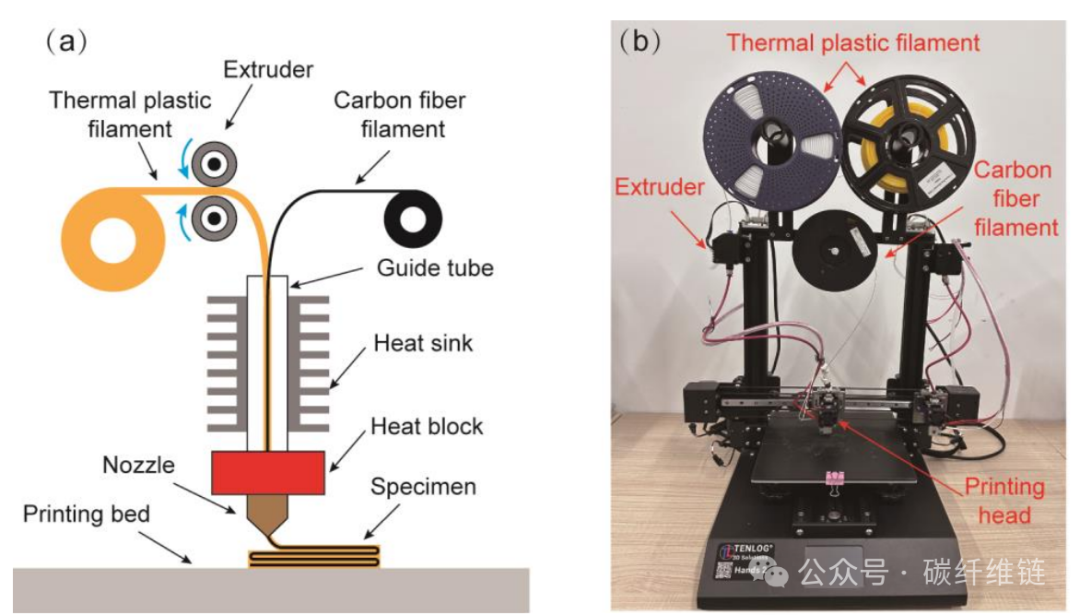
– A series of samples were prepared by varying parameters such as printing temperature, printing speed, layer thickness, and prepreg fiber volume fraction;
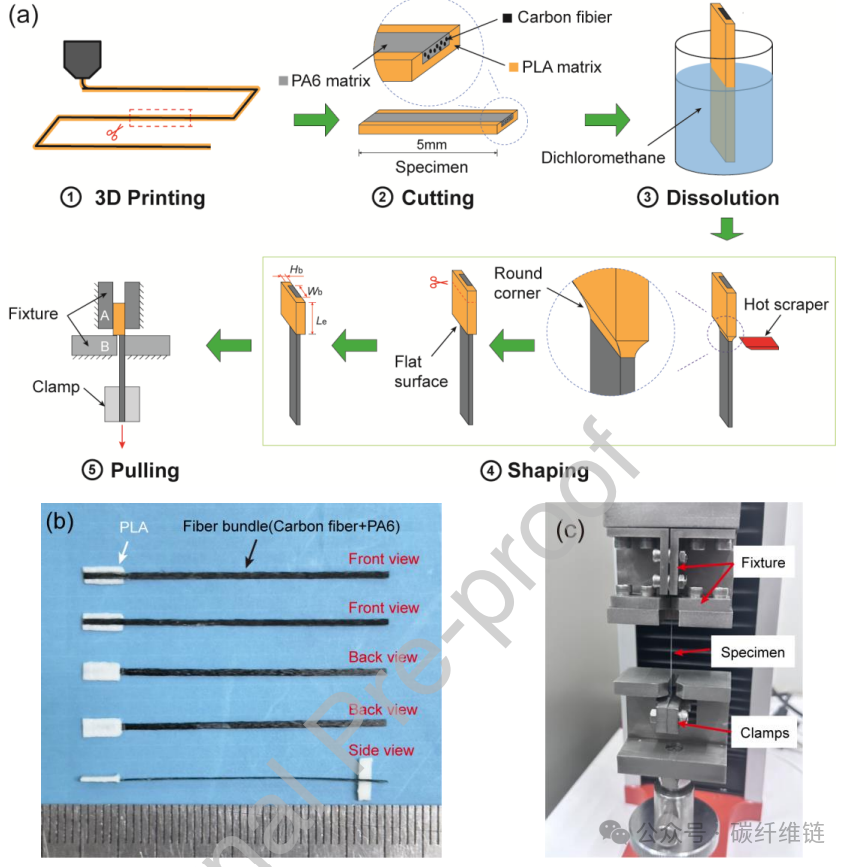
Sample preparation and testing process: (a) Preparation schematic; (b) Sample photos; (c) Testing process
– The M-M interface shear strength was tested using a single fiber pull-out test method;
– The thermal-mechanical and rheological properties of the materials were tested using differential scanning calorimetry (DSC) and rheometers;
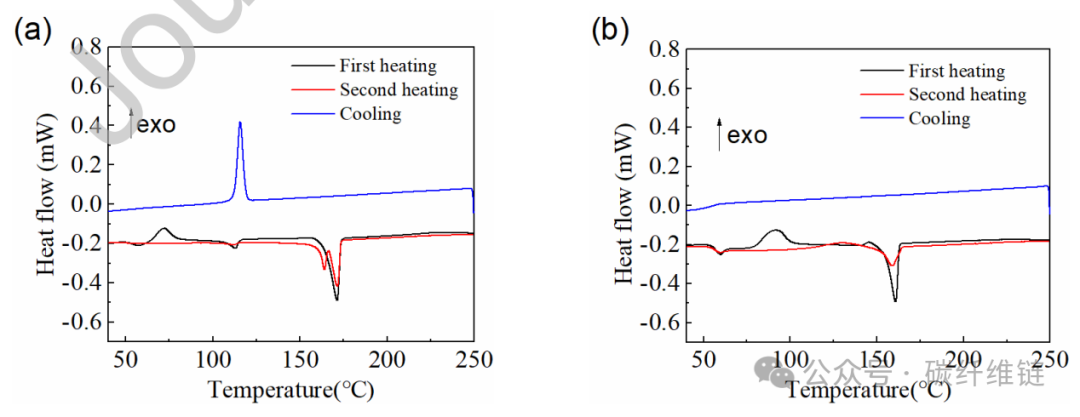
DSC curves of different matrix materials: (a) PLA-E; (b) PLA-F
– A finite element model was established to simulate the debonding process of the M-M interface and compared with experimental results.
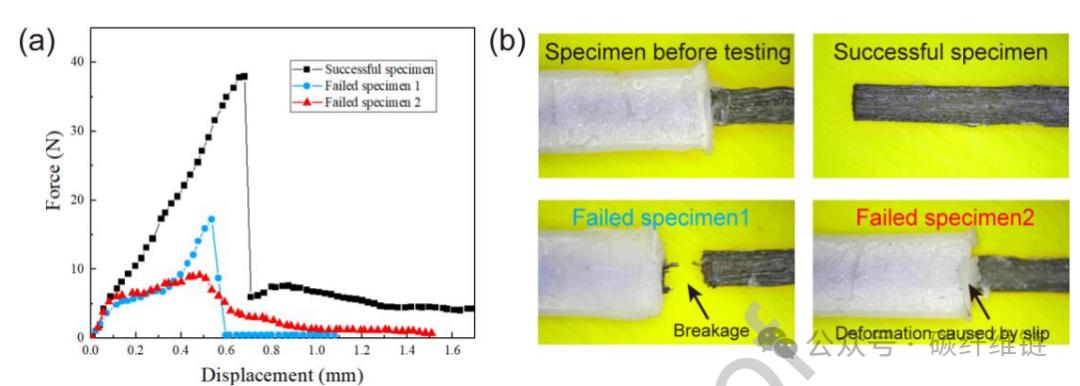
Comparison of successful and failed samples: (a) Force-displacement curves; (b) Sample photos
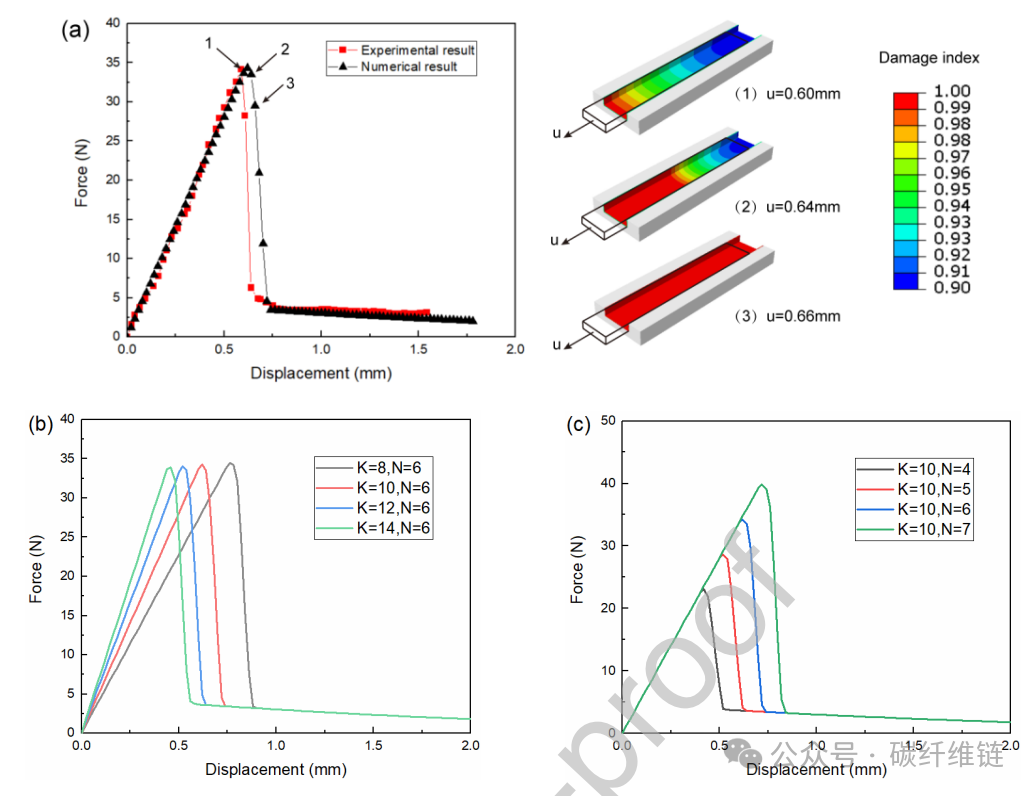
Force-displacement curves of the numerical model: (a) Comparison of experimental and numerical curves and the debonding propagation process of the M-M interface; (b) Numerical curves with different parameters
**Conclusion:**
– This study proposed a new method for testing the shear strength of the M-M interface in 3D printed continuous carbon fiber reinforced dual-matrix composites;
– It was found that PLA matrices with lower crystallinity can form stronger interfaces;
– Printing temperature and speed need to be controlled within a certain range to ensure reasonable viscosity and print quality, thus achieving higher M-M interface shear strength;
– Increasing the prepreg fiber volume fraction and reducing layer thickness are beneficial for improving M-M interface performance;
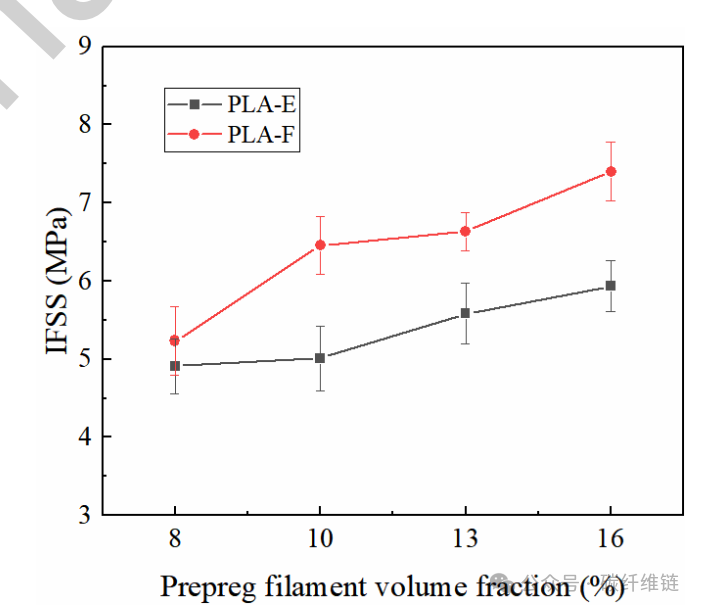
The effect of prepreg fiber volume fraction on M-M IFSS
– Finite element analysis validated the effectiveness of the proposed testing method.
Disclaimer|Some materials are sourced from publicly available information on the internet, and copyright belongs to the original authors.This platform publishes solely to convey a different perspective and does not represent endorsement or support of that perspective.If there are any copyright issues, please contact us for resolution.