The police are investigating whether Deji Freeman, a suspect in the Popka shooting, possessed homemade firearms, with experts stating that the laws regarding privately manufactured firearms are a “mess.”

According to Australian gun control laws, it is illegal to manufacture or possess any type of firearm without a license, but the legislation regarding 3D printing varies by state. Illustration: Richard Giliberto
In 2023, a mechanic in Canberra discovered a shocking secret while repairing a gray BMW: he found a handgun under the car seat.
This handgun looked strange, almost entirely made of plastic—half white and half black.
The mechanic was unaware that the car belonged to a street dealer who had traveled from Sydney to the suburbs of Canberra to sell ice for “quick money.”
Court documents reveal that the gun was manufactured by an accomplice using a 3D printer. It is untraceable and extremely lethal. Experts say this trend could fundamentally undermine Australia’s world-leading gun control policies.
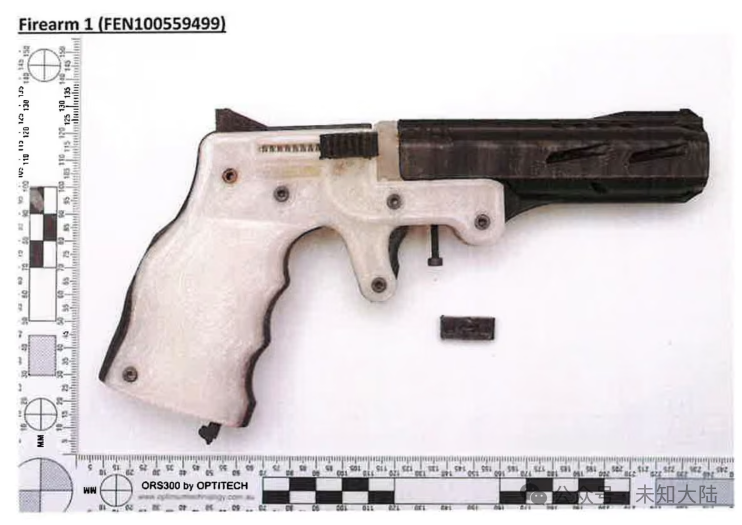
Above: A mechanic discovered this 3D-printed handgun under the car seat
Andrew Hemming, a criminal law expert at Southern Queensland University, stated that the laws regarding 3D-printed firearms are a complete mess.
In Australia, it is illegal to manufacture or possess any type of firearm without a license, but the specific laws regarding 3D printing differ by state.
Some countries classify the manufacture of 3D-printed weapons or possession of blueprints as a crime, while others rely on existing gun laws.
Hemming noted that the joint actions taken to strengthen gun control in Australia after the 1996 Port Arthur massacre (which resulted in 35 deaths) are now ineffective.
He said, “After the Port Arthur shooting, we all came together to work on banning (certain semi-automatic and pump-action firearms) and conducting buybacks.”
“Well, the fact is… if someone can do it, things have changed, it’s just a matter of time.”
More Complex and Lethal
Court documents state that the gun discovered in Canberra resembles a popular 3D-printed handgun model called “Harlot.” According to numerous online communities that advocate and promote 3D-printed firearms, “Harlot” is considered an entry-level product.
A website providing educational materials states: “Fast printing speed, low cost, easy to assemble, and the hardware needed to complete the build is also easily obtainable.”
However, more reliable and lethal models have now emerged.
Detective John Watson, commander of the Drug and Firearms Unit of the New South Wales Police Crime Command and head of the National Illegal Firearms Taskforce, stated that police have been discovering 3D-printed weapons for over a decade.
He noted that in the past three to four years, the trend has shifted from “very novel, very low power, almost disposable weapons” to higher quality firearms.
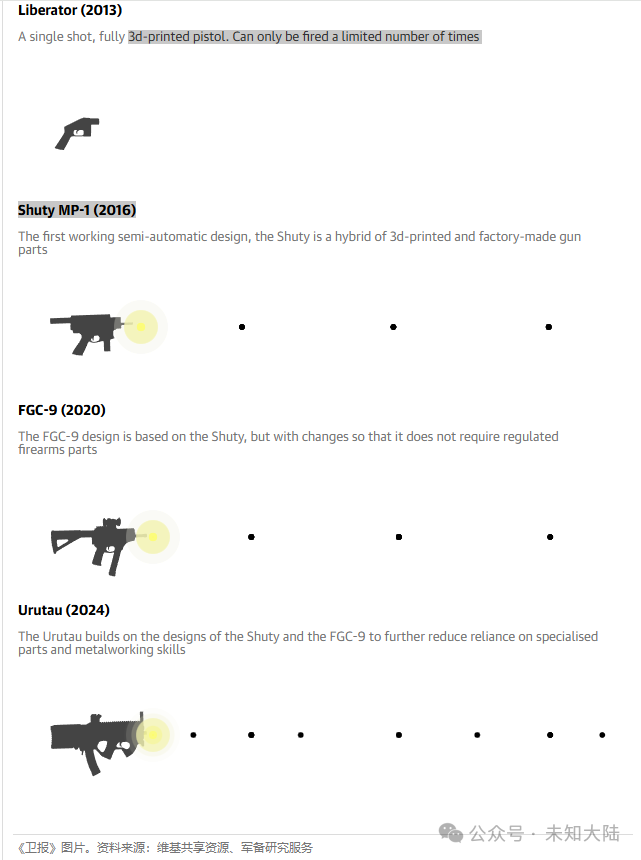
Notable 3D-Printed Firearms
3D-printed firearms are becoming increasingly complex, ranging from single-shot handguns to semi-automatic rifles.
By 2025, police stated that they have seized homemade firearms in almost every state and territory.
Police reported finding 3D printers along with 3D-printed handguns, magazines, and firearm parts in a suburban residence.
Among the seized items was a 3D-printed semi-automatic carbine part, commonly referred to online as “Urutau.”
The blueprints for Urutau were only released online last year, but police have reportedly found its components during raids in multiple states.
In another case, police reportedly discovered a “Nutty 9” firearm (a derivative of the FGC-9), a 3D-printed handgun, and digital blueprints for firearm manufacturing.
Images released by the police show a large number of components found during the raid, including an unfinished Urutau firearm.
Mailing Firearm Parts
Researcher Rajan Basra from King’s College London stated that the world of 3D-printed firearms has become a “social movement.”
Urutau and other models, including the possibly most notorious 3D-printed firearm FGC-9 (which stands for “F*** Gun Control”), originate from online communities that share information and promote weapon manufacturing, both to push scientific boundaries and to “permanently undermine global gun bans,” according to some designers.
The designer of Urutau stated in a podcast in May that Urutau intentionally omits certain components regulated by some countries, with all parts “essentially being things you can buy online.”
A public letter accompanying the release of the build kit advocates for “the right to bear and carry arms without limits.”
On Discord servers and file-sharing websites, this community publishes memes and quotes about gun rights, along with long project lists and links to recommended retailers for purchasing assembly kits and components that cannot be reliably 3D-printed.
In one case, the Australian Border Force reportedly intercepted several shipments sent from China. Court documents describe these packages as “pipes” or “high-pressure hoses.” Police claim they are “unfinished gun barrels.”
Dr. Yannick Wellerx-Leparge, an associate professor at the Royal Military College of Canada, stated that some groups are advocating for a so-called “new Second Amendment.” Broadly speaking, this viewpoint argues that the right to bear arms is universal, not just a part of the U.S. Constitution.
“All of this belongs to the same movement, essentially trying to break the boundaries of privately manufactured firearms,” he said. “Its main impact is the weakening of national gun control.”
Concern? “Make One Yourself”
It is currently unclear how many 3D-printed guns are seized in Australia each year (there is no centralized record), but a review of court documents indicates that various models of guns are emerging, made both by hobbyists and by those intending to use them for criminal purposes.
Court documents show that in 2023, a man in Melbourne was sentenced for possessing a marketable quantity of firearms (including six 3D-printed handguns, including a .22 caliber rimfire handgun) and aggravated carjacking.
Some believe that 3D-printed firearms may be unpopular among organized crime groups due to their lack of reliability and unattractive appearance. “They send a message to others that you can’t buy conventional firearms,” Wellerx-Leparge said.
But this situation may change. He noted that some popular models, like the “Not Glock,” look indistinguishable from traditional firearms and are inexpensive to produce.
Otherwise, extremist organizations may not easily access the illegal market, which poses a threat.
“In recent years… far-right groups have frequently shared gun blueprints while providing guidance materials and inciting followers to manufacture firearms at home,” Basra stated, revealing that the mastermind behind the FGC-9 was the now-deceased German citizen Jacob Duygu.
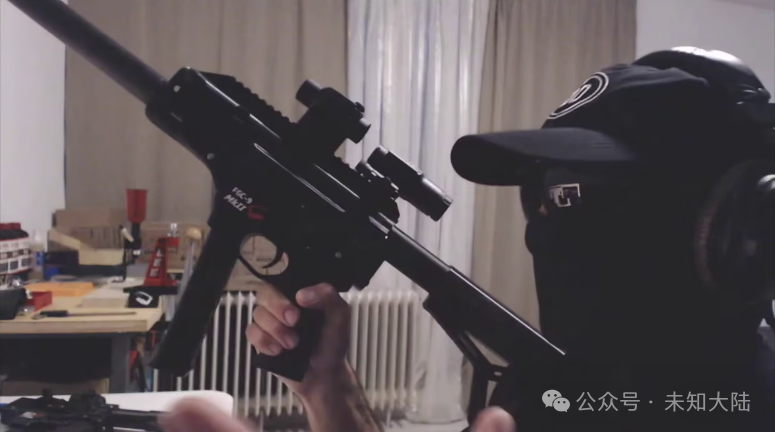
Jacob Duygu holding the FGC-9. Image source: HCPP Hackers Congress
Artyom Vasilyev was sentenced to at least three years in prison in 2024 by the Supreme Court of South Australia for admitting to over a dozen firearm offenses.
The judge referenced a report prepared by a forensic psychologist, which stated that Vasilyev “was becoming radicalized” and that his electronic devices contained materials “promoting far-right ideology.”
The court learned that a plastic barrel containing 3D-printed firearm parts used to manufacture the FGC-9 was found in his home.
During a hearing in New South Wales regarding whether to implement an extended supervision order, the court heard a case involving a man with extremist beliefs who downloaded hundreds of 3D-printed firearm files.
The anonymous initiator of Urutau, known online as “Joseph the Parrot,” was asked in a podcast this year about extremists using his design.
“I mean, I don’t support them, but if they make guns, I can’t help it,” he said.
“If you are upset about white supremacists building Urutau, you can build one yourself to counter them.”