
Electrochemical gas detection elements require a constant bias to operate accurately, which can consume a significant amount of power. When the device is in idle or sleep mode, normal power management systems often attempt to keep these devices turned off. However, electrochemical sensors may take tens of minutes or even hours to stabilize. Therefore, the detection element and its bias circuit must remain in an “always on” state. Additionally, for consumer electronic applications powered by a single AA battery, the required bias voltage is typically very low..
MAX40108 is a low-power, high-precision operational amplifier (op-amp) that operates at supply voltages as low as 0.9 V, specifically designed for instrumentation applications. Furthermore, this device features rail-to-rail input and output characteristics, with a typical supply current consumption of only 25.5 µA, and a typical zero-drift input offset voltage of 1 µV over time and temperature variations. Thus, it is very suitable for various low-power applications, such as consumer electronics like ethanol and CO gas sensors.

Scan to learn more about MAX40108
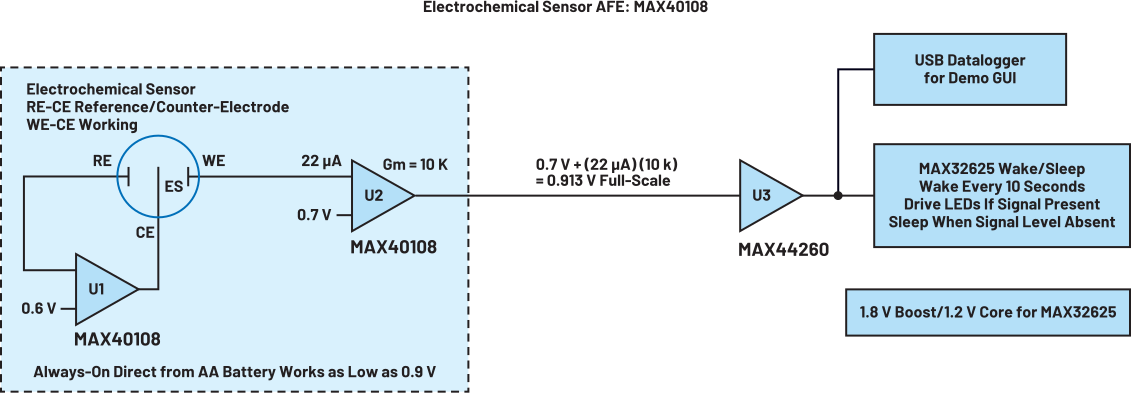
Figure 1 shows the block diagram of an electrochemical sensor for detecting ethanol or CO. The system employs a low-voltage operational amplifier, powered directly by a 1.5 V AA/AAA battery, to provide bias current to the electrochemical sensor, while the rest of the system remains in sleep mode to save power. The first op-amp U1 powers the reference electrode of the electrochemical sensor. The second op-amp U2 is configured as a transconductance amplifier, converting the sensor’s current output into a voltage output, which is then amplified and digitized by the microcontroller. The voltage signal is amplified by MAX44260 (U3), which is a 1.8 V, 15 MHz, low-offset, low-power, rail-to-rail input/output (I/O) operational amplifier. ES represents the electrochemical sensor.
Ethanol Sensor Evaluation
In the ethanol sensor evaluation, the sensor used is the SPEC 3SP_Ethanol_1000 package 110-202 shown in Figure 2.
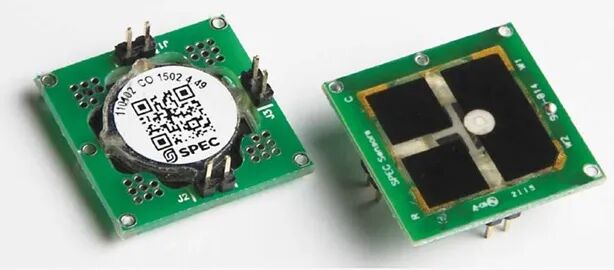
This SPEC ethanol sensor generates a current proportional to the amount of gas captured. It is a three-electrode device: WE, RE, and CE.
WE: Working electrode. The WE bias voltage is 0.7 V for detecting gas vapor.
RE: Reference electrode. This RE provides a stable electrochemical potential with a 0.6 V bias voltage in the electrolyte, without coming into contact with the gas vapor.
CE: Counter electrode (CE).
When gas is present, the CE conducts. The level of conductivity is proportional to the gas concentration, allowing the system to perform electrical measurements of the gas concentration.
In this gas sensor evaluation, gas particles need to physically contact the SPEC sensor. In other words, the ethanol sensor essentially only measures the gas present at the location of the sensor itself. Therefore, to accurately and effectively detect gases such as ethanol and CO, the sensor should be placed where the expected gas concentration will diffuse. In this experiment, a cotton swab was soaked in ethanol solution and placed directly in front of the SPEC sensor.
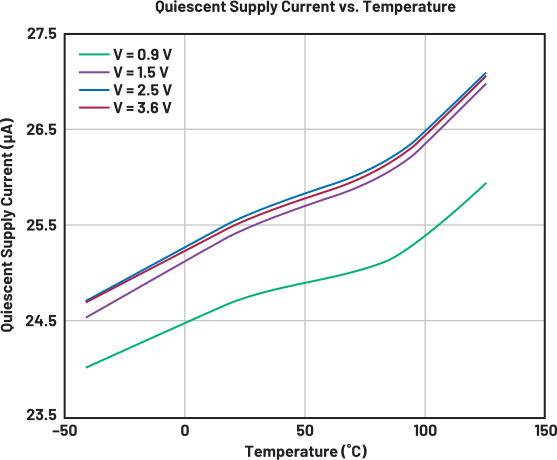
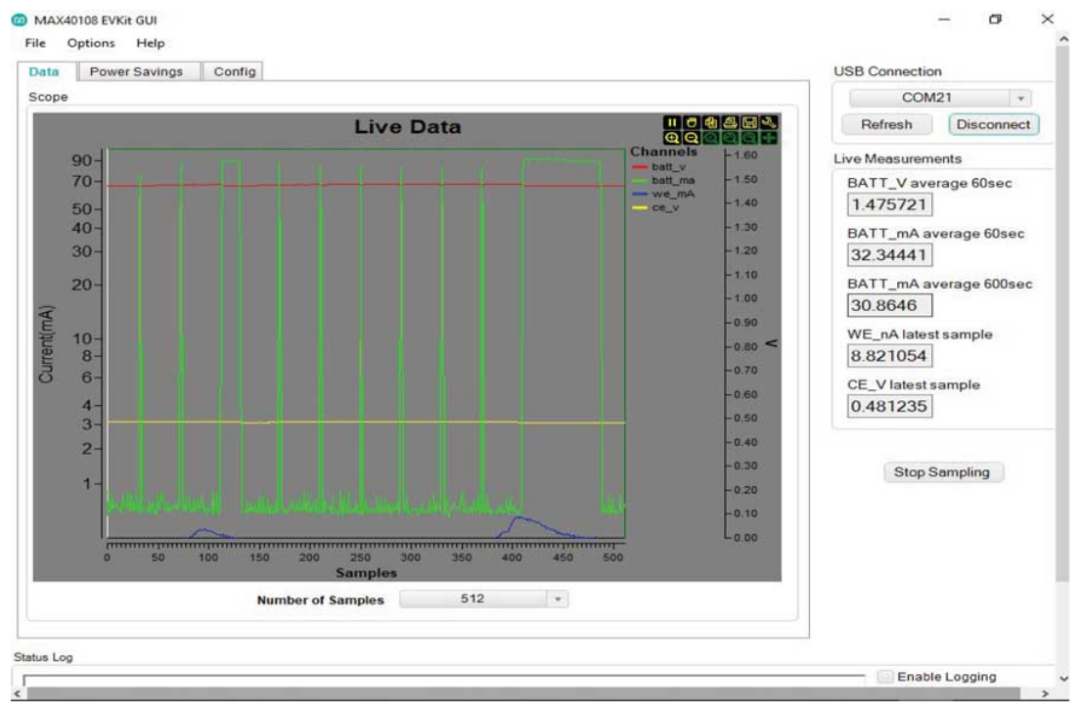
Figure 3 shows the captured ethanol vapor, as indicated by the blue curve. The green curve represents the current consumption of the entire system, including the microcontroller, with a typical value of 90 mA. However, when VDD = 0.9 V, TA = 25°C, the current consumption of the MAX40108 itself is only 25.5 µA, as shown in Figure 4.
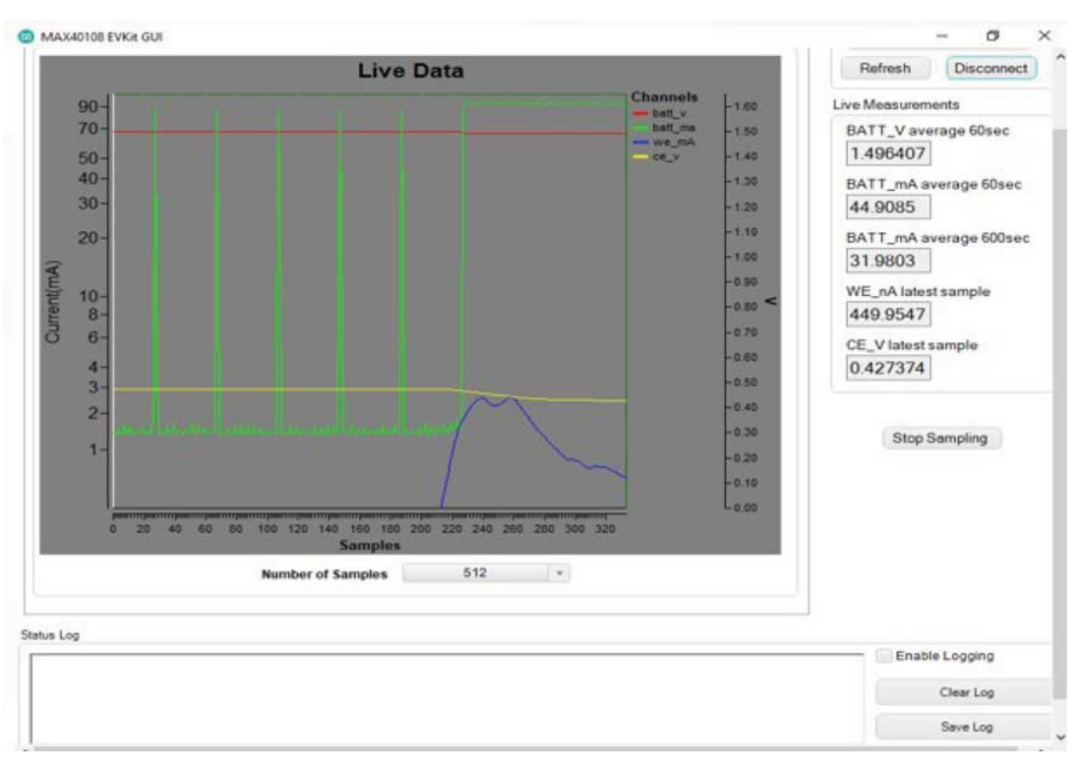
When in idle mode, the microcontroller wakes up every 10 seconds to monitor ethanol vapor. When vapor is present, the microcontroller begins measuring the vapor concentration, as indicated by the blue curve. The red line shows the AA battery voltage at approximately 1.5 V, while the yellow line represents the CE voltage.
To observe the response of the ethanol sensor to vapor concentration, the cotton swab was moved further away from the sensor. The captured results are shown in Figure 5. As expected, the amplitude of the vapor concentration (blue curve) correspondingly decreased.
CO Sensor Evaluation
Unlike ethanol, CO is a potentially toxic gas produced during incomplete combustion of gasoline and even harmless candles. Therefore, it is crucial to take appropriate ventilation measures to ensure health and safety when conducting CO gas experiments. In the CO sensor evaluation, we used a candle to generate CO gas in a covered wide-mouth jar and employed the same SPEC 3SP_Ethanol_1000 package 110-202 sensor to capture CO gas concentration.
Figure 6 shows the captured CO gas, as indicated by the blue curve. The green curve represents the current consumption of the entire system, including the microcontroller, with a typical value of 90 mA.
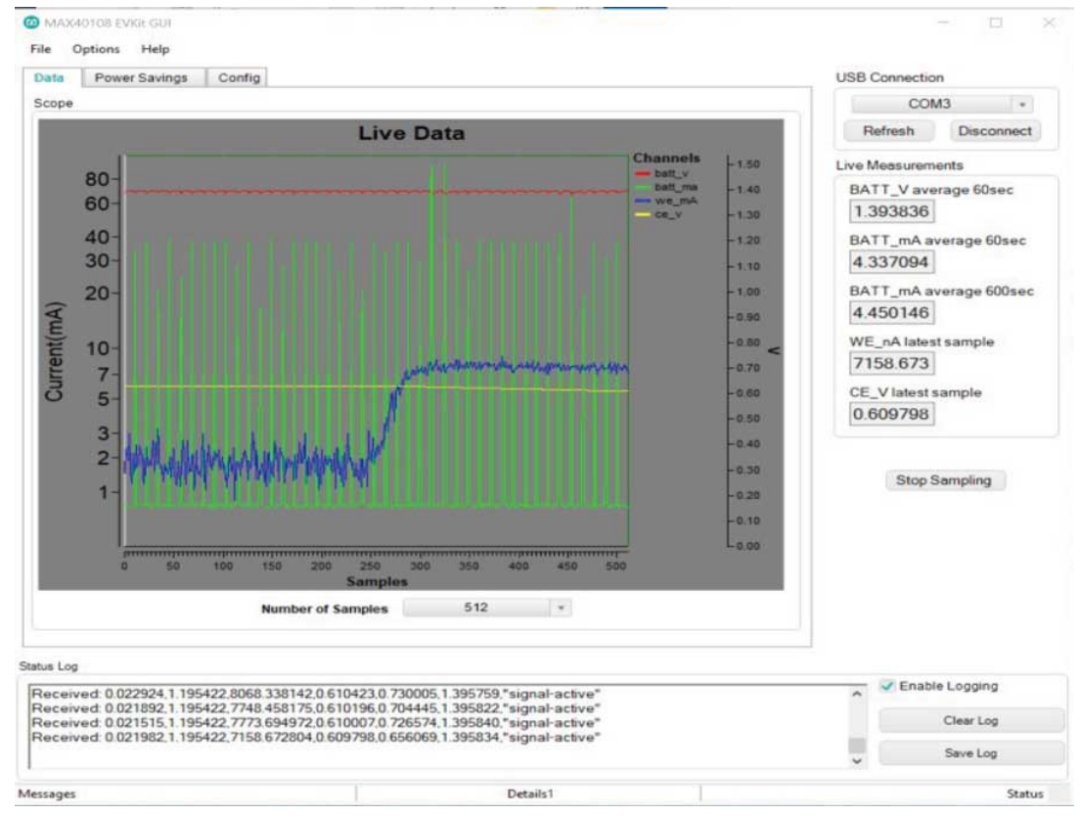
Similar to the ethanol evaluation, when in idle mode, the microcontroller wakes up every 10 seconds to monitor CO gas. When the gas is detected, the microcontroller begins measuring its concentration, as indicated by the blue curve. The red line shows the AA battery voltage at approximately 1.5 V, while the yellow line represents the CE voltage.
Conclusion
To enable accurate measurement of ethanol and CO gases in consumer electronics and industrial applications, a low-power, high-precision operational amplifier with a working supply voltage as low as 0.9 V is required. The MAX40108 device is designed to effectively capture and measure common gases such as ethanol and CO, with a current consumption as low as 25.5 µA and a size of only 1.22 mm × 0.92 mm, packaged in an 8-pin WLP. This amplifier features a shutdown mode that further saves power, which is crucial for wearable devices, portable medical systems, and Industrial Internet of Things (IIoT) applications (e.g., pressure, flow, level, temperature, and proximity measurements).
👇 Click to explore the ADI “chip” world
··