 Produced by Zhineng Zhixin
Among the wave of companies related to automotive and automotive parts heading towards the Hong Kong stock market, Naxin Micro, as a representative of automotive chips, passing the Hong Kong Stock Exchange hearing is not surprising. This chip company, which specializes in analog chips, continues to strengthen its long-term layout in the automotive electronics and high-voltage signal chain markets.
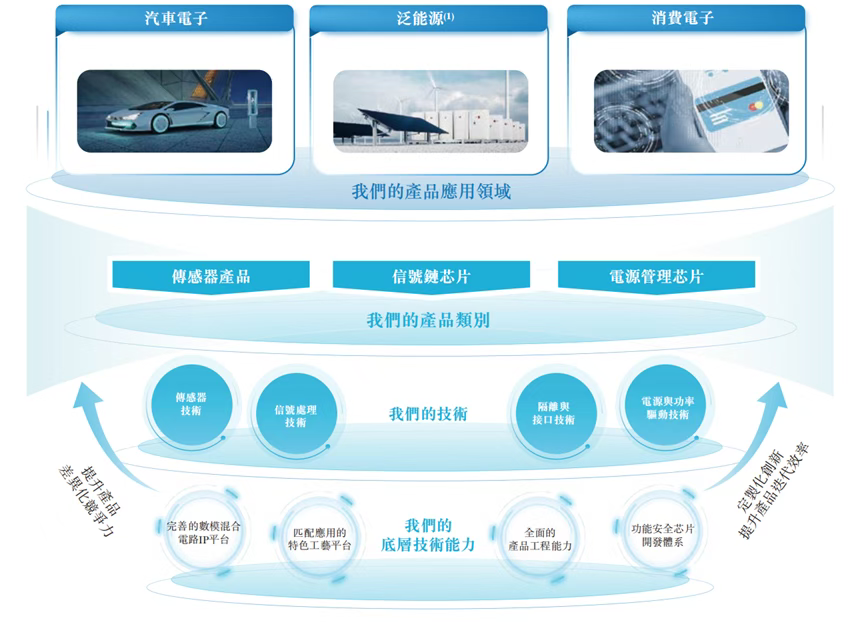
The three major categories are beginning to expand into solutions, indicating a broad scope.
◎ Sensor products: including magnetic sensors, thermopile infrared sensors, etc., for automotive motor drives, body temperature monitoring, and other scenarios.
◎ Signal chain chips: such as digital isolation chips, using capacitive isolation technology, for high-voltage scenarios like new energy vehicle battery management systems.
◎ Power management chips: LDO, voltage monitoring, LED driving, etc., for automotive electronic scenarios such as tail lights, front lights, and body controllers.
Part 1
Revenue Fluctuations
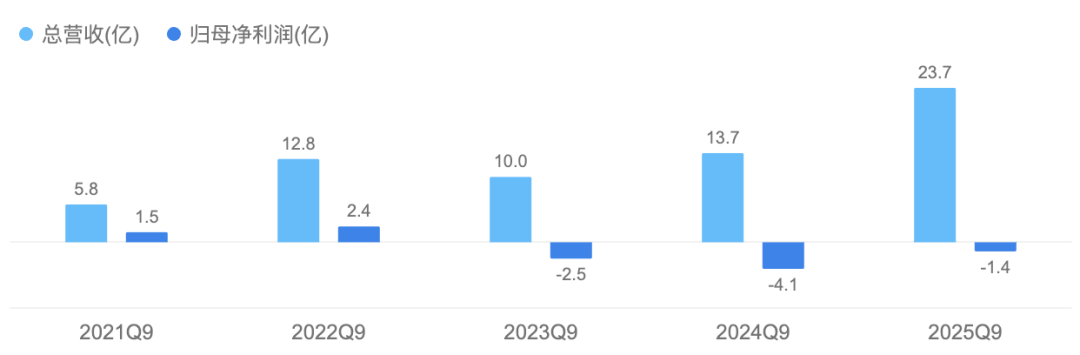
Naxin Micro’s revenues from 2022, 2023, 2024 to 2025 (January to September) were 1.67 billion, 1.31 billion, 1.96 billion, and 2.366 billion respectively (a year-on-year increase of 73.18%);
From 2022 to 2024, operating profits were 281 million, -282 million, -381 million, with a net loss of 140 million in the first nine months of 2025, and a net loss of 177 million after excluding non-recurring items. Among them, the revenue for the third quarter of 2025 was 842 million, with a net loss of 62.48 million, and a net loss of 71.54 million after excluding non-recurring items.
This change in revenue is also related to Texas Instruments (TI) launching an aggressive price war in the Chinese market in 2023, using a strategy of “exchanging profits for market share.” In 2025, due to well-known issues, TI initiated a large-scale price increase, and the revenue changes of Naxin Micro are directly related to domestic replacements.
Naxin Micro’s product structure covers three key categories in analog chips: sensors, signal chains, and power management, forming a complete link from information collection in the physical world to signal conversion and processing, and then to system power supply and power drive, which is the main artery for building automotive electronics, energy storage, and industrial control systems.
The three types of chips are mostly used in automotive and industrial fields, with long verification cycles and strict quality requirements, and the willingness to replace is not strong. With the cost reduction pressure in the automotive industry, we can see the gross margins of domestic chip companies drop from nearly 50% to 33.9%, continuing to decline to 28% in 2024.
Naxin Micro’s characteristic of “scale for profit” over the past three years has expanded its product categories from a regional supplier, beginning to move outward along the Chinese supply chain, facing considerable pressure.
The change in revenue composition also shows an increase in the proportion of automotive electronics, including Great Wall, Leap Motor, NIO, Xpeng, Geely, FAW, Wuling, and also penetrating into international Tier 1 companies such as Bosch, Valeo, CATL, and Panasonic.
Part 2
“MCU+” Route
The replacement opportunities in automotive electronics are reflected in Naxin Micro’s continuous promotion of the “MCU+” route in recent years.
The “+” part (analog chips, sensors, communication interfaces, power management, etc.) is deeply integrated to achieve a system-level breakthrough of “one chip replacing multiple discrete chips,” upgrading the product positioning from “peripheral device pairing” to “intelligent control core.”
Understanding this strategy revolves around the actual application needs in the development of automotive intelligence, using one chip to solve a subsystem. This can be seen as a transition path from the integration of analog ICs and digital ICs to hardware-software integration.
As centralized architectures become prevalent in vehicles, the number of terminal MCUs decreases, and algorithms are gradually hardware-implemented to achieve lower latency, higher reliability, and lower costs.
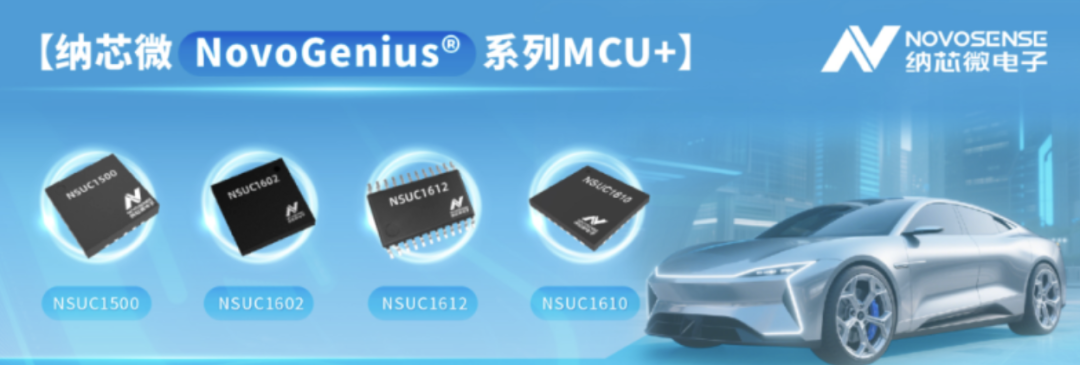
Naxin Micro has launched the NovoGenius® series along this path, including motor driver chips NSUC1610, NSUC1602, ambient light driver chip NSUC1500, and NSUC1800 for ultrasonic radar, all of which integrate ARM MCUs with different analog IPs, forming small SoCs with complete system capabilities.
From the perspective of technological evolution, the current competition in automotive chips is not about local replacements, but rather about creating a solution around MCUs, requiring analog IP, system understanding capabilities, and hardware-software collaboration to achieve deep integration of analog modules such as MOSFETs, communication buses, and power management.
Of course, due to the complexity of chips, relying solely on oneself is not sufficient; it is necessary to deeply bind with automotive clients, jointly define products, and establish a closed-loop model of “demand-research and development-verification” to form a competitive advantage that is difficult to replicate.
From the perspective of chip companies, through self-developed IP across all categories, deep coupling of algorithms and hardware, and systematic optimization of EMC/EMI and other means, the defined products can be produced, which is the practical demand currently posed by automotive chips.
Conclusion
The situation of Naxin Micro in the Chinese automotive chip circle is something we need to track over the long term.