On August 11, 2025, a research team led by researcher Xu Cao from the Institute of Genetics and Developmental Biology of the Chinese Academy of Sciences published a paper titled Engineering crop flower morphology facilitates robotization of cross-pollination and speed breeding in Cell. This study deeply integrates BT (biotechnology) and AI (artificial intelligence), proposing for the first time the concept of Crop-robot co-design, which emphasizes a “two-way approach”. By using gene editing to redesign crop flower morphology, the team rapidly and accurately created a “robot-friendly” structural male sterile line. They successfully developed the world’s first intelligent breeding robot “GEAIR” (Genome Editing combined with AI-based Robotics) that can autonomously cruise for hybrid pollination, breaking through the bottlenecks of hybrid breeding and seed production, significantly reducing breeding costs, shortening breeding cycles, and improving breeding efficiency. This research opens up a new intelligent breeding model of “BT foundation + AI empowerment + Robot labor” (BAR), showcasing the significant application prospects of “AI for Science” in the innovation of biological breeding paradigms and the generation of new productive forces.
The utilization of hybrid vigor significantly contributes to increasing crop yields and ensuring food security. The global hybrid seed market is expected to reach 383 billion yuan in 2024 and is projected to grow to 590.4 billion yuan by 2029; the market value of global tomato hybrid seeds is estimated at 8.54 billion yuan in 2024, with a forecast of 15.05 billion yuan by 2030. However, the high costs and low efficiency of hybrid breeding and seed production have become significant bottlenecks in utilizing hybrid advantages. For example, most commercial tomato varieties are hybrids, but due to the closed flower morphology with retracted stigmas, global tomato hybrid breeding and seed production still entirely rely on manual pollination, which accounts for over 25% of the total breeding cost, with manual emasculation alone constituting 40% of the hybrid pollination cost. As the population ages, the labor costs for hybrid seed production are rising annually. More importantly, some crops with closed flower morphologies cannot utilize hybrid advantages due to excessively high hybrid seed production costs. Soybean hybrids have over 30% yield potential, but the highly closed flower structure makes hybrid pollination operations extremely difficult, preventing hybrid seed production. Structural male sterile lines with exposed stigmas can eliminate the need for such operations and have long been a sought-after trait in hybrid breeding and seed production.
Researcher Xu Cao’s team took a different approach, using gene editing to target the MADS-box gene GLO2, which specifically regulates stamen development in the ABC model genes of tomato floral organs. This caused the originally closed stamens to split and become sterile, allowing the stigmas to naturally expose without elongation. They successfully created a structural male sterile line without affecting the yield of hybrid fruits and seed quality, ending the long-standing lack of exposed stigma male sterile lines in tomato breeding. This technology is free from genetic background limitations and has universal applicability.
Researcher Xu Cao collaborated with Associate Researcher Yang Minghao from the Institute of Automation of the Chinese Academy of Sciences to develop an intelligent pollination robot that has been stably operating in commercial production greenhouses. The robot achieves an accuracy rate of 85.1% in stigma recognition, taking only 15 seconds to pollinate a single flower, with a single cruise pollination success rate of 77.6% ± 9.4%. The robot can perform continuous autonomous hybrid pollination around the clock to ensure successful pollination and fruit set for every flower. The localization rate of the components of the “GEAIR” robot has reached over 95%, making the overall cost highly promising for application.
Furthermore, the researchers integrated the “GEAIR” robot with the “de novo domestication” breeding technology and “speed breeding” technology established by Xu Cao’s team in 2018, creating an intelligent breeding factory. This reduced the breeding cycle of closely related wild species from the original 5 years to 1 year while saving labor, unlocking the breeding potential of wild relatives in enhancing the stress resistance and flavor characteristics of cultivated varieties. This allows for the rapid mass cultivation of flavorful tomatoes and high-yield, stress-resistant new tomato germplasm. To overcome the high costs of hybrid pollination that have hindered the application of hybrid advantages in soybeans, the researchers applied the “GEAIR” system to soybeans, achieving the rapid creation of structural male sterile lines for soybeans for the first time. Using this sterile line can save 76.2% of the time spent on manual pollination operations, promising to lead the way in breaking through soybean hybrid breeding in China, significantly increasing yields, and providing a new generation of intelligent breeding technology and equipment.
The technologies related to the creation of structural male sterile lines and the intelligent breeding robot have applied for national patents and PCT international patents. Researcher Xu Cao’s team is working on integrating the entire industry chain of “breeding-production-harvesting-tracing” with BT + AI, developing the “GEAIR 2.0” robot breeder, and expanding the application of structural male sterile lines to different crops.
Researcher Xu Cao from the Institute of Genetics and Developmental Biology of the Chinese Academy of Sciences is the corresponding author of this paper, with doctoral students Xie Yue and Zhang Tinghao, and Associate Researcher Yang Minghao from the Institute of Automation as co-first authors. Professor Lian Wenzhao from Shanghai Jiao Tong University, Professor Tao Jianhua from Tsinghua University, Researcher Han Hua from the Institute of Automation, Dr. Zou Yuping from the Institute of Genetics and Developmental Biology, and graduate students Lü Hongchang, Sun Yangchang, and Xiao Jun also participated in this research. Dr. Zhang Fengxia from the Institute of Genetics and Developmental Biology and members of Xu Cao’s research group, including Lu Yezhi, Zhang Xinyu, and Lü Yuyuan, as well as Qi Jingda, Wang Jinyang, Xiao Zhigang, and Liu Anqi from the Institute of Automation, and Li Xinxu, Li Shushan, and Wang Lili from the Shou Nong Cuihu Factory provided significant support and assistance for this research. This research was funded by major projects from the Ministry of Agriculture and Rural Affairs, the Strategic Priority Research Program of the Chinese Academy of Sciences, the National Natural Science Foundation, and the Beijing Intelligent Greenhouse Vegetable Innovation Team Project.
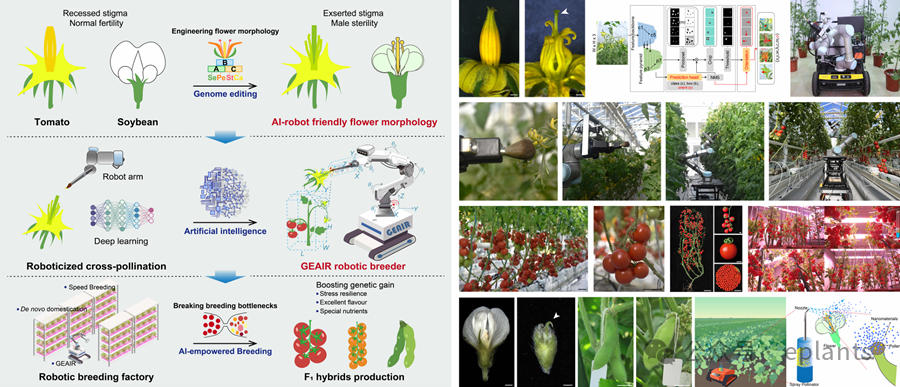 Figure: Reshaping crop flower morphology and AI robot co-design achieving intelligent automated hybrid breeding

For submissions, business cooperation, and reprint whitelist matters, please contactemail: [email protected]