Welcome to the Battery Perspective!
Previously, we introduced various electrode materials, battery manufacturing processes, and battery analysis content, mainly focusing on material manufacturers and cell manufacturers, with little introduction to battery applications. This section mainly discusses issues such as SOC and SOH in battery applications.
The state of charge (SOC) of lithium-ion batteries is very important for users; it can alert smartphone users to pay attention to their phone’s battery level and remind electric vehicle drivers how far their vehicle can still travel. Therefore, an accurate SOC estimation method is essential. There are many commonly used SOC estimation methods, as shown in the figure below. Overall, they can be classified into direct measurement methods and indirect measurement (model-assisted methods).
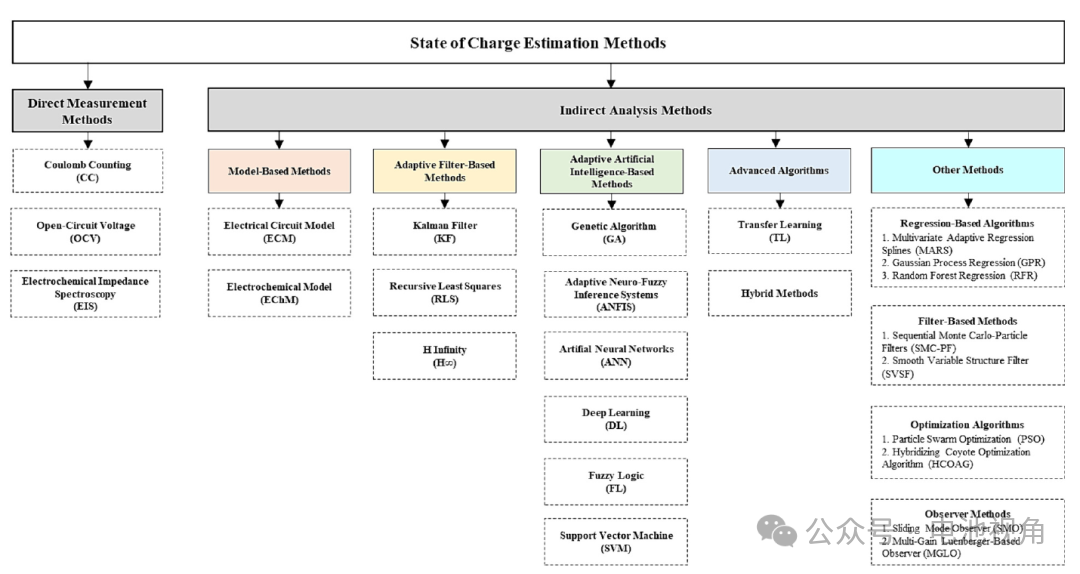
Figure 1. SOC Calculation Methods
1 Direct Measurement Methods
1.1 Ampere-Hour Integration Method
Principle: By measuring the current flowing into or out of the battery in real-time and integrating it over time, the change in charge can be calculated to estimate SOC. The mathematical formula is as follows:

Advantages: Simple principle, easy to implement; low computational load, suitable for embedded systems.
Disadvantages:
Dependency on Initial SOC Value: Requires an accurate initial SOC value; if the initial value is inaccurate, subsequent estimates will always have deviations.
Cumulative Error: Measurement errors from current sensors and small deviations during integration will accumulate over time, leading to long-term drift in SOC estimation results.
Impact of Capacity Degradation: Battery capacity will degrade with use and aging.
1.2 Voltage Interpolation Method
Principle: After the battery has been at rest for a long time (usually several hours), the voltage across its terminals will reach a stable value, known as the open-circuit voltage (OCV). There is a definite, nonlinear functional relationship between OCV and SOC. By experimentally calibrating the OCV-SOC curve in advance, during actual use, after the battery has rested long enough, measuring its OCV and referring back to that curve will yield the corresponding SOC value.
Advantages: Under ideal conditions of complete battery rest, the estimation accuracy is very high; it is not affected by cumulative errors.
Disadvantages:
Requires Long Rest Period: For electric vehicles in motion, it is almost impossible to meet the long rest condition, so this method cannot be used for real-time online estimation.
Voltage Platform Effect: Many lithium batteries (such as lithium iron phosphate batteries) have very flat OCV-SOC curves in the middle SOC region, meaning that when SOC changes significantly, the OCV changes very little. At this point, even small voltage measurement errors can lead to significant SOC estimation errors.
1.3 Impedance Method
Principle:
By applying a small multi-frequency AC signal to the battery and measuring its response, the internal impedance information of the battery at different frequencies can be obtained, known as the electrochemical impedance spectrum. Research has found that the impedance spectrum characteristics of the battery are related to SOC. By analyzing these characteristics, SOC can be estimated.
Advantages: Can provide rich information about the internal electrochemical state of the battery.
Disadvantages:
Complex and Expensive Equipment: Requires specialized frequency response analyzers.
Time-Consuming, Not Suitable for Online Applications: The measurement process is time-consuming and cannot meet the real-time estimation needs of vehicles.
Complex Data Analysis: Interpretation and modeling of the impedance spectrum are very complex.
Reliability Needs Verification: The relationship between SOC and impedance is not monotonic, making accurate matching sometimes difficult.
2 Indirect Analysis Methods
These methods do not directly rely on a single physical quantity but estimate SOC by establishing a battery model and combining advanced algorithms. These methods typically have higher accuracy and better robustness.
2.1 Equivalent Circuit Model (ECM):
Principle: A circuit is constructed using resistors, capacitors, voltage sources, and other electronic components to simulate the dynamic electrochemical behavior of the battery. The most commonly used is the Thevenin model (such as first-order and second-order models). In the model, the voltage source simulates OCV, the resistor simulates ohmic internal resistance, and the RC network simulates the polarization effect of the battery.
Application: After establishing the model, it can be used as the state-space equation for algorithms like Kalman filtering. By measuring the terminal voltage and current of the battery, the internal state variables of the model (such as the voltage across the RC network) can be estimated in real-time, ultimately inferring SOC.
Advantages: The model structure is simple, with moderate computational load, achieving a good balance between accuracy and computational cost, making it one of the most widely used models in the industry.
Disadvantages: Model parameters (such as resistance and capacitance values) vary with temperature, SOC, and battery aging state. If the parameters are inaccurate, it will affect estimation accuracy.
2.2 Electrochemical Model (P2D):
Principle: Based on a complex set of partial differential equations, this model describes the diffusion of lithium ions and electrochemical reactions within the battery. This model has very high accuracy.
Advantages: Extremely high accuracy, capable of reflecting the true state of the battery.
Disadvantages: The model is extremely complex, with a huge computational load, making it unsuitable for vehicle-mounted BMS with limited computational capabilities. It is mainly used for battery design and offline analysis.
These methods combine battery models with filtering algorithms to correct estimation results in real-time, demonstrating strong robustness against noise and uncertainty.
2.3 Kalman Filter (KF) and Its Variants:
Principle: The Kalman filter is an optimal state estimation algorithm, very suitable for handling noisy dynamic systems. It consists of two main steps:
Prediction: Based on the previous state and the battery model (such as ECM), predict the current SOC.
Correction: Compare the terminal voltage predicted by the model with the actual measured terminal voltage, using the error between the two to correct the predicted SOC, resulting in a better estimate.
2.4 KF Variants:
Extended Kalman Filter (EKF): Since battery models are usually nonlinear, EKF applies linearization to use standard KF in nonlinear systems. (As shown in Figure 7, the EKF algorithm flow)
Unscented Kalman Filter (UKF): Another method for handling nonlinear systems, typically with higher accuracy than EKF.
Advantages: Good real-time performance, high estimation accuracy, and effective suppression of measurement noise.
Disadvantages: Relatively high computational load, with performance heavily dependent on the accuracy of the battery model.
These methods are data-driven, not relying on precise physical models, but instead establishing complex nonlinear relationships between inputs (voltage, current, temperature) and outputs (SOC) through learning from large amounts of data.
2.5 Artificial Neural Networks (ANN) / Deep Learning (DL):
Principle: Simulating the structure of human brain neurons, it automatically learns features from data through a multi-layer network structure. A large amount of battery operating data (V, I, T) is used as input, with the corresponding true SOC as labels, to train the network. After training, the network can predict SOC based on new input data. Common network structures include RNN and LSTM (especially suitable for handling time series data).
Advantages: Capable of fitting highly nonlinear relationships without the need to establish complex physical models, achieving high accuracy when sufficient data is available.
Disadvantages:
Data Dependency: Requires a large amount of training data covering various operating conditions.
“Black Box” Model: The internal working mechanism of the model is opaque and difficult to explain.
High Computational Load: The training process requires powerful computational resources.
Applicability: Cross-system capabilities are difficult to guarantee.
2.6 Support Vector Machine (SVM):
Principle: Initially used for classification, later extended to regression problems (SVR). It fits the relationship between input data and SOC by finding an optimal “hyperplane”.
Advantages: Performs excellently in handling small samples, high dimensions, and nonlinear problems.
Disadvantages: Sensitive to parameter and kernel function selection, with relatively high computational complexity.
2.7 Transfer Learning (TL):
Principle: Addresses the strong data dependency of AI methods. First, a large amount of data from one battery (source domain) is used to train a base model, then this trained model is transferred to a new battery (target domain), requiring only a small amount of data from the new battery to fine-tune the model. This greatly reduces the amount of data and time required for modeling each new battery. (As shown in the transfer learning architecture in Figure 11)
2.8 Hybrid Methods:
Principle: Combines the advantages of two or more methods to achieve better performance. This is currently a research hotspot. For example:
ECM + EKF: A classic model-based approach.
EKF + ANN: Uses EKF for primary estimation while using ANN to learn and compensate for EKF’s estimation errors, thereby improving accuracy.
CC + KF: Uses the coulomb counting method as part of the model, with Kalman filtering to correct its cumulative errors and initial value inaccuracies in real-time.
[1] A Critical Look at Coulomb Counting Approach for State of Charge Estimation in Batteries.
[2] State of charge dependency of graphitized-carbon-based reactions in a
lithium-ion secondary cell studied by electrochemical impedance spectroscopy.
[3] Kalman filter SoC estimation for Li-ion batteries
[4] Li-ion battery SOC estimation method based on the reduced order extended Kalman filtering
[5] Intelligent state of charge estimation of battery pack based on particle swarm optimization algorithm improved radical basis function neural network,