Dongwei Wu and colleagues from the Department of Applied Biochemistry at the Technical University of Berlin published an article titled “Embedded Bioprinting Enables Precise Fabrication of Cultured Meat with Authentic Structural Properties” in the journal Food Hydrocolloids in March 2026 (Corresponding author: Jens Kurreck).
Background
In recent years, the global food landscape has faced increasingly severe challenges, including climate change, food security issues, and the ethical implications of traditional livestock farming. It is projected that by 2050, the world population will reach nearly 10 billion, leading to a sharp increase in demand for meat. However, traditional meat production is resource-intensive and significantly contributes to greenhouse gas emissions, deforestation, and biodiversity loss. Cultured meat has emerged as a promising sustainable alternative to traditional meat production. Cultured meat is produced by cultivating animal cells or cell-rich biomaterials in a controlled environment, eliminating the need to raise and slaughter animals. This technology offers various advantages, including reduced use of antibiotics and hormones, minimized risk of foodborne pathogen contamination, and potential improvements in nutritional value. Additionally, cultured meat addresses sustainability and ethical concerns associated with traditional livestock farming and provides opportunities for developing healthier and more efficient meat production methods.
Despite its potential, cultured meat still faces several challenges that hinder its widespread commercialization and adoption. One of the main obstacles is the technical complexity of replicating the intricate structures and textures of traditional meat. Natural meat consists of muscle fibers, fat cells, and connective tissues, each of which affects its structure, texture, flavor, and mouthfeel—key factors for consumer acceptance. Current cultured meat products often struggle to achieve the same sensory attributes, making structural and textural engineering a focal point of research.
To address this challenge, 3D bioprinting has emerged as a promising technology for manufacturing structured meat products. This method allows for the precise deposition of bioinks in a layer-by-layer manner to create complex tissue structures. By engineering muscle and fat tissues in a controlled configuration, 3D bioprinting offers the potential to closely mimic the natural structure and composition of traditional meat. Furthermore, by modifying the composition of bioinks and printing parameters, the flavor, nutritional content, texture, and structure of cultured meat can be fine-tuned.
In recent years, both academic researchers and industry pioneers have been exploring the use of 3D bioprinting for cultured meat production. Initial studies primarily employed extrusion-based bioprinting to create thin layers or small structures, successfully demonstrating the feasibility of this approach. However, these early models lacked the structural complexity and scale required to replicate real meat. Recently, Kang et al. advanced the field by bioprinting integrated fibers from three types of bovine cells (including muscle, fat, and vascular tissues) to design meat tissue with more realistic tissue-like structures. In the industrial sector, companies such as Revo Foods (Austria) and Redefine Meat (Israel) have developed bioprinted meat products, using multiple print heads to extrude muscle and fat components in filamentous and layered configurations. While these technologies show promise, they face limitations, including low efficiency and the need to balance printing speed and resolution, posing challenges for scalability. Therefore, achieving high-fidelity, scalable 3D bioprinting of cultured meat remains an ongoing challenge in both research and commercial environments. To overcome the limitations of traditional extrusion bioprinting, embedded bioprinting has emerged as an innovative alternative. This technology involves extruding bioinks within a supportive hydrogel matrix, enabling the effective fabrication of complex multi-component structures with enhanced structural integrity. The supporting hydrogel stabilizes the bioink, opening new possibilities for creating complex structures that closely resemble the natural structure of meat.
Embedded bioprinting also allows for the fine-tuning of mechanical properties by combining various biomaterials, theoretically achieving textures and mouthfeels similar to traditional meat. A key aspect of this approach is the development of optimized bioinks to support cell viability, proliferation, and functionality while maintaining printability and structural fidelity. Additionally, technological advancements are needed to achieve precise control over meat structures and ensure high-resolution replication of natural meat structures.
To address these challenges, this study aims to develop an efficient and scalable program for bioprinting cultured meat using embedded bioprinting technology. We introduce a hybrid method that combines casting techniques with bioprinting to produce structured meat products. The first step involves casting muscle components into porous plates to form muscle tissue in initial experiments or using custom 3D-printed steak-shaped molds as a supporting bath in later stages. Subsequently, fat tissue is precisely distributed within the muscle matrix using a pneumatic syringe’s needle extrusion to achieve the desired structure. We also demonstrate that this method can replicate the structure of natural pork chops captured through micro-computed tomography (μCT) imaging. By combining casting and embedded bioprinting, this method can produce cultured meat with varying structures that closely mimic traditional meat products while ensuring efficiency and scalability.
Abstract
Cultured meat has emerged as a promising alternative to traditional meat, offering potential solutions to environmental, ethical, and health-related issues. However, current technologies often yield unstructured products like meat paste that cannot replicate the complex structures and marbling of traditional meat, which are critical for consumer acceptance. This study employs a hybrid manufacturing approach that combines casting and embedded 3D bioprinting to produce cultured meat with complex structural features, thereby enhancing print quality and efficiency. Muscle tissue serves as the primary structural component, initially cast using a hydrogel-cell mixture, followed by the precise deposition of fat cells to form complex fat structures. It is capable of producing cell-cultured meat resembling pork, beef, and fish. To replicate the natural structure of meat, we utilize micro-computed tomography (μCT) to capture the fine structure of pork chops. Computational algorithms segment muscle and fat regions to obtain their 3D models, allowing for the fabrication of negative molds for casting muscle portions and obtaining deposition paths for embedding bioprinted fat components. The resulting cultured meat closely mimics the complex structure of traditional meat, reproducing the appearance of traditional meat and enhancing consumer acceptance.


Research Findings

1
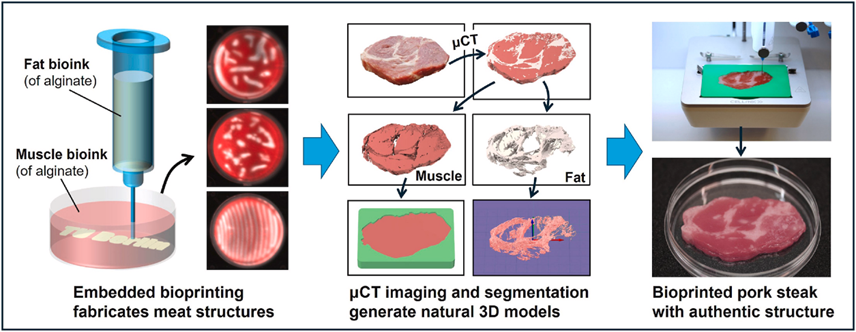
Figure 1. Graphical Abstract
2
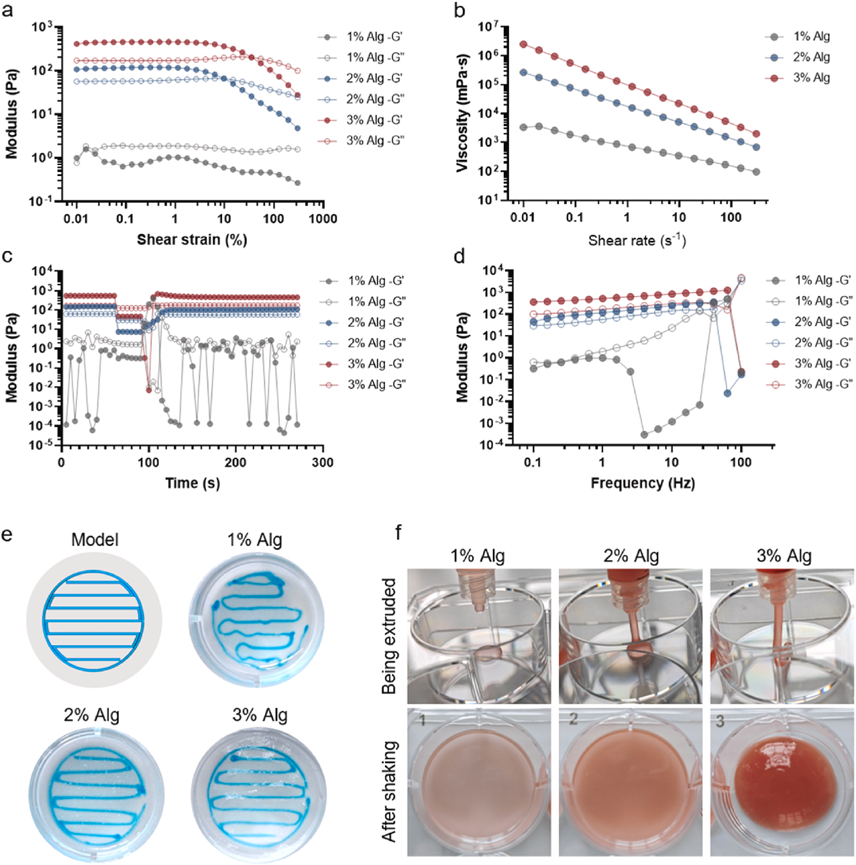
Figure 2. Optimization of alginate formulations for embedded bioprinting. The rheological properties of alginate (Alg) hydrogels were evaluated through (a) amplitude sweep, (b) shear rate sweep, (c) three-step strain switching tests, and (d) shear frequency sweep (G’: storage modulus; G”: loss modulus). The embedded bioprinting performance (e) and casting behavior (f) of alginate hydrogels at different concentrations were analyzed.
3
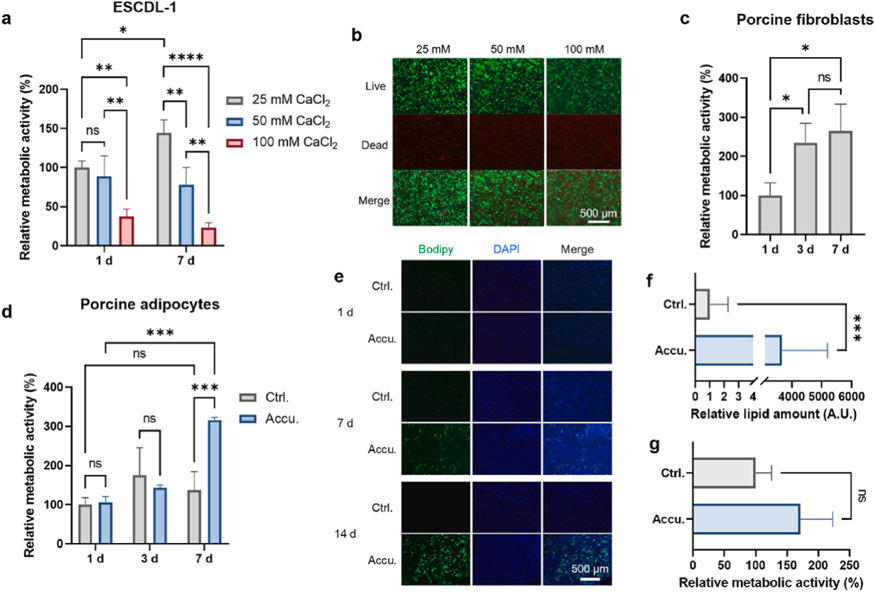
Figure 3. Biocompatibility assessment of alginate hydrogels. A 2% alginate hydrogel was used for bioprinting chicken embryonic stem cells DL-1, cultured in media with different concentrations of calcium chloride (as a crosslinking agent). (a) Metabolic activity of embryonic stem cells DL-1 was assessed using the XTT assay. (b) Cell viability of embryonic stem cells DL-1 was evaluated using a live/dead staining kit. (c) Relative metabolic activity of porcine fibroblasts was measured after bioprinting with alginate hydrogels, crosslinking with calcium chloride, and subsequent incubation. (d) The cell compatibility of porcine adipocytes was tested by measuring metabolic activity in complete media (control group) or lipid accumulation media (accumulation group) after bioprinting. (e) Visualization of lipid accumulation in porcine adipocytes using Bodipy (lipid-specific) and DAPI (nuclear-specific) fluorescent staining. (f) Quantitative analysis of lipid accumulation in porcine adipocytes. (g) Relative metabolic activity of bioprinted porcine adipocytes was measured after 14 days of culture in complete media (control group) or lipid accumulation media (accumulation group).
4
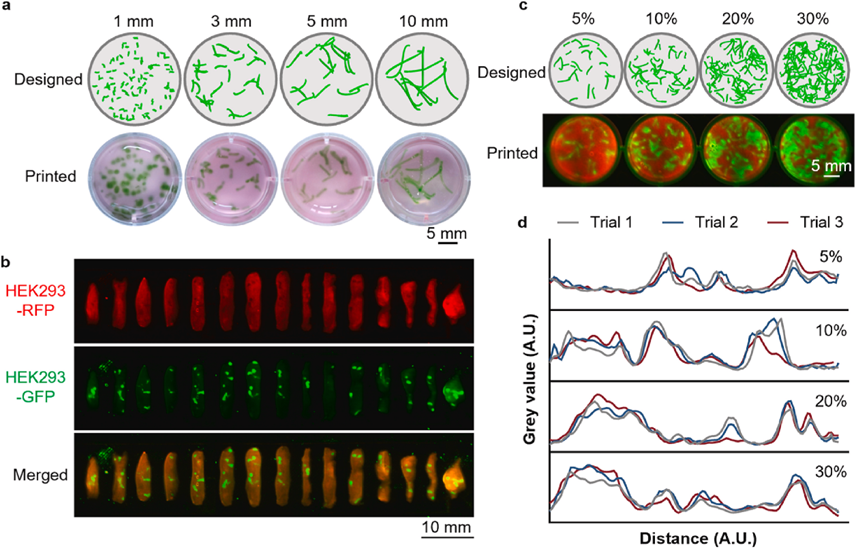
Figure 4. Validation and reproducibility study of embedded bioprinting using alginate hydrogels. (a) Different lengths of filamentous structures were deposited in a supporting liquid using embedded bioprinting technology. The top image shows the designed model, while the bottom image displays the optical image of the manufactured object after the bioprinting process. The green color comes from green food coloring. (b) Filament samples of 3 mm in length were sliced and analyzed using the ChemiDoc imaging system. The red fluorescent signal was emitted by RFP cells in HEK293-RFP cells, while the green fluorescent signal came from GFP cells in HEK293-GFP cells. (c) Models with random lengths and varying numbers of filaments were also printed. The top image shows the model design, while the bottom image displays the fluorescent image of the printed structure. (d) The reproducibility of the printing process was tested by bioprinting structures with different filament numbers three times. The gray values of the HEK293-GFP fluorescent channel in the middle region of each sample were measured in all three repetitions.
5
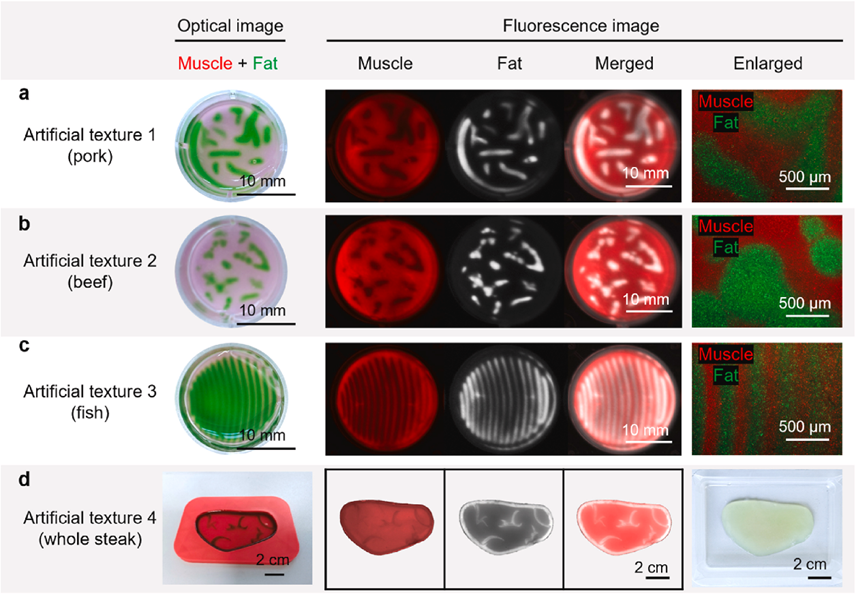
Figure 5. Production of artificial meat products with various structures using embedded bioprinting technology. Muscle bioink, composed of red dye and red fluorescent cells (HEK293-RFP), was injected into 12-well plates or steak molds, while fat components (containing green dye and green fluorescent cells (HEK293-GFP)) were placed within the muscle bioink for bioprinting. The resulting artificial meat product structures aim to replicate the structures of pork (a), beef (b), fish (c), and whole steaks (in a 3D-printed plastic mold made of red PLA) (d), with optical images (left), fluorescent images captured by the ChemiDoc imaging system (middle), and fluorescent microscope images (right) displayed. The bottom right of the figure also shows a crosslinked bioprinted whole steak with a thickness of approximately 1 cm.
6
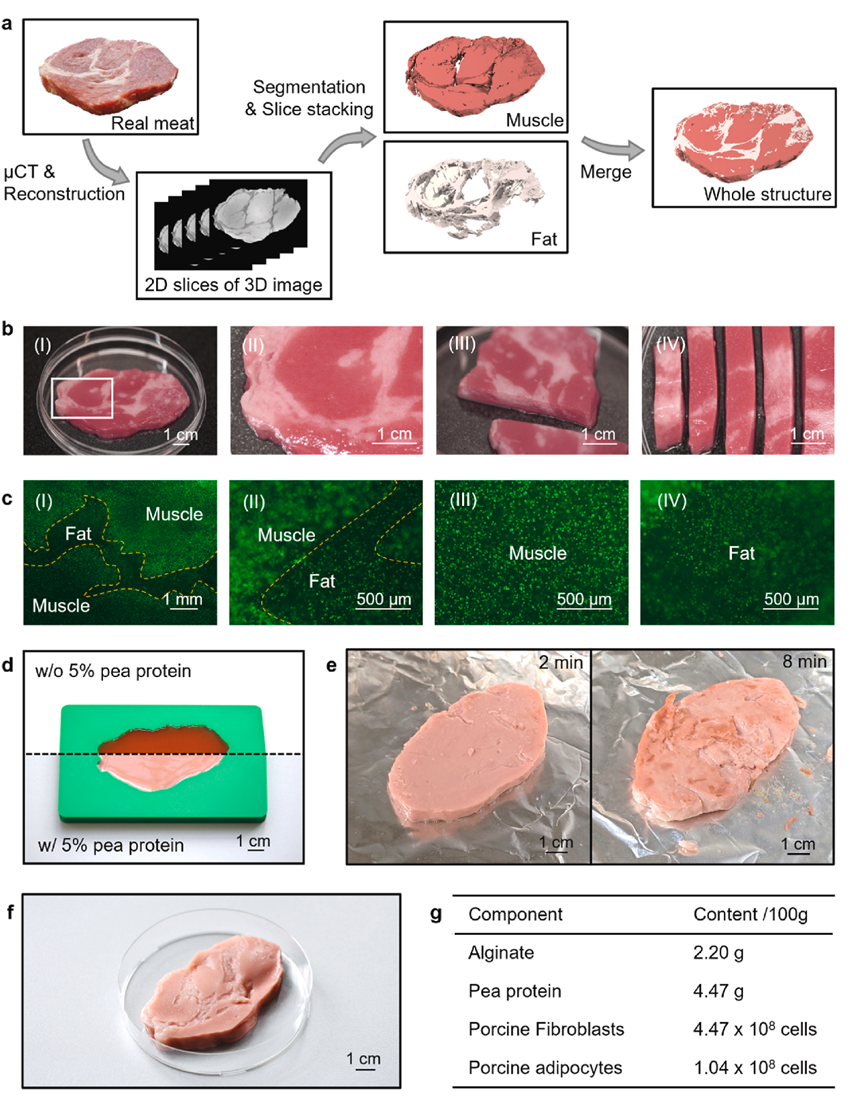
Figure 6. Generation of pork chunks with natural meat-like structures. (a) A schematic diagram of the process for obtaining the natural pork structure (including muscle and fat components) through μCT scanning and segmentation techniques. (b) Images of the manufactured pork chunks. An overview of the bioprinted pork chunks in the culture dish after crosslinking (I). A magnified view shows the detailed muscle and fat patterns within the pork chunks (II). The bioprinted pork chunks were sliced to showcase the cross-section (III). The pork chunks were also cut into small pieces to highlight the spatial distribution of fat components within the muscle (IV). (c) Fluorescent images of the bioprinted pork chunks. Live cells were observed in the bioprinted and crosslinked pork chunks, stained with Calcein AM (green signal), and observed under a fluorescent microscope. Yellow dashed lines indicate the boundaries of muscle and fat regions (I and II). The distribution of muscle and fat cells was well preserved.
Conclusion
This study demonstrates that embedded bioprinting, combined with optimized alginate hydrogel bioinks, μCT-based modeling, and advanced manufacturing techniques, can produce cultured meat products that are authentic and structurally accurate. This method provides exceptional flexibility for replicating the structure of natural meat, establishing embedded bioprinting as a promising tool for sustainable, customizable, and scalable meat production. However, transitioning from laboratory-scale research to practical food applications requires further improvements in bioink formulations, long-term cell functionality, sensory optimization, and production scalability. Ongoing advancements in these areas will bring embedded bioprinting closer to commercial viability, supporting the development of sustainable, high-quality cultured meat that aligns with global food security, environmental sustainability, and ethical considerations.
Original link
Wu D, Pang S, Bäther S, et al. Embedded Bioprinting Enables Precise Fabrication of Cultured Meat with Authentic Structural Properties[J]. Food Hydrocolloids, 2025: 111795.
https://doi.org/10.1016/j.foodhyd.2025.111795
Recommended Reading
Nature Communications丨Edible macroporous microcarriers amplify the production of microtissues containing muscle and fat cells for 3D printing of cultured fish fillets
The National Meat Center welcomes teachers and students to submit articles to exchange the latest developments in meat science. Please send submissions to [email protected]
(Please indicate in the email subject “<Meat Doctor>+Submission Unit+Name“).
Text: Tu Siyu
Edited by: Zhang Yue
Typesetting: Wu Meihong