Click the blue text to follow us

1
Introduction
Adolescence is a critical stage for individual psychological development and social adaptation. Bullying victimization, as a global psychosocial issue among adolescents, has garnered significant academic attention due to its negative impact on adolescent behavior and cognitive development. Particularly among rural adolescents, the dual exposure risk of school bullying and cyberbullying is significant. Limited by regional resources and a lack of adult guidance, rural adolescents are more likely to adopt novel and aggressive strategies when facing injustice, leading to the manifestation of malevolent creativity, which refers to the tendency to use creativity to harm others intentionally.
Existing research has confirmed a close association between bullying victimization and aggressive behavior in adolescents. However, there is still insufficient exploration of the differential impacts of different forms of bullying (school vs. cyber) on malevolent creativity, as well as the underlying mechanisms of their relationship. On one hand, due to characteristics such as anonymity and wide dissemination, cyberbullying may induce more persistent psychological stress than school bullying, and the high exposure of rural adolescents to electronic media further amplifies this risk. On the other hand, hostile attribution (the cognitive tendency to interpret social cues as hostile) is a key component in social information processing models and has been confirmed as an important mediating variable linking victimization and aggressive behavior. However, the longitudinal role of this mechanism in the relationship between bullying victimization and malevolent creativity among rural adolescents remains unclear.
Based on this, the present study uses a sample of rural adolescents in China and employs a two-wave longitudinal design to simultaneously examine the predictive effects of school bullying victimization and cyberbullying victimization on malevolent creativity, as well as to test the longitudinal mediating role of hostile attribution. The results of this study not only fill the research gap regarding the relationship between different forms of bullying and malevolent creativity but also provide a scientific basis for formulating bullying intervention strategies aimed at rural adolescents, reducing the emergence of malevolent creativity, and promoting the mental health and social adaptation of rural adolescents.

2
Research Methods
Research Subjects:The research subjects were drawn from a group of adolescents in a middle school in northern China. At the first wave (T1) assessment, a total of 464 adolescents were included, and at the second wave (T2) assessment, 275 participants remained. Ultimately, 262 adolescents with complete data across all waves were included in the final analysis, with an average age of 14.67 years (SD = 0.80), including 134 females.
Cyberbullying Victimization Scale:This scale includes 4 items, such as “I have been subjected to cyberbullying, such as insults, humiliation, and defamation.” A 6-point Likert scale was used, ranging from 1 (never experienced) to 6 (experienced daily), with higher scores indicating a higher frequency of cyberbullying victimization.
School Bullying Victimization Scale:This scale includes 4 items, such as “I have been deliberately harmed by peers, such as being nicknamed or having my belongings damaged.” Scoring is consistent with the Cyberbullying Victimization Scale, using a 6-point Likert scale (1 = never experienced, 6 = experienced daily), with higher scores indicating a higher frequency of school bullying victimization.
Malevolent Creativity Scale:This scale includes 13 items, such as “I have thought of unusual ways to harm those who hinder my goals.” The scale uses a 5-point Likert scale, ranging from 1 (never) to 5 (always), with higher scores indicating stronger malevolent creativity.
Hostile Attribution Scale:This scale includes 7 items, such as “I feel that I have experienced a lot of unfair things.” A 5-point Likert scale was used, with 1 indicating “strongly disagree” and 5 indicating “strongly agree,” with higher scores indicating a more pronounced tendency for hostile attribution among adolescents.
Using AMOS 21.0 software, cross-lagged models were constructed for cyberbullying victimization and malevolent creativity, as well as for school bullying victimization and malevolent creativity, to examine the predictive effects of bullying victimization on subsequent malevolent creativity and the reverse predictive effect of malevolent creativity on subsequent bullying victimization. For model fit assessment, chi-square statistics (χ²), Tucker-Lewis Index (TLI), Comparative Fit Index (CFI), and Root Mean Square Error of Approximation (RMSEA) were used as evaluation indicators. Generally, a model fit is considered good when CFI and TLI are greater than 0.90 and RMSEA is less than 0.06. Additionally, age and gender were included as control variables in the analysis to eliminate their potential interference with the research results.
To verify the longitudinal mediating effect of hostile attribution between bullying victimization and malevolent creativity, a corresponding mediation model was also constructed using AMOS 21.0. The Bootstrap method with 5000 resamples was used to test the significance of the mediating effect. If the 95% confidence interval (CI) of the mediating effect does not include 0, it indicates that the mediating effect is statistically significant. Maximum likelihood estimation was used for model parameter estimation, and the model fit assessment criteria were consistent with those of the cross-lagged model, while also controlling for the effects of age and gender to ensure the accuracy and reliability of the mediating effect results.
3
Research Results
The cyberbullying victimization at T1 significantly positively predicted malevolent creativity at T2 (β=0.13, p<0.05), indicating that the higher the level of cyberbullying victimization experienced by adolescents at T1, the higher the level of malevolent creativity exhibited at T2. However, the predictive effect of malevolent creativity at T1 on cyberbullying victimization at T2 was not significant (β=0.11, p>0.05), suggesting that malevolent creativity does not significantly increase the likelihood of subsequent cyberbullying victimization.
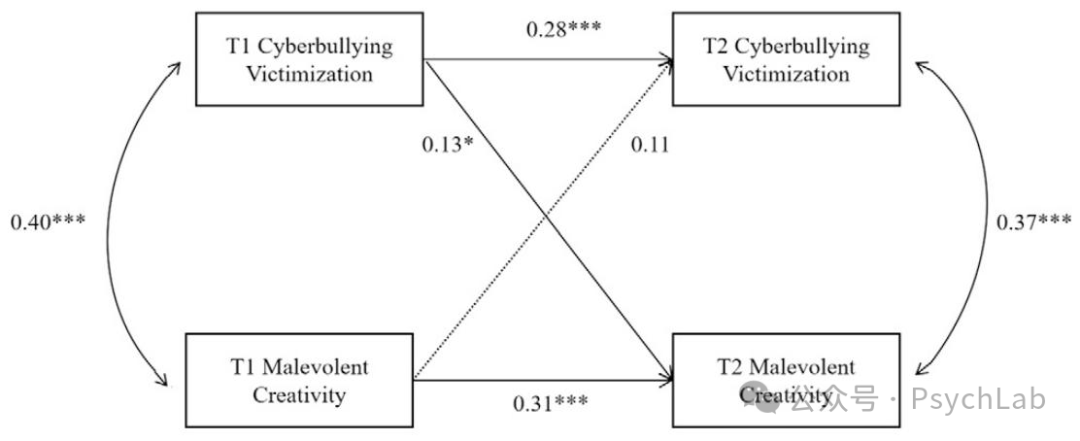
FIG. 1. A cross-lagged model of cyberbullying victimization and malevolent creativity (n=262).
The predictive effect of school bullying victimization at T1 on malevolent creativity at T2 was not significant (β=0.04, p>0.05), indicating that the level of school bullying victimization does not significantly predict changes in malevolent creativity among adolescents. Similarly, the predictive effect of malevolent creativity at T1 on school bullying victimization at T2 was also not significant (β=0.01, p>0.05).
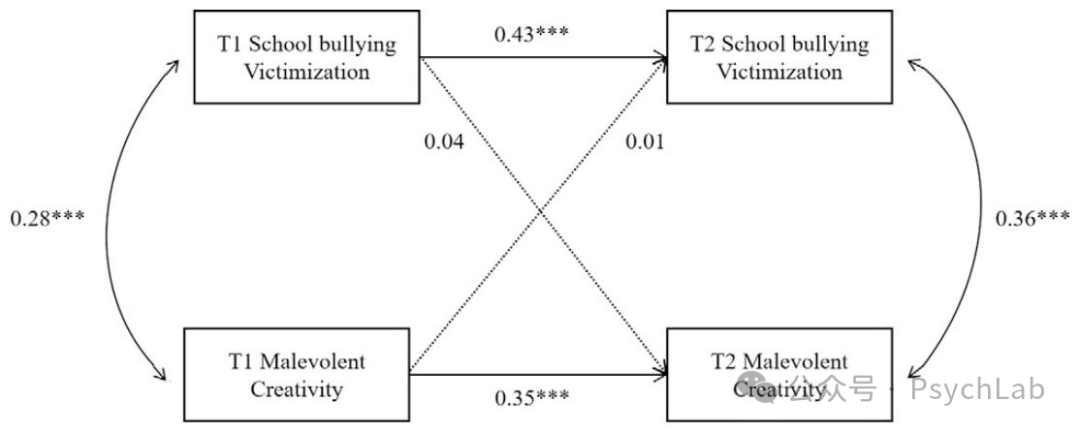
FIG. 2. A cross-lagged model of school bullying victimization and malevolent creativity (n = 262).
To test the longitudinal mediating effect of hostile attribution between cyberbullying victimization and malevolent creativity, a corresponding mediation model was constructed. The cyberbullying victimization at T1 significantly positively predicted hostile attribution at T2 (β=0.15, p<0.05), indicating that adolescents who experienced higher levels of cyberbullying at T1 were more likely to exhibit hostile attribution tendencies at T2. The direct predictive effect of cyberbullying victimization at T1 on malevolent creativity at T2 was not significant (β=0.10, p>0.05), suggesting that cyberbullying victimization does not directly affect subsequent malevolent creativity. However, the hostile attribution at T1 significantly positively predicted malevolent creativity at T2 (β=0.14, p<0.05), indicating that the more pronounced the tendency for hostile attribution among adolescents at T1, the higher the level of malevolent creativity exhibited at T2.
Further, using the bias-corrected Bootstrap method (with 5000 resamples) to test the mediating effect, the results showed that the indirect effect of hostile attribution between cyberbullying victimization and malevolent creativity was significant (β=0.08, 95% CI=[0.03-0.13]), and the total effect was also significant (β=0.26, p<0.001). This indicates that hostile attribution plays a significant longitudinal mediating role in the relationship between cyberbullying victimization and malevolent creativity, meaning that cyberbullying victimization enhances adolescents’ tendency for hostile attribution, which in turn leads to higher levels of malevolent creativity.
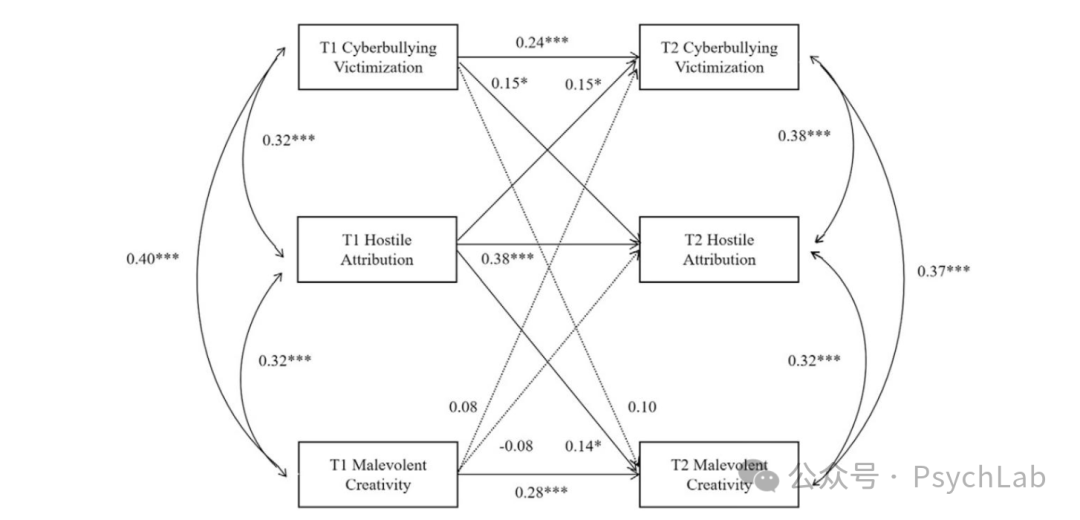
FIG. 3. The longitudinal mediation model of hostile attribution. (n = 262).
4
Limitations
Limitations of Sample Representativeness: The average score of bullying victimization in this study was relatively low, making it difficult to generalize the findings to adolescents experiencing severe bullying victimization.
Limitations of Research Time Points: The study only utilized data from two time points. Although this can initially reveal longitudinal relationships between variables, it does not sufficiently capture the dynamic changes between variables.
Limitations of Single Mediating Variable: This study only explored hostile attribution as a mediating variable, while the process of bullying victimization transforming into malevolent creativity may involve multiple complex mechanisms.
Limitations of Research Sample Source: The research sample was drawn solely from a middle school in northern China, which may introduce sampling bias due to the homogeneity of the region and school type, potentially affecting the external validity of the findings.
Limitations of Measurement Tools: Although the scales used in this study have good reliability, some scales showed a decline in reliability compared to T1, which may affect the accuracy of the measurement results to some extent.

Conclusion and Outlook
This study, involving 262 rural adolescents in China, explored the relationship between school and cyberbullying victimization and malevolent creativity, as well as the mediating role of hostile attribution through two waves of longitudinal data. The results indicated that cyberbullying victimization significantly positively predicts malevolent creativity, while school bullying victimization does not have this effect. Hostile attribution plays a longitudinal mediating role between cyberbullying victimization and malevolent creativity.Limitations of the study include low scores of bullying victimization, only two waves of data, and a single mediating variable. Future research could recruit adolescents experiencing severe bullying victimization, increase the number of data waves, include mediating variables such as criminal thinking, expand the sample’s regional and school type diversity, and improve measurement tools to enhance the generalizability of results and depth of mechanism exploration, providing a more comprehensive basis for interventions aimed at reducing malevolent creativity among rural adolescents.


Previous Issues of ‘Cross-Lagged Network Analysis’
Compr Psychiatry | The Longitudinal Relationship Between Internet Addiction and Psychotic Experiences Among Chinese College Students
Dev Psychopathol | The Bidirectional Longitudinal Relationship Between Nature Contact and Child Problem Behaviors: The Mediating Role of Prosocial Behavior
J Affect Disord | Longitudinal Correlates of School Bullying Victimization Among Early Chinese Adolescents: A Cross-Lagged Panel Network Analysis
J Fam Psychol | Individual Resilience and Family Resilience Among Left-Behind Children: A Longitudinal Network Analysis
Compr Psychiatry | The Association Between Internet Gaming Addiction and Forward Head Posture Among Chinese Adolescents: A Cross-Lagged Panel Network Analysis
Curr Psychol | The Longitudinal Relationship Between Depression Symptoms and Cognitive Emotion Regulation Strategies Among Chinese Adolescents: A Cross-Lagged Panel Network Analysis
Addict Behav | Internet Gaming Disorder, Depression, and Anxiety Symptoms Among Adolescents: A Cross-Lagged Panel Network Analysis
J Affect Disord | The Cross-Lagged Panel Network Analysis of Loneliness, Internet Use, and Depression Symptoms Among Chinese College Students
J Affect Disord | The Longitudinal Relationship Between Adolescent Bullying Victimization and Depression Symptoms: A Cross-Lagged Panel Network Analysis
Soc Sci Med | Which Comes First? The Comorbidity of Depression and Anxiety Symptoms: A Cross-Lagged Network Analysis
Depress Anxiety | The Longitudinal Associations of Anxiety and Depression Symptoms Across Adolescence, Early Adulthood, and Older Age: A Cross-Lagged Panel Network Analysis
Computers in Human Behavior | The Longitudinal Relationship Between Short Video Addiction and Depression Symptoms: A Cross-Lagged Panel Network Analysis
Previous Collections
Literature Review